
 zarkam21:
Help
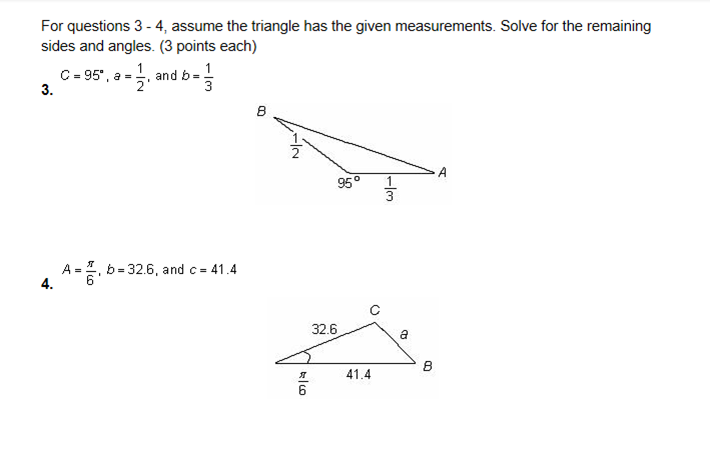
 Hero:
Hero:
@zarkam21 are you familiar with Law of Cosines?
zarkam21:
yes ive problems with voca before so am a little familiar
Hero:
Okay, if that's the case, what is the Law of Cosines formula? Would you mind typing it here using \(\LaTeX\)?
zarkam21:
\[a^2=b^2+c^2-2bc cosA\]
zarkam21:
\[b^2=a^2+c^2-2ac cosB\]
zarkam21:
\[c^2=a^2+b^2-2ac cosC\]
zarkam21:
@Hero
Hero:
Okay, since you know the formula already, the next step is to assign variables to the given values. Would you mind attempting to do this please?
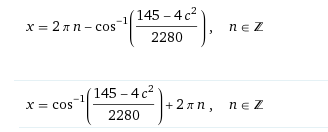 zarkam21:
I attempted to put the equation together
zarkam21:
c^2=½^2+6^2-2*½*6(cos*95)
Hero:
@zarkam21, btw, what are the given values of a and b for the 1st triangle?
zarkam21:
I apologize , i dont know where I got 6 from
zarkam21:
The corrected equation is : c^2=½^2+(1/3)^2-2*½*1/3(cos*95)
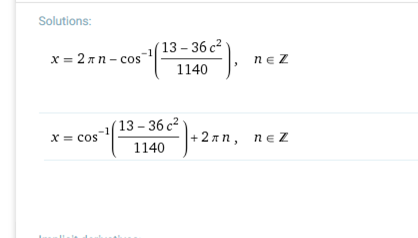 zarkam21:
you there?
zarkam21:
@Hero
zarkam21:
Am i right?
Hero:
Yes, that looks good.
Hero:
Sorry, I was AFK for a bit
zarkam21:
so to write that as an answer it would be x=2pi(n)(cos^-1) x=cos^-1
Hero:
Wait, what? You're solving for the missing sides of the triangle. Law of Cosines helps you find the missing side opposite the side of the given angle.
Hero:
So your final answer should be an approximate value for that side length.
Hero:
From there, you can just use law of sines to find the rest of the missing angles.
zarkam21:
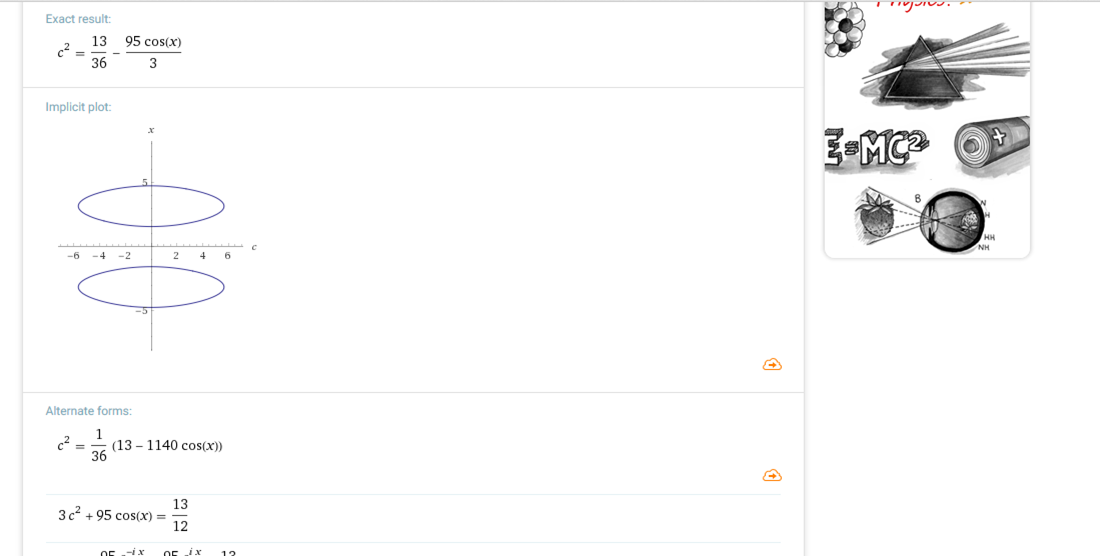
wait so c^2=13/36 right
Hero:
Where are you getting that from?
 Hero:
Hero:
What does that have to do with finding the missing sides of the triangle?
zarkam21:
isn't c^2 the missing length
Hero:
Yes, but you need to isolate c in order to find the missing length. Also, there needs to be a value inserted for x if you're going to use software to solve for the missing value.
zarkam21:
does it matter what value I put in. im sorry im asking so many questions im just a bit confused
Hero:
\(c = \sqrt{a^2 + b^2 - 2ab\cos(C)}\)
Hero:
That is the Law of Cosines formula after isolating \(c\). When using a formula to find a value, isolating the variable to be found is generally the first thing to do.
zarkam21:
okay got it so it would be : \[c^2=\sqrt{\frac{ 1 }{ 2 }^2+\frac{ 1 }{ 3 }^2-2*\frac{ 1 }{2 }*\frac{ 1 }{ 3 }(\cos*95)}\]
Hero:
Actually, it should be: \(c=\sqrt{\left(\dfrac{ 1 }{ 2 }\right)^2+\left(\dfrac{ 1 }{ 3 }\right)^2-(2)\left(\dfrac{ 1 }{2 }\right)\left(\dfrac{ 1 }{ 3 }\right)(\cos(95^{\circ}))}\)
Hero:
You get \(c\) by taking the square root on both sides of \(c^2 = a^2 + b^2 - 2(a)(b)\cos(C)\)
zarkam21:
c=0.62
Hero:
So \(c \approx \dfrac{3}{5}\)
Hero:
You should use the approx symbol when finding values that are not exact.
Hero:
And the value you present should resemble those you were given to begin with. So if you're given fractional values to begin with, then your result should also be fractional.
Hero:
If you were given whole numbers, then you would present the answer to the closest whole number unless specified otherwise.
zarkam21:
got it
zarkam21:
for the second one, im a little confused i dont know what im solving for
zarkam21:
like if its cos a , cos b , or cos c
Hero:
Are you sure you finished with the 1st triangle? What did the instructions say?
zarkam21:
solve for the remaining sides and angles
zarkam21:
Oh I still have to solve for the angles right?
Hero:
Exactly
zarkam21:
well a triangle adds up to 180degrees
Hero:
Yup, sure does.
zarkam21:
180-95=85
zarkam21:
but there are 3 sides so one side is 95 degrees 85/2=42.5 second and third sides = 42.5 degrees 95+42.5+42.5=180 degrees
Hero:
You have two missing angles, so using the law of sines formula would take precedence over using "three angles sum to 180" formula
zarkam21:
i dont think i am familiar with that. i forgot
zarkam21:
?
Hero:
Law of Sines? \(\dfrac{\sin(A)}{a} = \dfrac{\sin(B)}{b} = \dfrac{\sin(C)}{c}\)
Hero:
Note: You only need to use two equivalent fractions simultaneously, not three when calculating a value.
zarkam21:
so maybe 95 because that is given
Hero:
Yes, use the originally given values plus an unknown value to find it.
zarkam21:
\[\frac{ \sin(95) }{ 95 }=\frac{ \sin(95) }{ 95 }=\frac{ \sin(95) }{ 95 }\]
 Vocaloid:
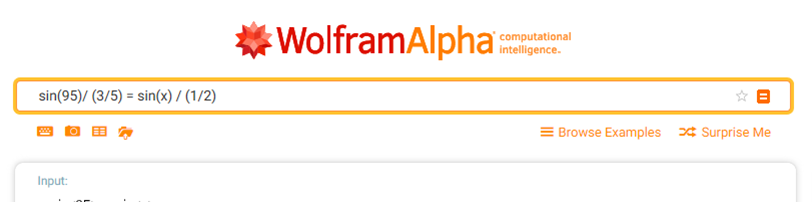
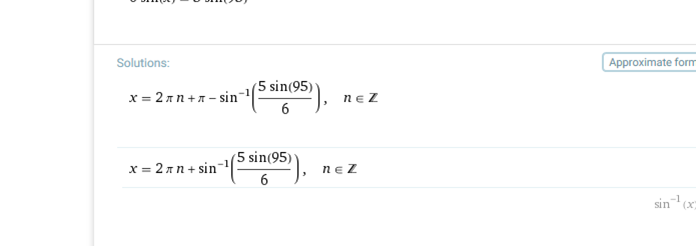
so you got c (the missing side) as 3/5 right? we can angle C, side c, angle A (the unknown), and side A (1/2) to get sin(95)/ (3/5) = sin(x) / (1/2) to find angle A
zarkam21:
2pi(n)
Vocaloid:
that's a little weird, try checking your calculator input again
Vocaloid:
try isolating sin(x) algebraically, then take the arcsin of the result
 Vocaloid:
sin(95)/ (3/5) = sin(x) / (1/2) solve for sin(x) algebraically then take the arcsin of the result
Hero:
@Zarkam21, where's your TI calculator for this?
zarkam21:
I actually left it at school
zarkam21:
which is why im using software
zarkam21:
ugh im doing it on paper and i keep getting weird values i got 23.9
Vocaloid:
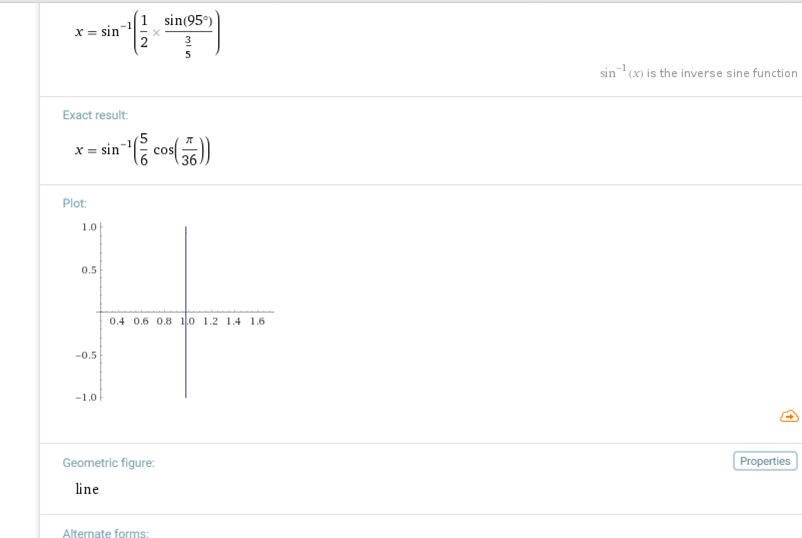
sin(95)/ (3/5) = sin(x) / (1/2) if you notice on the right hand side of the equation, sin(x) is being divided by (1/2) so we just need to multiply by (1/2) to isolate sin(x) (1/2)sin(95)/(3/5) = sin(x) then taking the arcsin of this gives us x = arcsin[(1/2)sin(95)/(3/5)] hopefully wolframalpha likes this input a little better
 Vocaloid:
try without the x = part
 Vocaloid:
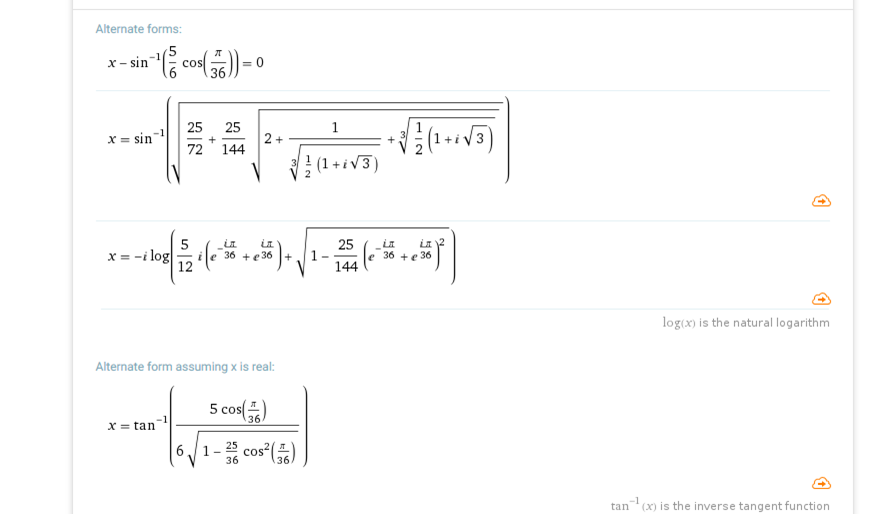
just try this as the input arcsin[(1/2)sin(95)/(3/5)]
zarkam21:
56.12
Vocaloid:
good, so we have angle A (56.12 degrees), angle B (unknown) and angle C (95 degrees), then simply subtract 180 - angle A - angle C to find angle B
zarkam21:
180-56.12-95=28.88
zarkam21:
so that is the missing angle
Vocaloid:
good, so that's the triangle solved would be a good idea to close this and re-open a new question since it's getting pretty long
zarkam21:
we are done though with the first one
zarkam21:
i will be back in about a hour then we can continue if you are still on
zarkam21:
is that alright
Vocaloid:
sure
Join our real-time social learning platform and learn together with your friends!
 KBaby:
Verse 1 We left our names in the dust of the driveway Watched the old town shrink
KBaby:
Lyrics Generator Use AI to write the lyrics for a song. Suggested Genres: Pop Hip
KBaby:
Verse 1 We left our names in the dust of the driveway Watched the old town shrink
KBaby:
Lyrics Generator Use AI to write the lyrics for a song. Suggested Genres: Pop Hip

 aitexturegenerator:
How are you all handling AI-generated textures for 3D models and game assets without losing the hand-made feel? I've been doing a small stylized environment
aitexturegenerator:
How are you all handling AI-generated textures for 3D models and game assets without losing the hand-made feel? I've been doing a small stylized environment

 Demon25:
Woke up feeling like that girl and that dude well he still aint crap pluse the du
Demon25:
Woke up feeling like that girl and that dude well he still aint crap pluse the du
 playtsec:
how do I get rid of stress from teachers... I just feel like running out the classroom and leaving on my own.
playtsec:
how do I get rid of stress from teachers... I just feel like running out the classroom and leaving on my own.
 JohnnyLFowler0812:
What type of gamer would play something and then get off for a while. Why not sta
JohnnyLFowler0812:
Which is better? Metallica Rap Country R&B hiphop Medal Gospel Chill Which 3 opti
JohnnyLFowler0812:
What type of gamer would play something and then get off for a while. Why not sta
JohnnyLFowler0812:
Which is better? Metallica Rap Country R&B hiphop Medal Gospel Chill Which 3 opti