
 Shadow:
Math
 Shadow:
Okay that should work
 Hero:
Hero:
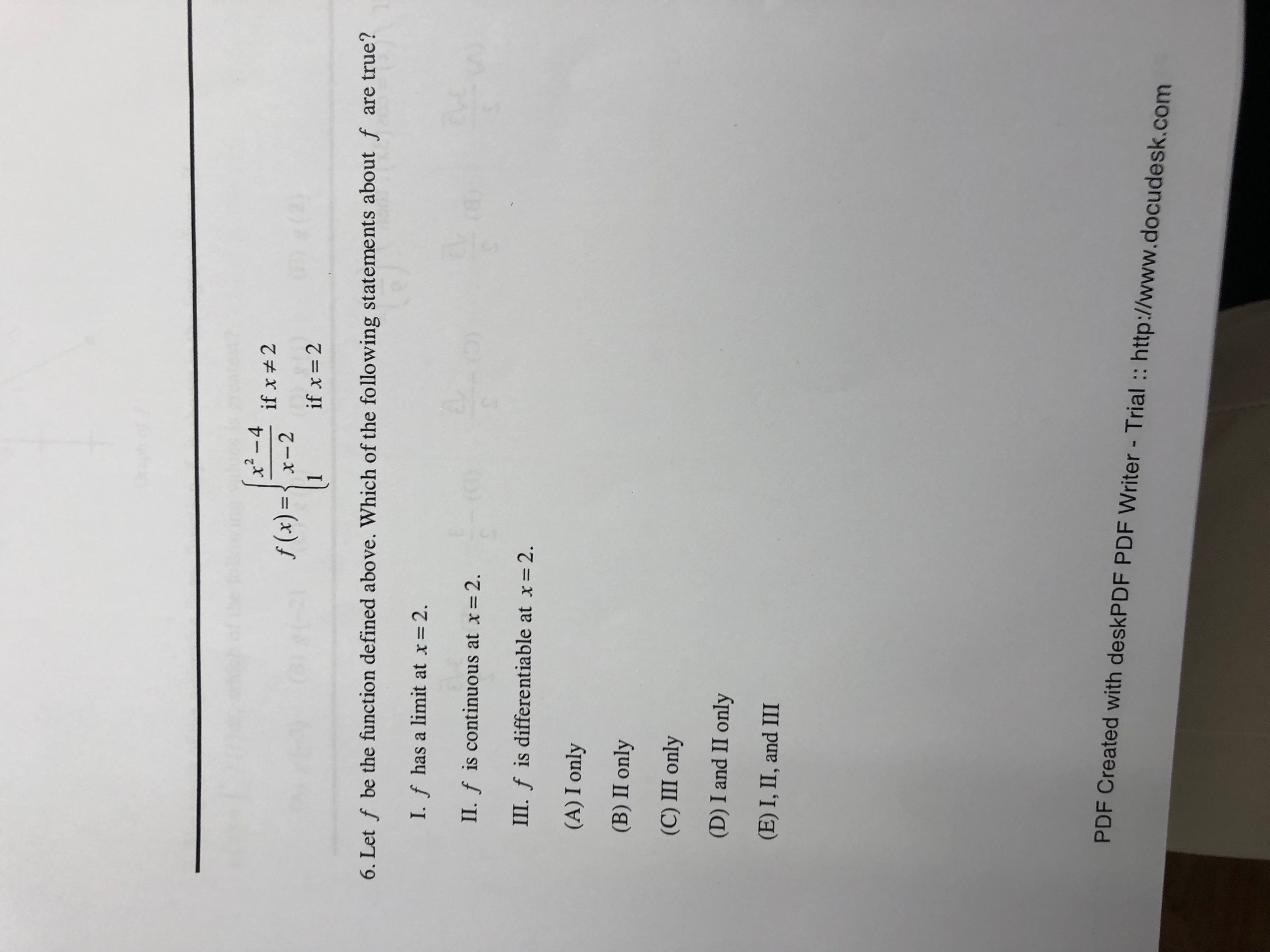
And so you would need to know the meaning of the following words, at a minimum, in order to be able to successfully answer the question: "Limit", "Continuous", and "Differentiable".
Hero:
So, @Shadow 1. What does it mean for the limit to exist at a point? 2. What does it mean for a function to be continuous at a point? 3. What does it mean for a function be differentiable at a point?
 gabethebabe:
the limit of a function is the value that x->a is approaching from both sides. Continuity describes a function that can be drawn without any breaks in the graph. Proving a functions' continuity is a 3-step process that can be verified using properties of limits. 1st: take the value the limit is supposedly approaching, 'f(a)'; does that point exist? if so then you can move onto the second necessary criteria for proving continuity. 2nd: check the one-sided limits as x->a- ; and as x->a+ . if they match then the limit as x-> that value exists too. 3: so now you know that the point at f(a), and the limit as x->a exist right? check if those 2 values are equal to each other if so then that function is continuous.
gabethebabe:
understand while its much easier to just determine continuity from a graph its important to learn how use the properties of limits to prove continuity, so that when you get abnormal functions that may or may not have breaks, you always have a solid way to tell if its continuous or not.
gabethebabe:
differentiability can be determined with limits also; it requires the definition of a limit. Differentiability basically is saying that you can take the tangent line of every spot in the domain. There are a few things that inhibit differentiability: sharp curves in the function, cusps, vertical slopes (undefined;vertical tangent), and jumps, the other non-removable discontinuity.
gabethebabe:
but back to proving differentiability
gabethebabe:
the formula is this \[\lim f(x) _{ Delta x \rightarrow \ 0}\] \[(f(x+ \Delta x) - f(x) )/( \Delta x)\] this formula seems like what we would call a brick but its really simple once you see the pattern. So the goal is to first, plug in terms for your 'f(Delta x)' and your 'f(x)' you will be given f(x), and finding f( Delta x) is easy. Take f(x) and plug in (x+Delta x) every single time you see an x in the function. use order of operations to simplify and you have your f(x+ Detla x). fyi dont worry the second step in this road map is to plug in values and cancel them, most of the terms will end up cancelling out if you do this correctly. so take the numerator, plug in your f(x + delta x) - (f(x)) (notice how the negative sign applies to all the terms in the f(x), it will need to be distributed) Now, at this point you should go ham, cancel all the terms that can be cancelled and you should only have terms with a Delta x in them now. This is VERY helpful because guess what we have on the denominator... a delta x. In effect, more terms with cancel through division leaving us with a much simpler and managable looking experession. uhh now what? well it goes back to the purpose of what we are trying to prove, differentiability, using the properties of limits! keyword: limits. So lets bring back the lim as Delta x->0. Plug in 0 into that new expression ANYWHERE that has Delta x left in it, when thats done you have found the derivative using the definition of a limit.
gabethebabe:
i hope that helps a bit, honestly khan academy has pretty good explanations for this stuff thats where i learned this stuff from last year
gabethebabe:
to directly answer that specific question you posted, when dealing with piecewise functions you always test....AT THE BOUNDS. so in this case its pretty easy because theres only 2 functions and one is just a point but yeah for this one because its pretty straight forward id just do this: 1: test the overall limit as x->2 so this means you could either graph it with a handmade graph, or create a table of points like x:(-1, 0, 1, 1.5, 2.5, 3, 4) that way you get a good idea of where this graph is headed from both sides of the value we are looking at (its 2). 2: check your handmade graph or the table, as you get closer to the x value 2from the left, what y-value does the function seem to approach? DO THE SAME THING FROM THE RIGHT. ask yourself what value is it approaching if I start from the right and work my way to the left and approach 2? If you get the same number then Congrats! your function has a limit. (notice how we never test the acutal point 2, just the anticipated number its approaching) But we know that this does not mean its continuous or differentiable. so we go back to the 3-part process of testing for continuity. 1st: does f(a) exist? its f(2),and that is clearly defined as 1. so check 2nd: does the two-sided limit exist? we just verified that check! 3rd: are f(a) and the value we found for the limit equal? (l'll let u check that, if so its continuous) and i just gave u step by step on how to differentiate using the definition of a limit.
Shadow:
Thank you :)
gabethebabe:
np just follow the steps and hit up the boy sal khan. if u ever get confused hit up sal khan or patrickJMT i think thats his youtube name lol
gabethebabe:
shoot i repeated myself
Join our real-time social learning platform and learn together with your friends!
 KBaby:
Verse 1 We left our names in the dust of the driveway Watched the old town shrink
KBaby:
Lyrics Generator Use AI to write the lyrics for a song. Suggested Genres: Pop Hip
KBaby:
Verse 1 We left our names in the dust of the driveway Watched the old town shrink
KBaby:
Lyrics Generator Use AI to write the lyrics for a song. Suggested Genres: Pop Hip

 aitexturegenerator:
How are you all handling AI-generated textures for 3D models and game assets without losing the hand-made feel? I've been doing a small stylized environment
aitexturegenerator:
How are you all handling AI-generated textures for 3D models and game assets without losing the hand-made feel? I've been doing a small stylized environment

 Demon25:
Woke up feeling like that girl and that dude well he still aint crap pluse the du
Demon25:
Woke up feeling like that girl and that dude well he still aint crap pluse the du
 playtsec:
how do I get rid of stress from teachers... I just feel like running out the classroom and leaving on my own.
playtsec:
how do I get rid of stress from teachers... I just feel like running out the classroom and leaving on my own.
 JohnnyLFowler0812:
What type of gamer would play something and then get off for a while. Why not sta
JohnnyLFowler0812:
Which is better? Metallica Rap Country R&B hiphop Medal Gospel Chill Which 3 opti
JohnnyLFowler0812:
What type of gamer would play something and then get off for a while. Why not sta
JohnnyLFowler0812:
Which is better? Metallica Rap Country R&B hiphop Medal Gospel Chill Which 3 opti