
 zarkam21:
Questions 8 - 10, deal with the ambiguous SSA case. For each, find all possible solutions and sketch the triangle(s) in each case.
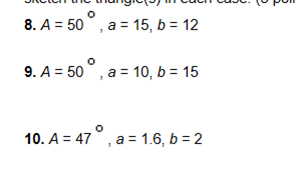
 Vocaloid:
for SSA we have two possibilities depending on the arrangement of the side across from the angle|dw:1526045496624:dw|
Vocaloid:
so first you'd use law of sines to find angle B using the left triangle, solve for the remaining sides/angles
Vocaloid:
as a reminder: a/sin(A) = b/sin(B) for law of sines
zarkam21:
15/sin(50) = 12/sin(B)
Vocaloid:
awesome, now solve for B
zarkam21:
0.66 2.48
zarkam21:
DO i round to the nearest tenth or hundredth?
Vocaloid:
you should only be getting 1 value for B also the solution should be in degrees not radians since the angle you are given is also in degrees try cross multiplying 15/sin(50) = 12/sin(B) and solving for sin(B), then take the arcsin of the result
zarkam21:
4 sin (50)/5
Vocaloid:
good, then take the arcsin of 4 sin (50)/5
zarkam21:
0.61
zarkam21:
i think :/
zarkam21:
wait 39.79
Vocaloid:
remember your answer should be in degrees not radians
Vocaloid:
good, 37.79 degrees for angle B now you have angle A and angle B, find angle C
zarkam21:
i use the c^2=a^2+b^2-2ab cosC right
Vocaloid:
hint: all the triangles add up to 180 degrees you can't use law of cosines yet because you don't have c
Vocaloid:
*all the angles in a triangle
zarkam21:
Im not sure i I would use the sin (a)-a formula or just subtract 180-
zarkam21:
a/sin(A) = b/sin(B)
Vocaloid:
angle A + angle B + angle C = 180 so angle C = ?
zarkam21:
something like this right
zarkam21:
oh okay 180-37.79-50=92.21
zarkam21:
for angle c
Vocaloid:
good now you have angle C, you can now use law of cosines to find c
zarkam21:
okay c^2=a^2+b^2-2ab (cos(C)) c^2=15^2+12^2-2*15*12(cos(C)
zarkam21:
like this
Vocaloid:
good but you need to plug in angle C = 92.21
zarkam21:
oh right..
zarkam21:
c^2=15^2+12^2-2*15*12(cos(92.21) c^2=531.07 c=24.05
Vocaloid:
wait a min
zarkam21:
sure.
Vocaloid:
awesome, so that's the first ambiguous case solved however, for the SSA case, angle B can also be obtuse [see the diagram] so we take 180 - the old angle B to get the new angle B so 180 - 92.21 = 87.79 as the new angle C then we re-solve the triangle for angle B and side c
Vocaloid:
so if angle A = 50 and angle C = 87.79 what is the new angle B?
zarkam21:
we use law of cosines right
zarkam21:
wait nvm its 180-50-87.79=42.21
Vocaloid:
yeah i just double checked and apparently there's only one case for this triangle so it's just the other set of solutions (angle B = 37.79, angle C = 92.2, c = 24.05)
Vocaloid:
so yeah that's #8 done, repeat the process for #9 and start by finding angle B using law of sines
zarkam21:
okay so is just the orgiinal ones we found right
zarkam21:
\(\color{#0cbb34}{\text{Originally Posted by}}\) @Vocaloid awesome, so that's the first ambiguous case solved however, for the SSA case, angle B can also be obtuse [see the diagram] so we take 180 - the old angle B to get the new angle B so 180 - 92.21 = 87.79 as the new angle C then we re-solve the triangle for angle B and side c \(\color{#0cbb34}{\text{End of Quote}}\)
zarkam21:
not this
Vocaloid:
yeah not that
zarkam21:
a/sin(A) = b/sin(B) 15/sin(50) = 12/sin(B) 37.79 degrees for angle B 180-37.79-50=92.21 (Angle C) c^2=15^2+12^2-2*15*12(cos(92.21) c^2=531.07 c=24.05
zarkam21:
so just this
zarkam21:
okay we can continue now
Vocaloid:
yes
zarkam21:
a/sin(A) = b/sin(B) 10/sin(50) = 15/sin(B)
zarkam21:
3sin(50)/2
zarkam21:
\[\frac{ 3 }{ 2 } \cos(\frac{ 2\pi }{ 9})\]
zarkam21:
72.64 degrees
Vocaloid:
so you got sin(B) = 3sin(50)/2 you just need to take the arcsin of both sides to find what B is, converting to cos isn't helpful here
zarkam21:
\(\color{#0cbb34}{\text{Originally Posted by}}\) @zarkam21 72.64 degrees \(\color{#0cbb34}{\text{End of Quote}}\)
zarkam21:
is this it
Vocaloid:
huh for some reason it's giving me B = 90 degrees
zarkam21:
its prob me thats wrong
Vocaloid:
oh duh since 3sin(50)/2 is greater than 1 then there's no solution for the arcsin making this triangle have no real solutions
zarkam21:
a/sin(A) = b/sin(B) 10/sin(50) = 15/sin(B) 72.64 degrees for angle B 180-72.64-50=57.36(Angle C) c^2=10^2+15^2-2*10*15(cos(57.36) c^2=118.44 c=10.88
zarkam21:
so this is all not necessary?
Vocaloid:
yeah, angle B has no solutions meaning this triangle cannot actually exist moving on to #10 i guess, we'd solve for angle B as usual using law of sines
zarkam21:
a/sin(A) = b/sin(B) 1.6/sin(50) = 2/sin(B) =-6.1
zarkam21:
6.28
Vocaloid:
the angle is 47 not 50
Vocaloid:
arcsin(2sin(47)/1.6) = ?
zarkam21:
1.15
Vocaloid:
good but what is that in degrees not radians?
zarkam21:
69.89
Vocaloid:
a little off, 66.09 degrees now find angle C, given angle A = 47 and angle B = 66.09
zarkam21:
180-66.09-47=66.91 (Angle C) c^2=1.6^2+2^2-2*1.6*2(cos(66.91) c^2=10.35 c=3.22
Vocaloid:
yeah that's good
Vocaloid:
I was double checking w/ law of sines and for some reason I get a diff. value for c hm..
zarkam21:
oh really
zarkam21:
so is the final answer okay or just i recheck
zarkam21:
should*
Vocaloid:
ok apparently you can't use the law of cosines for an ambigious case, in that case we would simply use law of sines to find c c/sin(C) = a/sin(A) so c/sin(66.91) = 1.6/sin(47) gives the value of c
Vocaloid:
that means we need to re-do the value of c for triangle #8 but we can get back to that after we finish #10 i guess
Vocaloid:
c/sin(66.91) = 1.6/sin(47) multiplying both sides by sin(66.91) gives us c = 1.6 * sin(66.91) / sin(47) = ?
zarkam21:
2.01
zarkam21:
this would be #10 right
Vocaloid:
good but for this triangle we have another possible solution first we take 180 - angle B to get 180 - 66.09 = 113.91 = the other possible angle B value so for this new case, we have angle A = 47, angle B = 113.91, angle C = ?
zarkam21:
180-113.91-47=19.09
Vocaloid:
awesome, then use law of sines again to find c c/sinC = a/sinA, plug in angles C and A, plus side a to solve for side c
zarkam21:
c/sinC = a/sinA c/sin(19.09)/1.6/sin(47)
Vocaloid:
that / in the middle should be an equal sign c/sin(19.09) = 1.6/sin(47) now find c
zarkam21:
2.19
zarkam21:
0.72
zarkam21:
*
Vocaloid:
good, 0.72 = c giving us the other solution for the ambiguous case anyway, going back to #8, we found that angle C = 92.21 giving us c/sin(92.21) = 15/sin(50) giving us c = 19.57 anyway, let's do a quick recap of our solutions:
Vocaloid:
#8: only one solution angle B = 37.79 degrees angle C = 92.21 degrees, c = 19.57 #9: no sol'ns (the arcsin of angle B is greater than 1 so no possible angle B values) #10: two solutions solution 1: angle B = 66.09 degrees, angle C = 66.91 degrees, c = 2.01 solution 2: angle B = 113.91 degrees, angle C = 19.09 degrees, c = 0.72
Vocaloid:
and that's it
zarkam21:
oh for #8, we got c^2=531.07 c=24.05
zarkam21:
its 19.57 instead?
Vocaloid:
yeah, I realized we can't use law of cosines we have to use law of sines which gives us 19.57
Join our real-time social learning platform and learn together with your friends!
 Demon25:
For a hoco proposal with a cheerleader and football player, what else should be a
Demon25:
For a hoco proposal with a cheerleader and football player, what else should be a

 Breathless:
TOC: "MGF any confirmation on the commander? we require confirmation as soon as[radio static].
Breathless:
TOC: "MGF any confirmation on the commander? we require confirmation as soon as[radio static].
 EdwinJsHispanic:
I wrote something that I don't know if I want it as a poem or song, Please let me know on yours thoughts about it, I'm still doing this! "Broken promises an
EdwinJsHispanic:
I wrote something that I don't know if I want it as a poem or song, Please let me know on yours thoughts about it, I'm still doing this! "Broken promises an
 thehearken:
hi um I don't know if this is the right section for this, but can someone go over my poem and tell me if its good enough to give my English professor for a
thehearken:
hi um I don't know if this is the right section for this, but can someone go over my poem and tell me if its good enough to give my English professor for a
 heartlessprophet:
Aye what's 19z%u00f74p=9u03c0 my teacher thinking of impossible questions for us
heartlessprophet:
Aye what's 19z%u00f74p=9u03c0 my teacher thinking of impossible questions for us
 kippppp:
does anyone have any good tips for writing stories? i'm trying to write a dnd campaign but i'm not that great of a writer yet.
kippppp:
does anyone have any good tips for writing stories? i'm trying to write a dnd campaign but i'm not that great of a writer yet.
 GRIZZLEY19:
Y'all let me know what y'all think about this beat I made I took me like a hour maybe rate it 0/10 https://drive.
GRIZZLEY19:
Y'all let me know what y'all think about this beat I made I took me like a hour maybe rate it 0/10 https://drive.
 Ultrilliam:
Welcome to the 10th Anniversary Update! (Part 2) Sorry this one passed the date a
Ultrilliam:
Welcome to the 10th Anniversary Update! (Part 2) Sorry this one passed the date a
 Twaylor:
was walking downtown and my adhd brain wanted to make some (rock?) lyrics: There'
Twaylor:
was walking downtown and my adhd brain wanted to make some (rock?) lyrics: There'