
 zarkam21:
3 part question
 Vocaloid:
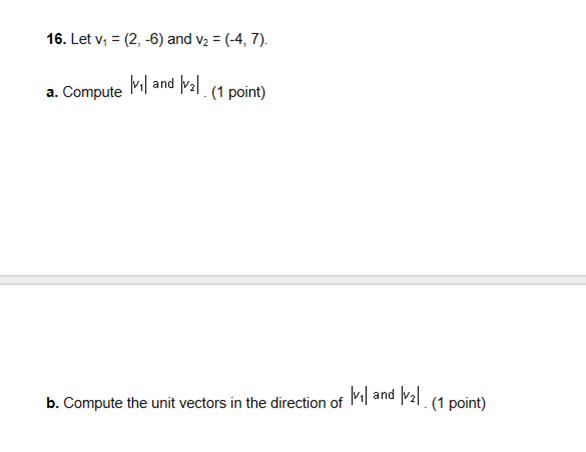
a) is asking for the magnitude of v1 and v2 remember that magnitude = sqrt(x^2 + y^2) so start with the coordinates of v1 first
Vocaloid:
oh I would recommend leaving the results in radical form rather than decimal form, so your answer should have the radical symbol in it
zarkam21:
magnitude = sqrt(x^2 + y^2) =sqrt(2^2+-6^2) =4isqrt2 magnitude= sqrt(x^2 + y^2) =sqrt(-4^2+7^2) =sqrt33
Vocaloid:
you have to be very careful with negative signs if you want to square a negative # then it must be written (-x)^2 not -x^2
zarkam21:
magnitude = sqrt(x^2 + y^2) =sqrt(2^2+(-6)^2) =2sqrt10 magnitude= sqrt(x^2 + y^2) =sqrt((-4)^2+7^2) =sqrt65
Vocaloid:
awesome now for b) the unit vector is simply the vector divided by the magnitude for example, the unit vector in the direction of v1 = v1/ magnitude of v1 = ?
zarkam21:
(2,-6)/2sqrt10
Vocaloid:
good, but "distribute" the division across both coordinates, ex: 2/(2*sqrt(10) and (-6)/(2sqrt10)
Vocaloid:
anyway, you just need to simplify these to get (1/sqrt(10) and (-3sqrt(10) and put these together to get the unit vector (1/sqrt(10), -3sqrt(10)) can you try to repeat this process with vector v2?
zarkam21:
yes i will
Vocaloid:
*oh btw that last vector should be (1/sqrt(10), -3/sqrt(10)) whoops
Vocaloid:
so vector 2 = (-4,7) right the magntitude = sqrt(65) so you just need to divide each coordinate by sqrt(65) to get the unit vector
zarkam21:
(-4)/sqrt(65) and 7/sqrt65
zarkam21:
like that
Vocaloid:
yes, now put them together as a vector to get the new unit vector
zarkam21:
((-4)/sqrt(65) , 7/sqrt65)
Vocaloid:
awesome
Vocaloid:
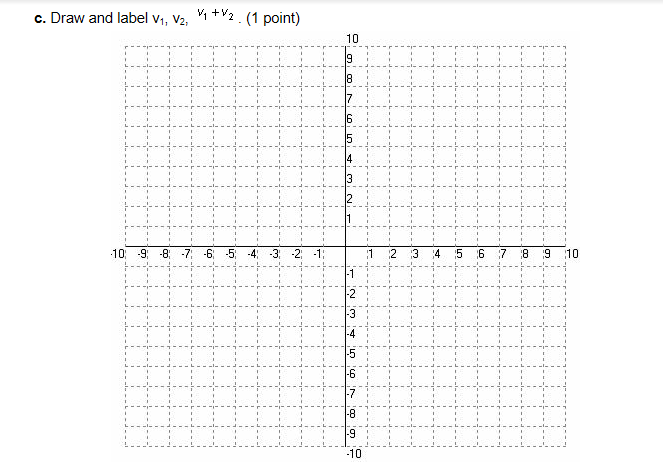
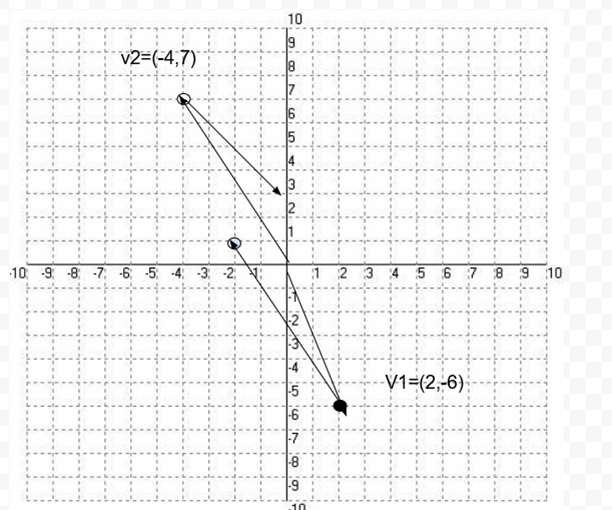
alright now for the graph, to plot a vector, assume it starts at the origin (unless otherwise stated), plot a point at the vector coordinates, then draw an arrow pointing from the origin to the point (probably easier to see as a picture so:
Vocaloid:
|dw:1526054348195:dw|
Vocaloid:
|dw:1526054358690:dw|
Vocaloid:
then the arrow:|dw:1526054375403:dw|
Vocaloid:
can you try repeating with v2?
Vocaloid:
the coordinates of v2 are (-4,7) so we just gotta plot (-4,7) and draw the arrow
Vocaloid:
|dw:1526054738656:dw|
Vocaloid:
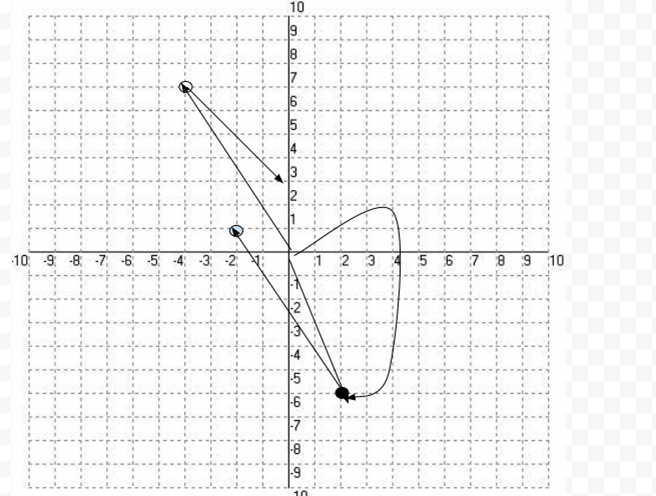
then to add 2 vectors we use the tail to tip method|dw:1526054770534:dw|
Vocaloid:
in this case, we would move v2 so that the tail of v2 is at the tip of v1
Vocaloid:
|dw:1526054791775:dw|
Vocaloid:
|dw:1526054812180:dw|
Vocaloid:
and that's it
zarkam21:
sorry im drawing this all out which is why i am not responding tht fast
 Vocaloid:
you don't need the curvy arrow (that's just for you to see how the vector moved) make sure to label the three vectors as v1, v2, and v1 + v2 respectively
Vocaloid:
|dw:1526055240196:dw|
Vocaloid:
|dw:1526055245657:dw|
 Vocaloid:
|dw:1526055348324:dw|
Vocaloid:
|dw:1526055352647:dw|
Vocaloid:
|dw:1526055382177:dw|
Join our real-time social learning platform and learn together with your friends!
 KBaby:
Verse 1 We left our names in the dust of the driveway Watched the old town shrink
KBaby:
Lyrics Generator Use AI to write the lyrics for a song. Suggested Genres: Pop Hip
KBaby:
Verse 1 We left our names in the dust of the driveway Watched the old town shrink
KBaby:
Lyrics Generator Use AI to write the lyrics for a song. Suggested Genres: Pop Hip

 aitexturegenerator:
How are you all handling AI-generated textures for 3D models and game assets without losing the hand-made feel? I've been doing a small stylized environment
aitexturegenerator:
How are you all handling AI-generated textures for 3D models and game assets without losing the hand-made feel? I've been doing a small stylized environment

 Demon25:
Woke up feeling like that girl and that dude well he still aint crap pluse the du
Demon25:
Woke up feeling like that girl and that dude well he still aint crap pluse the du
 playtsec:
how do I get rid of stress from teachers... I just feel like running out the classroom and leaving on my own.
playtsec:
how do I get rid of stress from teachers... I just feel like running out the classroom and leaving on my own.
 JohnnyLFowler0812:
What type of gamer would play something and then get off for a while. Why not sta
JohnnyLFowler0812:
Which is better? Metallica Rap Country R&B hiphop Medal Gospel Chill Which 3 opti
JohnnyLFowler0812:
What type of gamer would play something and then get off for a while. Why not sta
JohnnyLFowler0812:
Which is better? Metallica Rap Country R&B hiphop Medal Gospel Chill Which 3 opti