
 zarkam21:
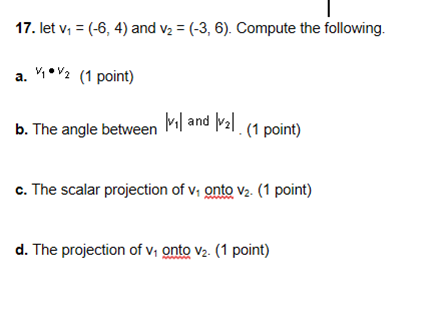
4part question
 zarkam21:
okay so: (-6+-3)=-9 (4+6)=10 =1
 Vocaloid:
17a) is the dot product, so remember the steps: 1. multiply the x-coordinates 2. multiply the y-coordinates 3. sum the results from step 1 + 2
Vocaloid:
meant to say multiply instead of add
Vocaloid:
dot product = (-6)(-3) + 4(6) = ?
zarkam21:
42
Vocaloid:
good now for b) we need to use the angle between two vectors formula|dw:1526056051207:dw|
Vocaloid:
the dot product is in the numerator (which we already calculated in part a) the denominator is the product of the magnitudes so you will need to calculate the magnitude of v1 and v2 first then multiply the results
zarkam21:
do i leave it in its radical form
Vocaloid:
yes
zarkam21:
magnitude = sqrt(x^2 + y^2) =sqrt((-6)^2+4^2) =2sqrt13 magnitude= sqrt(x^2 + y^2) =sqrt((-3)^2+6^2) =3sqrt5 2sqrt13 * 3sqrt5 = 6sqrt65 answer: 42/6sqrt65
Vocaloid:
good but that gives us cos(theta), so to solve for theta we just need to take the arccos of that so arccos(42/6sqrt65) = 29.74 degrees (solution for b)
Vocaloid:
for c) the scalar projection of vector b onto a is given as (dot product of a and b) / (magnitude of a) therefore: for our problem, the scalar projection of v1 onto v2 = (dot product of v1 and v2) / (magnitude of v2) = ?
zarkam21:
42/3sqrt5 =14sqrt5/5
Vocaloid:
awesome now for d) the scalar projection is [ (dot product of v1 and v2) / (magnitude of v2)^2 ] * vector v2 = ?
zarkam21:
[42/(3sqrt5)^2]* (-3,6)
Vocaloid:
good, now simplify the [42/(3sqrt5)^2] and then distribute to the (-3,6) part
zarkam21:
(-14/5) (28/5)
Vocaloid:
good, so the final answer combines those two coordinates to get (-14/5 , 28/5) probably going to get something to eat soon
zarkam21:
Sure have a good lunch
Vocaloid:
alright cool i'm back lmk if you have any other problems to work on
Join our real-time social learning platform and learn together with your friends!
 KBaby:
Verse 1 We left our names in the dust of the driveway Watched the old town shrink
KBaby:
Lyrics Generator Use AI to write the lyrics for a song. Suggested Genres: Pop Hip
KBaby:
Verse 1 We left our names in the dust of the driveway Watched the old town shrink
KBaby:
Lyrics Generator Use AI to write the lyrics for a song. Suggested Genres: Pop Hip

 aitexturegenerator:
How are you all handling AI-generated textures for 3D models and game assets without losing the hand-made feel? I've been doing a small stylized environment
aitexturegenerator:
How are you all handling AI-generated textures for 3D models and game assets without losing the hand-made feel? I've been doing a small stylized environment

 Demon25:
Woke up feeling like that girl and that dude well he still aint crap pluse the du
Demon25:
Woke up feeling like that girl and that dude well he still aint crap pluse the du
 playtsec:
how do I get rid of stress from teachers... I just feel like running out the classroom and leaving on my own.
playtsec:
how do I get rid of stress from teachers... I just feel like running out the classroom and leaving on my own.
 JohnnyLFowler0812:
What type of gamer would play something and then get off for a while. Why not sta
JohnnyLFowler0812:
Which is better? Metallica Rap Country R&B hiphop Medal Gospel Chill Which 3 opti
JohnnyLFowler0812:
What type of gamer would play something and then get off for a while. Why not sta
JohnnyLFowler0812:
Which is better? Metallica Rap Country R&B hiphop Medal Gospel Chill Which 3 opti