
 zarkam21:
For questions 11 - 14, solve the given triangles by finding the missing angle and other side lengths.
 Vocaloid:
sorry if this takes a while, people on QC are being butts as usual
Vocaloid:
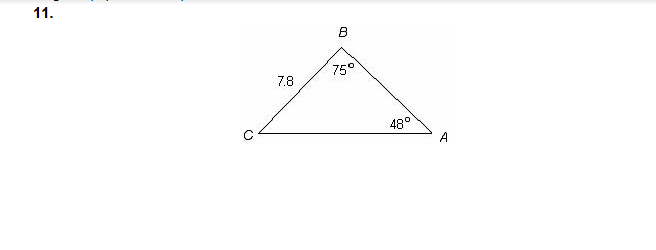
anyway, for 11 you can use law of sines to solve for side B
zarkam21:
b/sin(B)=c/sin(C) b/sin(75)=7.8/
zarkam21:
ugh im confused
Vocaloid:
you don't have angle C or side c so we can't use those in the formula but we can use a and b, A and B, to find b b/sin(B) = a/sin(A) then you can solve for b
zarkam21:
b/sin(B) = a/sin(A) b/sin(75)=7.8/sin(48) b=10.14
Vocaloid:
cool now, since we have angle A and B, we can simply use the 180 - angle A - angle B rule to find angle C 180 - 75 - 48 = 57 for angle C then use law of sines again to find c
zarkam21:
c^2=a^2+b^2-2*a*b cos(C) c^2=7.8^2+10.14^2-2*7.8*10.14 (cos57) c^2=77.51 c=8.80
Vocaloid:
that's law of cosines
zarkam21:
oh shoot
zarkam21:
lol hold on im sorry
Vocaloid:
I mean, it'll probably work either way, but just to double check c/ (cos57) = 7.8/cos(48)
zarkam21:
6.35
Vocaloid:
huh that's weird anyway I'm going to check to see which one we should use, law of sines vs cosines
zarkam21:
okay sounds good il be here
Vocaloid:
apparently in terms of accuracy, law of cosines takes precedence over law of sines so I guess let's go with 8.80 for side c
Vocaloid:
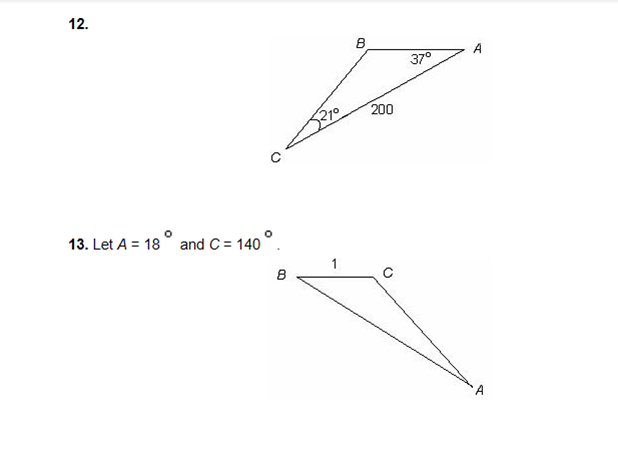
anyway for 12) we only have one side so we have to start with law of sines first let's start by finding angle B = 180 - angle A - angle C = 122 then let's try finding side (a) b/sin(B) = a/sin(A)
zarkam21:
200/sin(21)=a/sin(37)
Vocaloid:
you used the side 200 which is across from angle B angle B is 122 not 21 so 200/sin(122) = a/sin(37) then find a
zarkam21:
141.93 =a
Vocaloid:
awesome then you can use law of cosines to find side c
zarkam21:
c²=a²+b²-2abCos(C) c^2=141.93^2+200^2-2*141.93*200 (cosC)
Vocaloid:
* 21 degrees
Vocaloid:
good but angle C = 21 degrees, plug that in and find c
zarkam21:
c²=a²+b²-2abCos(C) c^2=141.93^2+200^2-2*141.93*200 (cos21) c^2=7142.9 c=84.52
Vocaloid:
good, that's the triangle solved
Vocaloid:
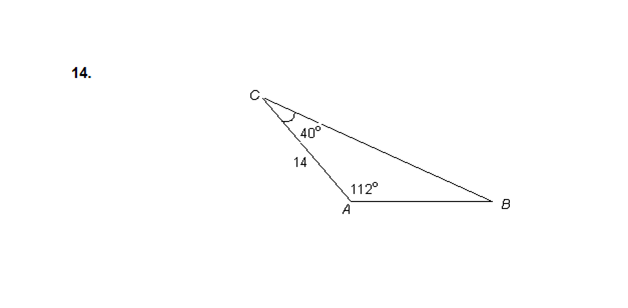
anway for #13 let's label angle C and angle A on the triangle:
Vocaloid:
|dw:1526064009153:dw|
Vocaloid:
first let's find angle B by subtracting 180 - angle C - angle A = 180 - 18 - 140 = 22 degrees
zarkam21:
oh okay so now we have all the angles
zarkam21:
A=140 B=22 C=18
Vocaloid:
(got momentarily kicked from the site) anyway, since we only have 1 side, we have to use law of sines first to find side b b/sin(B) = a/sin(A) as usual, find b
Vocaloid:
* take a look at the diagram: angle A = 18 angle B = 22 angle C = 140
zarkam21:
b/sin(B) = a/sin(A) b/sin(22)=1/sin(128)
zarkam21:
b=0.48
Vocaloid:
b/sin(22)=1/sin(18) 18 not 128
zarkam21:
b=1.21
Vocaloid:
awesome now we got a, b, and all the angles, then use law of cosines to find c
zarkam21:
c²=a²+b²-2abCos(C) c^2=1^2+1.21^2-2*1*1.21 (cos140) c^2=4.32 c=2.08
Vocaloid:
awesome so that's triangle 13solved
 zarkam21:
so im trying to do #14 on my own. Im using #12 as a reference. But how did you get 122 in the first line
Vocaloid:
angle B = 180 - 21 - 37 = 122
zarkam21:
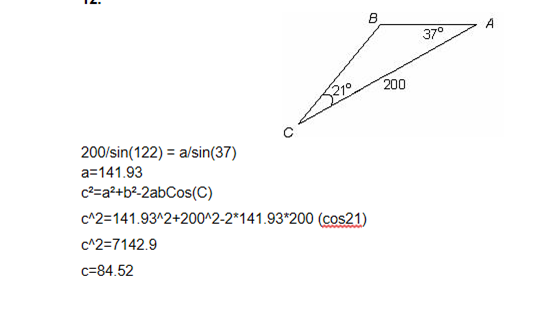
14/sin(28) = a/sin(37) a=17.95
zarkam21:
@Vocaloid i tagged you, so whenever you are back on we can continue
Vocaloid:
oh I didn't realize that there was a #14 whoops anyway the left side is good 14/sin(28) but side a is across from 112 so it would be 14/sin(28) = a/sin(112)
zarkam21:
14/sin(28) = a/sin(37) a=17.95 14/sin(28) 14/sin(28) = a/sin(112) a=27.65
zarkam21:
right
Vocaloid:
good, then you'd use law of cosines to find angle C
Vocaloid:
*side c
zarkam21:
what is b again
Vocaloid:
the side across from angle B
zarkam21:
14
zarkam21:
?*
Vocaloid:
yes
zarkam21:
c^2=a^2+b^2-2ab cosC c^2=27.65^2+14^2-2*27.65+14 (cos40) c^2=915.95 c=30.26
Vocaloid:
that plus sign between the 27.65 and the 14cos(40) shouldn't be there
zarkam21:
c^2=a^2+b^2-2ab cosC c^2=27.65^2+14^2-2*27.65*14 (cos40) c^2=367.45 c=19.17
Vocaloid:
yup that's it
zarkam21:
thankssss
Join our real-time social learning platform and learn together with your friends!
 KBaby:
Verse 1 We left our names in the dust of the driveway Watched the old town shrink
KBaby:
Lyrics Generator Use AI to write the lyrics for a song. Suggested Genres: Pop Hip
KBaby:
Verse 1 We left our names in the dust of the driveway Watched the old town shrink
KBaby:
Lyrics Generator Use AI to write the lyrics for a song. Suggested Genres: Pop Hip

 aitexturegenerator:
How are you all handling AI-generated textures for 3D models and game assets without losing the hand-made feel? I've been doing a small stylized environment
aitexturegenerator:
How are you all handling AI-generated textures for 3D models and game assets without losing the hand-made feel? I've been doing a small stylized environment

 Demon25:
Woke up feeling like that girl and that dude well he still aint crap pluse the du
Demon25:
Woke up feeling like that girl and that dude well he still aint crap pluse the du
 playtsec:
how do I get rid of stress from teachers... I just feel like running out the classroom and leaving on my own.
playtsec:
how do I get rid of stress from teachers... I just feel like running out the classroom and leaving on my own.
 JohnnyLFowler0812:
What type of gamer would play something and then get off for a while. Why not sta
JohnnyLFowler0812:
Which is better? Metallica Rap Country R&B hiphop Medal Gospel Chill Which 3 opti
JohnnyLFowler0812:
What type of gamer would play something and then get off for a while. Why not sta
JohnnyLFowler0812:
Which is better? Metallica Rap Country R&B hiphop Medal Gospel Chill Which 3 opti