
 zarkam21:
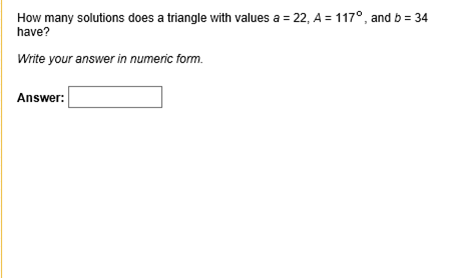
3?
 zarkam21:
@Vocaloid
 Vocaloid:
have you tried using law of cosines? by finding the missing sides/angles it should be clear whether the triangle(s) are possible or not
zarkam21:
0?
Vocaloid:
good, 0, since angle A is the biggest angle then a must be the biggest side which is not the case here
zarkam21:
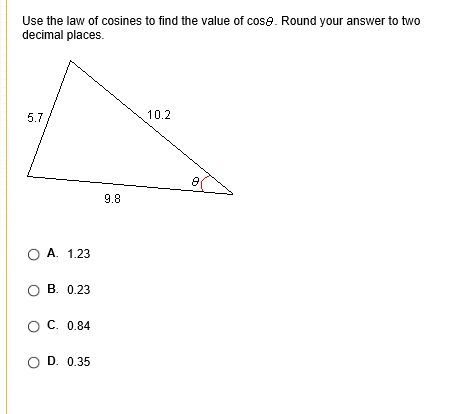
c²=a²+b²-2abCos(C)
 Vocaloid:
good, so what do you get when you start plugging values into the law of cosines?
zarkam21:
A=10.2 B=9.8 C=5.7
zarkam21:
just want to ge tthe values straight
Vocaloid:
good, now solve for cos(C)
zarkam21:
c²=a²+b²-2abCos(C) 5.7^2=10.2^2+9.8^2-2*10.2*9.8(CosC)
zarkam21:
Choice C
Vocaloid:
well done
 Vocaloid:
|dw:1526404817581:dw|
Vocaloid:
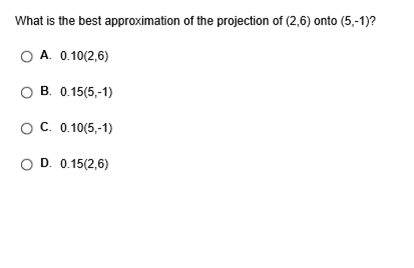
any attempts to calculate the projection?
Vocaloid:
notice how the dot product is in the numerator, start with the dot product of your two vectors
Vocaloid:
remember the rule for dot product of two vectors: 1. multiply the x-coordinates 2. multiply the y-coordinates 3. add the results from step 1 and 2
zarkam21:
10 + -6 = 4
Vocaloid:
good, now calculate the magnitude of the vector being projected onto, in other words the magnitude of (5,-1)
zarkam21:
the magnitude is multiplication right
Vocaloid:
magnitude = sqrt(x^2+y^2)
zarkam21:
sqrt 26
Vocaloid:
good, now you have the dot product and magntiude, plug these into the projection formula to find the projection
zarkam21:
\[\frac{ \sqrt{26} * 4 }{ 4 }\]
Vocaloid:
|dw:1526406038156:dw|
zarkam21:
\[\frac{ 4 * (5,-1) }{ \sqrt{26}^2 }\]
Vocaloid:
good, now what do you get when you simplify the 4/sqrt(26)^2 part
zarkam21:
2/13
zarkam21:
choice b
Vocaloid:
awesome
zarkam21:
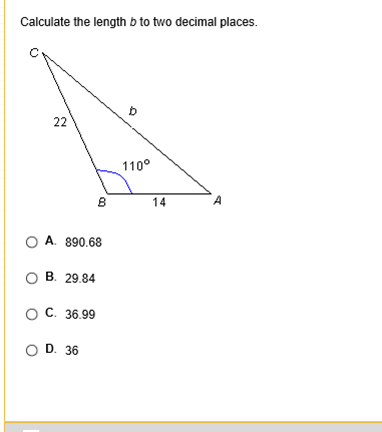
b^2=ac-2*a*c*(cos B) b^2=22^2*14^2-2*22*14*(cos 110)
 zarkam21:
oh wait i use law of sines right
Vocaloid:
no it's law of cosines
Vocaloid:
let me just double check your calculations
zarkam21:
okay
Vocaloid:
b^2=22^2+14^2-2*22*14*(cos 110) there needed to be a + sign between the 22^2 and the 14^2 not a * sign
zarkam21:
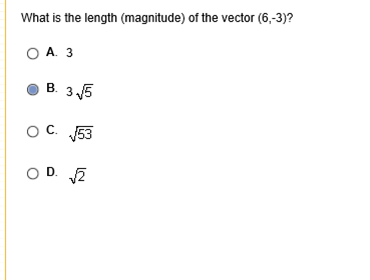
B
 Vocaloid:
good
 zarkam21:
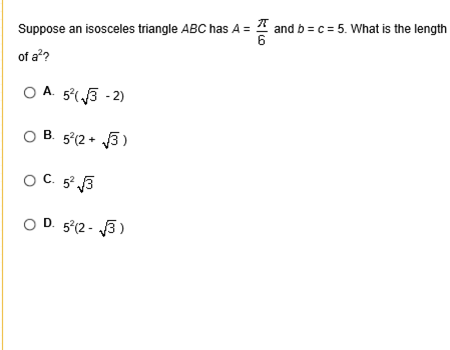
B
Vocaloid:
yeah that's good
 zarkam21:
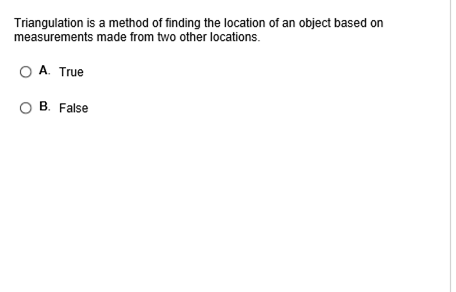
t
Vocaloid:
good
 zarkam21:
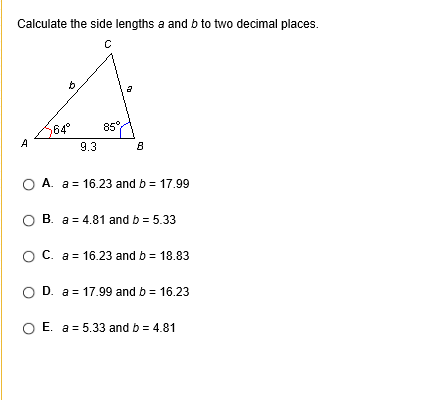
law of sines right
Vocaloid:
I think so yeah
zarkam21:
\[\frac{ \sin(B) }{ b }=\frac{ \sin(C) }{ c }\]
Vocaloid:
good, now plug in the values of angle B, angle C, and side c to solve for b
zarkam21:
\[\frac{ Sin(85) }{ b }=\frac{ Sin(31) }{ 9.3 }\]
zarkam21:
Chioce A
Vocaloid:
well done
 zarkam21:
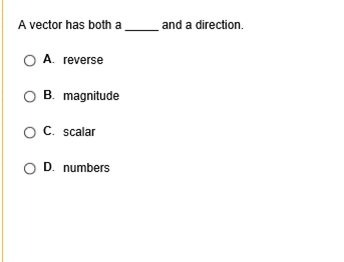
B
Vocaloid:
good
 zarkam21:
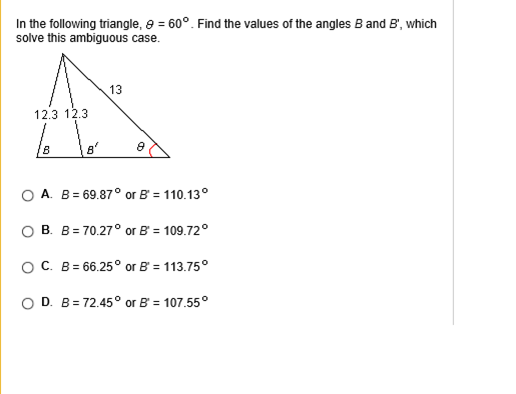
D
Vocaloid:
hm. I guess you could start with the large triangle and use law of cosines to try and find the bottom side
Vocaloid:
|dw:1526408660206:dw|
zarkam21:
Im stuck between a and d
Vocaloid:
try to use the 60 degree angle as the reference angle for the law of cosines, find the bottom side, then use law of cosines again to find angle B keep as many decimal places as possible since the answers are all very close to each other
Vocaloid:
12.3^2 = 13^2 + x^2 - 2(x)(13)cos(60) solve for x, you will get two values, let's use the larger x-value for now since we are solving for the big triangle
zarkam21:
11.45
Vocaloid:
good, let's keep a few more digits so let's use 11.4538 then we can plug that back into the law of cosines to find angle B
Vocaloid:
|dw:1526409275487:dw|
zarkam21:
b^2=a^2+c^2-2*a*c*(Cos B)
Vocaloid:
good, start plugging in the sides and angle
zarkam21:
b=11.4538 a=13 c=12.3 right?
Vocaloid:
the lower case letter matches the angle it is across from so side b is the side across from angle B, so b = 13 technically we didn't assign an a and c value but it doesn't really matter here, we can just pick a = 12.3 and c = 11.4538
zarkam21:
b^2=a^2+c^2-2*a*c*(Cos B) 13^2=12.3^2+11.4538^2-2*12.3*11.4538 (Cos B) =0.4027
Vocaloid:
awesome, then you take the arccos of that to get angle B
zarkam21:
1.16
Vocaloid:
your calculator is in radians that would be 66.25 degrees which points us towards choice C
 zarkam21:
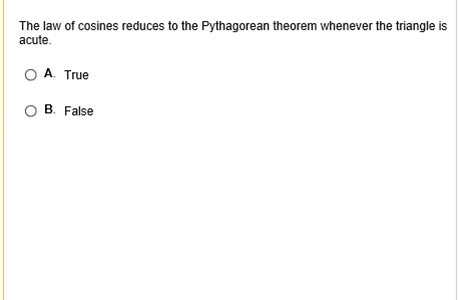
False
Vocaloid:
good
 zarkam21:
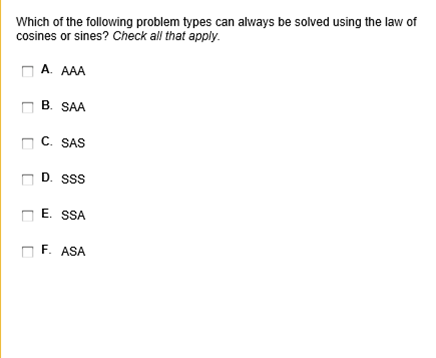
A, C, D, E,
Vocaloid:
AAA doesn't work; for law of cosines/sines you need at least one side SAA: yes (law of sines) SAS: yes (that's law of cosines) SSS: yes (law of cosines) SSA: maybe (my research says no?) ASA: yes so BCDF is my best attempt
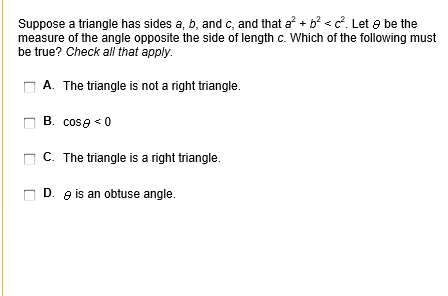 zarkam21:
B C
Vocaloid:
keep in mind pythaogrean theorem states that a^2 + b^2 = c^2 for a right triangle, it cannot be > or < than so A must be true and C false B is correct any thoughts on D? try to see which values of theta make cos(theta) < 0, or try drawing a triangle where c^2 > a^2 + b^2
zarkam21:
yeah d is an answer
zarkam21:
ii think
Vocaloid:
good so A+B+D
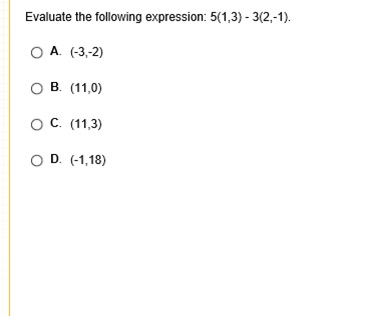 zarkam21:
D
Vocaloid:
good
Join our real-time social learning platform and learn together with your friends!
 KBaby:
Verse 1 We left our names in the dust of the driveway Watched the old town shrink
KBaby:
Lyrics Generator Use AI to write the lyrics for a song. Suggested Genres: Pop Hip
KBaby:
Verse 1 We left our names in the dust of the driveway Watched the old town shrink
KBaby:
Lyrics Generator Use AI to write the lyrics for a song. Suggested Genres: Pop Hip

 aitexturegenerator:
How are you all handling AI-generated textures for 3D models and game assets without losing the hand-made feel? I've been doing a small stylized environment
aitexturegenerator:
How are you all handling AI-generated textures for 3D models and game assets without losing the hand-made feel? I've been doing a small stylized environment

 Demon25:
Woke up feeling like that girl and that dude well he still aint crap pluse the du
Demon25:
Woke up feeling like that girl and that dude well he still aint crap pluse the du
 playtsec:
how do I get rid of stress from teachers... I just feel like running out the classroom and leaving on my own.
playtsec:
how do I get rid of stress from teachers... I just feel like running out the classroom and leaving on my own.
 JohnnyLFowler0812:
What type of gamer would play something and then get off for a while. Why not sta
JohnnyLFowler0812:
Which is better? Metallica Rap Country R&B hiphop Medal Gospel Chill Which 3 opti
JohnnyLFowler0812:
What type of gamer would play something and then get off for a while. Why not sta
JohnnyLFowler0812:
Which is better? Metallica Rap Country R&B hiphop Medal Gospel Chill Which 3 opti