
 AnimeGhoul8863:
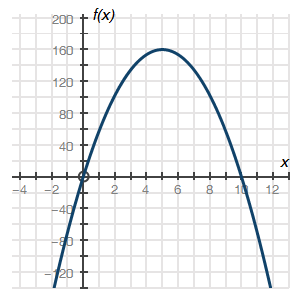
The graph below shows a company's profit f(x), in dollars, depending on the price of pencils x, in dollars, being sold by the company: Part A: What do the x-intercepts and maximum value of the graph represent? What are the intervals where the function is increasing and decreasing, and what do they represent about the sale and profit? (6 points) Part B: What is an approximate average rate of change of the graph from x = 2 to x = 5, and what does this rate represent? (4 points)
 AnimeGhoul8863:
@Hero Please help meh e.e
AnimeGhoul8863:
@Dude
 simplysadie:
@Hero
 Elsa213:
@Ultrilliam Drama dropped
Elsa213:
Might that catch his attention? e.e
 Ultrilliam:
that click bait though
Elsa213:
Aye o;
Ultrilliam:
BUT, I can't help on math, so uh... good luck?
Elsa213:
Rip.
AnimeGhoul8863:
T~T
simplysadie:
have you tried to google it
AnimeGhoul8863:
yes T~T
AnimeGhoul8863:
let me double check to see if there is any hope
simplysadie:
https://questioncove.com/updates/56d8ea9ce4b07475bd9af366 i dont know if that will help but i found it so
AnimeGhoul8863:
i think i found something
 dude:
dude:
x-intercepts is when the graph reaches the x-axis |dw:1526506127472:dw|
AnimeGhoul8863:
Part A: The x intercepts Represents the price of pencils when the profit is zero. The maximum value of this question tells us that intervals are decreasing because the graph lines go down ward instead of up ward.
 Hero:
Hero:
Part A: In this particular case, the x-intercepts represent the price of pencils, \(x\), when the company's profit, \(f(x)\) is zero. The maximum value of the graph reflects the maximum profit the company can attain from selling the pencils at their current price.
AnimeGhoul8863:
Part B: in this question the average rate of change from x=2 to x=5 is 20. This tells us there is a $20 increase in profit when each dollar increases. The selling price Each pencil is between 2 and 5 dollars.y
Hero:
Actually, I realize we should say what the current price is that gives the max profit.
Hero:
Part A: In this particular case, the x-intercepts represent the price of pencils, x, when the company's profit, f(x) is zero. The maximum value of the graph reflects the maximum profit, $160, the company can attain if they sell the pencils for $5.
AnimeGhoul8863:
Part B: in this question the average rate of change from x=2 to x=5 is 20. This tells us there is a $20 increase in profit when each dollar increases. The selling price Each pencil is between 2 and 5 dollars ^^so is this what should put for part b or no
Hero:
In part B, you should include your calculation steps for average rate of change as part of your explanation.
AnimeGhoul8863:
Part B: in this question the average rate of change from x=2 to x=5 is 20. This tells us there is a $20 increase in profit when each pencil gets sold. The selling price for Each pencil is5 dollars
Hero:
Yes, I mean the full calculation. In other words, show how you got the 20.
AnimeGhoul8863:
the question doesnt ask for explanation it ask what it represents
AnimeGhoul8863:
but ok .......
Hero:
What it represents is the 2nd part of the question. Part B: 1. What is the approximate average rate of change of the graph from x = 2 to x = 5 2. What does approximate average rate of change represent?
AnimeGhoul8863:
i got no idea my friend gave it to me and said its the answer but wont tell me how to get it
AnimeGhoul8863:
she said find it yourself i gave u the answer just try to find how to get it and my mind is blank i got nothing
AnimeGhoul8863:
can you walk me through it so i can figure it out cause my mind is drawing a blank
AnimeGhoul8863:
@Vocaloid
AnimeGhoul8863:
any help would be appreciated
dude:
Do you know how to find the rate of change using two points?
AnimeGhoul8863:
i remeber some of it but not much we did this early in the module so i kinda forgot some
AnimeGhoul8863:
*remember
dude:
There is an equation you're supposed to use: (Using any two points) \(\large \frac{y_2-y_1}{x_2-x_1}\) The numbers under it represent which dot coordinate you are using i.e First point would be written as \((x_1,y_1)\) Second point would be written as \((x_2,y_2)\)
AnimeGhoul8863:
so \[\left( \frac{ 2,5 }{ 5,2 }\right)\]
AnimeGhoul8863:
kinda ish
dude:
Sort of? So whats is y in the equation when x is 2? (Look at the graph)
AnimeGhoul8863:
100
dude:
Right and what is the y value when x is 5?
AnimeGhoul8863:
\[\left(\begin{matrix}100,2 \\160, 5\end{matrix}\right)\]
AnimeGhoul8863:
so it looks like this
dude:
Points are written as (x,y) So point 1 would be \((x_1,y_1)\rightarrow(2,100)\) Point 2 would be \((x_2,y_2)\rightarrow(5,160)\)
AnimeGhoul8863:
thats what it though then i second guessed it srry
AnimeGhoul8863:
so once we have that whats next
dude:
Substitute into the equation We know that \((x_1,y_1)\rightarrow(2,100)\) and \((x_2,y_2)\rightarrow(5,160)\) So.... \(\large \frac{y_2-y_1}{x_2-x_1}\rightarrow \large \frac{160-100}{5-2}\) Does that make sense?
AnimeGhoul8863:
\[\frac{ 100 }{ 3 }\]
dude:
You subtracted the top incorrectly
AnimeGhoul8863:
your right its 60
AnimeGhoul8863:
\[\frac{ 60 }{ 3 }\]
dude:
I love you're grammar :) Anyway yes its \(\large \frac{60}{3}\) You can divide to simplify now :D
AnimeGhoul8863:
you get 20 OMG
dude:
Right that is you're slope!
Join our real-time social learning platform and learn together with your friends!
 KBaby:
Verse 1 We left our names in the dust of the driveway Watched the old town shrink
KBaby:
Lyrics Generator Use AI to write the lyrics for a song. Suggested Genres: Pop Hip
KBaby:
Verse 1 We left our names in the dust of the driveway Watched the old town shrink
KBaby:
Lyrics Generator Use AI to write the lyrics for a song. Suggested Genres: Pop Hip

 aitexturegenerator:
How are you all handling AI-generated textures for 3D models and game assets without losing the hand-made feel? I've been doing a small stylized environment
aitexturegenerator:
How are you all handling AI-generated textures for 3D models and game assets without losing the hand-made feel? I've been doing a small stylized environment

 Demon25:
Woke up feeling like that girl and that dude well he still aint crap pluse the du
Demon25:
Woke up feeling like that girl and that dude well he still aint crap pluse the du
 playtsec:
how do I get rid of stress from teachers... I just feel like running out the classroom and leaving on my own.
playtsec:
how do I get rid of stress from teachers... I just feel like running out the classroom and leaving on my own.
 JohnnyLFowler0812:
What type of gamer would play something and then get off for a while. Why not sta
JohnnyLFowler0812:
Which is better? Metallica Rap Country R&B hiphop Medal Gospel Chill Which 3 opti
JohnnyLFowler0812:
What type of gamer would play something and then get off for a while. Why not sta
JohnnyLFowler0812:
Which is better? Metallica Rap Country R&B hiphop Medal Gospel Chill Which 3 opti