
 AnimeGhoul8863:
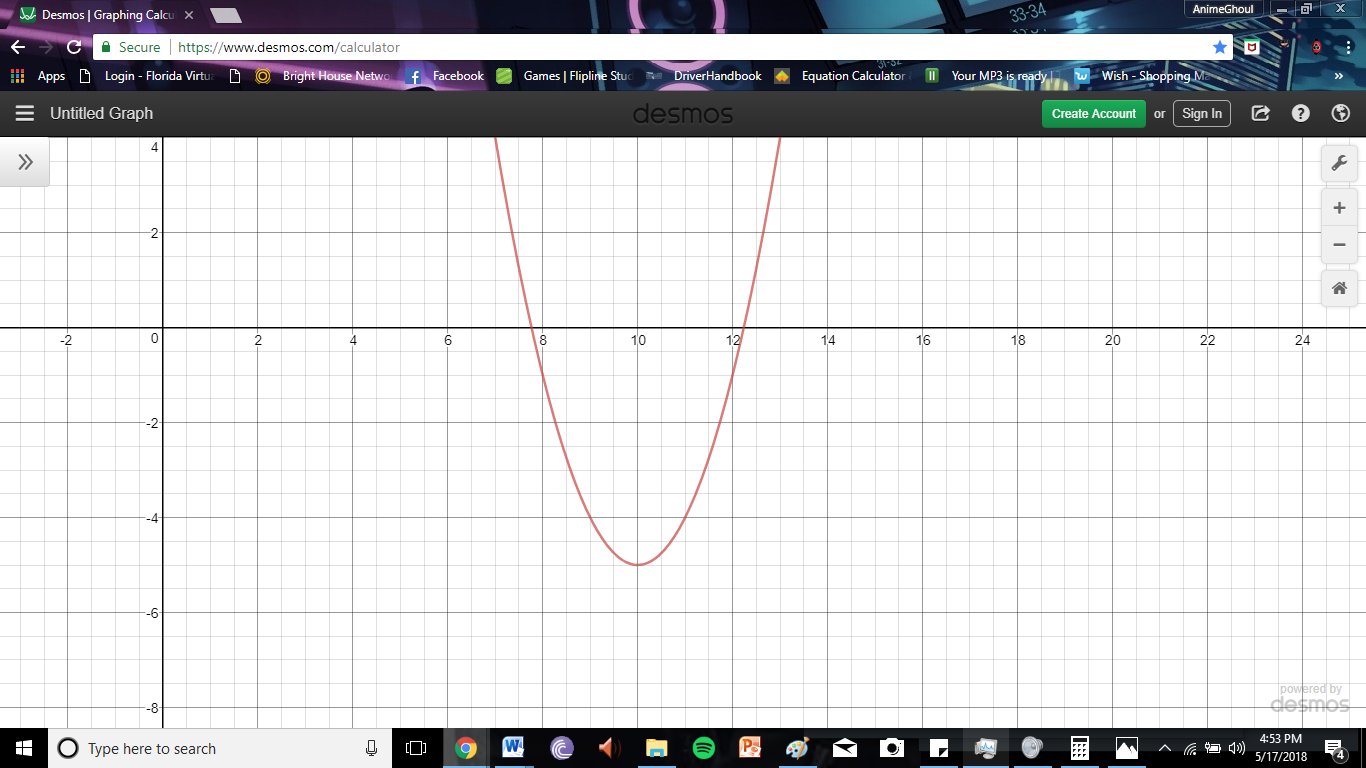
The function g(n) = n2 − 20n + 95 represents a parabola. Part A: Rewrite the function in vertex form by completing the square. Show your work. (6 points) Part B: Determine the vertex and indicate whether it is a maximum or a minimum on the graph. How do you know? (2 points) Part C: Determine the axis of symmetry for g(n).
AnimeGhoul8863:
@Shadow
AnimeGhoul8863:
Did part A with dude yesterday but now need part B and C
 Shadow:
I have to study for a quiz so I won’t be able to help you. Try tagging dude. I know there are easy websites that can help you find the vertex and axis of symmetry. I used them years ago. Also, a minimum just means the vertex is on the bottom, with the lines going up. Maximum means the vertex is the highest point, with the parabola going down.
AnimeGhoul8863:
g(n)= n^2-20n+95 Step 1: n^2 - 20n + 100 Step 2: (b over 2) ^2 So (-20 over 2) ^2=-10^2=100 Step 3: (n^2-20n=100)=95-100 Step 4: (n-10) (n-10)- 5 Step 5: (n-10)^2 - 5 Answer G(n)=(n-10)^2-5
AnimeGhoul8863:
@dude
Shadow:
Do you know what the vertex is?
AnimeGhoul8863:
yes
Shadow:
What is it?
AnimeGhoul8863:
hold on im pulling it up
AnimeGhoul8863:
(10,-5)
Shadow:
Mhm, and have you determined whether this is a minimum or a maximum?
AnimeGhoul8863:
I think its maximum because it goes from negative to positive
Shadow:
What do you mean from negative to positive
AnimeGhoul8863:
hold on imma show u what i have
.png) AnimeGhoul8863:
AnimeGhoul8863:
^^if u look it goes down to up so that would make it maximum because it goes up to the positives
Shadow:
Maximum is when the vertex is the highest point. Does that seem to be the case?
AnimeGhoul8863:
Nu so it would be minimum because the vertex has negatives and it is not at its highest points
Shadow:
Think of it this way: Maximum: Parabola opens down Minimum: Parabola opens up
AnimeGhoul8863:
Ohhhh so Its minimum because the vertext is not at its highest points and becuase the parabola opens up
 Shadow:
Yes
AnimeGhoul8863:
*because
Shadow:
And it since it's the lowest point.
AnimeGhoul8863:
how do we know? i know because if the vertex is in the negatives it means its at its lowest points so that would make the parabola open
Shadow:
A vertex can be in the negative and still be a maximum. |dw:1526590701385:dw|
Shadow:
That's why you focus on these two qualifications: Opens up/Opens down Highest point/lowest point It's positioning of the vertex in terms of pos/neg doesn't matter.
AnimeGhoul8863:
so how would you explain how you know if a vertex could still be in negatives but still maximum
Shadow:
Because it's the highest point in the graph and the parabola opens down.
AnimeGhoul8863:
I know because its the lowest point in the graph and the parabola opens up
AnimeGhoul8863:
@dude can yew helps yeet
AnimeGhoul8863:
@dude e.e
AnimeGhoul8863:
Part C im on den one last question
 dude:
dude:
In order to find axis of symmetry you have to use the this equation: \(\large -\frac{b}{2a}\) Remember: This equation is written as \(g(n)=ax^2+bx+c\)
AnimeGhoul8863:
i know so it would be (n-10) over -5?
AnimeGhoul8863:
cause the equation we finished yesterday is G(n)=(n-10)^2-5
dude:
Ah we're using the original equation for this one \(n^2 − 20n + 95\) As its written in standard form \(ax^2+bx+c\)
AnimeGhoul8863:
im confused now so we dont use our revised equation we use the original
dude:
We use the original
dude:
Its easier to solve for the vertex at least in my opinion
AnimeGhoul8863:
i have the vertex i need the axis symmetry
AnimeGhoul8863:
^^look up i already told shadow the vertex for part B
dude:
OHHHHHHHHH
dude:
Scratch what I just said, just look at the h value Hint: \(g(n)=a(x-h)+k\)
AnimeGhoul8863:
Umm ok.....
dude:
\(g(n)=(n-10)^2-5\) What is the h value?
AnimeGhoul8863:
10?
dude:
Right so x=10 is the axis of symmetry This may help https://www.desmos.com/calculator/s7k0gr4pee
AnimeGhoul8863:
what? u just what IM SOOO CONFUSED how did it go from 10 being h to 10 being x
dude:
The rule for axis of symmetry: \(x=h\) \(g(n)=(x-h)+k\) The value of x for the line of symmetry is equal to the value of h on the vertex form for an equation
AnimeGhoul8863:
so Part C: The Axis equals 10.
dude:
The axis of symmetry is when x=10, yes
AnimeGhoul8863:
Ok are you ready to finish da last question
dude:
give me a few mins, ill be right there. Post it though
AnimeGhoul8863:
ok
Join our real-time social learning platform and learn together with your friends!
 KBaby:
Verse 1 We left our names in the dust of the driveway Watched the old town shrink
KBaby:
Lyrics Generator Use AI to write the lyrics for a song. Suggested Genres: Pop Hip
KBaby:
Verse 1 We left our names in the dust of the driveway Watched the old town shrink
KBaby:
Lyrics Generator Use AI to write the lyrics for a song. Suggested Genres: Pop Hip

 aitexturegenerator:
How are you all handling AI-generated textures for 3D models and game assets without losing the hand-made feel? I've been doing a small stylized environment
aitexturegenerator:
How are you all handling AI-generated textures for 3D models and game assets without losing the hand-made feel? I've been doing a small stylized environment

 Demon25:
Woke up feeling like that girl and that dude well he still aint crap pluse the du
Demon25:
Woke up feeling like that girl and that dude well he still aint crap pluse the du
 playtsec:
how do I get rid of stress from teachers... I just feel like running out the classroom and leaving on my own.
playtsec:
how do I get rid of stress from teachers... I just feel like running out the classroom and leaving on my own.
 JohnnyLFowler0812:
What type of gamer would play something and then get off for a while. Why not sta
JohnnyLFowler0812:
Which is better? Metallica Rap Country R&B hiphop Medal Gospel Chill Which 3 opti
JohnnyLFowler0812:
What type of gamer would play something and then get off for a while. Why not sta
JohnnyLFowler0812:
Which is better? Metallica Rap Country R&B hiphop Medal Gospel Chill Which 3 opti