
 zarkam21:
D
 Vocaloid:
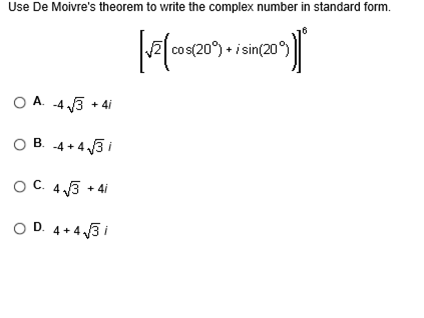
|dw:1527617419136:dw| so you would start by using de moivres to re-write the problem r^n (cos(n*theta) + isin(n*theta)) then use the polar to rectangular conversion
Vocaloid:
yeah I got something other than D
Vocaloid:
still there? when you re-write the formula with de moivres you get [sqrt(2)] ^ 6 * cos(6*20) for the x-coordinate, simply evaluate that to see what it would be in rectangular form
zarkam21:
-4
zarkam21:
B
Vocaloid:
good and there's only one choice where the x-coordinate is -4
Vocaloid:
good, B
 zarkam21:
D
Vocaloid:
need to re-teach myself this ;_; might take a bit
Vocaloid:
@Shadow have you learned this yet? (nth roots)
 Shadow:
ah no. But it's summer and I've already turned off my brain so who knows.
Vocaloid:
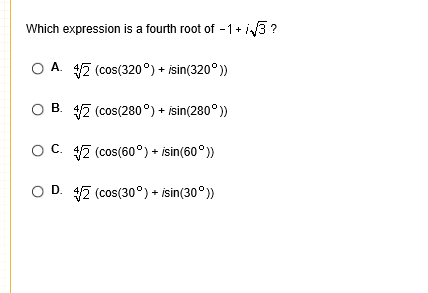
what I have so far: you can find the angle of the original expression by taking arctan(y/x) as usual, that gives arctan(-sqrt(3)) = -60 degrees, converting this to a positive angle gives 300 since we must add 360 degrees from there you're supposed to divide by the root # to get 75 degrees but that's not one of the choices :S I guess I can try plugging them into a calculator to see which one works
zarkam21:
C mahybe
Vocaloid:
had to use a calculator for this tbh but I end up with theta = 30?
zarkam21:
SO D
zarkam21:
Ugh thank you , you really didnt have to do that
 zarkam21:
B
Vocaloid:
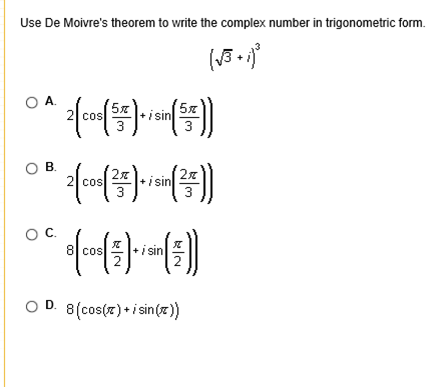
good attempt but not quite first you'd have to convert to polar coordinates r = sqrt(x^2 + y^2) = ?
Vocaloid:
remember that x is the first term sqrt(3) and y is the the coefficient of i (1)
zarkam21:
2
Vocaloid:
good, and if we look at our de moivre formula we can see that r^n is the coefficient where n is the exponent, so the coefficient in front must be 2^3 or 8, not 2
zarkam21:
C
Vocaloid:
then you need to find arctan(y/x) to find the angle then multiply by 3 to find the angle arctan(1/sqrt(3)) gives theta = pi/6, multiply that by 3 to get pi/2, so yes C
 zarkam21:
B and C
Vocaloid:
C yes, still double checking B
Vocaloid:
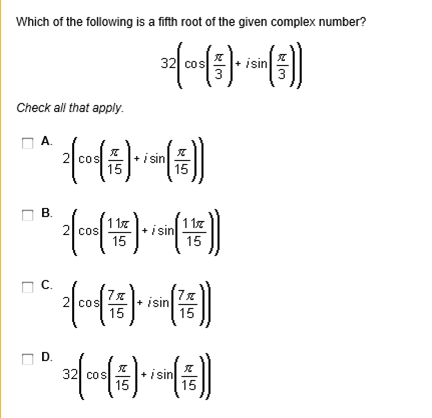
hm, not quite for the angle you can find possible angles by taking (theta + 2*pi*k)/n where theta is the original angle (pi/3), n is the root number (5), and k is a constant integer from 0,1,2, etc. what happens if you plug in k = 0?
zarkam21:
0
Vocaloid:
(pi/3 + 0*pi)/5 = ?
zarkam21:
pi/15 so A
Vocaloid:
good, A + C only
 zarkam21:
C
Vocaloid:
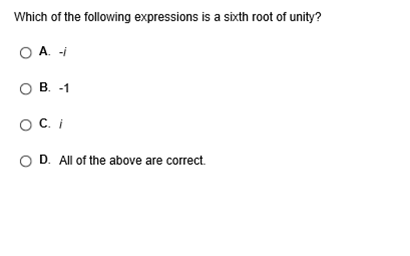
hm. not quite. "sixth root of unity" means that number can be raised to the power of 6 and will result in 1 (not -1) so which answer choice, when raised to the sixth power, gives 1 as the result?
zarkam21:
A
Vocaloid:
check your calculations again be very careful with negative signs and parentheses
zarkam21:
-1
Vocaloid:
good so B
 Vocaloid:
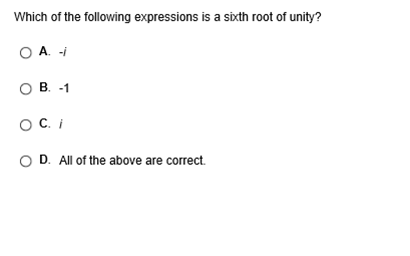
that's the same question as before
 zarkam21:
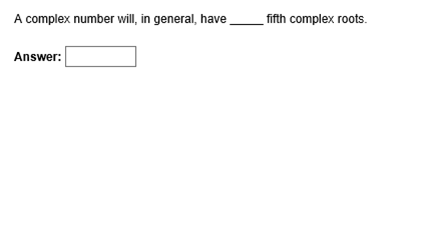
five
 zarkam21:
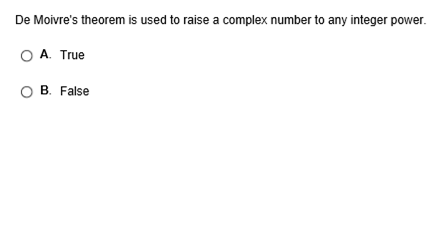
T
Vocaloid:
oh whoops got distracted by something, yes I believe those are both correct
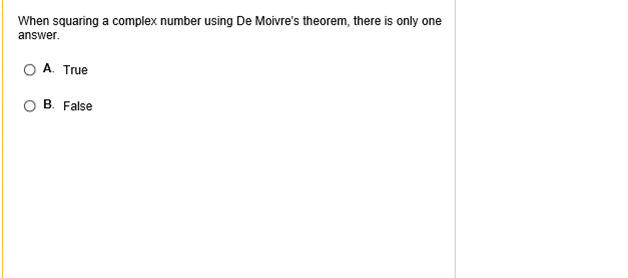 zarkam21:
F
Vocaloid:
this one is actually true, looking at the formula gives us r^n and 2theta as the things to plug in, giving only one possible solution
Vocaloid:
technically you could do the angle + 2pi thing but for all intents and purposes they're equivalent angles
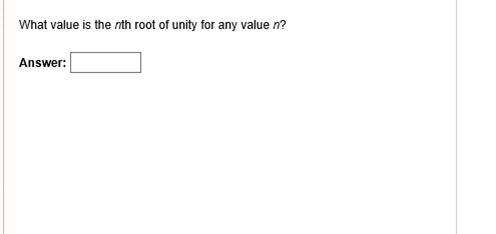 Vocaloid:
try plugging in a few n values for 1^(1/n), you'll see that you will get the same result each time
zarkam21:
1
Vocaloid:
good, 1 is your solution
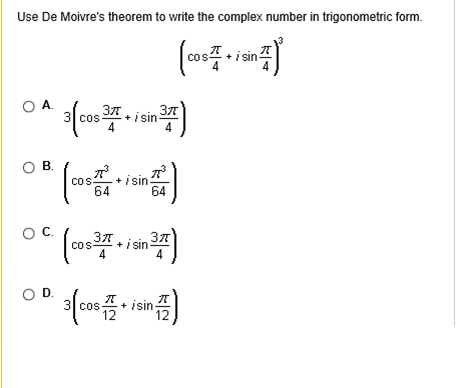 zarkam21:
C
Vocaloid:
excellent
Join our real-time social learning platform and learn together with your friends!
 KBaby:
Verse 1 We left our names in the dust of the driveway Watched the old town shrink
KBaby:
Lyrics Generator Use AI to write the lyrics for a song. Suggested Genres: Pop Hip
KBaby:
Verse 1 We left our names in the dust of the driveway Watched the old town shrink
KBaby:
Lyrics Generator Use AI to write the lyrics for a song. Suggested Genres: Pop Hip

 aitexturegenerator:
How are you all handling AI-generated textures for 3D models and game assets without losing the hand-made feel? I've been doing a small stylized environment
aitexturegenerator:
How are you all handling AI-generated textures for 3D models and game assets without losing the hand-made feel? I've been doing a small stylized environment

 Demon25:
Woke up feeling like that girl and that dude well he still aint crap pluse the du
Demon25:
Woke up feeling like that girl and that dude well he still aint crap pluse the du
 playtsec:
how do I get rid of stress from teachers... I just feel like running out the classroom and leaving on my own.
playtsec:
how do I get rid of stress from teachers... I just feel like running out the classroom and leaving on my own.
 JohnnyLFowler0812:
What type of gamer would play something and then get off for a while. Why not sta
JohnnyLFowler0812:
Which is better? Metallica Rap Country R&B hiphop Medal Gospel Chill Which 3 opti
JohnnyLFowler0812:
What type of gamer would play something and then get off for a while. Why not sta
JohnnyLFowler0812:
Which is better? Metallica Rap Country R&B hiphop Medal Gospel Chill Which 3 opti