
 zarkam21:
..
 Vocaloid:
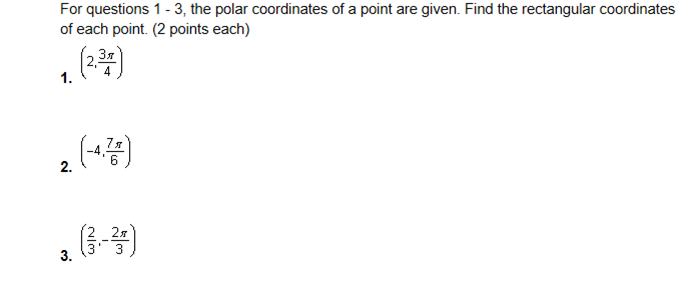
for every point you are given the polar coordinates (r, theta) to find the rectangular (x,y) coordinates simply find x = r*cos(theta) y = r*sin(theta)
Vocaloid:
still there? ^^
 zarkam21:
Yes I was doing the math lol
zarkam21:
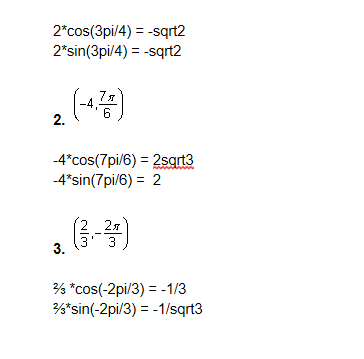
would this be right
Vocaloid:
almost on the first one the y value would be positive sqrt(2) not negative everything else is good
zarkam21:
wait the sin one right
Vocaloid:
yes, instead of 2sin(3pi/4) = -sqrt(2) it's sqrt(2)
 Vocaloid:
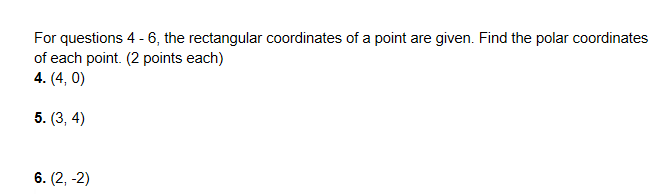
this is a bit more complicated but for every value (x,y), to find r and theta: r = sqrt(x^2 + y^2) and theta = arctan(y/x)
zarkam21:
sqrt(4^2 + 0^2)
zarkam21:
4
zarkam21:
arctan (0/4)
zarkam21:
0
Vocaloid:
good, so putting everything together you get r= 4 and theta = 0 so (4,0) = your solution
zarkam21:
sqrt(3^2 + 4^2) = 5 arctan (4/3) = 53.13 degrees
zarkam21:
(5,53.13 degrees)
Vocaloid:
well done
zarkam21:
sqrt(2^2+(-2)^2) = 2 sqrt 2 Arctan (-2/2) = -57.3 degrees (2sqrt2,-57.3)
Vocaloid:
arctan(-2/2) = arctan(-1) which has the value -45 degrees
zarkam21:
sqrt(2^2+(-2)^2) = 2 sqrt 2 Arctan (-2/2) = -45 degrees (2sqrt2,-45degrees)
Vocaloid:
actually since theta is usually given as an angle between 0 and 2pi it would be a good idea to add 360 to that to get 315 degrees
zarkam21:
sqrt(2^2+(-2)^2) = 2 sqrt 2 Arctan (-2/2) = -45 degrees + 360 = 315 (2sqrt2, 315 degrees)
Vocaloid:
good, perfect
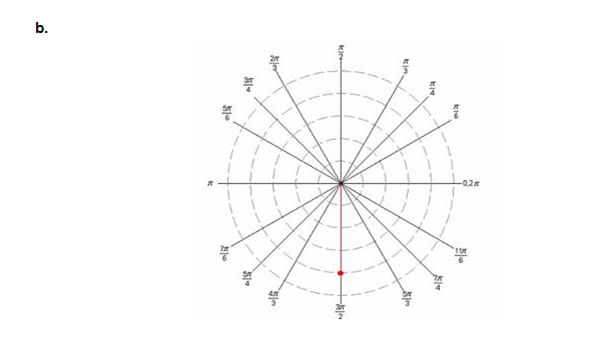 Vocaloid:
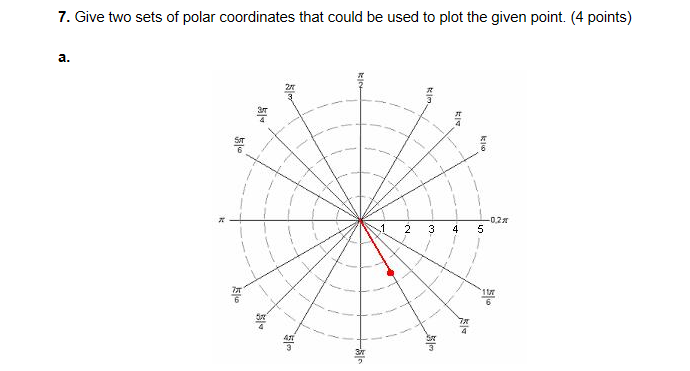
uh let's take it one at a time for the first one start by identifying the angle and radius
Vocaloid:
|dw:1527629792776:dw|
zarkam21:
5pi/3
Vocaloid:
good, what about the radius? notice how the red line stops at about halfway between 2 and 3
zarkam21:
2.5
Vocaloid:
good so that gives us one set of polar coordinates to get another set of polar coordinates we can multiply the r by -1 and subtract pi from the angle value
zarkam21:
2.5*-1
Vocaloid:
good, that gives us -2.5 as the second possible r-value
zarkam21:
so 2.5 and -2.5
Vocaloid:
you must also consider the theta values if we subtract pi from 5pi/3 we get 2pi/3 so two possible coordinates are (2.5,5pi/3) and (-2.5, 2pi/3)
Vocaloid:
if you'd like you can try the same process with b)
zarkam21:
oh okay i think I get it
zarkam21:
i will try it and then you can check it
zarkam21:
(4,3pi/2) and (-4,pi/2)
Vocaloid:
perfect

 Vocaloid:
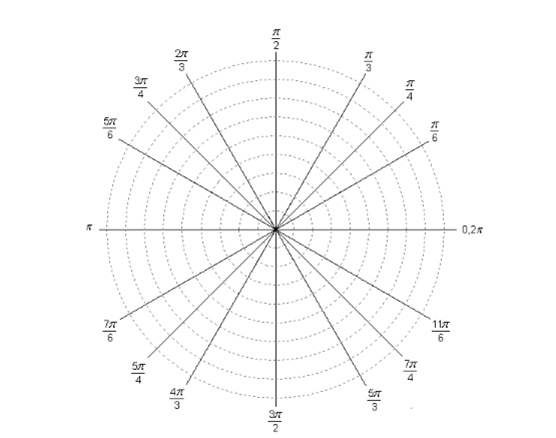
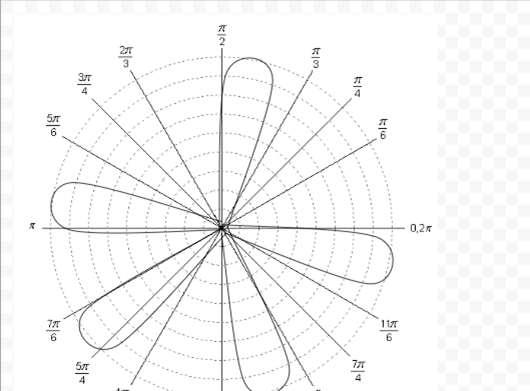
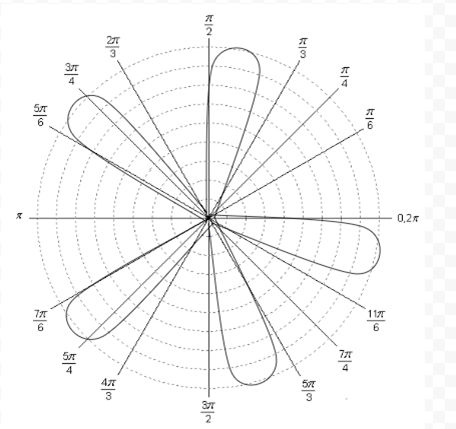
from what I remember r = 9cos(5theta) should be a five-petalled rose with a radius of 9 (so the farthest parts of the petals should reach 9) I don't remember the rules for how to orient the rose but you could try plugging in various theta values into the equation to see where the points should be
Vocaloid:
oh, right, since it's a cos rose there should be a petal aligned exactly with the x-axis and then the other petals should be separated by 2pi/5 radians (you will have to do some estimation) so something like:
 Vocaloid:
|dw:1527630974560:dw|
Vocaloid:
almost, gotta make sure that first petal is symmetric about the x-axis
Vocaloid:
|dw:1527631120460:dw|
 Vocaloid:
|dw:1527631125447:dw|
Vocaloid:
otherwise good
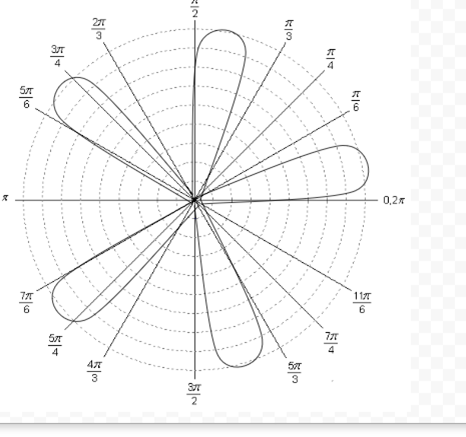 Vocaloid:
that petal needs to be right along the x-axis you can use this as a reference https://www.desmos.com/calculator/ms3eghkkgz
Vocaloid:
not above or below it
zarkam21:
wait is this file supposed to look like a rose?
zarkam21:
i dont see it :/
Vocaloid:
on desmos you need to plug in 9cos(5theta) as the reference function it's just called a rose for naming purposes, it's more like a daisy tbh
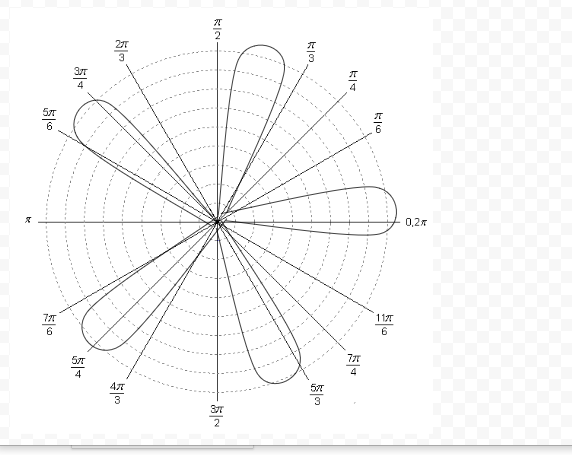 Vocaloid:
that petal could be a bit lower but otherwise good
zarkam21:
okay so now we have to name out the symmetries for the polar equation. WOULd it just be pi/2
zarkam21:
and have to tell what scale I used for the polar axis
Vocaloid:
oh well, there's a couple forms of symmetry here: notice how the rose can be divided in half along each of the five petals so it's not just the polar axis, it's also theta = 2pi/5, 4pi/5, 6pi/5, 8pi/5 there's also symmetry with respect to the pole (notice how each corresponding point on each petal is the same distance from the origin)
Vocaloid:
as for the scale, since we made each tick mark equal to 1 unit, simply state that each dotted radial mark represents 1 unit
zarkam21:
Okay so we are on the second part to this question
Vocaloid:
Right Is there anything about part a) that's still unclear?
 zarkam21:
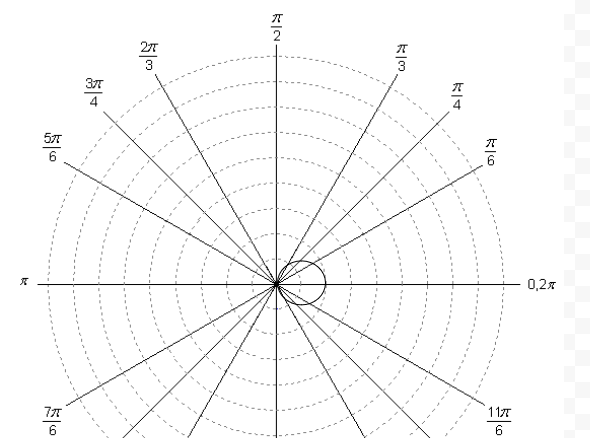
I used desmos as a reference
Vocaloid:
What's the function
zarkam21:
NO I think I got part A in the bag. I think I understand it
zarkam21:
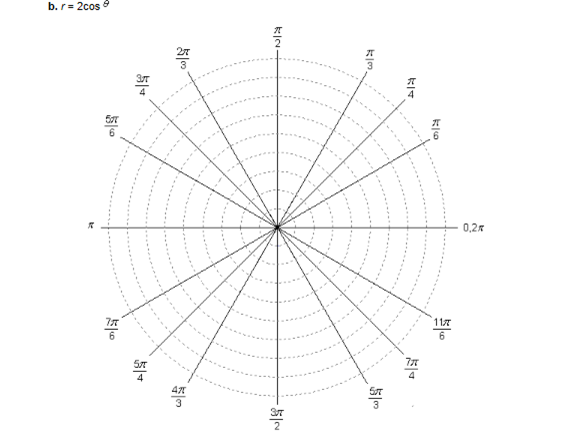
that I graphed? r=2 cos theta
Vocaloid:
yeah I think that's alright need some help with the symmetry and scale?
zarkam21:
hold on let me look at the previous question and see if I can figure it out from what you said ^~^
zarkam21:
well the scale used is that each dotted radical mark represents 1 unit.
Vocaloid:
*radial but yes
Vocaloid:
anyway for symmetry there's only one line, the polar axis
zarkam21:
The picture this function makes on the graph is a circle. This is also theta = 0.2pi, 5pi/3, pi/3, The scale used is that each dotted radial mark represents 1 unit.
zarkam21:
OH okay
zarkam21:
So the theta part is incorrect?
Vocaloid:
yeah don't include that part
Vocaloid:
everything else is fine
 Vocaloid:
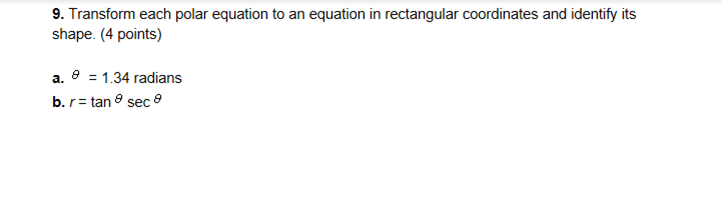
9a: since we don't have r we only need to consider arctan(y/x) = theta taking tan of both sides gives us y/x = tan(theta) so y = xtan(theta) = xtan(1.34 radians) so this is just a straight line with slope tan(1.34)
 Vocaloid:
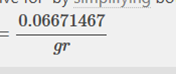
uh not sure where g is coming from
zarkam21:
Lol ,
zarkam21:
I think we shall move on , no ? :)
zarkam21:
OKay so for the second one, I got all real numbers . I put it into Wolfran Alpha
zarkam21:
0 = pi n
Vocaloid:
sure so if r = sec(theta)tan(theta) we can re-write the function in terms of sin and cos r = [1/cos(theta)] * [sin(theta)/cos(theta)] multiplying both sides by r*cos^2(theta) gives r^2 * cos^2(theta) = r*sin(theta) since x = rcos(theta) and y = r(sintheta) we can simply re-write this as x^2 = y
Vocaloid:
so it's a parabola
Join our real-time social learning platform and learn together with your friends!
 KBaby:
Verse 1 We left our names in the dust of the driveway Watched the old town shrink
KBaby:
Lyrics Generator Use AI to write the lyrics for a song. Suggested Genres: Pop Hip
KBaby:
Verse 1 We left our names in the dust of the driveway Watched the old town shrink
KBaby:
Lyrics Generator Use AI to write the lyrics for a song. Suggested Genres: Pop Hip

 aitexturegenerator:
How are you all handling AI-generated textures for 3D models and game assets without losing the hand-made feel? I've been doing a small stylized environment
aitexturegenerator:
How are you all handling AI-generated textures for 3D models and game assets without losing the hand-made feel? I've been doing a small stylized environment

 Demon25:
Woke up feeling like that girl and that dude well he still aint crap pluse the du
Demon25:
Woke up feeling like that girl and that dude well he still aint crap pluse the du
 playtsec:
how do I get rid of stress from teachers... I just feel like running out the classroom and leaving on my own.
playtsec:
how do I get rid of stress from teachers... I just feel like running out the classroom and leaving on my own.
 JohnnyLFowler0812:
What type of gamer would play something and then get off for a while. Why not sta
JohnnyLFowler0812:
Which is better? Metallica Rap Country R&B hiphop Medal Gospel Chill Which 3 opti
JohnnyLFowler0812:
What type of gamer would play something and then get off for a while. Why not sta
JohnnyLFowler0812:
Which is better? Metallica Rap Country R&B hiphop Medal Gospel Chill Which 3 opti