
 zarkam21:
Write each complex number in rectangular form. Plot and label (with a - d) each point on the polar axes below.
 Vocaloid:
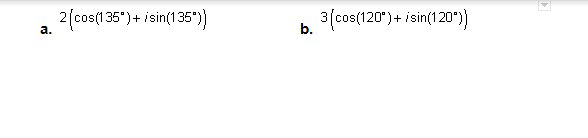
let's use a) as an example 2(cos(135) + isin(135)) you basically just need to distribute the 2 to get 2cos(135) + 2i*sin(135), then replace cos(135) and sin(135) with their actual values (use a calculator)
zarkam21:
2(cos(135) + isin(135)) = -1 + I sqrt 2
zarkam21:
= -1 + i sqrt 2 *****
zarkam21:
wait
Vocaloid:
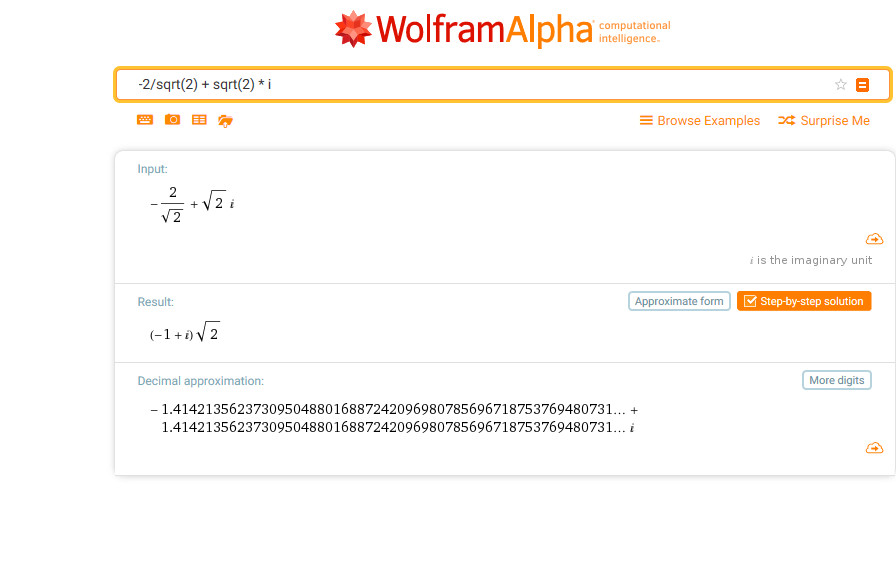
hm 2*cos(135) = -2/sqrt(2) so -2/sqrt(2) + sqrt(2) * i should do it
Vocaloid:
(the coefficient sqrt(2) is written before the i)
zarkam21:
i AM still getting the same answer
 Vocaloid:
parentheses are important -1 + i sqrt 2 is not the same as [-1 + i]sqrt(2)
Vocaloid:
the one on top is the one written in standard form
zarkam21:
Okay so it needs to include parentheses making the answer [-1 + i]sqrt(2)
zarkam21:
solve that i get -1.41
Vocaloid:
you do not need to do anything with the coordinates once you have them -2/sqrt(2) + sqrt(2) * i is sufficient, nothing else needs to be done
Vocaloid:
similar thought process for b)
zarkam21:
3cos(120) + 3i*sin(120), 3*cos(120)=-3/sqrt3
zarkam21:
i think ;O
Vocaloid:
cos(120) = -1/2 so 3cos(120) = -3/2 don't forget about the 3*i*sin(120)
zarkam21:
-3/2 3isqrt3/2
Vocaloid:
good so -3/2 + [3*sqrt(3)/2]i is your solution
zarkam21:
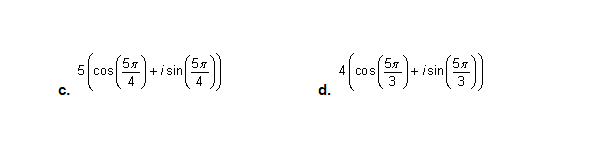
cos(5pi/4) = -1/sqrt2 so 5cos(5pi/4) = -5/2 5*i*sin(5pi/4) = -5i/sqrt2
Vocaloid:
almost 5cos(5pi/4) = -5/sqrt(2) so your sol'n is -5/sqrt(2) + [-5/sqrt(2)]i
Vocaloid:
any attempts on d yet?
zarkam21:
cos(5pi/3) = 1/2 so 4cos(5pi/3) = 2 4*i*sin(5pi/3) = -2i/sqrt3
Vocaloid:
good so 2 - (-2/sqrt(3))i
Vocaloid:
wait isn't it just -2sqrt(3) i
zarkam21:
okay so c is cos(5pi/4) = -1/sqrt2 so 5cos(5pi/4) = -5/2 5*i*sin(5pi/4) = -5i/sqrt2 and d is cos(5pi/3) = 1/2 so 4cos(5pi/3) = 2 4*i*sin(5pi/3) = -2i/sqrt3i
Vocaloid:
you need to combine the values to get the complete coordinate c: -5/sqrt(2) + [-5/sqrt(2)]i d: 2 - 2sqrt(3) * i
Vocaloid:
those are your solutions
Join our real-time social learning platform and learn together with your friends!
 KBaby:
Verse 1 We left our names in the dust of the driveway Watched the old town shrink
KBaby:
Lyrics Generator Use AI to write the lyrics for a song. Suggested Genres: Pop Hip
KBaby:
Verse 1 We left our names in the dust of the driveway Watched the old town shrink
KBaby:
Lyrics Generator Use AI to write the lyrics for a song. Suggested Genres: Pop Hip

 aitexturegenerator:
How are you all handling AI-generated textures for 3D models and game assets without losing the hand-made feel? I've been doing a small stylized environment
aitexturegenerator:
How are you all handling AI-generated textures for 3D models and game assets without losing the hand-made feel? I've been doing a small stylized environment

 Demon25:
Woke up feeling like that girl and that dude well he still aint crap pluse the du
Demon25:
Woke up feeling like that girl and that dude well he still aint crap pluse the du
 playtsec:
how do I get rid of stress from teachers... I just feel like running out the classroom and leaving on my own.
playtsec:
how do I get rid of stress from teachers... I just feel like running out the classroom and leaving on my own.
 JohnnyLFowler0812:
What type of gamer would play something and then get off for a while. Why not sta
JohnnyLFowler0812:
Which is better? Metallica Rap Country R&B hiphop Medal Gospel Chill Which 3 opti
JohnnyLFowler0812:
What type of gamer would play something and then get off for a while. Why not sta
JohnnyLFowler0812:
Which is better? Metallica Rap Country R&B hiphop Medal Gospel Chill Which 3 opti