
 zarkam21:
Help
 Vocaloid:
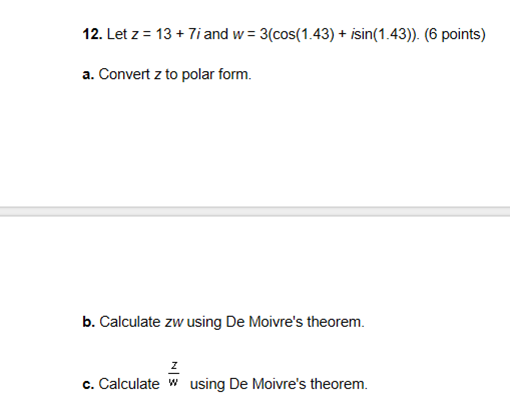
a) any attempts yet? as a reminder r = sqrt(x^2+y^2) and theta = arctan(y/x)
zarkam21:
(17i)/13?
zarkam21:
wiat
zarkam21:
r = sqrt(13^2+17i^2)
Vocaloid:
we don't consider the i part (it is assumed that y is graphed in the imaginary plane) so sqrt(13^2+7^2) and arctan(7/13)
Vocaloid:
anyway, then you just need to simplify sqrt(13^2 + 7^2) to get sqrt(218) as the modulus z = __*[cos(theta) + isin(theta)] where the modulus goes into the blank and the theta value goes into the theta
zarkam21:
z = _sqrt 218_*[cos(theta) + isin(theta)]
Vocaloid:
make sure to also plug in the theta value
zarkam21:
1.43 righht
zarkam21:
z = _sqrt 218_*[cos(1.43) + isin(1.43)]
Vocaloid:
arctan(7/13) = ?
zarkam21:
z = _sqrt 218_*[cos(28.3) + isin(28.3)]
Vocaloid:
I would recommend using the radians value here since the other angle is in radians so 0.49
zarkam21:
sqrt 218_*[cos(0.49) + isin(0.49)]
Vocaloid:
good then for b and c try to apply the multiplication and division rules of de moivres to your problem |dw:1527825303044:dw|
zarkam21:
wouldnt it just be (13 + 7i) * 3(cos(1.43) + isin(1.43)).
Vocaloid:
notice how the numbers in front of your z and w roots are 3 and sqrt(218) so r1r2 = 3*sqrt(218)
Vocaloid:
notice also how it calls for theta1 + theta2 so you must add the theta value 0.49 obtained from step a) to 1.43 to obtain the new theta value
zarkam21:
0.49+1.43
Vocaloid:
good so putting everything together what is zw?
zarkam21:
1.92
zarkam21:
3*sqrt(218)
Vocaloid:
that's the theta value, but what about the entire expression?
zarkam21:
44.29
zarkam21:
3*sqrt(218)=44.29
Vocaloid:
|dw:1527825826612:dw|
Vocaloid:
when you replace those values in, what do you get for the entire expression?
zarkam21:
3sqrt(218)[cos(1.92)+isin(1.92)]
Vocaloid:
awesome so that's zw now repeat the same process for the division formula, be careful because order matters
zarkam21:
is theta 1 0.49 or 1.43
Vocaloid:
it's z/w so theta1 will be the theta value for z (0.49)
zarkam21:
(0.20)[cos(-0.94)+isin(-0.94)]
Vocaloid:
it's z/w so the r-value for z goes in the numerator sqrt(218)/3 should be the r value not the other way around
zarkam21:
(4.9)[cos(-0.94)+isin(-0.94)]
Vocaloid:
good, so that's it
Join our real-time social learning platform and learn together with your friends!
 KBaby:
Verse 1 We left our names in the dust of the driveway Watched the old town shrink
KBaby:
Lyrics Generator Use AI to write the lyrics for a song. Suggested Genres: Pop Hip
KBaby:
Verse 1 We left our names in the dust of the driveway Watched the old town shrink
KBaby:
Lyrics Generator Use AI to write the lyrics for a song. Suggested Genres: Pop Hip

 aitexturegenerator:
How are you all handling AI-generated textures for 3D models and game assets without losing the hand-made feel? I've been doing a small stylized environment
aitexturegenerator:
How are you all handling AI-generated textures for 3D models and game assets without losing the hand-made feel? I've been doing a small stylized environment

 Demon25:
Woke up feeling like that girl and that dude well he still aint crap pluse the du
Demon25:
Woke up feeling like that girl and that dude well he still aint crap pluse the du
 playtsec:
how do I get rid of stress from teachers... I just feel like running out the classroom and leaving on my own.
playtsec:
how do I get rid of stress from teachers... I just feel like running out the classroom and leaving on my own.
 JohnnyLFowler0812:
What type of gamer would play something and then get off for a while. Why not sta
JohnnyLFowler0812:
Which is better? Metallica Rap Country R&B hiphop Medal Gospel Chill Which 3 opti
JohnnyLFowler0812:
What type of gamer would play something and then get off for a while. Why not sta
JohnnyLFowler0812:
Which is better? Metallica Rap Country R&B hiphop Medal Gospel Chill Which 3 opti