
 zarkam21:
???
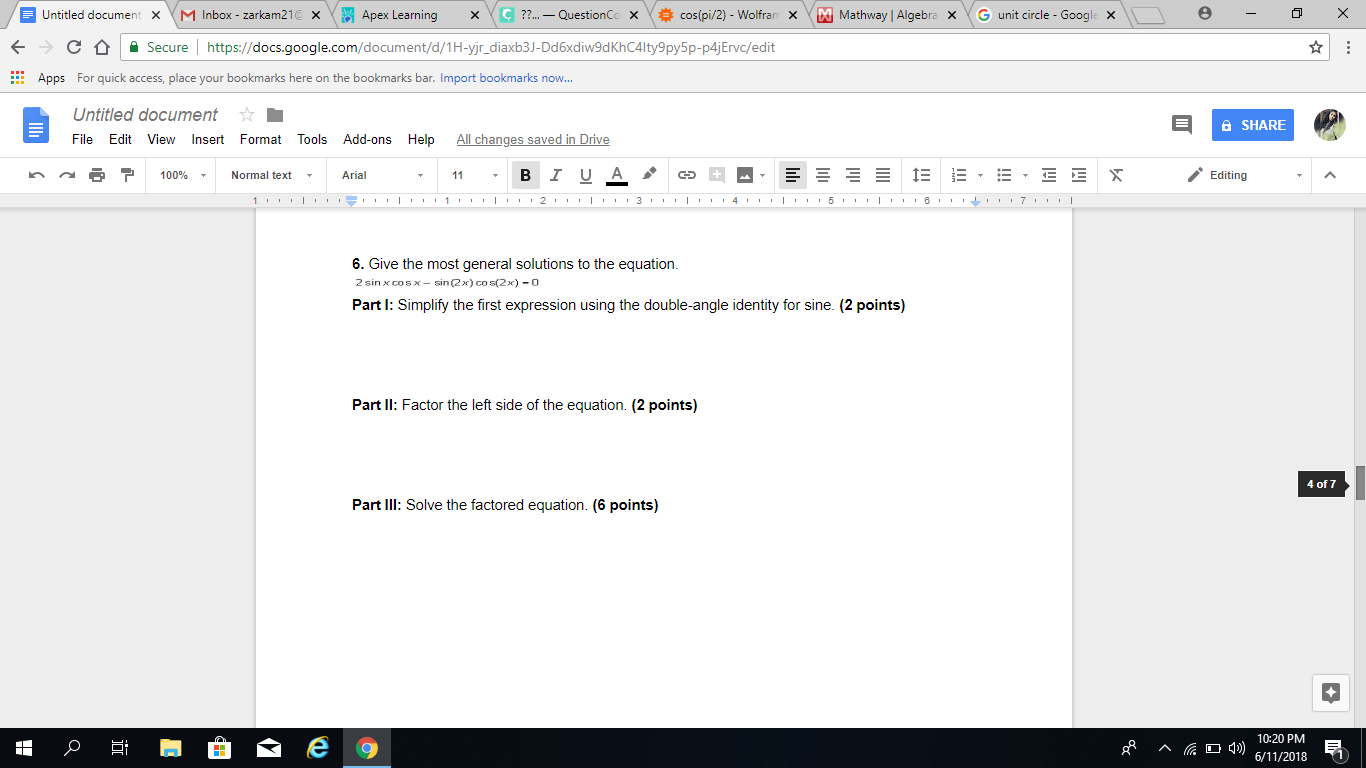
 Vocaloid:
|dw:1528770068720:dw| use line 1 to re-write 2sin(x)cos(x) in terms of sin only
Vocaloid:
hint: try replacing the alpha's with x's sin(2x) = 2sin(x)cos(x)
zarkam21:
wait so : sin(2x) = 2sin(x)cos(x)
Vocaloid:
yes now going back to the original equation how can you rewrite 2sin(x)cos(x) in terms of sin only?
zarkam21:
sin(2x)
Vocaloid:
good then for part I our sol'n would be sin(2x) - sin(2x)cos(2x) = 0 for part II: try factoring out sin(2x)
zarkam21:
4sin^3 sin(x) cos(x)
Vocaloid:
hm. that's not quite what I meant. try to re-write sin(2x) - sin(2x)cos(2x) so you have sin(2x) factored out like this: sin(2x)[_____ - ______] and fill in the blanks with the appropriate values after sin(2x) is factored out
zarkam21:
pi/2
Vocaloid:
we aren't solving for x yet, just factoring
Vocaloid:
like, if we have something like x - xy we can factor out x to get x(1-y) can you try applying this same logic to sin(2x) - sin(2x)cos(2x)?
Vocaloid:
it's basically the opposite of the distributive property
zarkam21:
sin(2x)(- sin(2x)cos(2x))
Vocaloid:
hm, getting there but not quite to make this a little easier you can divide each term by sin(2x) so sin(2x)/sin(2x) = ? sin(2x)cos(2x)/sin(2x) = ?
zarkam21:
cos(2x)
Vocaloid:
good but don't forget about the first expression sin(2x)/sin(2x) = 1 since anything divided by itself is 1
Vocaloid:
so putting that together we get sin(2x) - sin(2x)cos(2x) = sin(2x)[1-cos(2x)]
Vocaloid:
sin(2x)[1-cos(2x)] = 0 to be more specific
Vocaloid:
then for part III you have a case where A*B = 0, so either A = 0 or B = 0, or both applying this logic to our problem sin(2x) = 0 [1-cos(2x)] = 0 try solving both these scenarios for x
Vocaloid:
this is mostly a matter of knowing your unit circle let's start with sin(2x) = 0 b/c that's a little simpler what theta value(s) have a sin value = 0?
zarkam21:
0
zarkam21:
ugh
Vocaloid:
good but there's one more check the other side of the UC
zarkam21:
0 and pi
Vocaloid:
awesome since we have sin(2x) not just sin(x) we have to divide those by 2 so 0 and pi/2 now, it asks for the general solution which means must account for equivalent angles
Vocaloid:
to account for this we can add 2pi*n to these values to get 0 + 2pi*n and pi/2 + 2pi*n
zarkam21:
so this is part II
Vocaloid:
part II is just asking for the factored form so sin(2x)[1-cos(2x)] = 0
Vocaloid:
part III is getting into the solving part so just for the sin values we have 0 + 2*pi*n and pi/2 + 2*pi*n for any integer n then we just repeat this process for the cos values
Vocaloid:
hm
zarkam21:
so just using cos 2x
zarkam21:
so just what we have?
Vocaloid:
actually nvm it's alright so far anyway the other part of the eqn is [1-cos(2x)] = 0 so solving for cos(2x) gives us cos(2x) = 1 not 0, so you can start by finding theta where cos(theta) = 1
zarkam21:
[1-cos(2x)] = 0 cos(2x) = 1 um 0
Vocaloid:
good, only one x value this time dividing that by 2 gives us 0 again 0 + 2pi*n which is already covered w/ sin so it really comes down to 0 + 2pi*n and pi/2 + 2*pi*n
Vocaloid:
ok there's something that's still not quite sitting right with me on this one I believe there also needs to be pi + 2pi*n to account for odd pi multiples
Join our real-time social learning platform and learn together with your friends!
 KBaby:
Verse 1 We left our names in the dust of the driveway Watched the old town shrink
KBaby:
Lyrics Generator Use AI to write the lyrics for a song. Suggested Genres: Pop Hip
KBaby:
Verse 1 We left our names in the dust of the driveway Watched the old town shrink
KBaby:
Lyrics Generator Use AI to write the lyrics for a song. Suggested Genres: Pop Hip

 aitexturegenerator:
How are you all handling AI-generated textures for 3D models and game assets without losing the hand-made feel? I've been doing a small stylized environment
aitexturegenerator:
How are you all handling AI-generated textures for 3D models and game assets without losing the hand-made feel? I've been doing a small stylized environment

 Demon25:
Woke up feeling like that girl and that dude well he still aint crap pluse the du
Demon25:
Woke up feeling like that girl and that dude well he still aint crap pluse the du
 playtsec:
how do I get rid of stress from teachers... I just feel like running out the classroom and leaving on my own.
playtsec:
how do I get rid of stress from teachers... I just feel like running out the classroom and leaving on my own.
 JohnnyLFowler0812:
What type of gamer would play something and then get off for a while. Why not sta
JohnnyLFowler0812:
Which is better? Metallica Rap Country R&B hiphop Medal Gospel Chill Which 3 opti
JohnnyLFowler0812:
What type of gamer would play something and then get off for a while. Why not sta
JohnnyLFowler0812:
Which is better? Metallica Rap Country R&B hiphop Medal Gospel Chill Which 3 opti