
 princeevee:
can someone check my answers?
 mhchen:
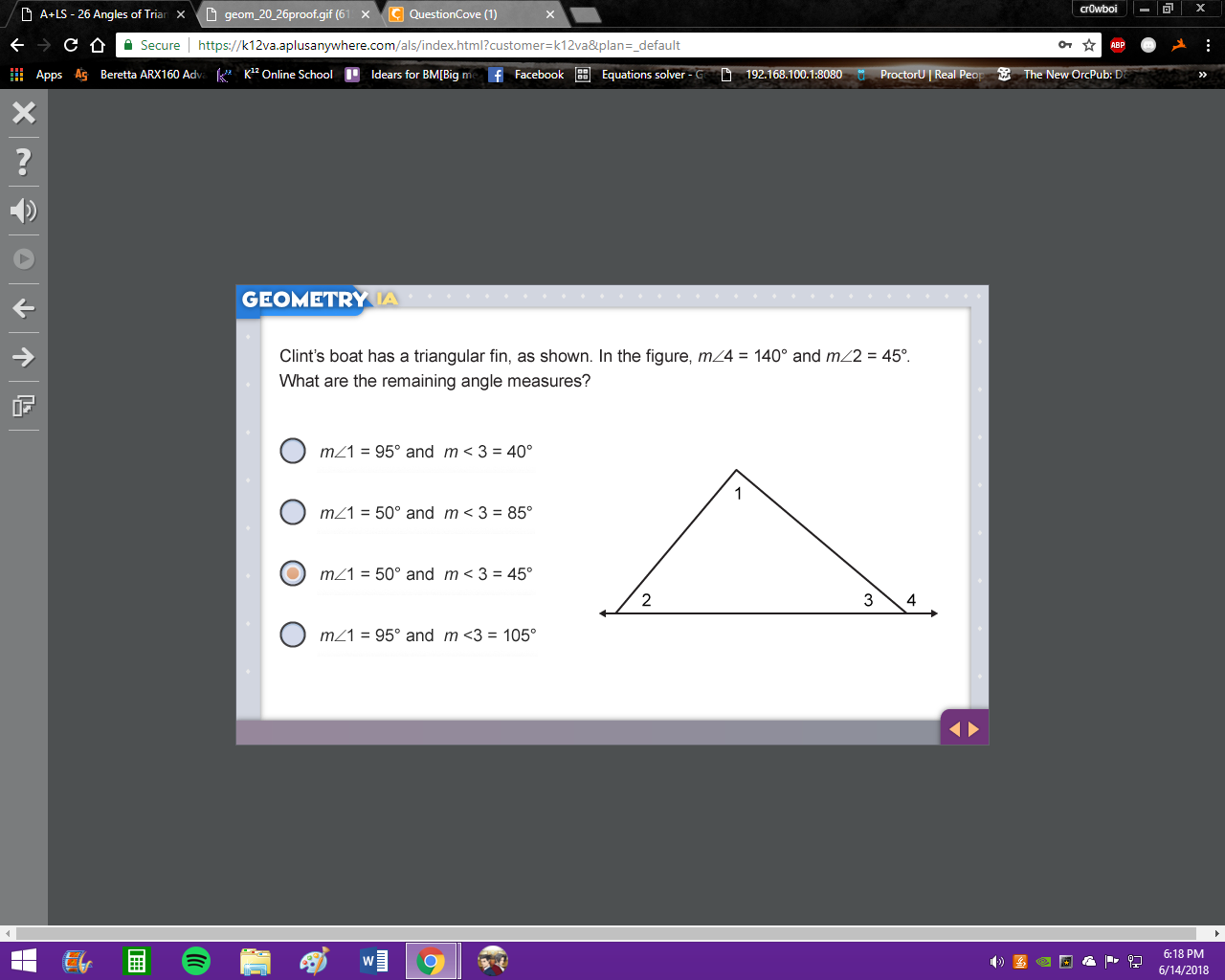
Sorry I don't think that's correct. |dw:1529025871118:dw| Look at this part and see if you can figure out what the question mark '?' is.
princeevee:
40
princeevee:
right?
mhchen:
Sorry I was gone. Yeah it's 40.
mhchen:
So the measure of angle 3 is 40. And it says the measure of angle 2 is 45 soooo |dw:1529028413190:dw|
mhchen:
Now find the measure of angle 1 here.
princeevee:
95
mhchen:
Yep.
 princeevee:
is this correct?
princeevee:
19 + 60 = 150 + 30 = 180
mhchen:
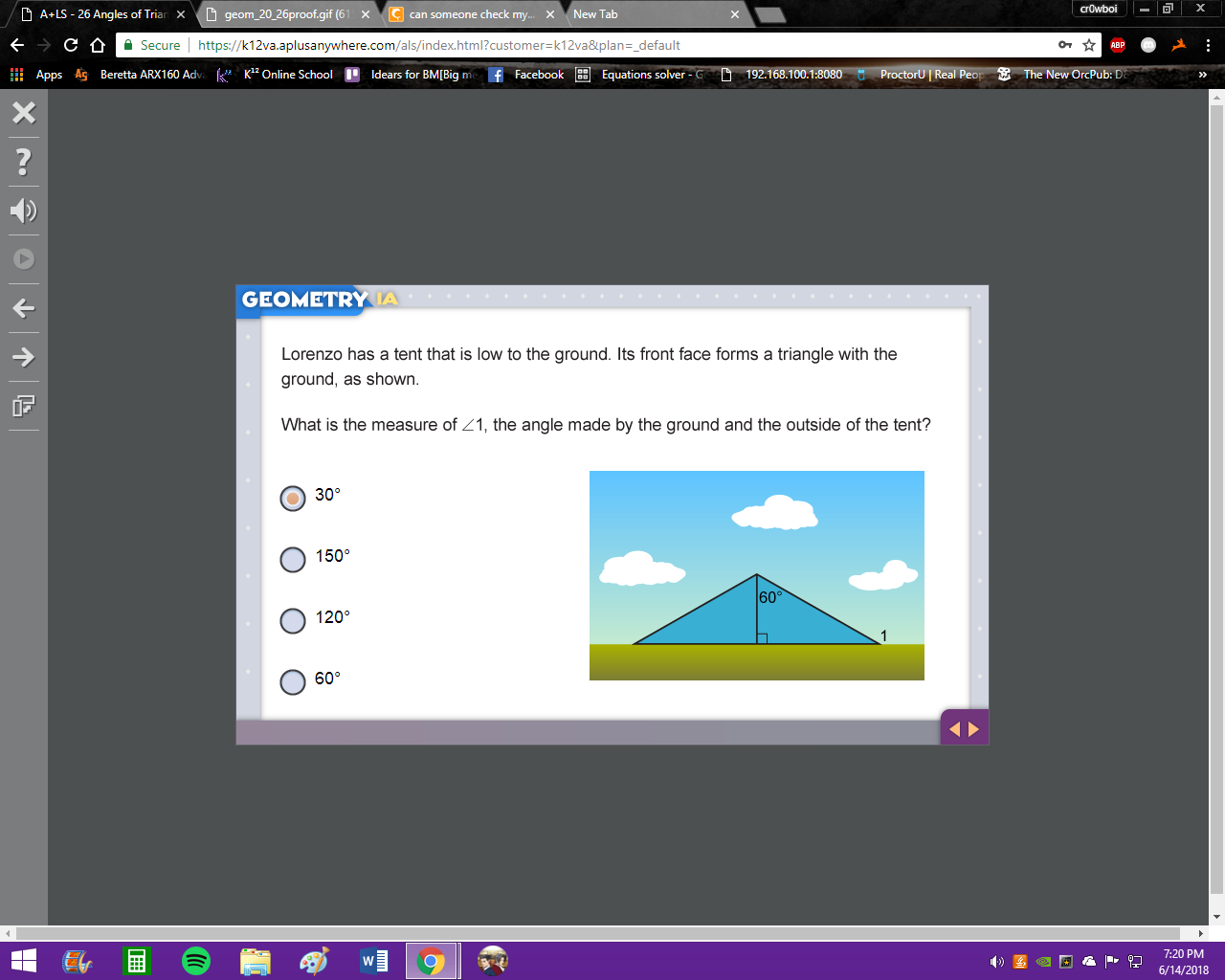
Uh, that angle looks like it's outside of the tent.
mhchen:
|dw:1529029679420:dw| I think it's more like this. Can you find out what '?' is here
princeevee:
120?
mhchen:
Nope. Let me make this easier: |dw:1529030019563:dw| Since it's a straight line, it'll add up to 180.
princeevee:
ah, so it's 150
mhchen:
yeap
 mhchen:
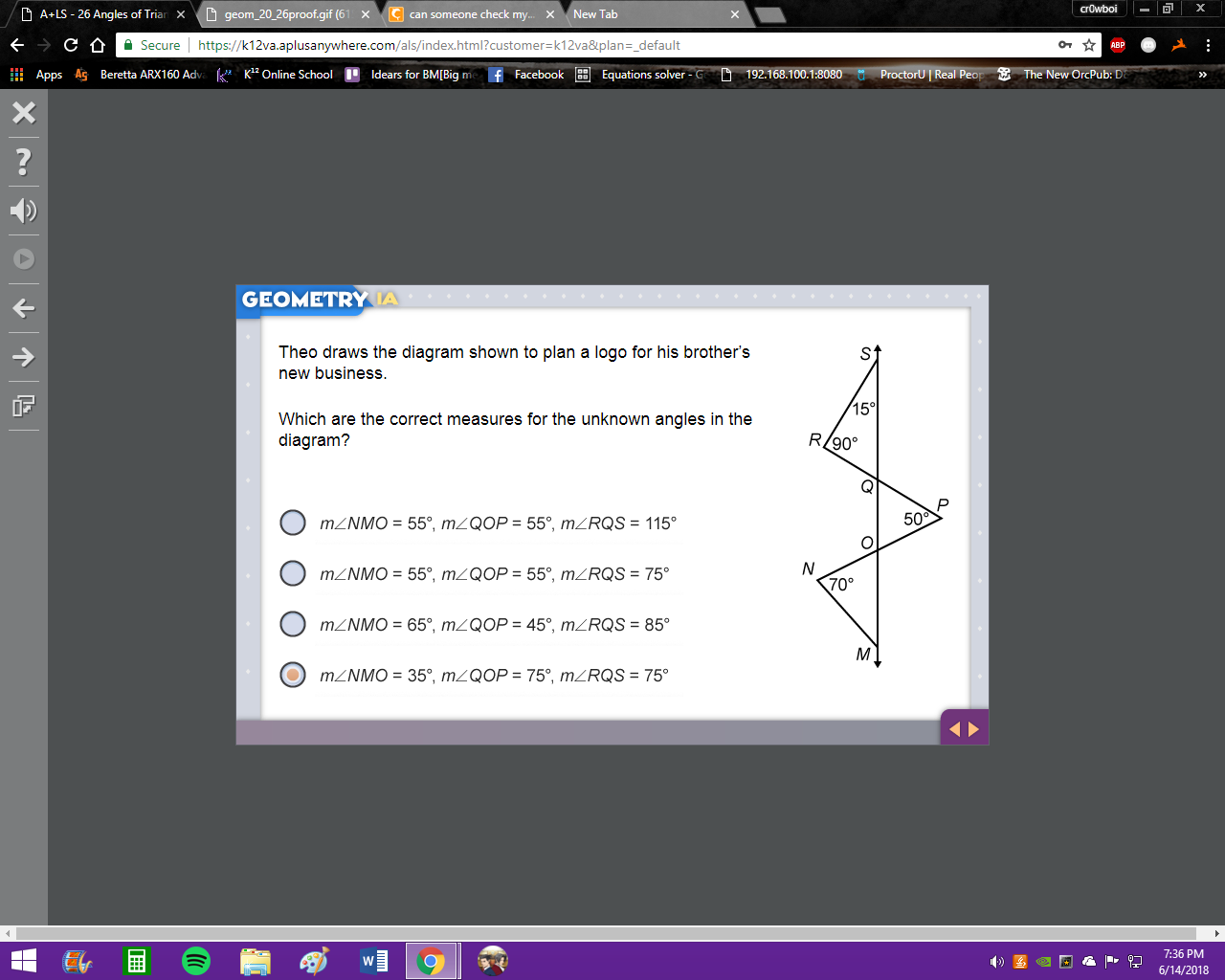
RQS is correct, but NMO doesn't seem right. |dw:1529030373334:dw|
princeevee:
so B?
mhchen:
yeah
 mhchen:
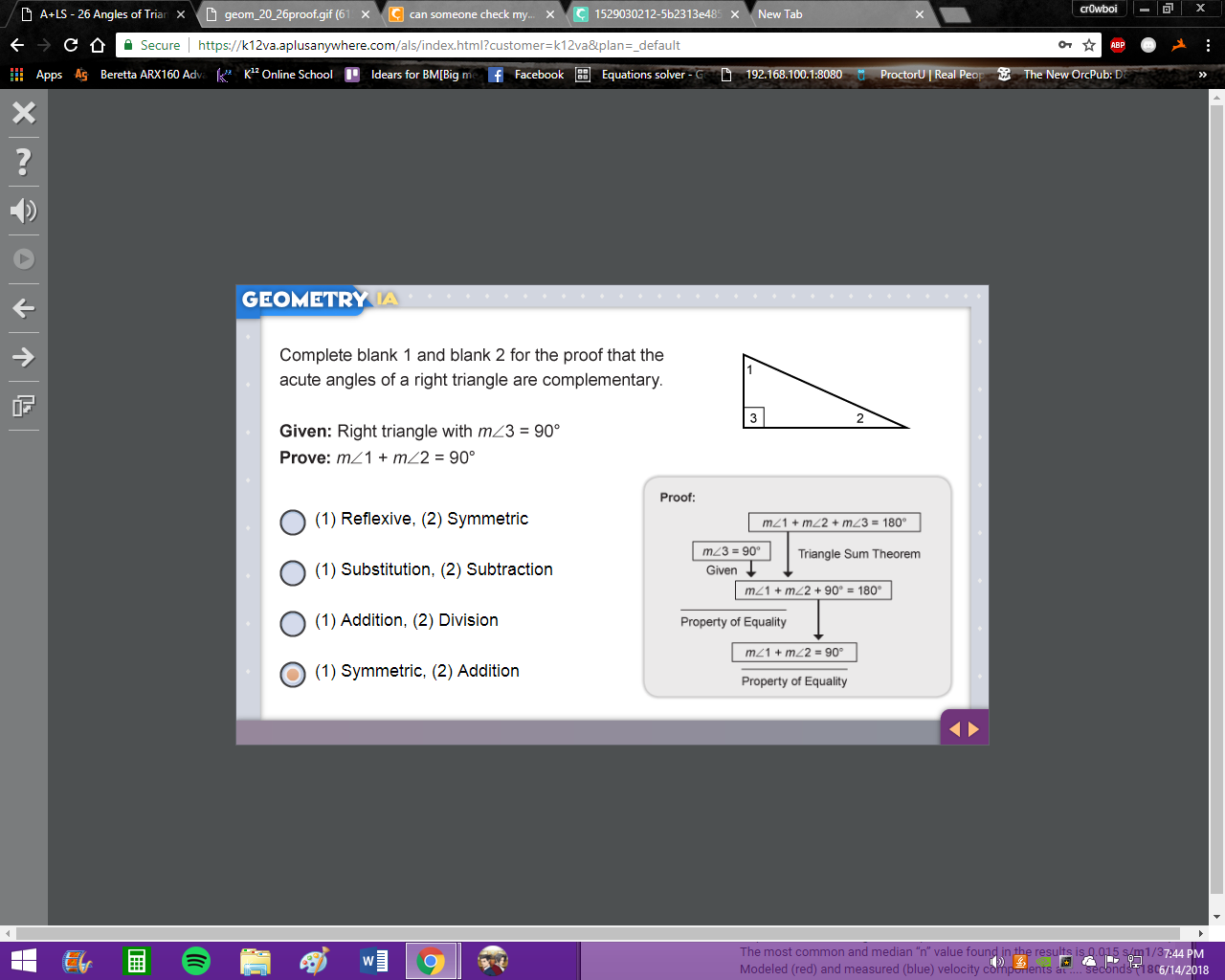
Well the first blank is wrong. What they did is combine the equations: 1. m<1 + m<2 + m<3 = 180 2. m<3 = 90 | | | | \/ m<1 + m<2 + 90 = 180 They replaced m<3 in the first equation with 90. That's called substitution.
mhchen:
And the second blank is wrong as well. To get from \[m<1 + m<2 + 90 = 180\] to \[m<1 + m<2 = 90\] You subtract 90 from both sides. So that would be subtraction.
princeevee:
oh, alright
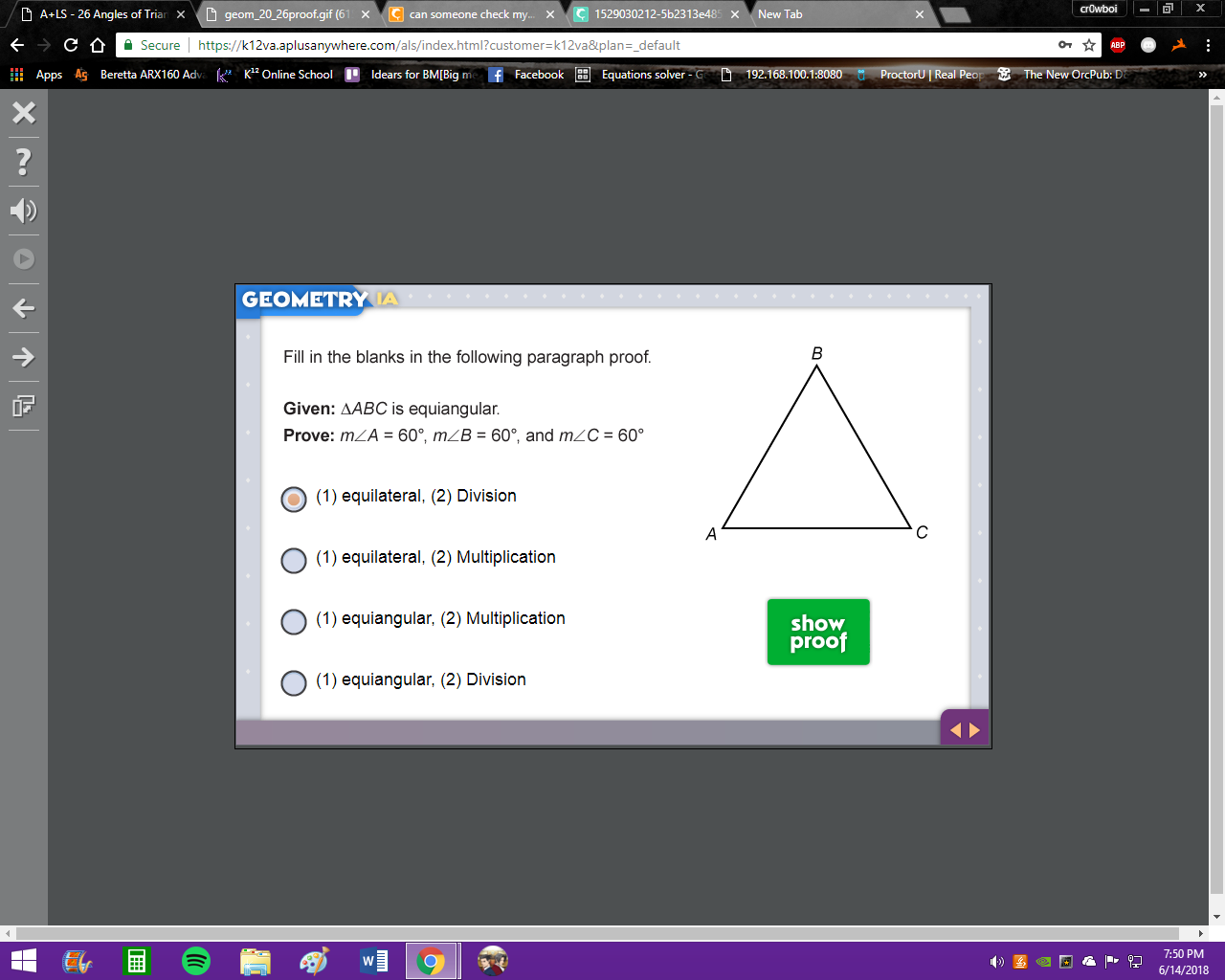 mhchen:
Er, I can't see the proof in that picture. But I'm going to say that you're wrong again xD. You're 'given' that it's equiangular, and you should always use the 'given' a the beginning of proofs. So the first blank is equiangular. The second blank is division since you know that all the angles in a triangle add up to 180. If you divide 180 by 3, because there's 3 angles, all the angles become 60. So it'll be division.
princeevee:
oh, sorry
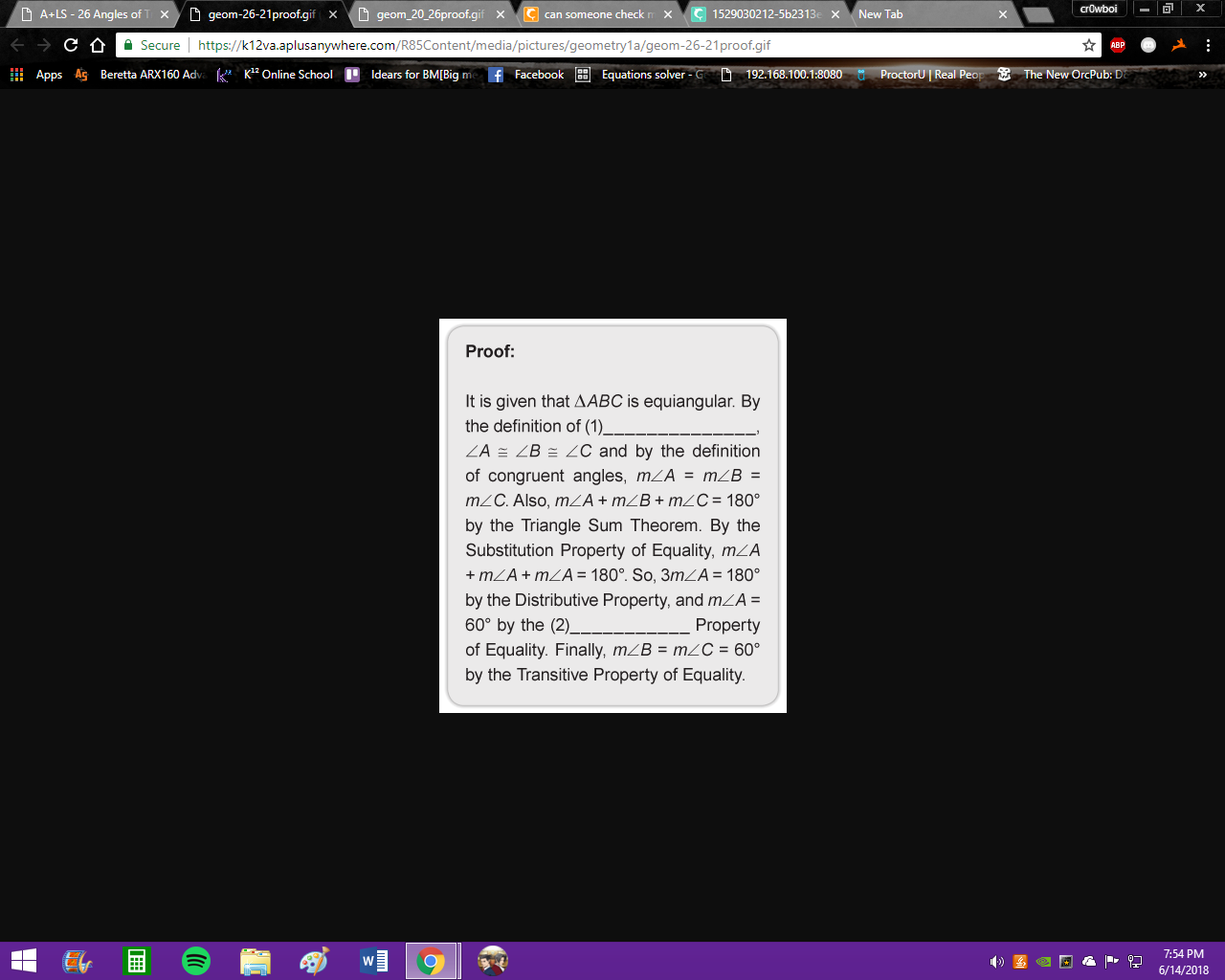 mhchen:
The first blank is equiangular. Equiangular just means that every angle is the same. <A = <B = <C The second blank is talking about how they got from 3m<A = 180 to m<A = 60 Do you know what 'property of equality' they used to do that?
princeevee:
division?
mhchen:
yep
mhchen:
So it'll be the Division property of equality
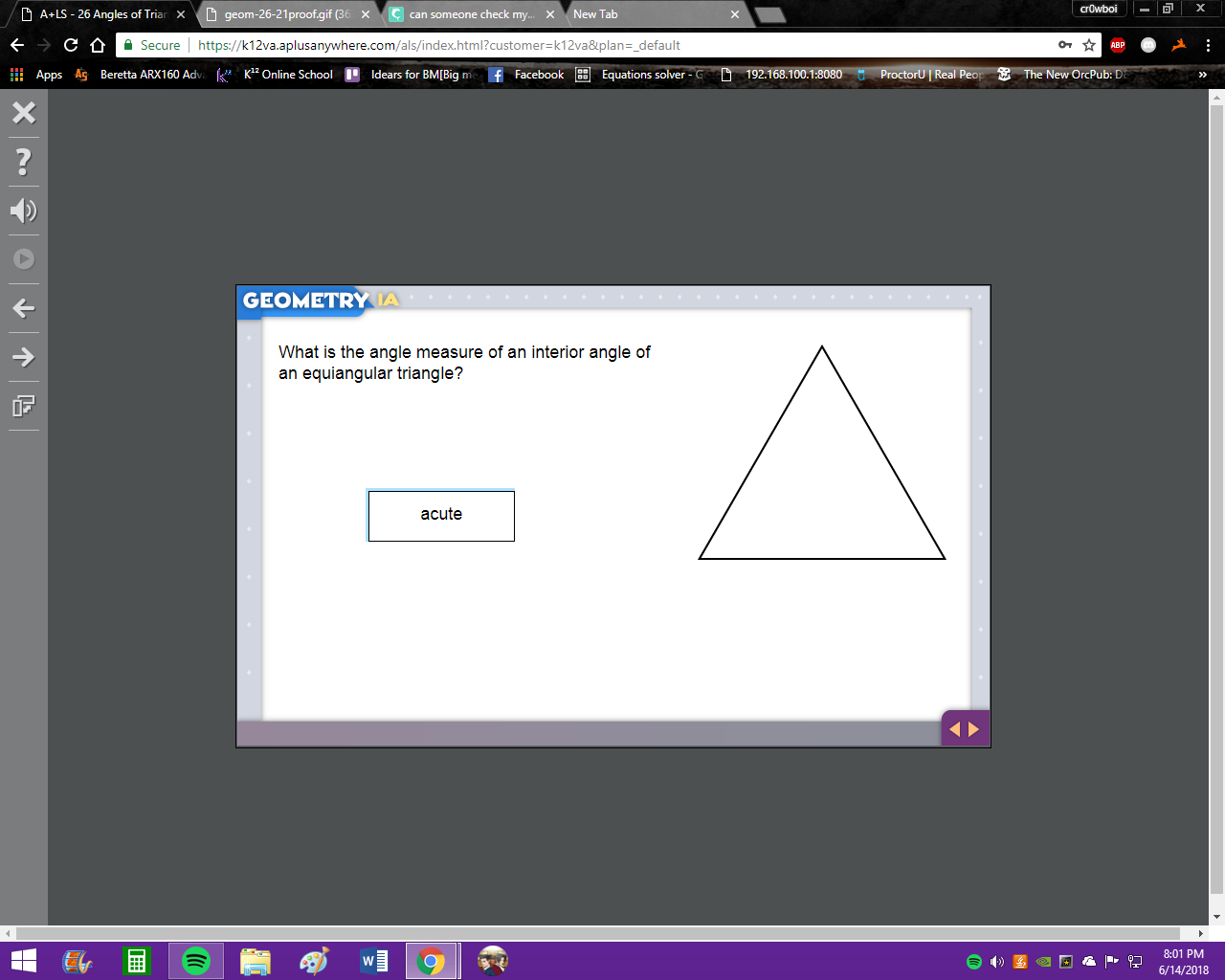 mhchen:
Well...it is acute since it's less than 90. Buuuut the question asks for an angle measure, so it should be a number.
princeevee:
then 60.
princeevee:
then 60.
mhchen:
yeah
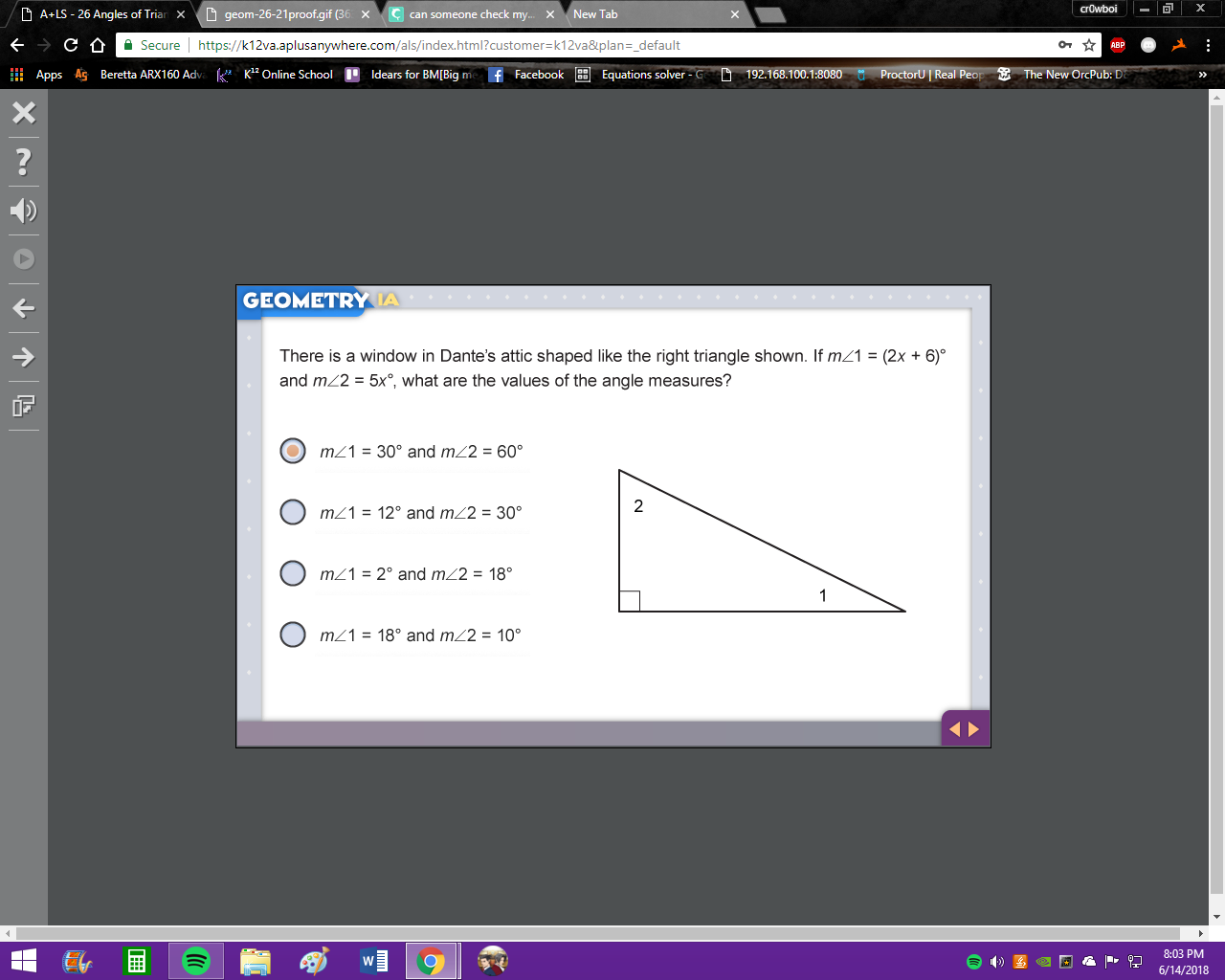 mhchen:
Yep. That's correct.
 mhchen:
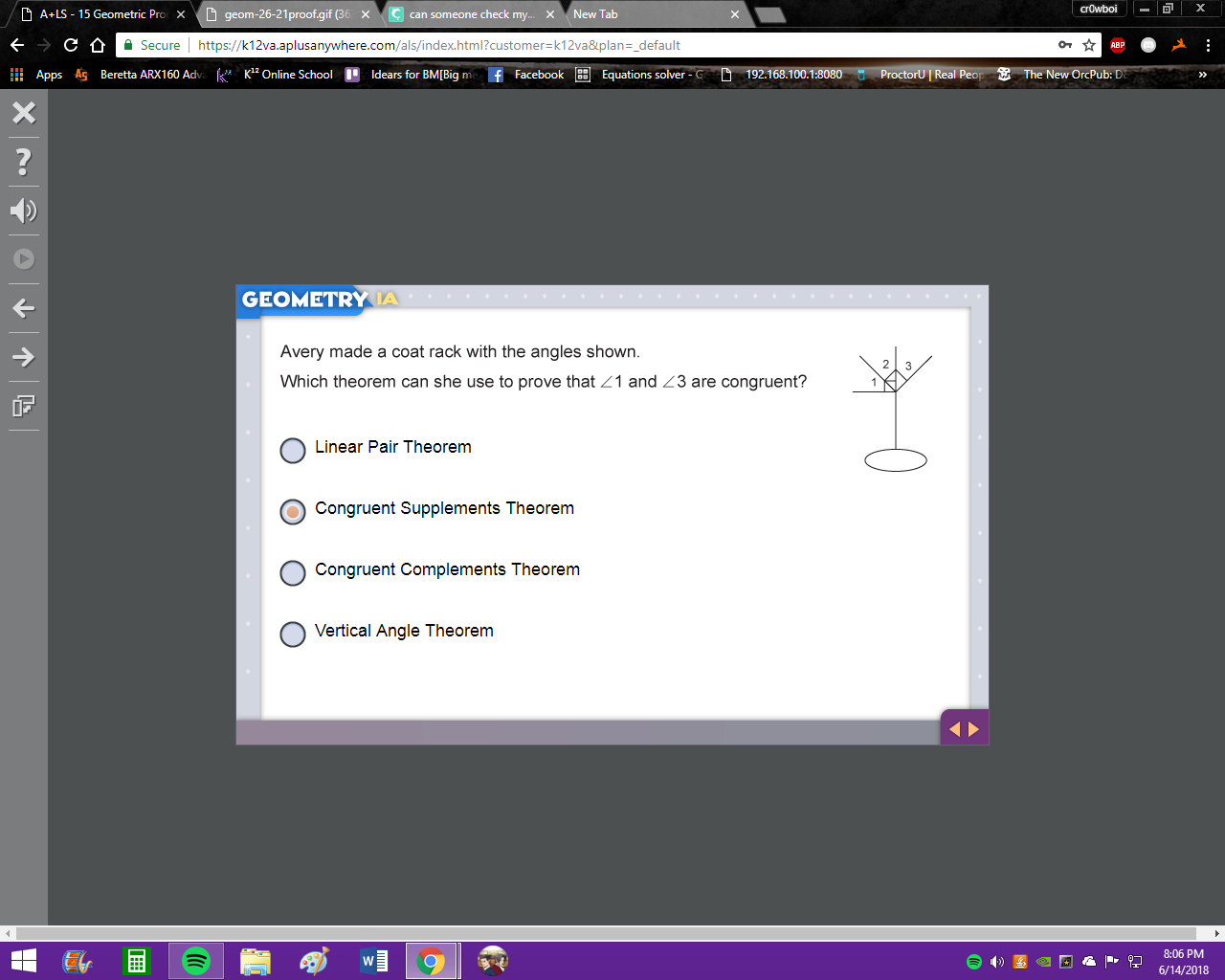
Congruent Supplements Theorem is like this: |dw:1529032199502:dw| It uses angles that add up to 180. But your question has angles that adds up to 90. so we use the Congruent Complements Theorem instead |dw:1529032296452:dw|
mhchen:
Basically anything that says 'supplements' adds up to 180. A straight line. Anything that says 'complements' adds up to 90. A right-angle.
princeevee:
alright
 mhchen:
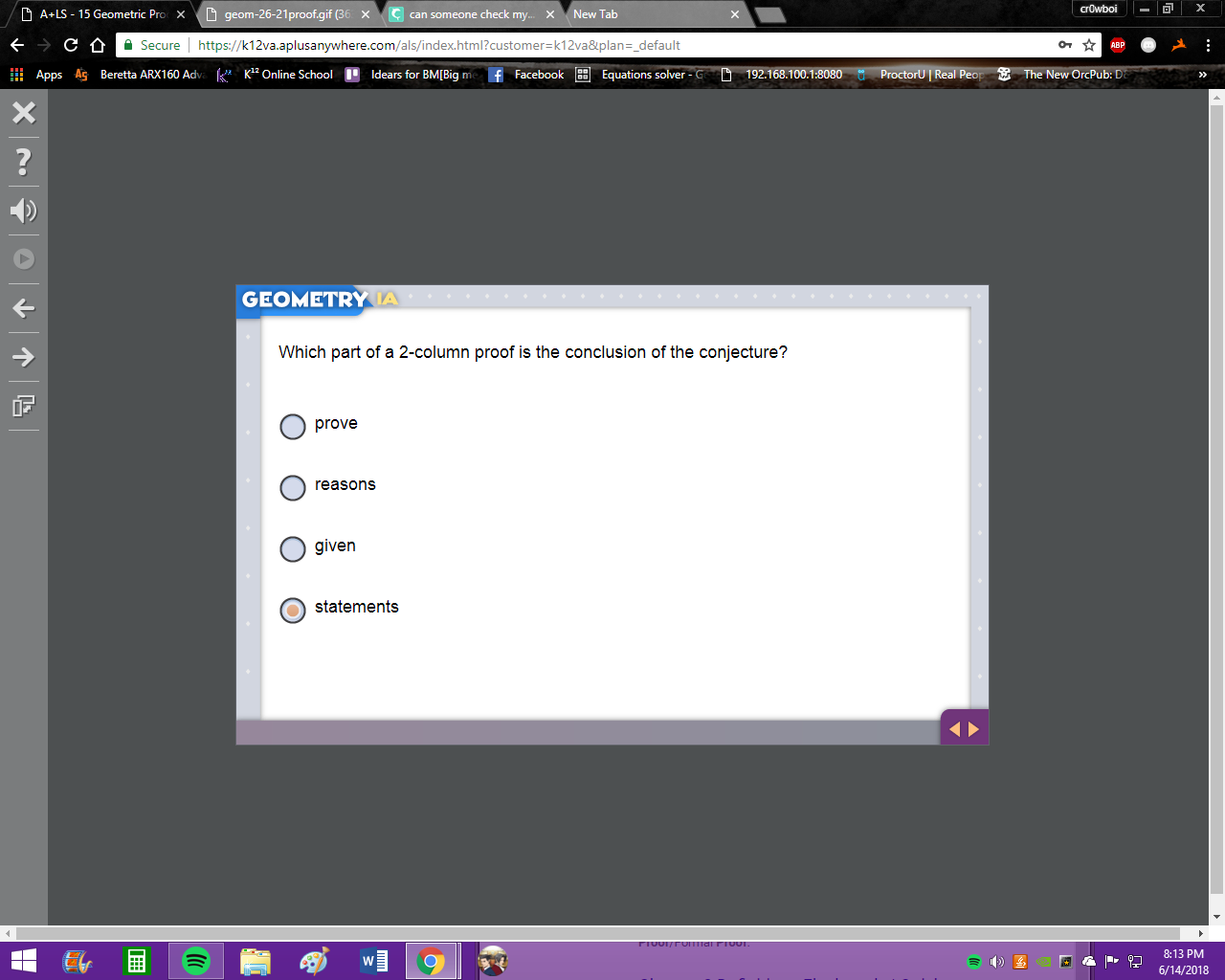
So the the conclusion is what you get at the very end. And when you prove something, the thing at the very is always the thing you're trying to 'prove'. So it would be 'prove' instead. Statements only lead to the conclusion.
 mhchen:
yep
 mhchen:
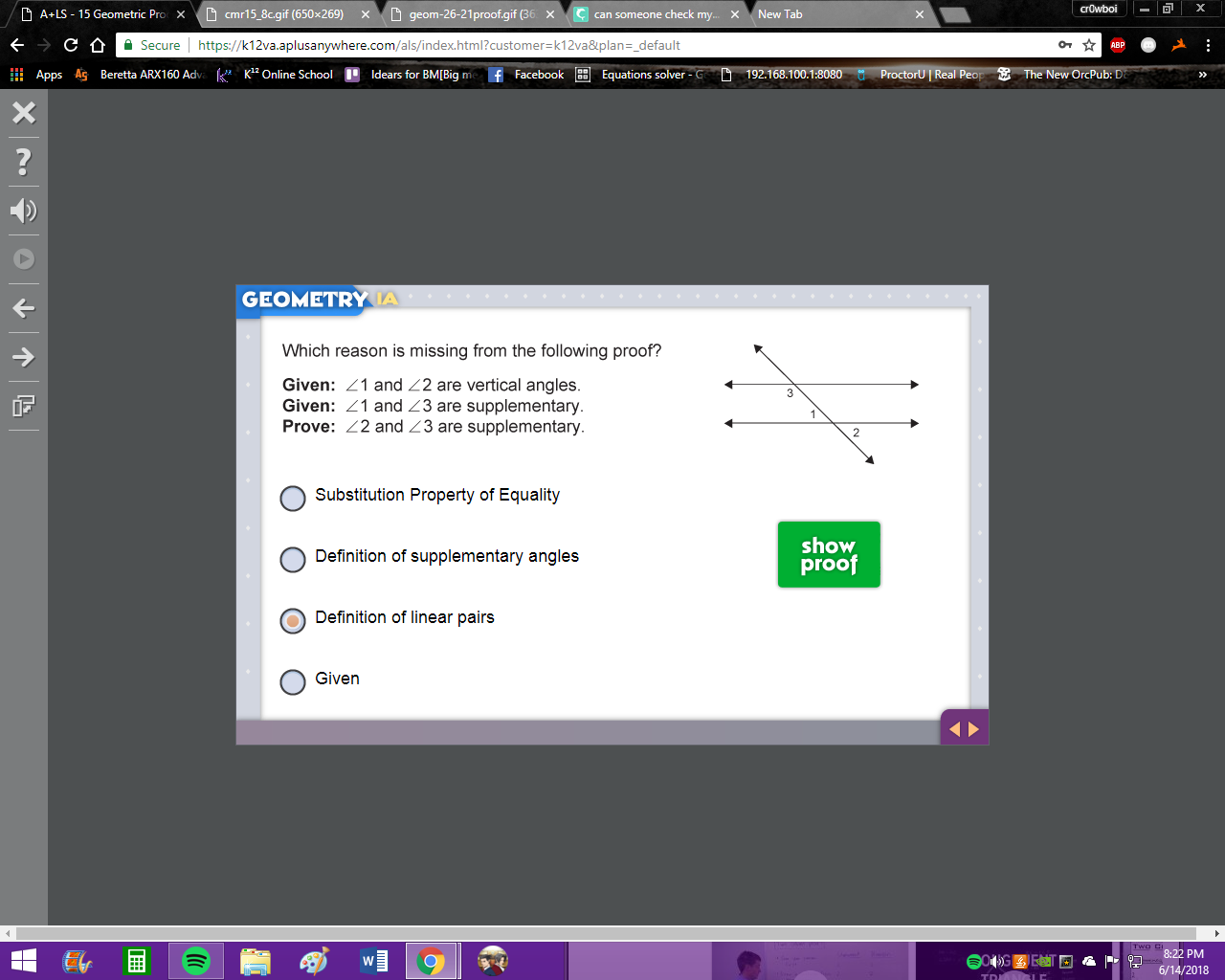
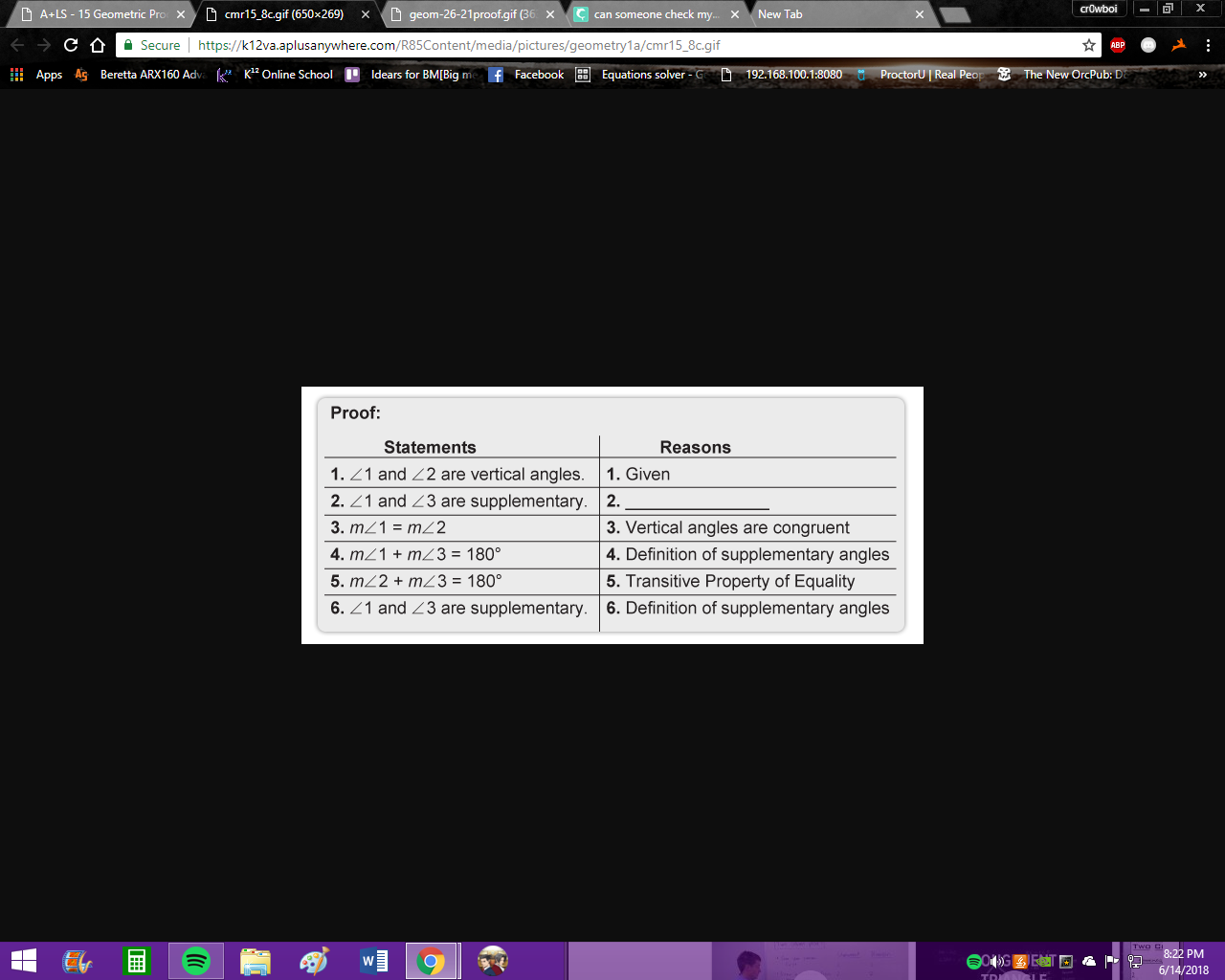
It says 'Given: <1 and <3 are supplementary' So that's given. Come on that should've been easy.
princeevee:
i'm r e a l l y not good at math...
mhchen:
ah well. Are there any more?
 mhchen:
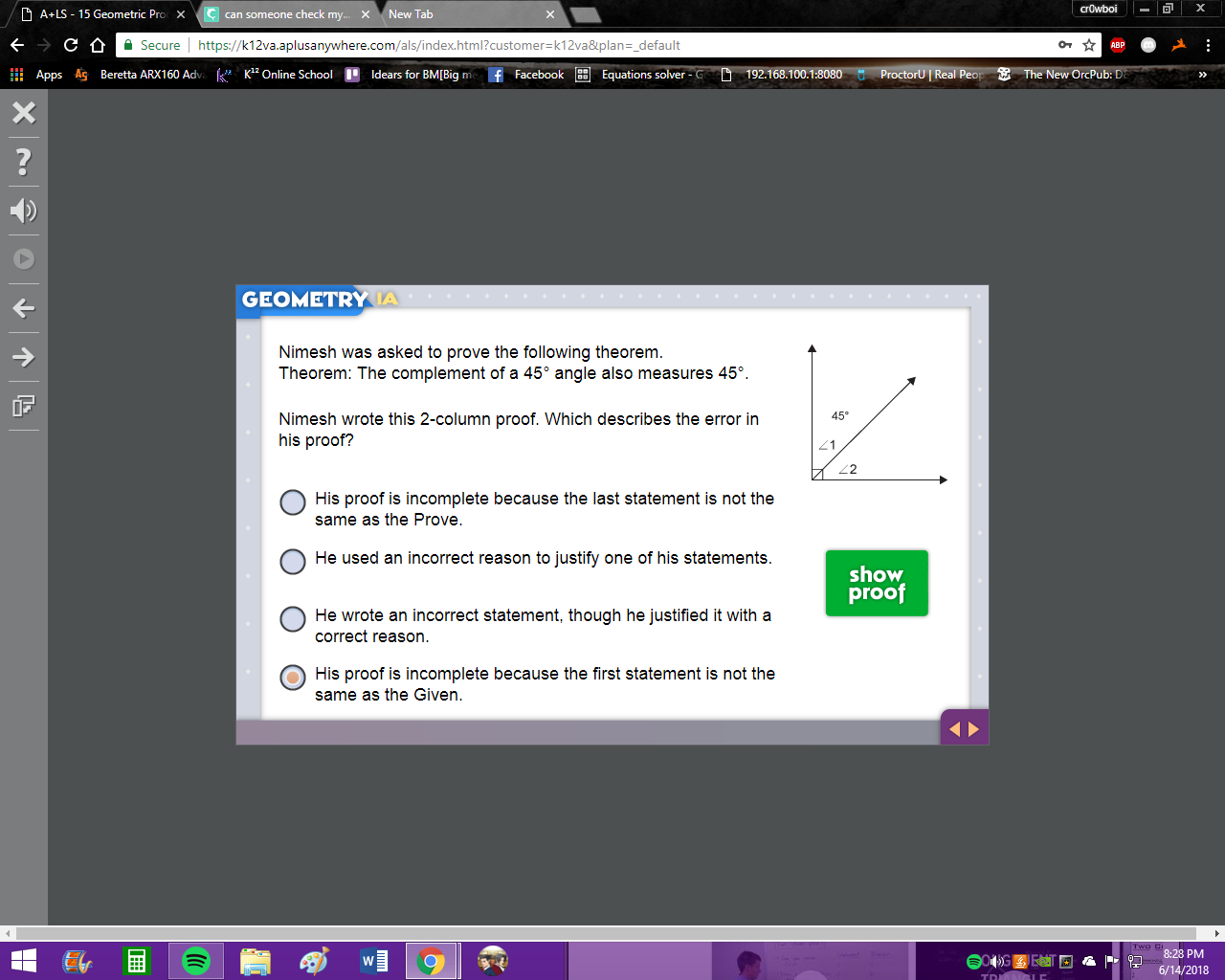
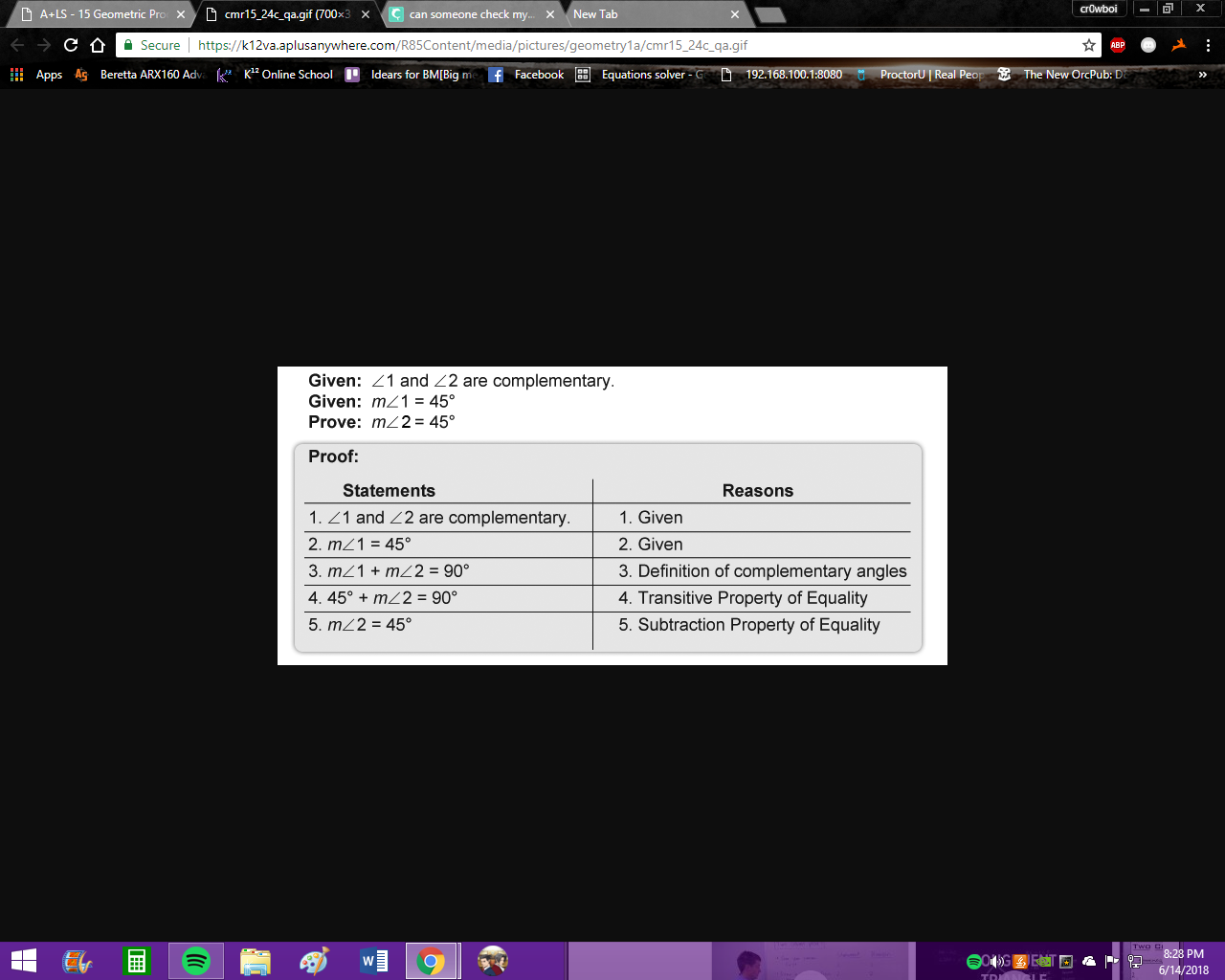
This one is a little harder probably. Look what he did at line 4. 45 + m<2 = 90 || Transitive Property of Equality This is actually Substitution Property of Equality cuz he replaced "m<1" with 45 in "m<1" + m<2 = 90 That's substitution, so it's an 'incorrect reason to justify his statement.'
 mhchen:
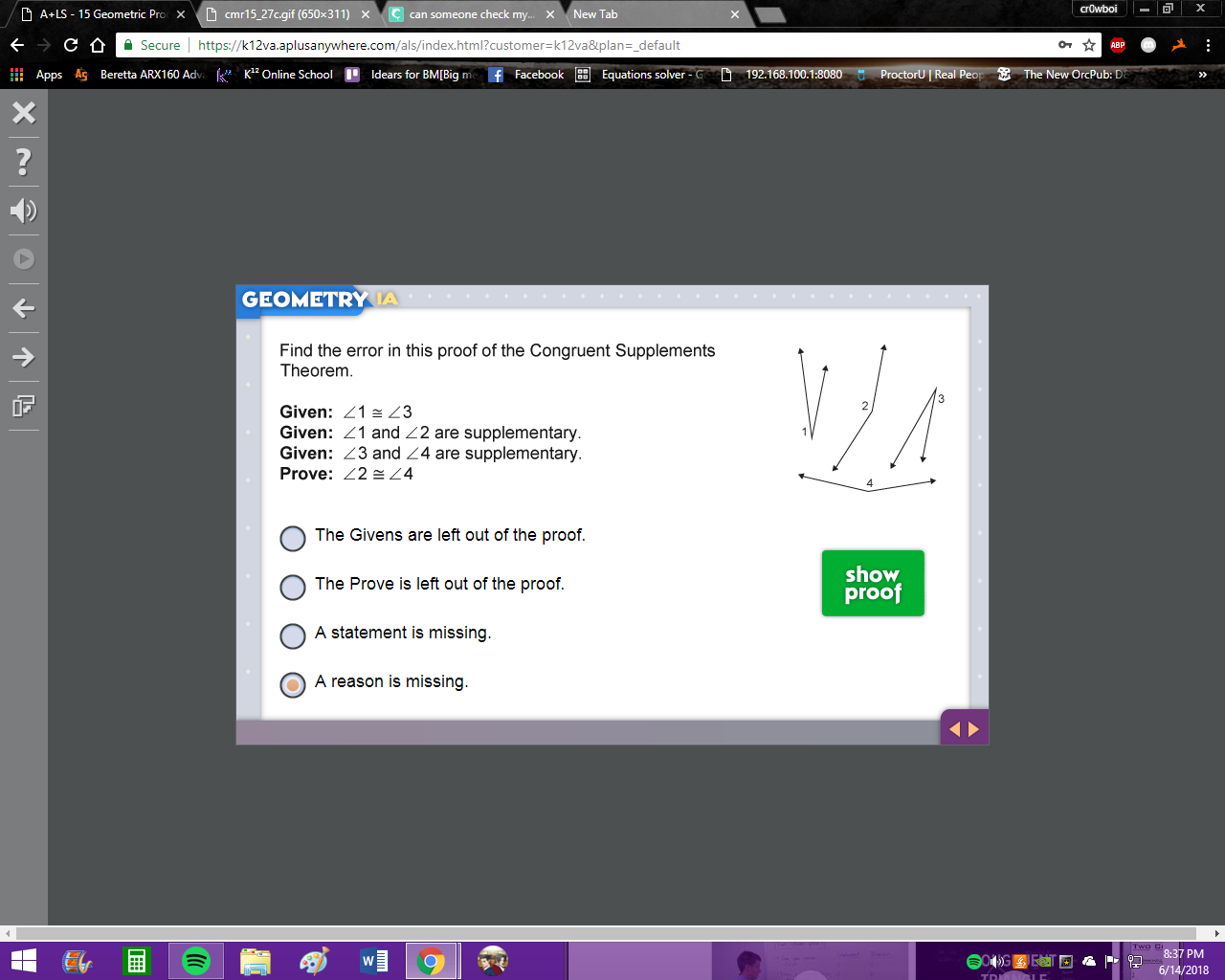
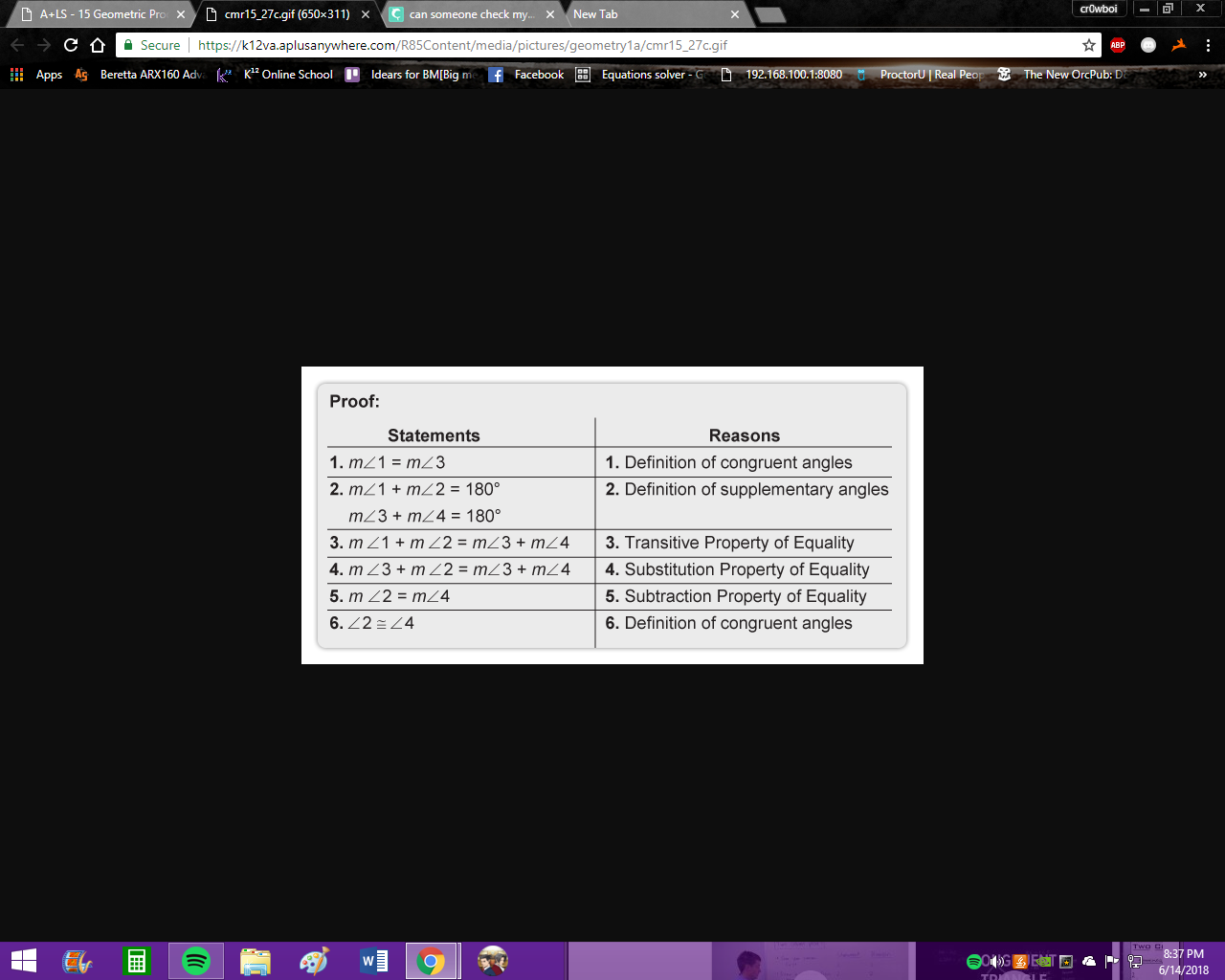
Actually there's not a single 'Given' in the proof. Every proof should start with a the givens.
mhchen:
Bro I'm pretty tired now. I don't think I can help much longer.
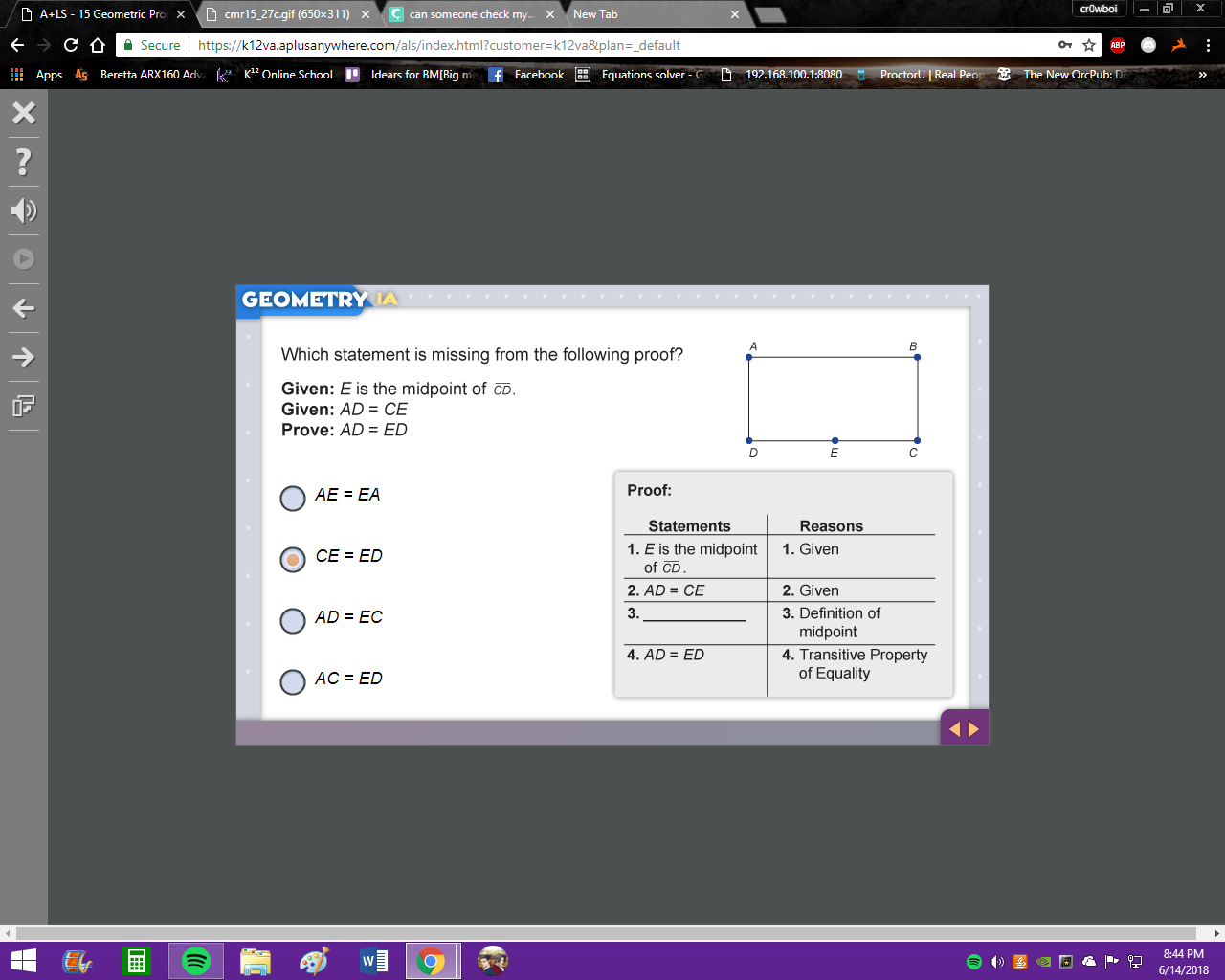 princeevee:
oh, alright then.
mhchen:
I'll help with this last one
mhchen:
And yes you are correct
Join our real-time social learning platform and learn together with your friends!
 KBaby:
Verse 1 We left our names in the dust of the driveway Watched the old town shrink
KBaby:
Lyrics Generator Use AI to write the lyrics for a song. Suggested Genres: Pop Hip
KBaby:
Verse 1 We left our names in the dust of the driveway Watched the old town shrink
KBaby:
Lyrics Generator Use AI to write the lyrics for a song. Suggested Genres: Pop Hip

 aitexturegenerator:
How are you all handling AI-generated textures for 3D models and game assets without losing the hand-made feel? I've been doing a small stylized environment
aitexturegenerator:
How are you all handling AI-generated textures for 3D models and game assets without losing the hand-made feel? I've been doing a small stylized environment

 Demon25:
Woke up feeling like that girl and that dude well he still aint crap pluse the du
Demon25:
Woke up feeling like that girl and that dude well he still aint crap pluse the du
 playtsec:
how do I get rid of stress from teachers... I just feel like running out the classroom and leaving on my own.
playtsec:
how do I get rid of stress from teachers... I just feel like running out the classroom and leaving on my own.
 JohnnyLFowler0812:
What type of gamer would play something and then get off for a while. Why not sta
JohnnyLFowler0812:
Which is better? Metallica Rap Country R&B hiphop Medal Gospel Chill Which 3 opti
JohnnyLFowler0812:
What type of gamer would play something and then get off for a while. Why not sta
JohnnyLFowler0812:
Which is better? Metallica Rap Country R&B hiphop Medal Gospel Chill Which 3 opti