
 princeevee:
i need some questions checked
 Mercury:
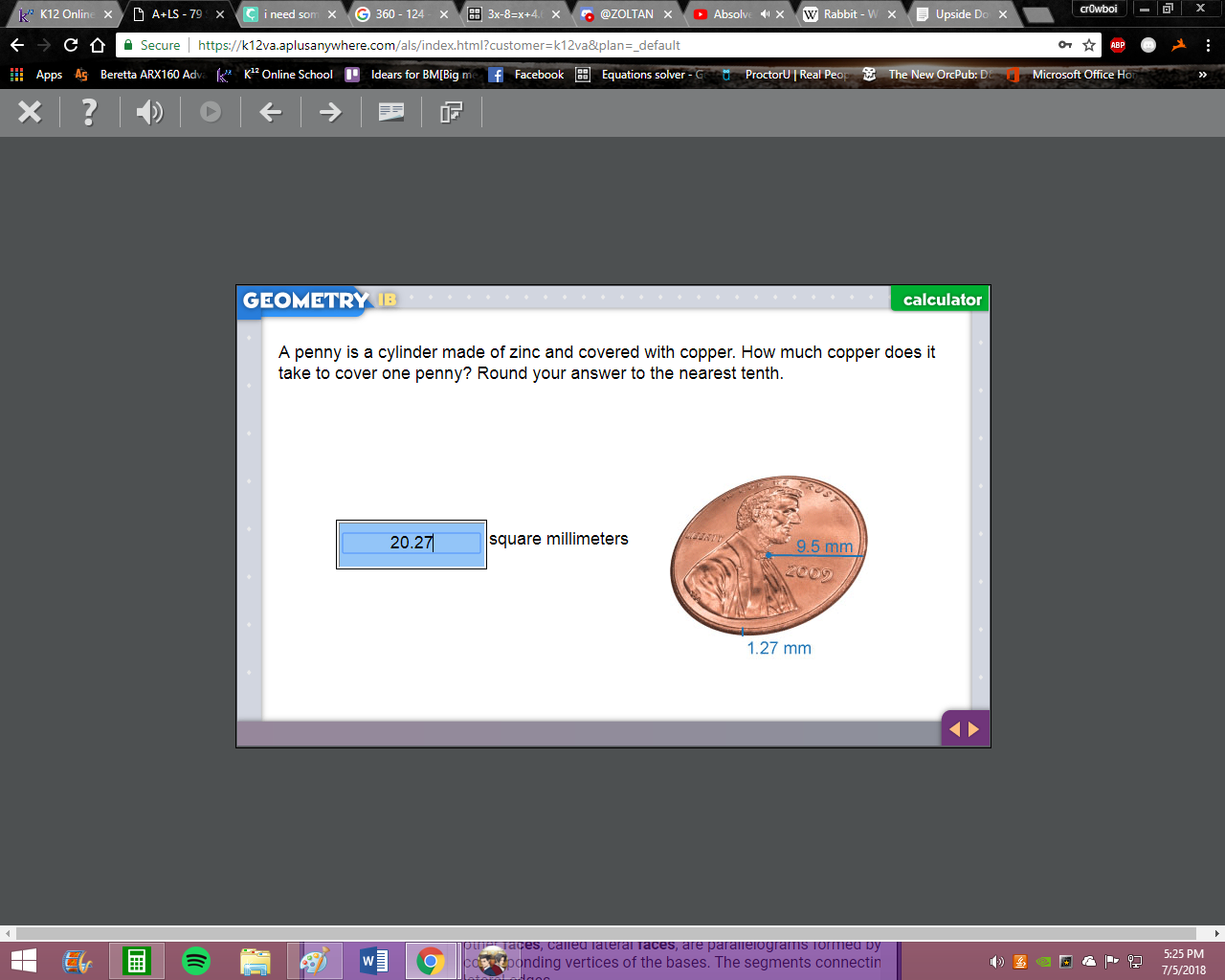
check your calculations again volume of a cylinder = pi * r^2 * h
princeevee:
90.25 for the radius
princeevee:
1.27 for the height
Mercury:
the radius is just 9.5 not 90.25
princeevee:
643.3?
Mercury:
wait a sec
Mercury:
it's asking for the surface area not volume (since the penny is only coated w/ copper) so the formula ends up being SA = 2*pi*r*h + 2*pi*r^2 plug in r and h
princeevee:
uh, can you plug those in real quick?
princeevee:
i gotta run a quick errand
Mercury:
r is 9.5 as stated before h is 1.27 SA = 2*pi*r*h + 2*pi*r^2 = 2*pi*1.27*9.5 + 2*pi*9.5^2
princeevee:
642.8
Mercury:
be careful with order of operations start by calculating 2*pi*9.5^2 and 2*pi*1.27*9.5 separately then add them together
Mercury:
plug 2*pi*9.5^2 into a calculator and write the result down plug 2*pi*1.27*9.5 into a calculator and write the result down then add them together
princeevee:
567 and 75.8
Mercury:
ugh apparently I had the wrong thing typed in anyway 2*pi*9.5^2 + 2*pi*1.27*9.5 becomes 642.86 which rounds up to 642.9 = your sol'n
 Mercury:
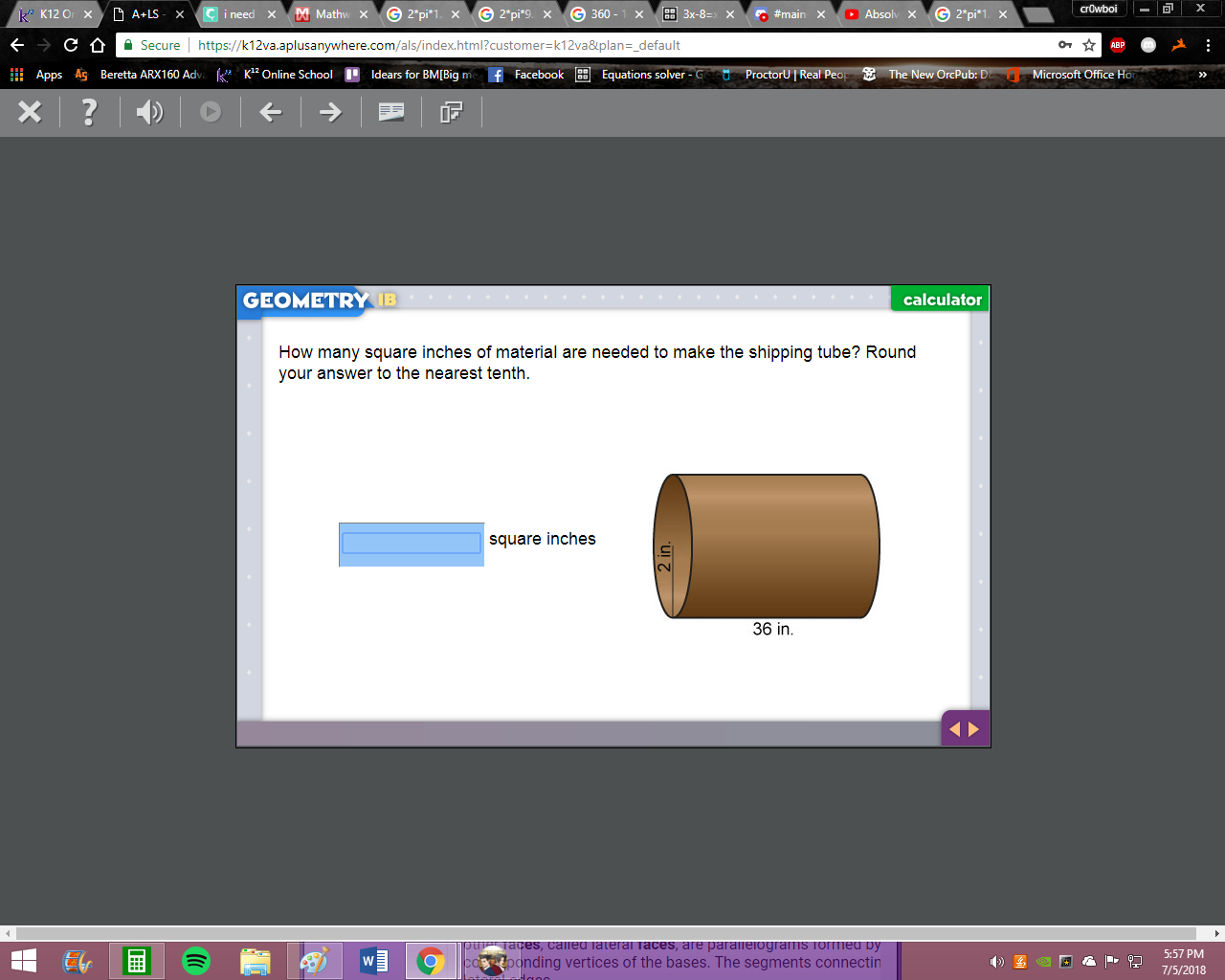
SA = 2*pi*r*h + 2*pi*r^2 again plug in r and h
princeevee:
477.5
Mercury:
good
 princeevee:
true?
Mercury:
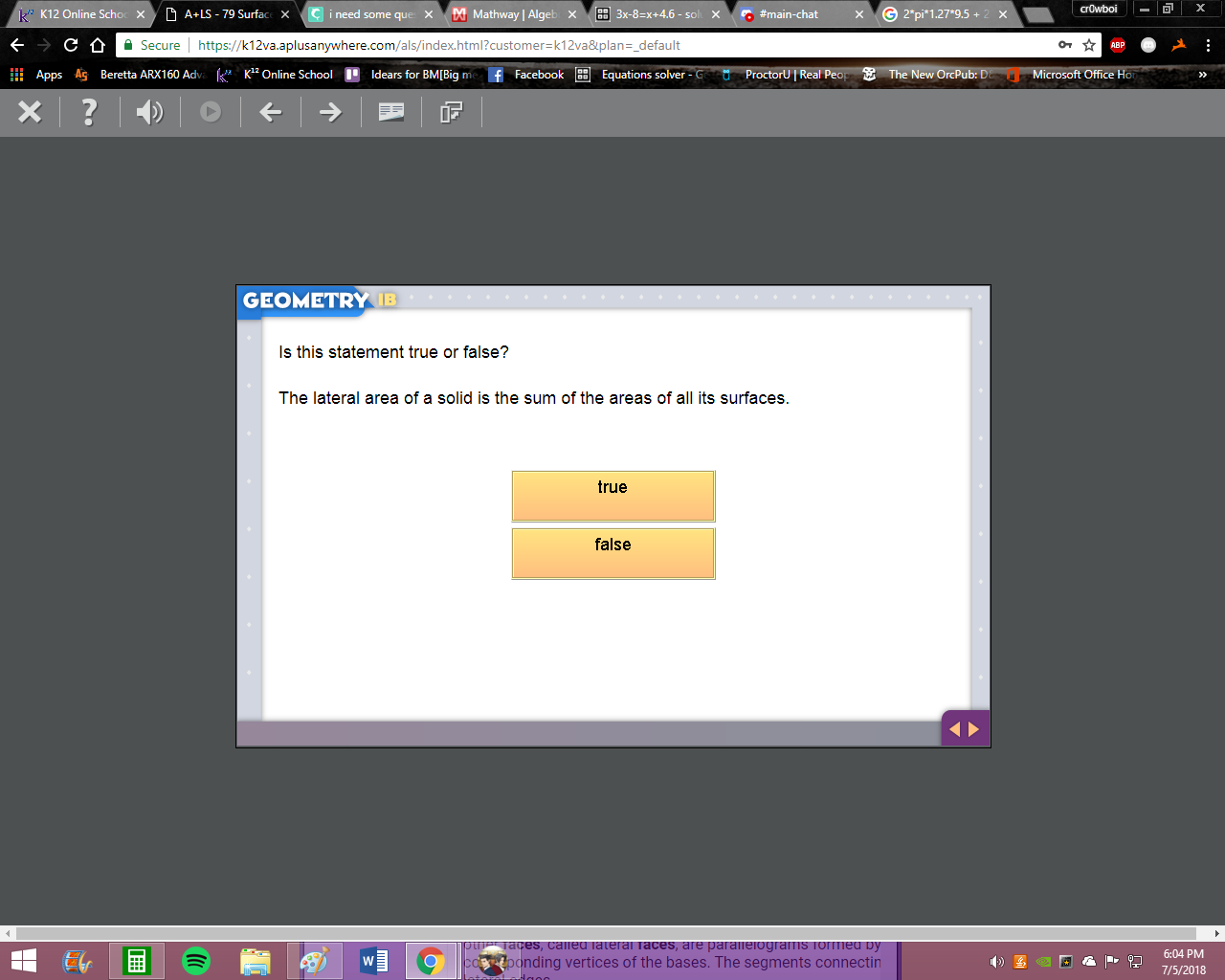
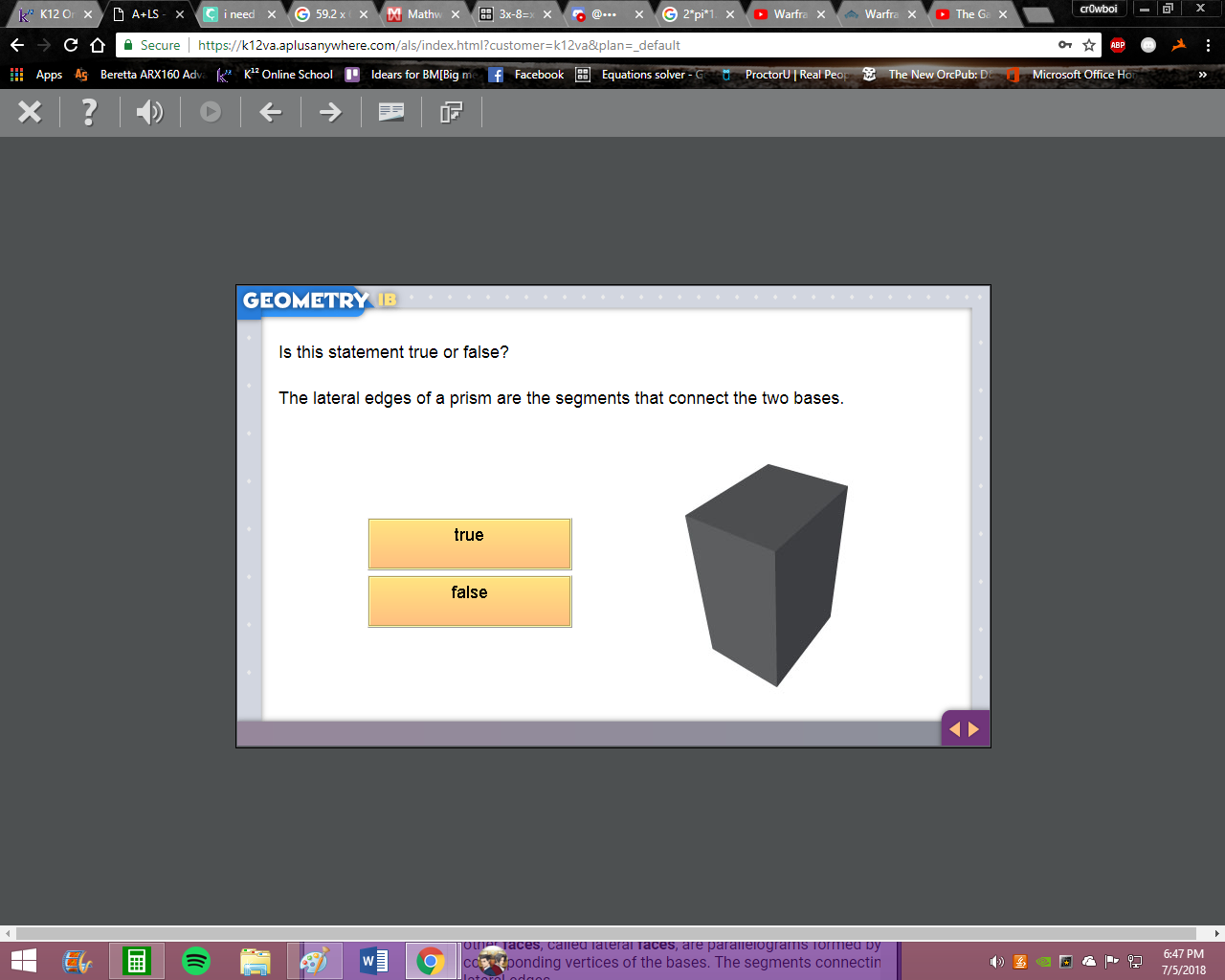
|dw:1530839227692:dw| this one is actually false, lateral area excludes the top/bottom bases
 princeevee:
so use the same equation for this, right?
Mercury:
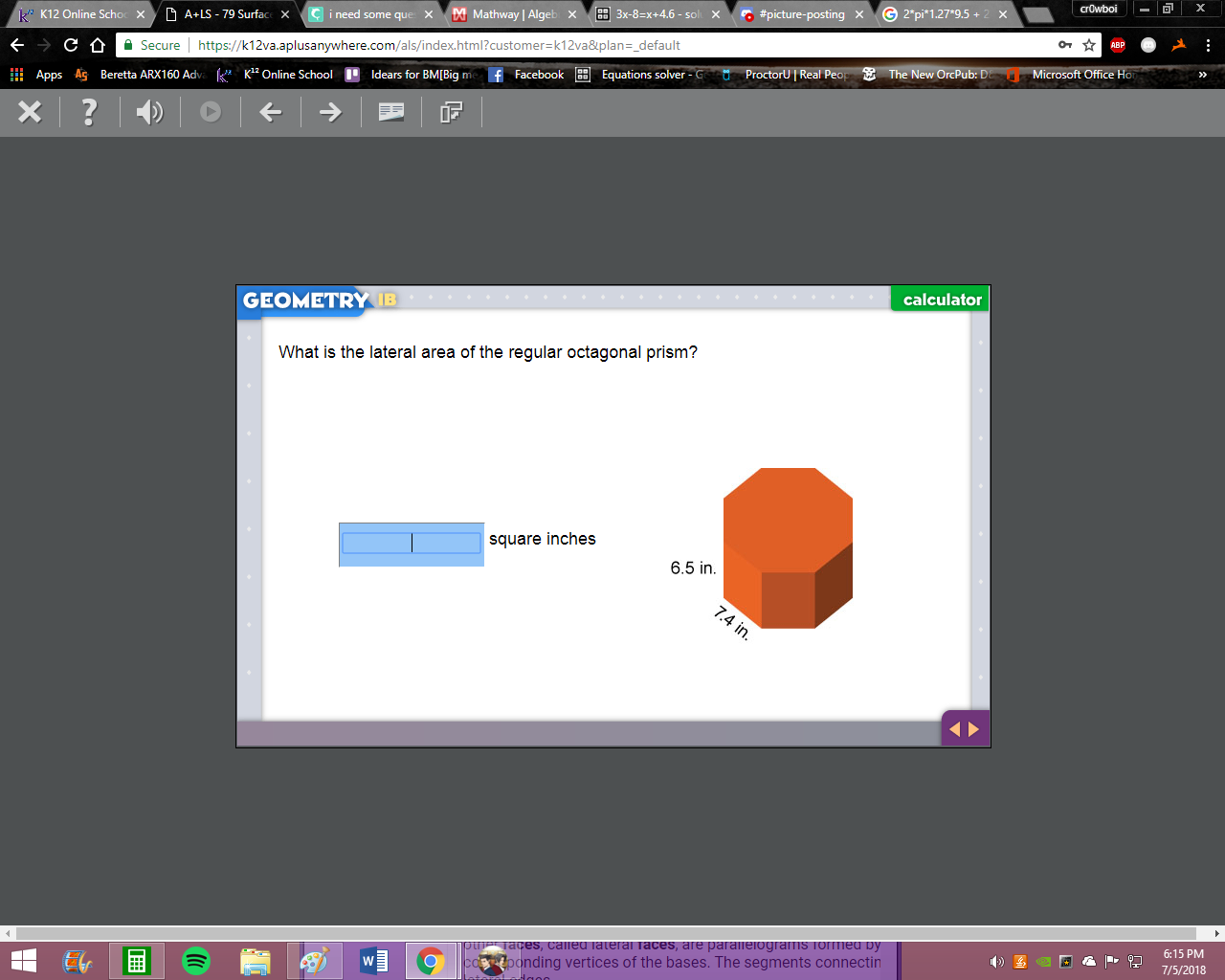
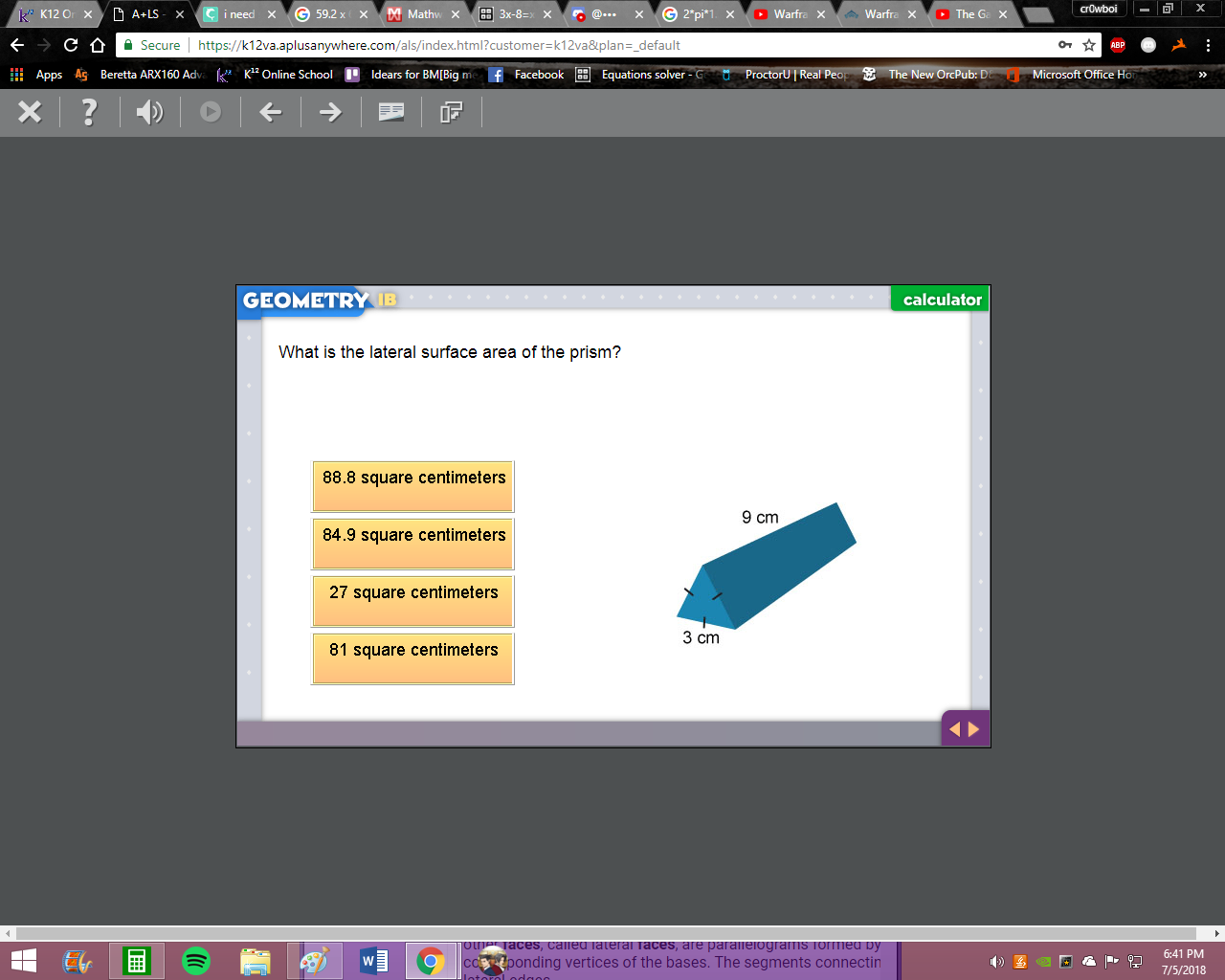
it's asking for lateral area not surface area so simply find the perimeter of the octagon and then multiply by the height
Mercury:
an octagon has eight equal sides so its perimeter is 8 * side length.
princeevee:
65.7
Mercury:
6.5 is the height and 7.4 is the side length
Mercury:
if 7.4 is the side length what is the perimeter?
princeevee:
6.5
Mercury:
\(\color{#0cbb34}{\text{Originally Posted by}}\) @Mercury an octagon has eight equal sides so its perimeter is 8 * side length. \(\color{#0cbb34}{\text{End of Quote}}\)
Mercury:
the side length as we established is 7.4 therefore perimeter = 8*7.4 all that's left is to multiply by the height 6.5.
princeevee:
384.8
Mercury:
good so that's your solution
 princeevee:
D?
Mercury:
good
 princeevee:
true?
Mercury:
good
 Mercury:
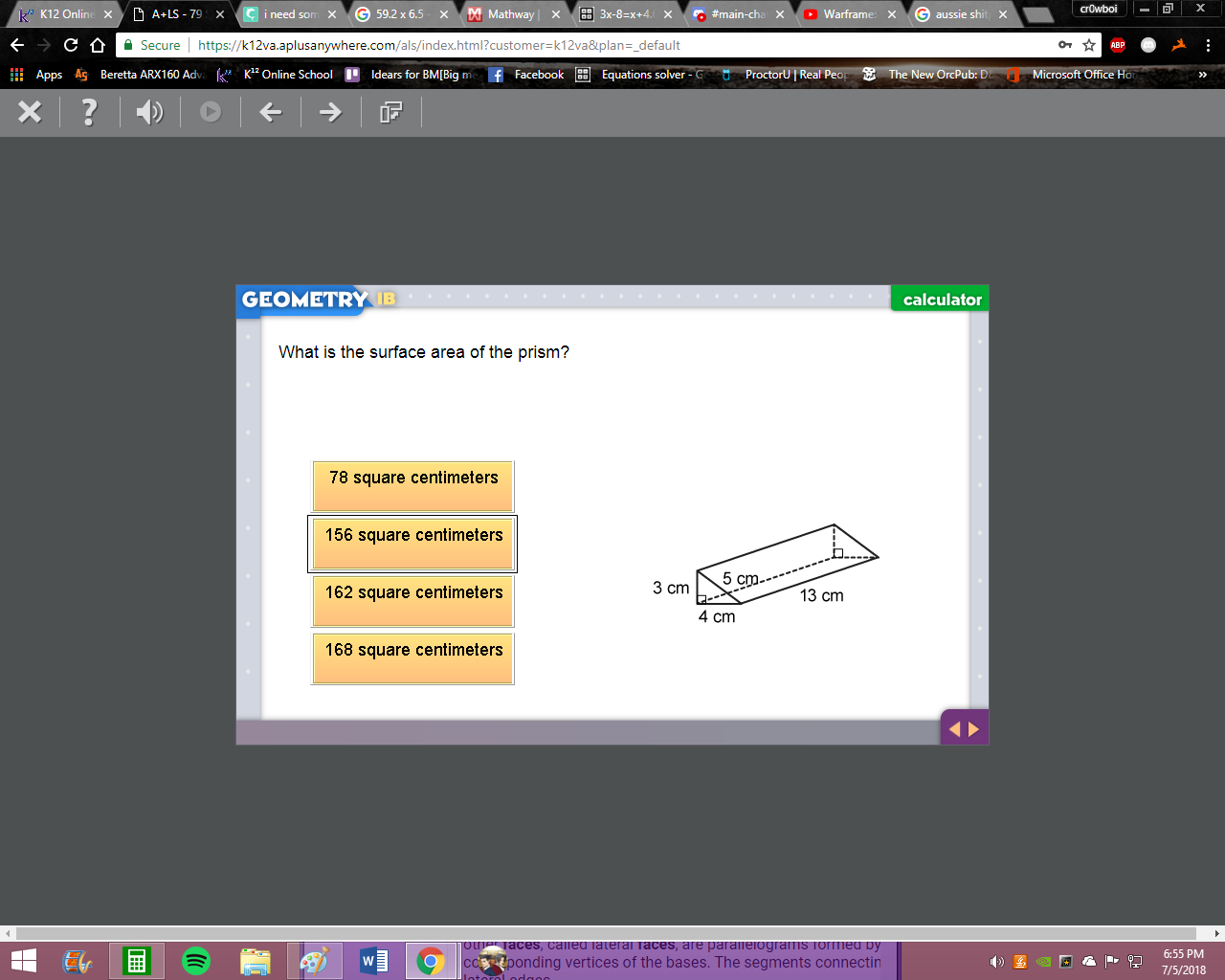
check your calculations again let's start with the two triangle sides. height 3, base 4, what's the combined area of both triangles?
Mercury:
remember the formula for the area of a triangle is (1/2)bh.
princeevee:
6
Mercury:
good but we want to know the area of both triangles so double that to get 12 now let's look at the three remaining faces you have a rectangle with side lengths 5 and 13 a rectangle with side lengths 4 and 13 and a rectangle with side lengths 3 and 13 calculate the sum of these areas
princeevee:
i got it now
 Mercury:
still working i keep getting something that's not one of the choices
Mercury:
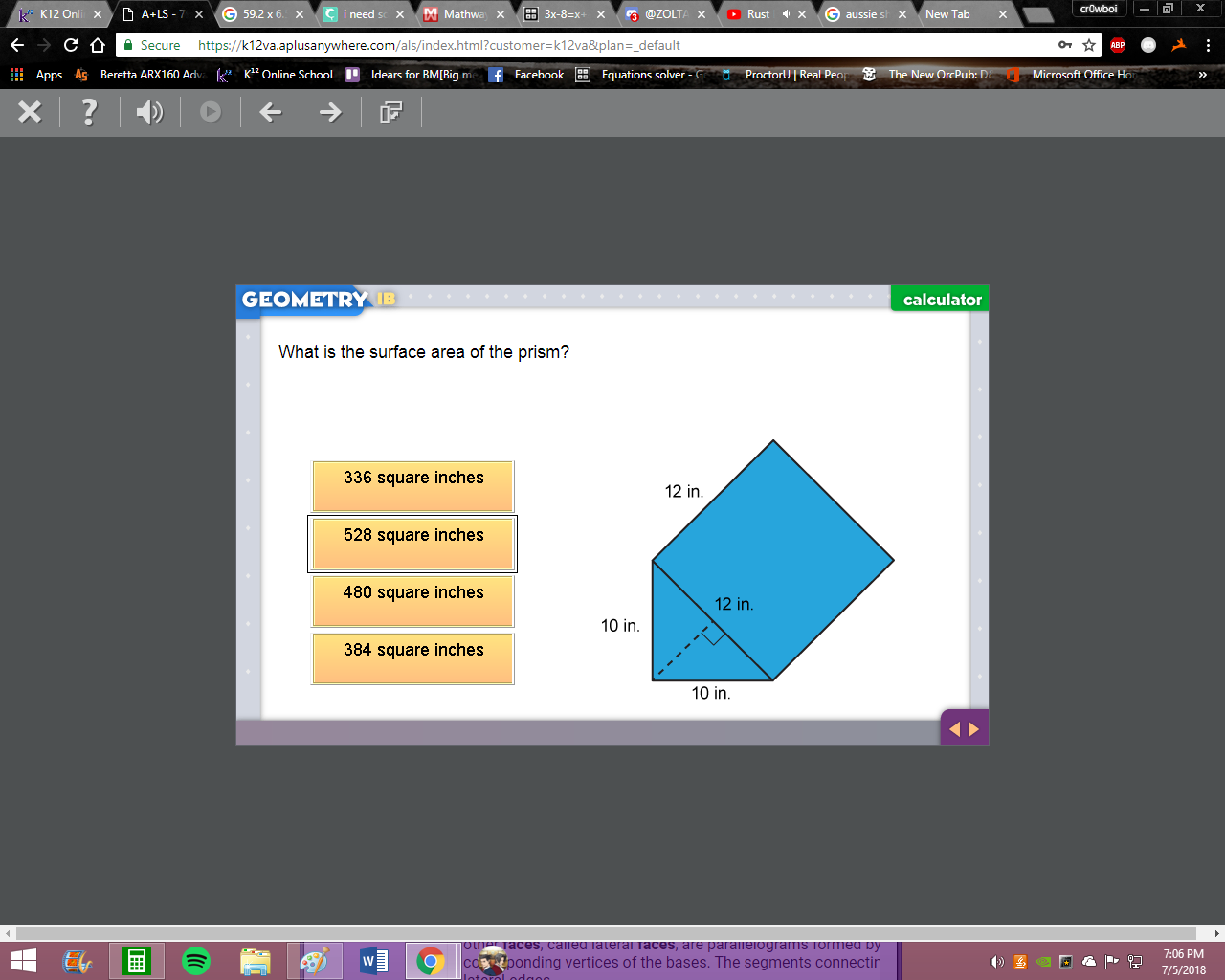
alright finally figured out where i was going wrong you need to calculate the height of the triangle on the dotted line so its a right triangle with hypotenuse 10 and leg 12/2 calculate the other leg
princeevee:
i'm getting confused now...
Mercury:
|dw:1530843652728:dw|
Mercury:
|dw:1530843684338:dw|
Mercury:
check the circled triangle notice how you have a right triangle with leg 6 and hypotenuse 10 calculate the length of the other leg.
princeevee:
like, 4?
Mercury:
use the Pythagorean theorem
princeevee:
136
Mercury:
leg^2 + leg^2 = hypotenuse^2 plug in the hypotenuse, leg, and solve for the other leg
Mercury:
leg = 6 hypotenuse = 10 6^2 + leg^2 = 10^2 solve for leg.
princeevee:
8
Mercury:
good so 8 gives us the height of the triangle we already know the base is 12 so area = (1/2)bh = (1/2)8*12 we have two triangles so just double that to get 8*12 = 96, then we keep going w/ the other sides
Mercury:
we have one big side on the front that's 12 * 12 and two smaller rectangular sides that are 10 * 12 each so 12 * 12 + 2(10*12) + 96 from before = 480 = your solution
 Mercury:
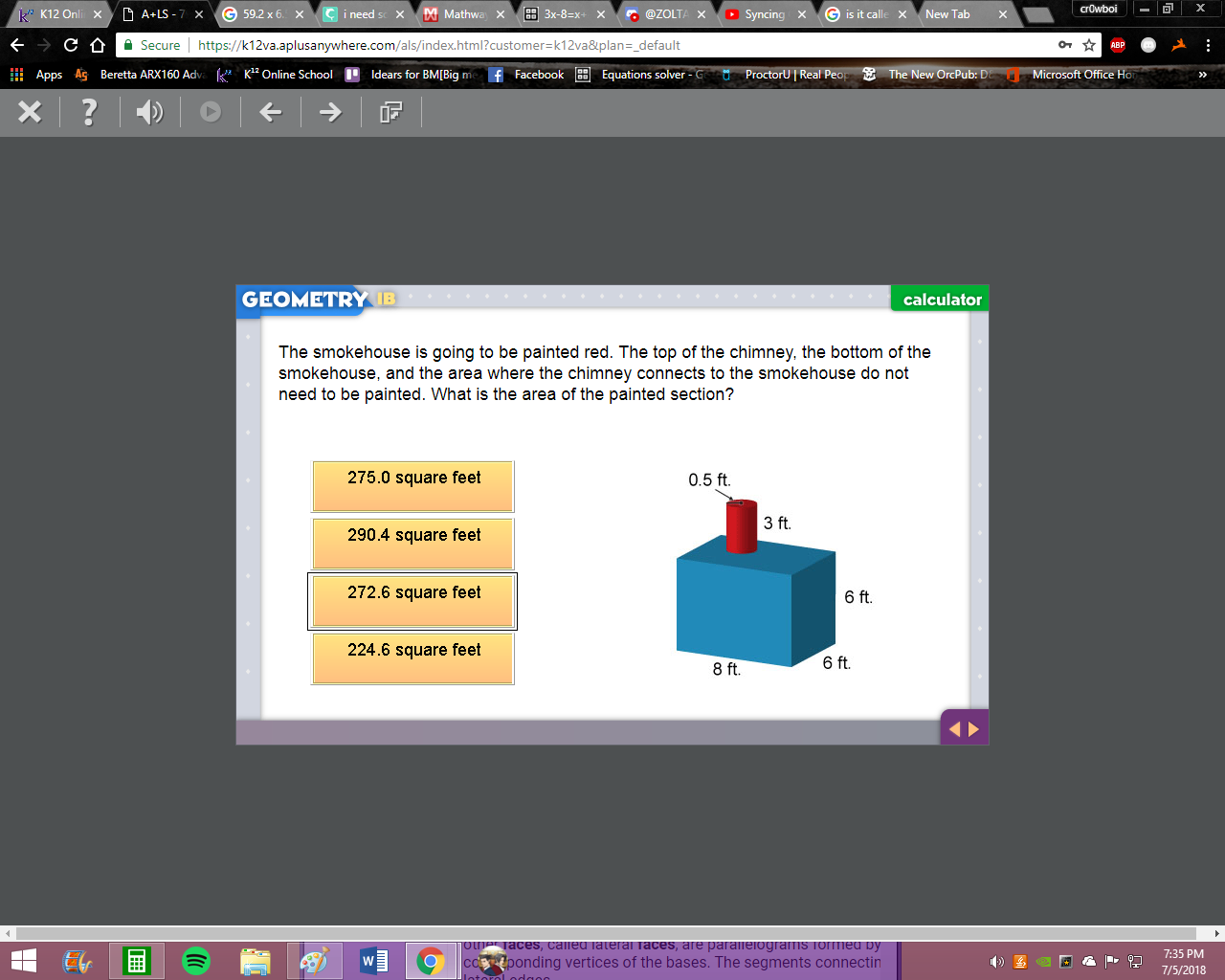
hm not quite let's check your calculations again let's start w/ the walls of the building two walls that are 8*6 and two walls that are 6*6 gives us 2(8*6) + 2(6*6)
Mercury:
then, we add the top which is another 8*6 side we subtract the area where the smokestack and ceiling touch so - (0.5)^2 * pi from that finally we add the painted area of the smokestack which is just 2*pi*r*h = 2*pi*0.5*3
Mercury:
putting it all together 2(8*6) + 2(6*6) + 8*6- (0.5)^2 * pi + 2*pi*0.5*3 = ?
Mercury:
for the sake of time after you plug this into a calculator it's 224.6 = your solution.
princeevee:
sorry, i'm not really working at full capacity today...
 princeevee:
@Mercury
Mercury:
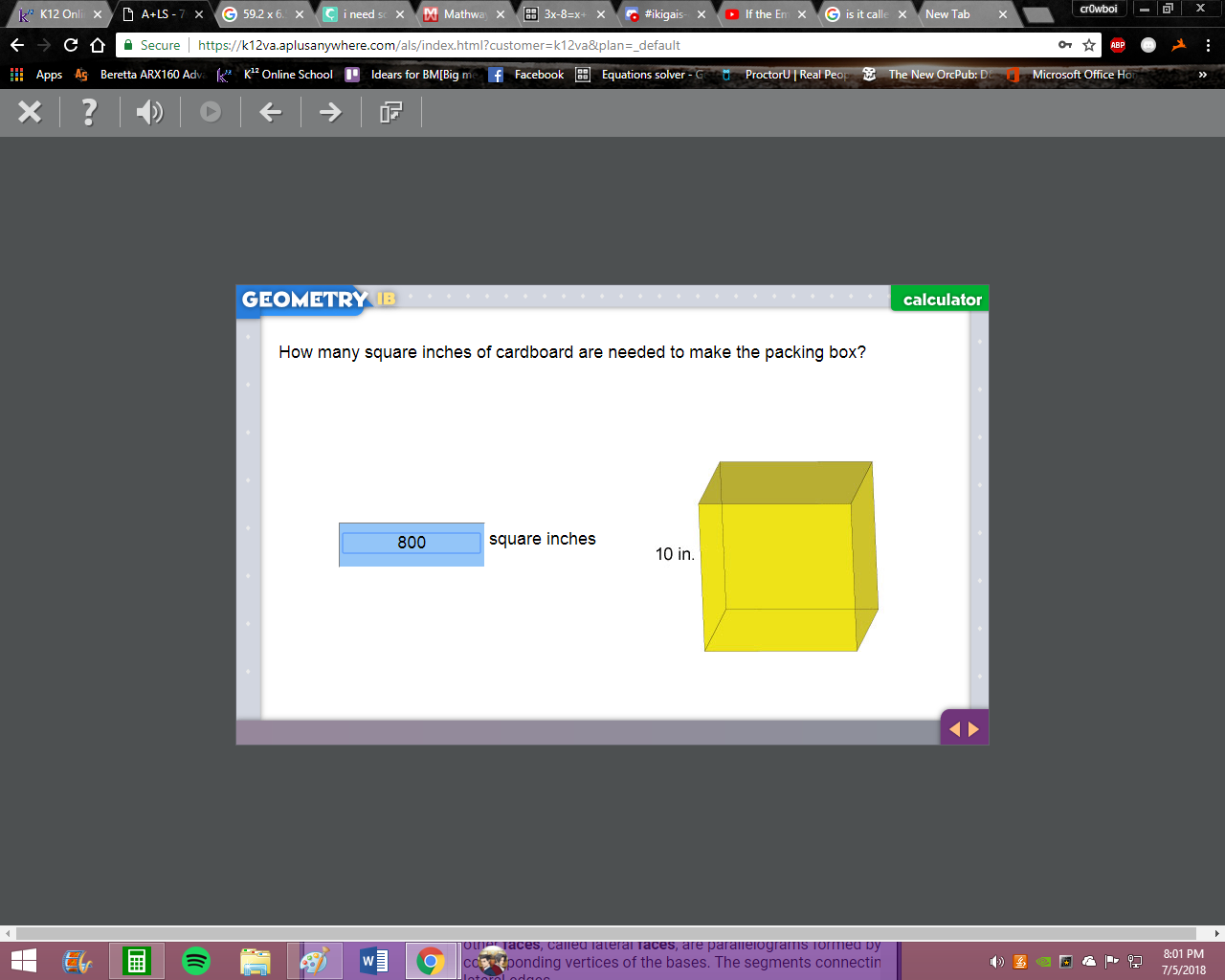
close but not quite the amt. of material to make a box is equal to its surface area a cube has 6 sides so 6 * area of each side
princeevee:
so it was just 60?
Mercury:
6*10*10 = 600 not 60
princeevee:
sorry
 Mercury:
let me ask someone b/c i'm not quite sure i understand what they're looking for
princeevee:
ok
Mercury:
alright i got it |dw:1530847398992:dw|
Mercury:
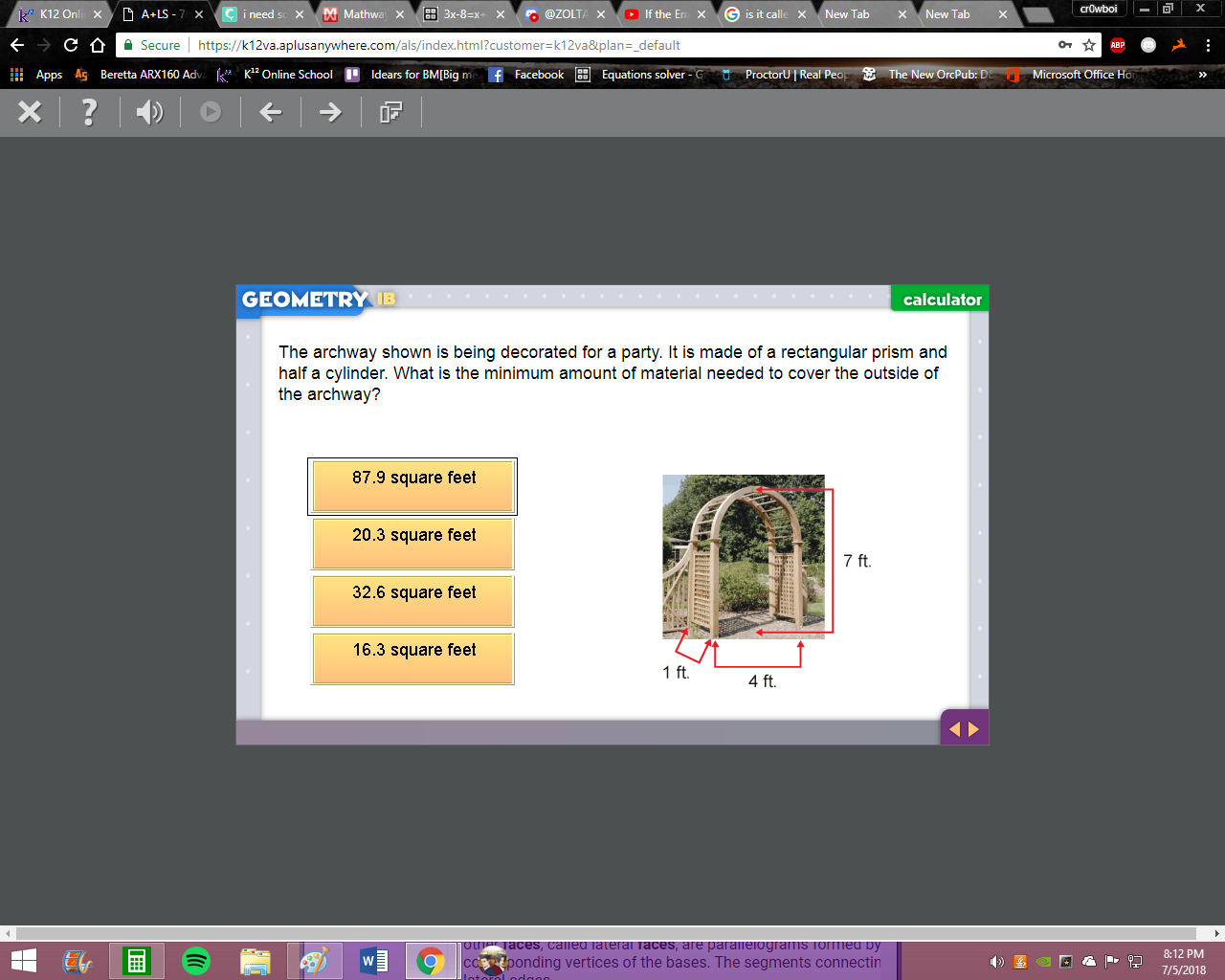
let's start w/ the semicircle circumference is 2pi*r as usual we only have half the circle so (1/2) * 2pi*r or just pi*r, or 2pi multiplying this by the thickness of the arch (1ft) just gives us 2pi * 1 for the semicircular part
princeevee:
wait, is r 4 or 7?
Mercury:
|dw:1530847535136:dw|
Mercury:
notice how the top part of the arch has diameter 4 as shown in the original picture so the radius is 1/2 the diameter, or 2
Mercury:
moving on to the rectangular parts, we saw that the top part of the arch is 2 ft and the total height of the arch is 7 feet so the part of the arch without the circular dome part is 5 feet tall the two wooden parts on the left and right side of the arch are 1 foot wide so area of each rectangular piece on the side is 1 * 5 = 5 since there are two of them, we double to get 10
Mercury:
adding everything together: 10 from the rectangular pieces + 2pi from the arch part gives us about ~16.3 feet when you chuck this into a calculator so 16.3 is the best choice out of all of them
Mercury:
if you're having some trouble understanding try to visualize the arch first as a 2dimensional figure like this|dw:1530848110438:dw|
Mercury:
since 4 is essentially the diameter of the semicircle, divide 4/2 to get the radius 2
Mercury:
|dw:1530848196881:dw|
Mercury:
(sorry for the crappy diagram but) since we have a semicircle, we can draw any line segment from the center to the edge to get another segment with length 2
Mercury:
|dw:1530848265063:dw|
Mercury:
now, we know the circular part + rectangular part combined have a height of 7 feet subtracting the 2 feet from the "dome" circular part, we get 5 as the height of the rectangular part
Mercury:
|dw:1530848338835:dw|
Mercury:
then we switch back to a 3-d view of the image |dw:1530848419103:dw|
Mercury:
sorry if this is kind of overwhelming
princeevee:
it's perfectly fine.
princeevee:
@Mercury so the equation is to just multiply pi with the diameter or something?
Mercury:
hm perhaps I could explain it another way imagine if we took the arch and "unrolled" it into a giant rectangle
Mercury:
|dw:1530848932879:dw|
Mercury:
|dw:1530848956437:dw| where the entire length of the arch becomes the length of this rectangle and the width of the arch becomes the width of this new rectangle
Mercury:
we already know how wide the arch is (1 foot), but we need to do a bit of work to find the length we can see that the arch has a rectangular part underneath the semicircle. so we just need to find the circumference of the semicircle + the lengths of the sides to find the length of the long rectangle when the arch is "unrolled"
Mercury:
|dw:1530849080418:dw|
Mercury:
using these calculations, we can see that the arch (from a 2d perspective) is composed of: 1) a rectangle with length 5 and 2) a semicircle with radius 2
Mercury:
we have two rectangular sides (5 each, so 5+5 = 10) and a semicircle which we can find the circumference by taking (1/2)*2*pi*r or just pi*r the entire diameter of the circular part is 4 (see the original diagram) so the radius is just 2 therefore the circumference is pi*r = 2*pi
Mercury:
so adding up all these lengths together: 5 + 5 + 2*pi === > the length of the entire arch when "unrolled" 1 is the width and as usual, area of a rectangle is L*W so (5+5+2pi)*1 ==> area of the entire arch when unrolled, and thus the solution
princeevee:
alright
princeevee:
16.3
Mercury:
good
 Mercury:
good
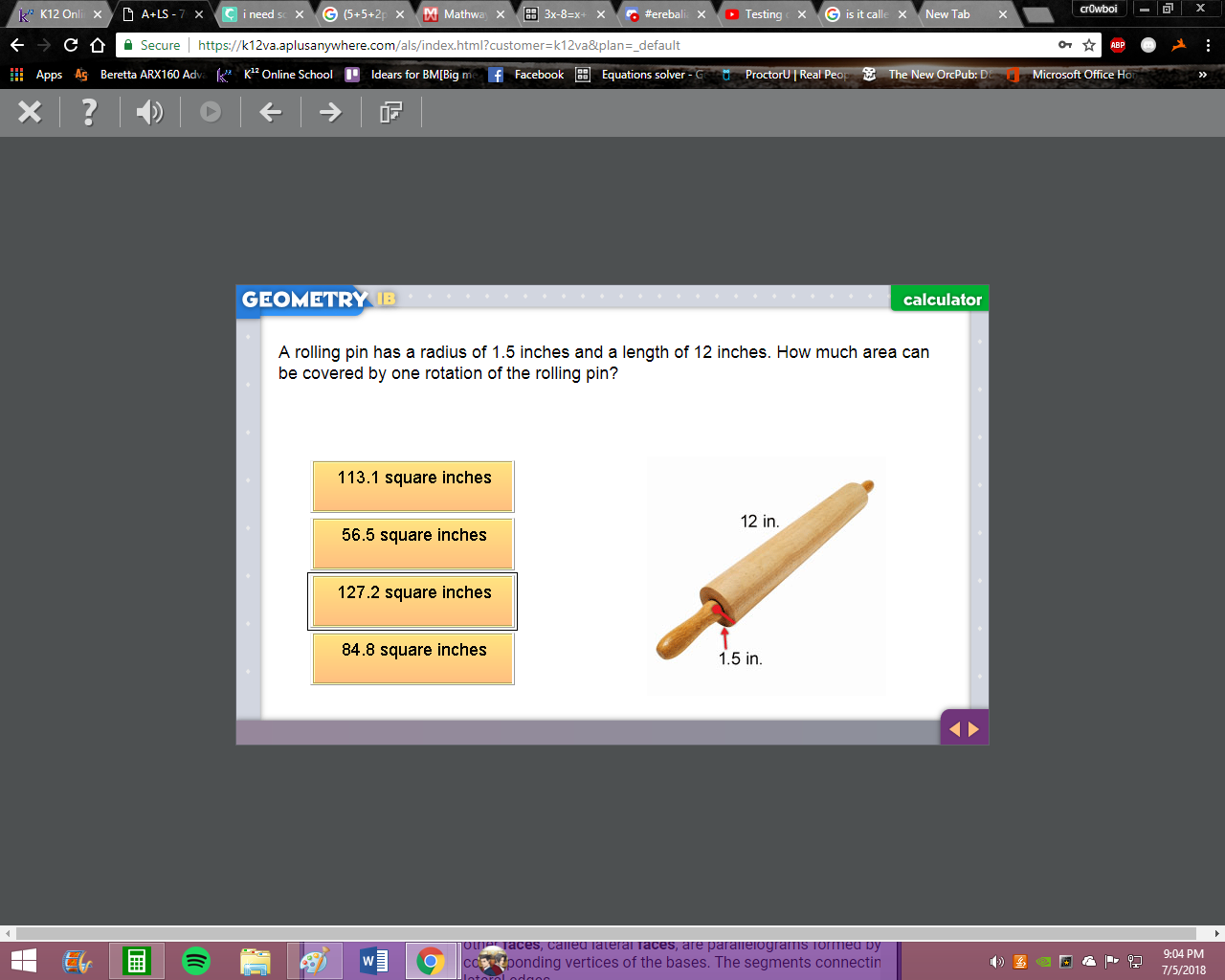 Mercury:
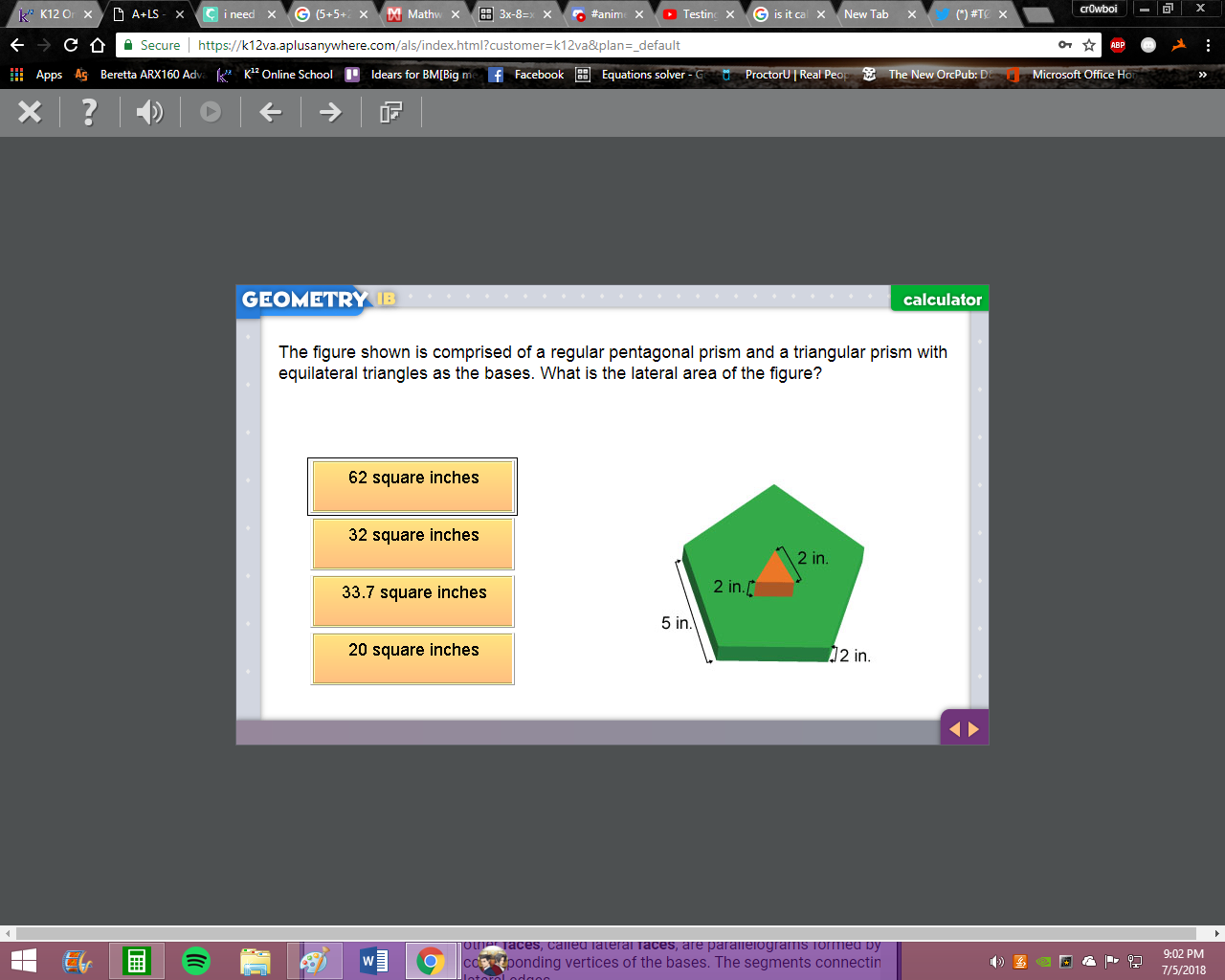
hm not quite we want the lateral surface area so pi*r^2 * h plug in r and h and pi
princeevee:
D
Mercury:
good
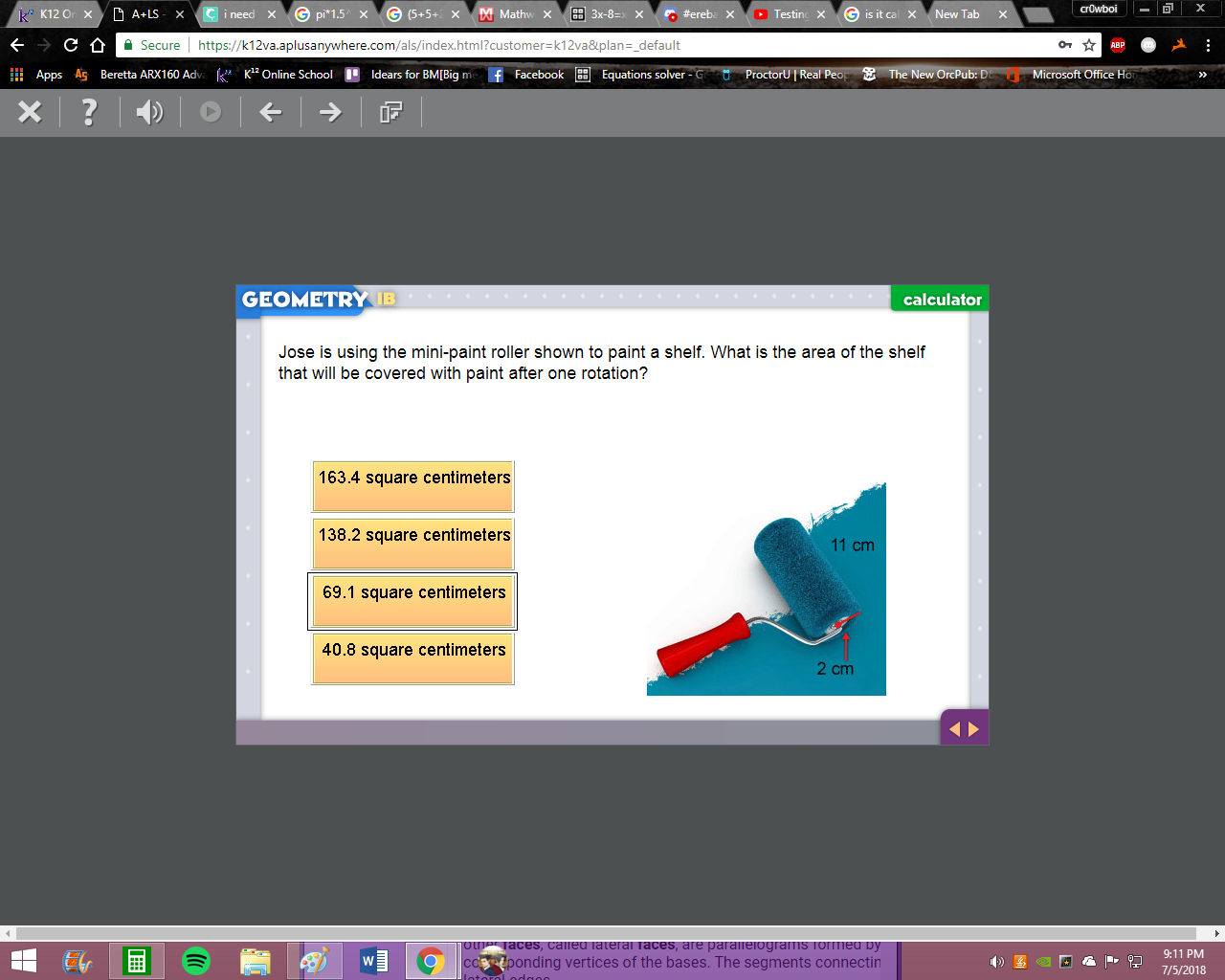 Mercury:
hm not quite pi*r^2 * h check your calculations again
princeevee:
pi*2^2*11
princeevee:
B
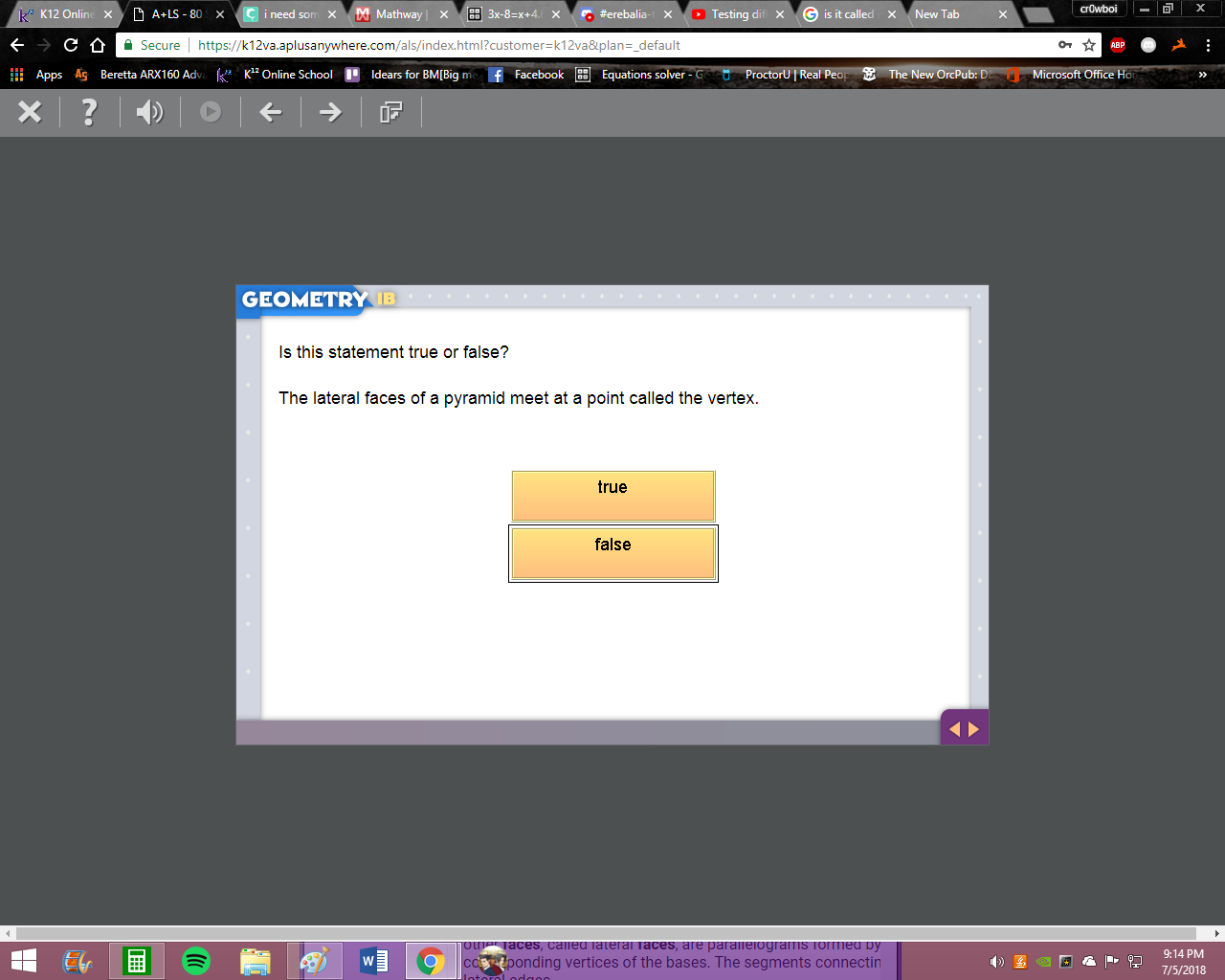 Mercury:
|dw:1530850554653:dw| the 4 lateral faces are the triangles which ~do~ meet at the vertex (apex) so the original statement is true
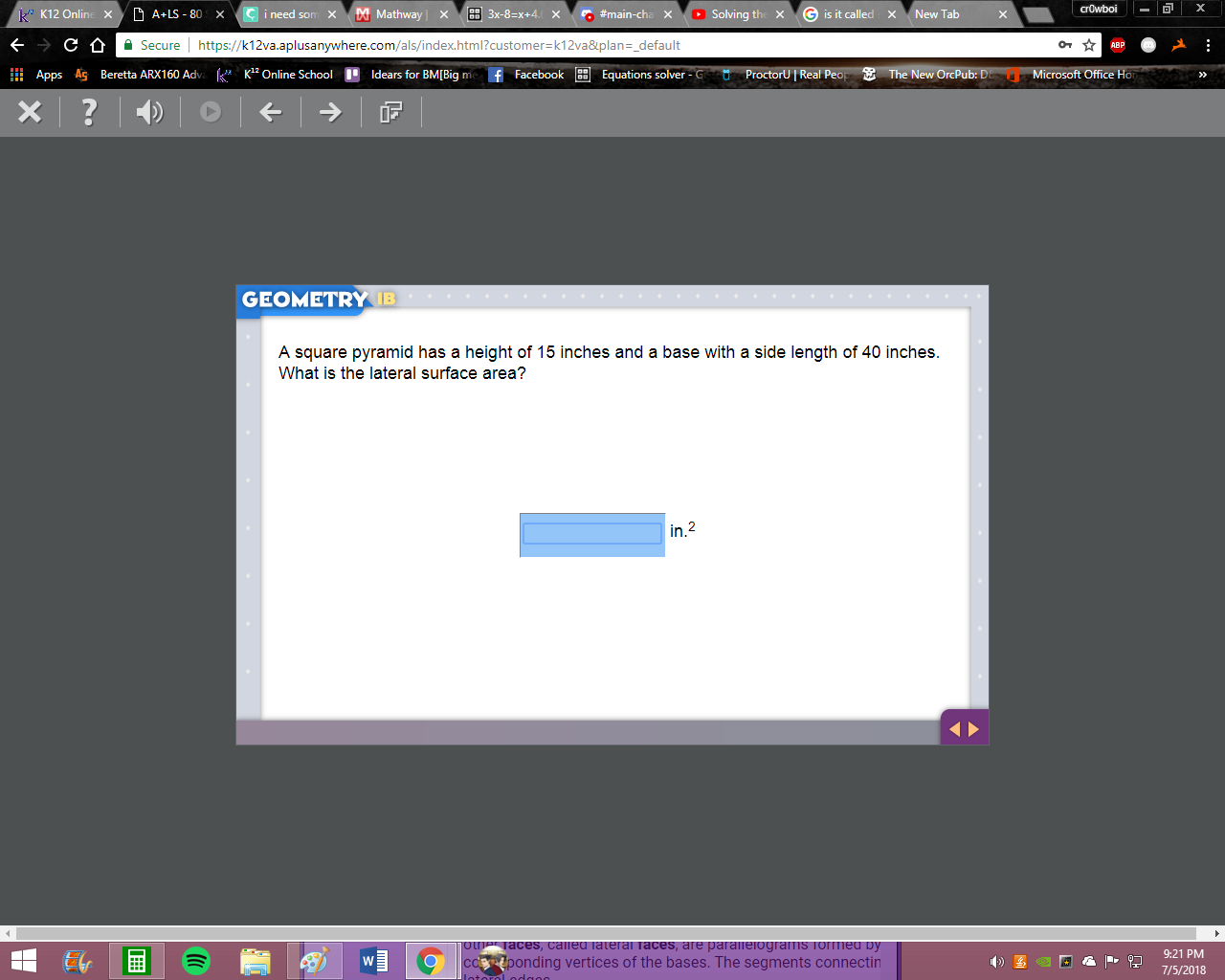 Mercury:
|dw:1530850957549:dw|
Mercury:
if we try shading in this right triangle over here:|dw:1530851006546:dw|
Mercury:
we can see we have a right triangle with legs 15 and 20 (since the bottom leg is half the length of one side) use the pythagorean theorem to find the hypotenuse first
princeevee:
625
Mercury:
almost, remember the pythagorean theorem gives you the square of a side so we take the sqrt of 625 to get 25 as the hypotenuse with that being said we go back to the original pyramid:
Mercury:
|dw:1530851276994:dw|
Mercury:
now we can see each side of the triangle has height 25 and base 40 calculate the area of one triangle (using area = 1/2 * b * h) and multiply by 4 to get the lateral area
princeevee:
so 25?
princeevee:
no, 15
Mercury:
(1/2)bh * 4 = (1/2)(25)(40) * 4
princeevee:
75
princeevee:
right?
princeevee:
@Mercury
princeevee:
@sammixboo
 Vocaloid:
Yo my wifi randomly cut out last night sorry about that :/
princeevee:
@vocaloid @Mercury that's alright, should we continue now though?
Join our real-time social learning platform and learn together with your friends!
 KBaby:
Verse 1 We left our names in the dust of the driveway Watched the old town shrink
KBaby:
Lyrics Generator Use AI to write the lyrics for a song. Suggested Genres: Pop Hip
KBaby:
Verse 1 We left our names in the dust of the driveway Watched the old town shrink
KBaby:
Lyrics Generator Use AI to write the lyrics for a song. Suggested Genres: Pop Hip

 aitexturegenerator:
How are you all handling AI-generated textures for 3D models and game assets without losing the hand-made feel? I've been doing a small stylized environment
aitexturegenerator:
How are you all handling AI-generated textures for 3D models and game assets without losing the hand-made feel? I've been doing a small stylized environment

 Demon25:
Woke up feeling like that girl and that dude well he still aint crap pluse the du
Demon25:
Woke up feeling like that girl and that dude well he still aint crap pluse the du
 playtsec:
how do I get rid of stress from teachers... I just feel like running out the classroom and leaving on my own.
playtsec:
how do I get rid of stress from teachers... I just feel like running out the classroom and leaving on my own.
 JohnnyLFowler0812:
What type of gamer would play something and then get off for a while. Why not sta
JohnnyLFowler0812:
Which is better? Metallica Rap Country R&B hiphop Medal Gospel Chill Which 3 opti
JohnnyLFowler0812:
What type of gamer would play something and then get off for a while. Why not sta
JohnnyLFowler0812:
Which is better? Metallica Rap Country R&B hiphop Medal Gospel Chill Which 3 opti