
 sleepyjess:
@thesmartone
sleepyjess:
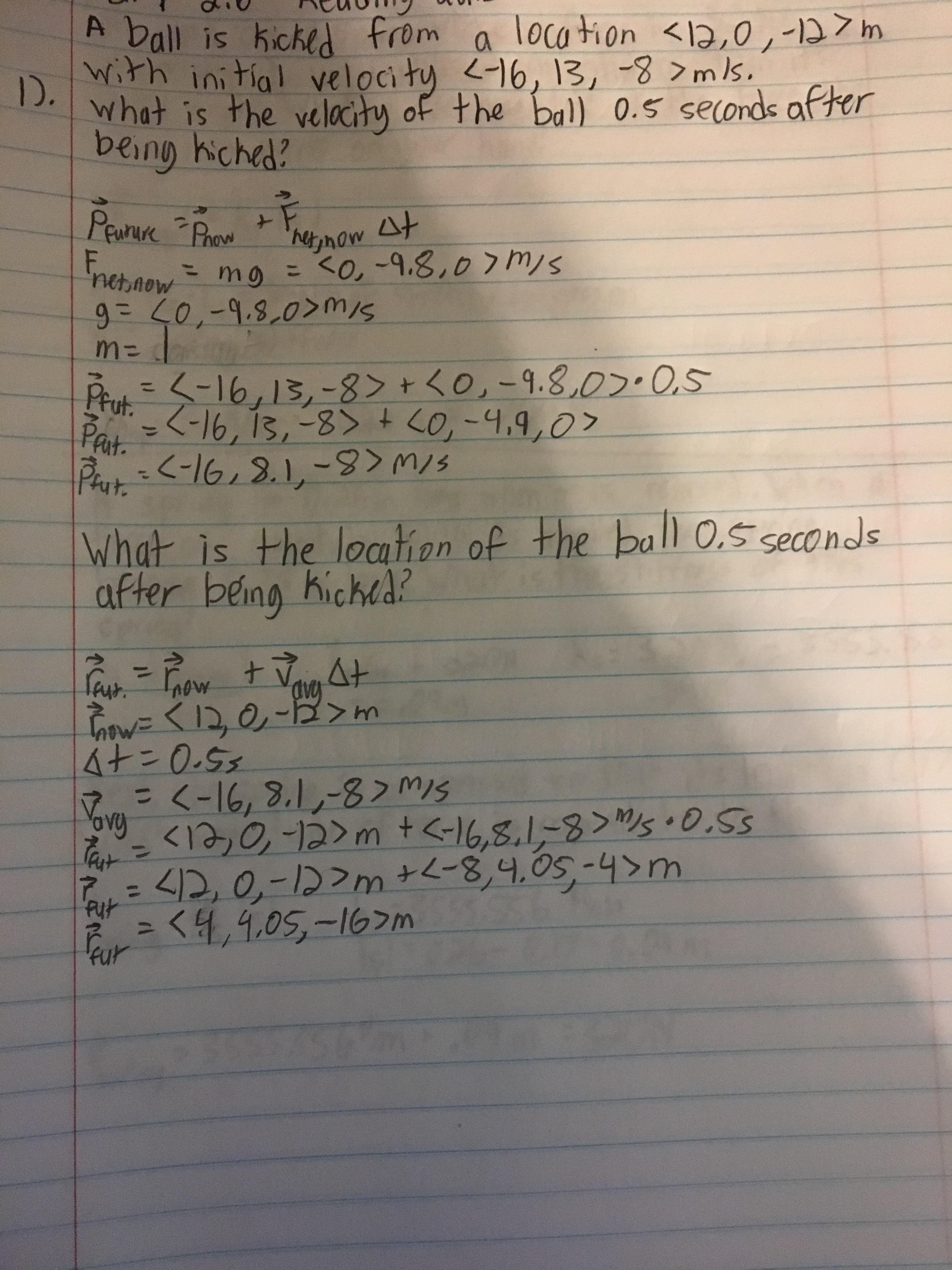
A ball is kicked from a location <12, 0, -12> m (on the ground) with initial velocity <-16, 13, -8> m/s. First part: What is the velocity of the ball 0.5 seconds after being kicked? I got <-16, 8.1, -8>m/s which was correct Second part: What is the location of the ball 0.5 seconds after being kicked?
sleepyjess:
putting a pic of my work in a sec
 sleepyjess:
It says the x and z components are correct on the second part, but not the y
sleepyjess:
@SmokeyBrown ?
 SmokeyBrown:
So the problem is that the velocity of the ball after 0.5 seconds is not the same as the *average* velocity across that time. The calculation you used would be correct for the average velocity, but you only used the final velocity. Now, since we know the initial velocity and the final velocity, and we know that the acceleration is constant, the average velocity, should be the sum of those two values divided by two.
sleepyjess:
Ooohhhh, that makes sense. That was throwing me off though because in the example the book gave, they used the final velocity as the average
SmokeyBrown:
No problem, that does sound pretty confusing. The final velocity can be the same as the average, if the velocity stays constant, or if the velocity increases and decreases. In this case, as you've seen, the velocity constantly decreases
sleepyjess:
Gotcha, thanks for the help
SmokeyBrown:
Absolutely!
Join our real-time social learning platform and learn together with your friends!
 KBaby:
Verse 1 We left our names in the dust of the driveway Watched the old town shrink
KBaby:
Lyrics Generator Use AI to write the lyrics for a song. Suggested Genres: Pop Hip
KBaby:
Verse 1 We left our names in the dust of the driveway Watched the old town shrink
KBaby:
Lyrics Generator Use AI to write the lyrics for a song. Suggested Genres: Pop Hip
 aitexturegenerator:
How are you all handling AI-generated textures for 3D models and game assets without losing the hand-made feel? I've been doing a small stylized environment
aitexturegenerator:
How are you all handling AI-generated textures for 3D models and game assets without losing the hand-made feel? I've been doing a small stylized environment

 Demon25:
Woke up feeling like that girl and that dude well he still aint crap pluse the du
Demon25:
Woke up feeling like that girl and that dude well he still aint crap pluse the du
 playtsec:
how do I get rid of stress from teachers... I just feel like running out the classroom and leaving on my own.
playtsec:
how do I get rid of stress from teachers... I just feel like running out the classroom and leaving on my own.
 JohnnyLFowler0812:
What type of gamer would play something and then get off for a while. Why not sta
JohnnyLFowler0812:
Which is better? Metallica Rap Country R&B hiphop Medal Gospel Chill Which 3 opti
JohnnyLFowler0812:
What type of gamer would play something and then get off for a while. Why not sta
JohnnyLFowler0812:
Which is better? Metallica Rap Country R&B hiphop Medal Gospel Chill Which 3 opti