
 zarkam21:
Help please
zarkam21:
@dude
 dude:
dude:
Oh, post the q
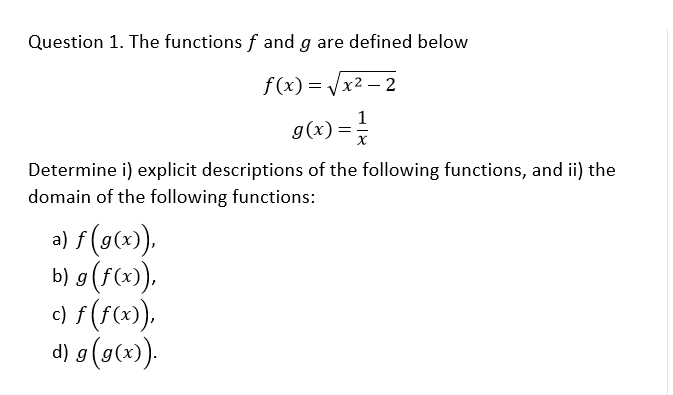 dude:
dude:
First one just asks about the description of the graph? I guess you can say that that its range cannot be negative (f(x)) For the second one the denominator cannot be 0, at least thats what I assume it means by that question Do you know how to write the functions as, f(g(x)), g(f(x)) and so on?
zarkam21:
Nope
zarkam21:
for c would it be that the functions cannot be zero too
zarkam21:
@Vocaloid
 silvernight269:
@Vocaloid
zarkam21:
@dude
zarkam21:
Im on can we continue please :)
dude:
f(g(x)) okay so the outside part is just the equation and whatever is inside you will substitute inside of the equation outside, for example the first one \(f(x)=\sqrt{x^2-2}\) => substitute \(g(x)=\frac1x\) in for x \(f(g(x))=\sqrt{{\frac{1}{x}}^2-2}\) (Note: \(\frac{1}{x}^2\) is just \(\frac{1^2}{x^2}\) or \(\frac{1}{x^2}\)) so \(\sqrt{{\frac{1}{x^2}}-2}\)
dude:
Does that make sense?
zarkam21:
Yes so for a-d we write the equation and descriptions?
dude:
It only seems to ask for the domain
zarkam21:
ANd the domain would be the possible variables right?
dude:
All the possible x values, yes
zarkam21:
okay so for a,
zarkam21:
it would be : the domain of this function is all real numbers?
zarkam21:
and its range cannot be negative?
zarkam21:
\[(-\infty,0) U (0,\infty)\]
zarkam21:
This is the domain actually
zarkam21:
i mean i would this it is
zarkam21:
? ya there
dude:
Not quite, the square root cannot be less 0 because it would be undefined \(\sqrt{\frac{1}{x^2}-2}\ge 0\) \((\sqrt{\frac{1}{x^2}-2})^2\ge 0^2\) which is just removing the root \(\frac{1}{x^2}-2\ge0\) Turn the -2 into a fraction with the same decimal by multiplying by \(x^2\) on both sides \(\frac{1}{x^2}-\frac{2x^2}{x^2}\ge 0\) \(\large\frac{-2x^2+1}{x^2}\ge 0\) You can factor this to isolate the negative \(\large \frac{-(\sqrt{2}x+1)+(\sqrt{2}x+1)}{x^2}\ge 0\) Multiply both sides by -1 (inverse the inequality) \(\frac{(\sqrt{2}x+1)+(\sqrt{2}x+1)}{x^2}\le 0\) Now just redistribute the factors \(\frac{2x^2-1}{x^2}\le 0\) You now just want to make a (sign diagram) find when \(2x^2-1\) negative as well as \(x^2\) \(2x^2-1=0\) =>\(2x^2=1\) =>\(x^2=\frac12\) =>\(x=\pm\sqrt{\frac12}\) and \(x^2=0\) =>\(x=0\) Anyway, made this too long but basically \(\mathbb D:[-\sqrt{\frac{1}{2}},0) ~U~(0,\sqrt{\frac{1}{2}}]\)
zarkam21:
okay so I think I understand this. Would my statement about the range not being negative be valid
dude:
Yes its valid
zarkam21:
okay for the next one the domain would be the opposite then
dude:
\(g(f(x))=\frac{1}{\sqrt{x^2-2}}\) From this we know that the denominator has to be greater than 0 \(\sqrt{x^2-2}\ge0\) \(x^2-2\ge0\) \(x^2\ge2\) \(\pm\sqrt2\) \(\mathbb D:-\sqrt{2}>x ~and~x>\sqrt{2}\)
zarkam21:
question
zarkam21:
does the zero cancel out?
dude:
Where
zarkam21:
when you get from x^2-2-0 to x^2>2
dude:
\(x^2-2\ge0\) \(x^2\ge2\) \(\pm\sqrt2\) this part?
zarkam21:
oh bcuz zero doesnt satisfy the function?
zarkam21:
yes
dude:
\(\sqrt{x^2-2}\ge0\) So I first raised both sides to the second power so the root cancels and I have to do 0^2 0^2 is just 0, it doesn't cancel itself \(x^2-2\ge0\) \(x^2\ge2\) \(\pm\sqrt2\) Does that answer your question?
zarkam21:
Yes it does .
zarkam21:
forc we wouldnt use 1/x in our function
zarkam21:
so would the f equation just double like be used twice
dude:
Right
dude:
\(f(f(x))=\sqrt{\sqrt{x^2-2}-2}\)
dude:
Same with the fourth one \(g(g(x))=\frac{1}{\frac{1}{x}}\) which is just x
zarkam21:
okay give me a sec while I figure out the domains
dude:
Okay
zarkam21:
\[(-\infty,-\sqrt{6}] U [\sqrt{6},\infty)\]
dude:
Yes
zarkam21:
Yay, and for an explicit description would it be that no negative numbers?
zarkam21:
and then for d it would be \[(-\infty,\infty)\]
zarkam21:
so all real numbers
dude:
Yes to both
zarkam21:
Yay
dude:
woot
.png) dude:
dude:
For rational functions, the denominator is ≠0
zarkam21:
for this one,,, domain for p(x) \[(-\infty,1)U(1,\infty)\]
dude:
Right
zarkam21:
domain for q(x) = \[(-\infty,\infty)\]
dude:
Yeah, no restrictions there
zarkam21:
okay for b how would I show that
dude:
Set them equal to each other \(\large \frac{x^3-x}{x-1}=x^2+x\)
zarkam21:
okay and solve?
dude:
Yes
zarkam21:
I got all real numbers
zarkam21:
for do I plug in 1?
dude:
Yes
zarkam21:
\[\frac{ 1^3-1 }{ 1-1 }1^2+1 = false\]
dude:
Well the issue is when you substitute 1 in the denominator, remember we wrote the range \(\large \frac{x^3-x}{x-1}\) x could not be 1 because it makes the denominator 0 So trying to substitute would automatically make it undefined \(\large \frac{1^3-1}{\color{red}{1-1}}=1^2+1\)
zarkam21:
okay and for c : yes, the functions are the same because when you combine them you end up with the same answer
dude:
Right
.png) zarkam21:
zarkam21:
x=1+e?
dude:
Okay, have you tried solving or are you lost? Also I havent done logs in some time, I'm rusty
zarkam21:
I solved and got x=1+e
dude:
For the first or second equation? o.o
zarkam21:
1st
dude:
I got something different, what did you do?
zarkam21:
i simplified , and then isolated
zarkam21:
its all written out and its hard cause i cant take a pic
dude:
Ah its okay
zarkam21:
SO are we good with my answe?
zarkam21:
@Angle
 Angle:
x=1+e is correct
zarkam21:
Yay
zarkam21:
and for the next equation x=1+sqrt2
Angle:
I believe there should be two answers
zarkam21:
for the first equation
zarkam21:
?
Angle:
for the second equation x=1+sqrt2 is correct but I think there is another one
zarkam21:
1+(-sqrt2)?
Angle:
yup you can sum it up into one answer with x = 1 ± sqrt(2)
zarkam21:
perfect. and just need help with one more
zarkam21:
if you can
Angle:
sure
.png) Angle:
Angle:
here's an example |dw:1536896603620:dw|
zarkam21:
so 0.002/1/2
Angle:
mmm it's called "half" life, but it doesn't have to be 'half' |dw:1536896784825:dw|
zarkam21:
oh okay so the half life is 500
zarkam21:
Thank you angle !!!!
Angle:
no problem haha hopefully I'm not wrong ^_^"
Join our real-time social learning platform and learn together with your friends!
 KBaby:
Verse 1 We left our names in the dust of the driveway Watched the old town shrink
KBaby:
Lyrics Generator Use AI to write the lyrics for a song. Suggested Genres: Pop Hip
KBaby:
Verse 1 We left our names in the dust of the driveway Watched the old town shrink
KBaby:
Lyrics Generator Use AI to write the lyrics for a song. Suggested Genres: Pop Hip

 aitexturegenerator:
How are you all handling AI-generated textures for 3D models and game assets without losing the hand-made feel? I've been doing a small stylized environment
aitexturegenerator:
How are you all handling AI-generated textures for 3D models and game assets without losing the hand-made feel? I've been doing a small stylized environment

 Demon25:
Woke up feeling like that girl and that dude well he still aint crap pluse the du
Demon25:
Woke up feeling like that girl and that dude well he still aint crap pluse the du
 playtsec:
how do I get rid of stress from teachers... I just feel like running out the classroom and leaving on my own.
playtsec:
how do I get rid of stress from teachers... I just feel like running out the classroom and leaving on my own.
 JohnnyLFowler0812:
What type of gamer would play something and then get off for a while. Why not sta
JohnnyLFowler0812:
Which is better? Metallica Rap Country R&B hiphop Medal Gospel Chill Which 3 opti
JohnnyLFowler0812:
What type of gamer would play something and then get off for a while. Why not sta
JohnnyLFowler0812:
Which is better? Metallica Rap Country R&B hiphop Medal Gospel Chill Which 3 opti