
 kaylak:
I need help with 9 questions! @vocaloid
 Vocaloid:
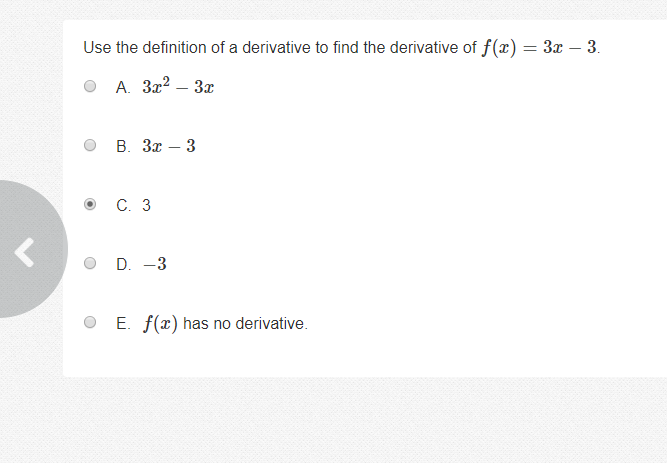
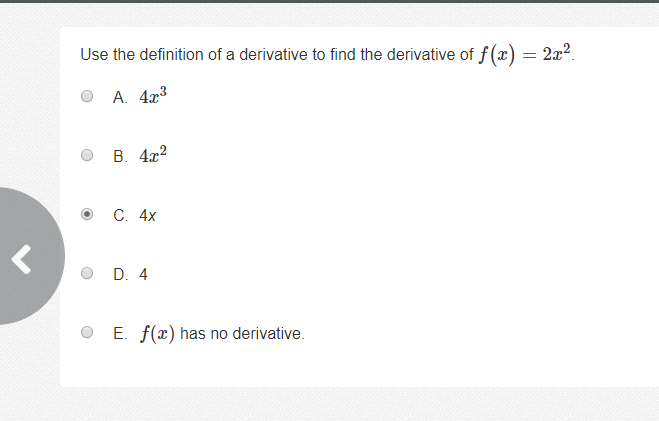
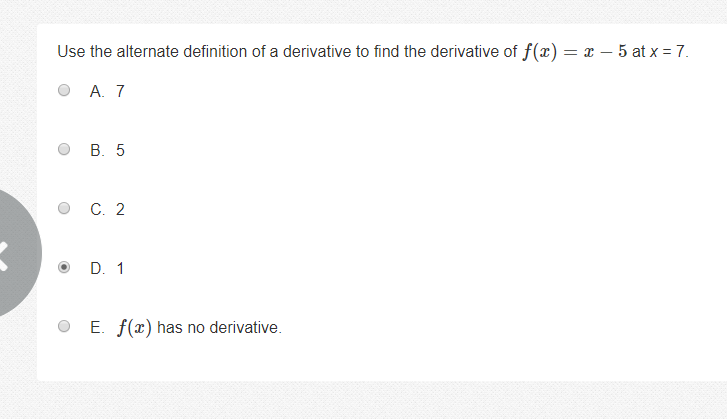
These are correct so far
 kaylak:
@vocaloid
kaylak:
1 is d
kaylak:
3 is b
kaylak:
don't know 2
Vocaloid:
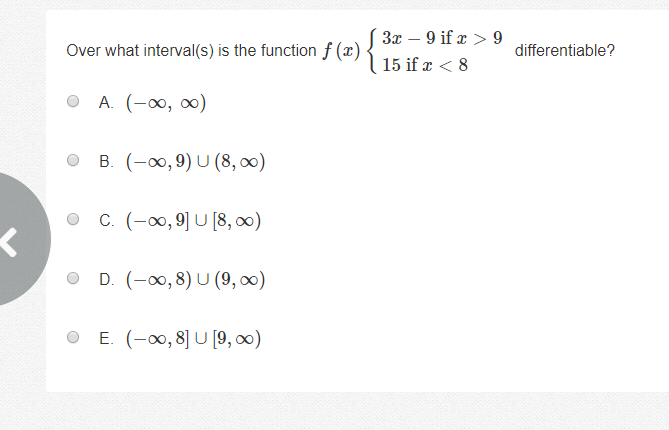
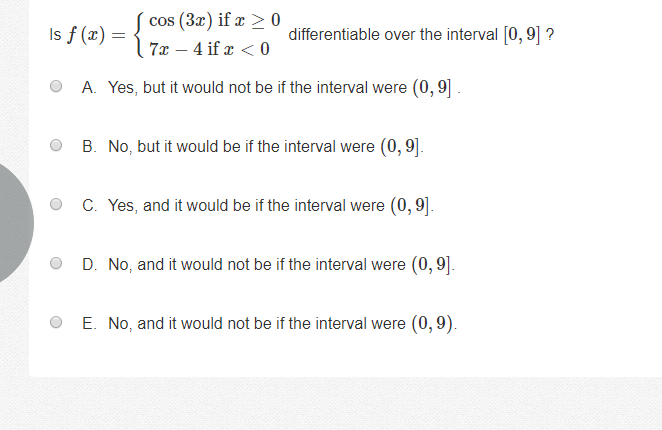
for the differentiable piecewise function it's only differentiable over the interval specified by the piecewise definition so where x < 8 and x > 9 exclusive
kaylak:
I'm going in order of how I sent it not the number the attachment says
kaylak:
so is d correct?
kaylak:
ok
Vocaloid:
yeah nvm that's right
kaylak:
so d is correct?
kaylak:
is a the answer for 2 -6?
kaylak:
3 is b?
kaylak:
After these questions, I have 3 more and I promise that is all
Vocaloid:
gonna get a second opinion on the derivative questions on closed intervals
kaylak:
okay
kaylak:
If a function f is differentiable, is the function f continuous? If not, give a counterexample. Explain your answer. do you know this?
kaylak:
If a function f is continuous, is the function f also differentiable? If not, give a counterexample. Explain your answer. or this?
Vocaloid:
being differentiable implies continuity but a continuous function is not necessarily differentiable (example: if it has a vertical tangent)
kaylak:
okay cool
Vocaloid:
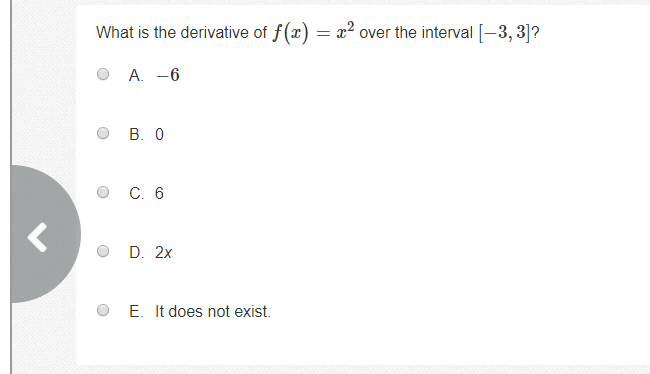
alright I got a second opinion about "what is the derivative of f'(x) = x^2 over the closed interval [-3,3]"? since there are no discontinuities the derivative is just taken normally to be 2x
kaylak:
okay cool and is 3 b?
Vocaloid:
yeah that's what i got too
kaylak:
\(\color{#0cbb34}{\text{Originally Posted by}}\) @Vocaloid being differentiable implies continuity but a continuous function is not necessarily differentiable (example: if it has a vertical tangent) \(\color{#0cbb34}{\text{End of Quote}}\) is this for the first writing response or second?
Vocaloid:
it applies to both If a function f is differentiable, is the function f continuous? If not, give a counterexample. Explain your answer. ---> being differentiable implies continuity If a function f is continuous, is the function f also differentiable? If not, give a counterexample. Explain your answer. or this? ---> but a continuous function is not necessarily differentiable
Vocaloid:
for the counter-example you can use f(x) = |x| since it's continuous but not differentiable on x = 0
kaylak:
okay I wonder why we got 2 of basically the same question
Vocaloid:
they're not the same question it's like the difference between "are all squares rectangles" or "are all rectangles squares" they're not asking the same thing and have different solutions
kaylak:
true just that this happens to have the same answer
Vocaloid:
If a function f is differentiable, is the function f continuous? ---> if a function is differentiable it must be continuous via the limit definition If a function f is continuous, is the function f also differentiable? ---> if a function is continuous it may or may not be differentiable if it has an edge or vertical tangent
kaylak:
1 more question (multiple choice)
 kaylak:
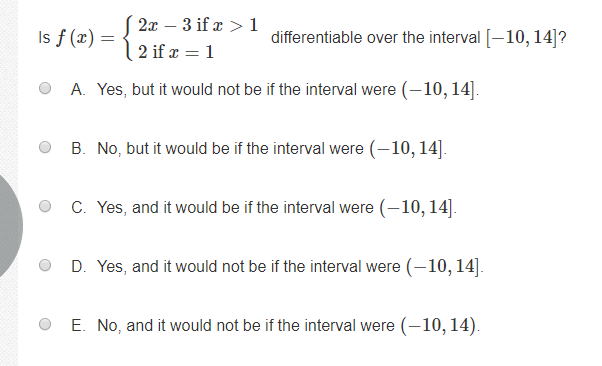
is b right for this one?
Vocaloid:
there's a discontinuity at x = 1 so changing it to (-10,14] still doesn't fix the problem so it's not differentiable there either
kaylak:
so e
Vocaloid:
plus it's not even defined from (-10 to 1) so yeah I think E is the better choice
kaylak:
okay thank you so much for your help!
Join our real-time social learning platform and learn together with your friends!
 KBaby:
Verse 1 We left our names in the dust of the driveway Watched the old town shrink
KBaby:
Lyrics Generator Use AI to write the lyrics for a song. Suggested Genres: Pop Hip
KBaby:
Verse 1 We left our names in the dust of the driveway Watched the old town shrink
KBaby:
Lyrics Generator Use AI to write the lyrics for a song. Suggested Genres: Pop Hip
 aitexturegenerator:
How are you all handling AI-generated textures for 3D models and game assets without losing the hand-made feel? I've been doing a small stylized environment
aitexturegenerator:
How are you all handling AI-generated textures for 3D models and game assets without losing the hand-made feel? I've been doing a small stylized environment

 Demon25:
Woke up feeling like that girl and that dude well he still aint crap pluse the du
Demon25:
Woke up feeling like that girl and that dude well he still aint crap pluse the du
 playtsec:
how do I get rid of stress from teachers... I just feel like running out the classroom and leaving on my own.
playtsec:
how do I get rid of stress from teachers... I just feel like running out the classroom and leaving on my own.
 JohnnyLFowler0812:
What type of gamer would play something and then get off for a while. Why not sta
JohnnyLFowler0812:
Which is better? Metallica Rap Country R&B hiphop Medal Gospel Chill Which 3 opti
JohnnyLFowler0812:
What type of gamer would play something and then get off for a while. Why not sta
JohnnyLFowler0812:
Which is better? Metallica Rap Country R&B hiphop Medal Gospel Chill Which 3 opti