
 zarkam21:
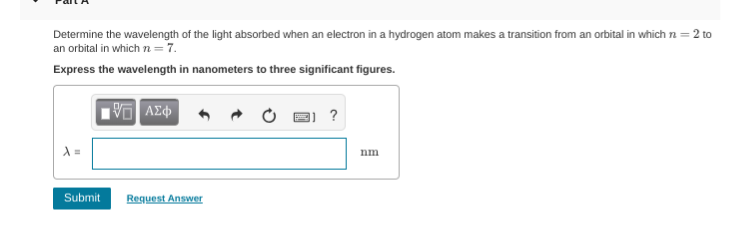
3.97 x 10^-7 ?
 Vocaloid:
it wants the answer in nanometers yours is currently in meters, so simply multiply by 10^9
zarkam21:
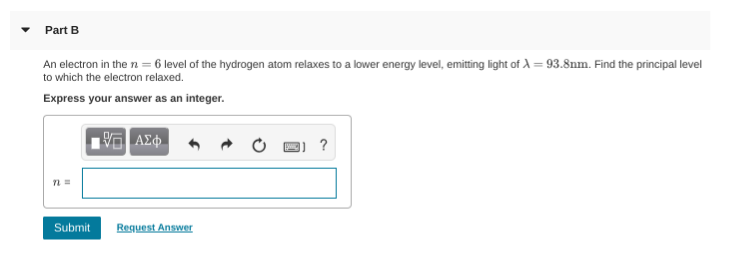
How do you find the principal level
 Vocaloid:
ah so you are given ni = 6 and the wavelength you'd use the rydberg equation 1/lambda = R(1/nf^2 - 1/ni^2) to find nf
Vocaloid:
make sure to convert 98.3nm to meters first since the rydberg constant is in meters
zarkam21:
1/(9.83x10^10) = (1.097x10^7)(1/nf^2 - 1/36)
Vocaloid:
wait
zarkam21:
okay
Vocaloid:
should be -10 on that exponent 1/(9.83x10^-10) = (1.097x10^7)(1/nf^2 - 1/36)
zarkam21:
I dont know why Im not getting a -10 ... oh well
Vocaloid:
ah should be -8
Vocaloid:
93.8nm --> divide by 10^9 --> 93.8e-8 whoops
Vocaloid:
but anyway 1/(9.83x10^-8) = (1.097x10^7)(1/nf^2 - 1/36) should give you your nf value
 zarkam21:
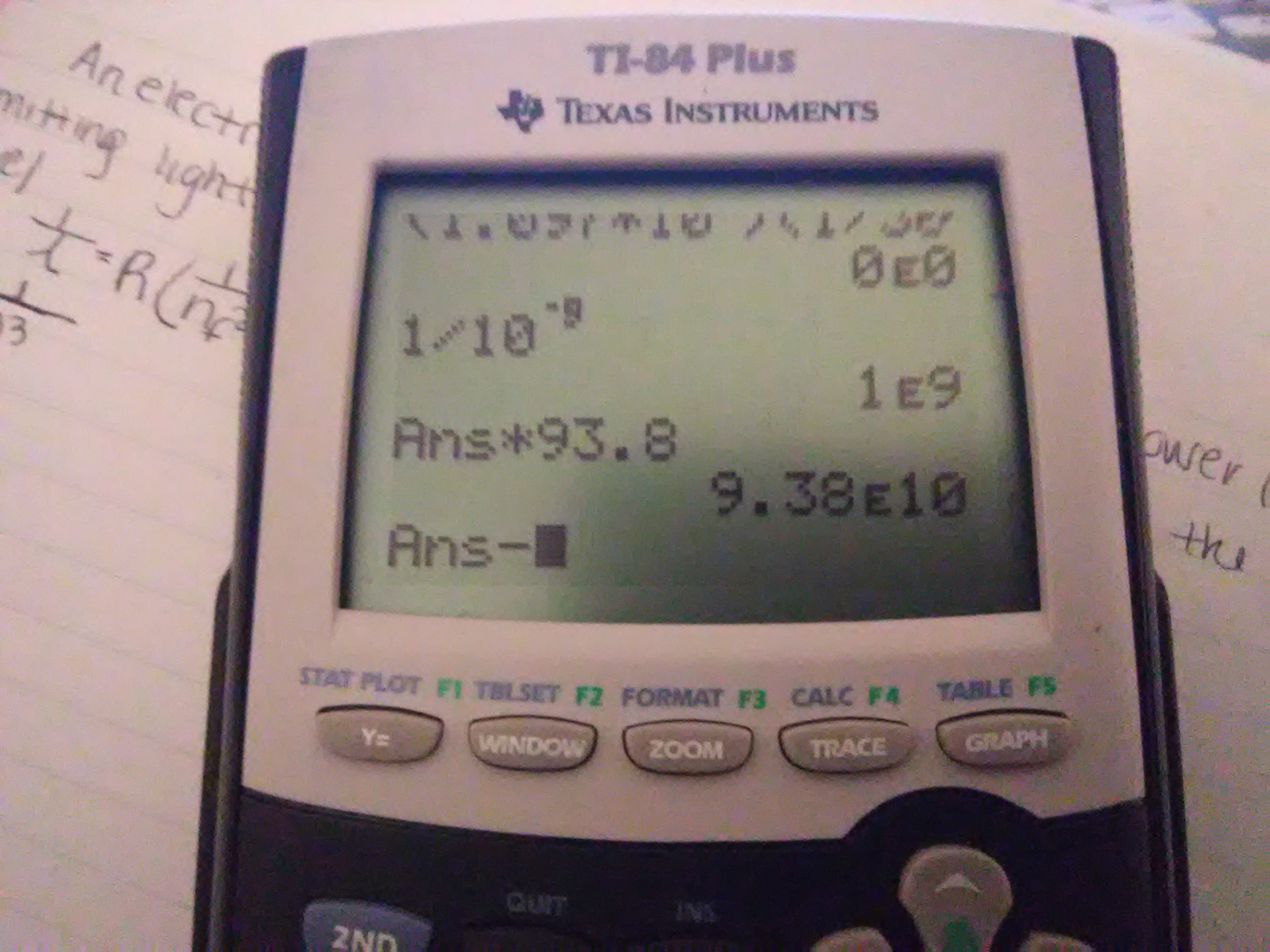
I thought it would be divived by 10^-9
Vocaloid:
ah, not quite, putting a negative exponent in the denominator --> end up with a positive exponent
Vocaloid:
if it helps to think of it this way, 93.8 nm is only a very small portion of a meter so we would expect the result to be very small thus we would want to divide by 10^9 not 10^(-9)
Vocaloid:
|dw:1538005835592:dw|
zarkam21:
but what about the nano part,,, isnt nano 10^-9
Vocaloid:
10^(-9) would be converting m to nm we want the other way around this time
zarkam21:
oh okay I see. Since it is like the inverse the signs would change
Vocaloid:
like, there's two ways to write the conversion factor 1 m = 10^9nm or 1 nm = 10^(-9) m so both of these conversion factors would work you just gotta be careful about how to use them
Vocaloid:
1 m = 10^9nm gives us 98.3nm/10^9 or 1 nm = 10^(-9) m gives us 98.3nm*10^(-9) both give the same result using different conversion factors
Vocaloid:
1/(9.83x10^-8) = (1.097x10^7)(1/nf^2 - 1/36) should give you your nf value anyway chucking this into a calculator gives 1 as your nf value, so n = 1 is the principal energy value and thus your sol'n
zarkam21:
Okay, so I got 3.31 x 10^-10
 zarkam21:
for this one
Vocaloid:
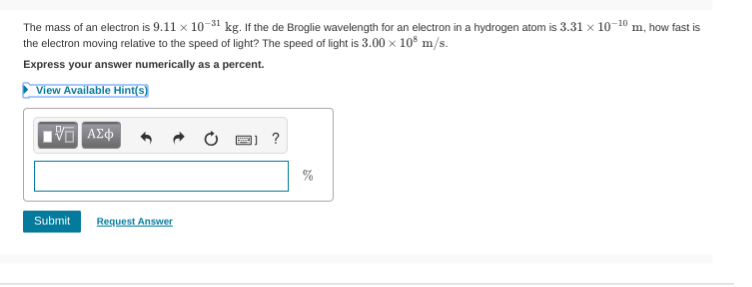
I’m on my phone so I can’t really check this easily But it wants it as a percentage of the speed of light So you’d solve for v in the de brogue equation then do v/c * 100
zarkam21:
so v is 2.20x10^6 its a given... so (2.20x10^6)/(2.998x10^8) * 100
zarkam21:
i got 7.34 x 10^15
Vocaloid:
Hm that doesn’t sound right Anyway i need to workout but I asked someone to take over for me >>
zarkam21:
OKay =)
 SmokeyBrown:
Hi zarkam, I'm trusting you're using the correct numbers here. If that's true, then I think you should get around 0.734 % as your answer.
SmokeyBrown:
To see why this is true, consider that (10^6)/(10^8)*100 simplifies to 1. 10^6 * 100 = 10^8; 10^8/10^8 = 1 So, the only relevant calculation you have to do is 2.20/2.998. As you can see for yourself, that equals about 0.734
zarkam21:
where is the 2.20 coming from
SmokeyBrown:
Haha, that's the number you gave my dude. But if we want to calculate the velocity of the particle from the information given, we can use the equation: \[\lambda=\frac{ h }{ p }\] where lambda stands for the de broglie wavelength of the particle, h stands for planck's constant, and p stands for the momentum of the particle (recall that momentum is equal to mass multiplied by velocity)
zarkam21:
Could you explain what I did wrong here?
.png) SmokeyBrown:
SmokeyBrown:
Hm, did you remember to convert the mass to kilograms when calculating momentum?
zarkam21:
Nvm got it lol sorry
SmokeyBrown:
Ok, awesome
zarkam21:
@SmokeyBrown I have a question> : What is the de Broglie equation used for?
zarkam21:
like to find what?
SmokeyBrown:
So, the de Broglie equation describes the relationship between a particle's wavelength and its momentum (using Planck's constant) Basically, if you have the wavelength, you can find the momentum, and if you have the momentum, you can find the wavelength. Since momentum can be broken down into mass and velocity, you can also calculate these values, provided you have the other values required in the equation.
zarkam21:
SO h wouldbe plancks.. v would be (velocity /speed) I'm confused with what m would be
zarkam21:
I know it would be mass but in a problem like : Calculate the wavelength of an electron traveling with a speed of 3.21 × 10⁵ m/s..... I don't know what the mass would be
SmokeyBrown:
Oh, for that question you'd just have to know that all electrons have approximately the same mass. According to Google, this value is 9.10938356 × 10^-31 kilograms
zarkam21:
OKay so 2.27 x 10^-9?
zarkam21:
?
SmokeyBrown:
uhhhhhhh yes
SmokeyBrown:
Sorry, it took a while for me to plug that into my calculator
Join our real-time social learning platform and learn together with your friends!
 KBaby:
Verse 1 We left our names in the dust of the driveway Watched the old town shrink
KBaby:
Lyrics Generator Use AI to write the lyrics for a song. Suggested Genres: Pop Hip
KBaby:
Verse 1 We left our names in the dust of the driveway Watched the old town shrink
KBaby:
Lyrics Generator Use AI to write the lyrics for a song. Suggested Genres: Pop Hip

 aitexturegenerator:
How are you all handling AI-generated textures for 3D models and game assets without losing the hand-made feel? I've been doing a small stylized environment
aitexturegenerator:
How are you all handling AI-generated textures for 3D models and game assets without losing the hand-made feel? I've been doing a small stylized environment

 Demon25:
Woke up feeling like that girl and that dude well he still aint crap pluse the du
Demon25:
Woke up feeling like that girl and that dude well he still aint crap pluse the du
 playtsec:
how do I get rid of stress from teachers... I just feel like running out the classroom and leaving on my own.
playtsec:
how do I get rid of stress from teachers... I just feel like running out the classroom and leaving on my own.
 JohnnyLFowler0812:
What type of gamer would play something and then get off for a while. Why not sta
JohnnyLFowler0812:
Which is better? Metallica Rap Country R&B hiphop Medal Gospel Chill Which 3 opti
JohnnyLFowler0812:
What type of gamer would play something and then get off for a while. Why not sta
JohnnyLFowler0812:
Which is better? Metallica Rap Country R&B hiphop Medal Gospel Chill Which 3 opti