
 kaylak:
Calculus help please!
 kaylak:
@Vocaloid
kaylak:
@Vocaloid please help
kaylak:
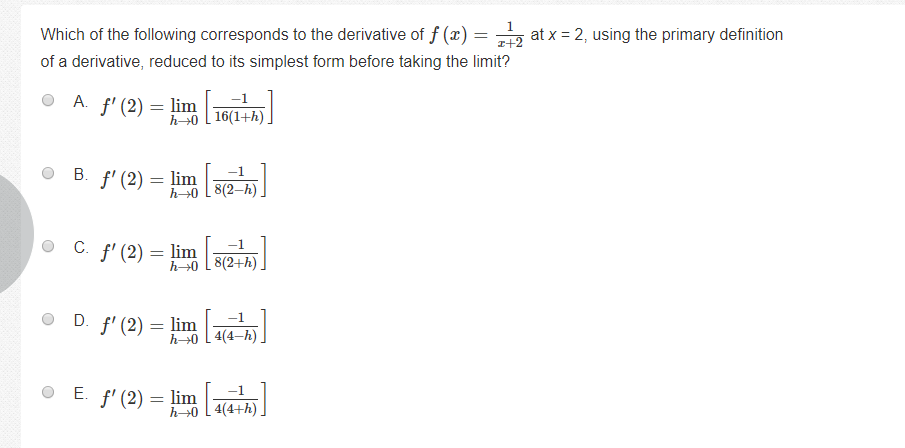
1 is e
kaylak:
@Mercury
 Mercury:
uhtook me a while but I think I got the same thing
kaylak:
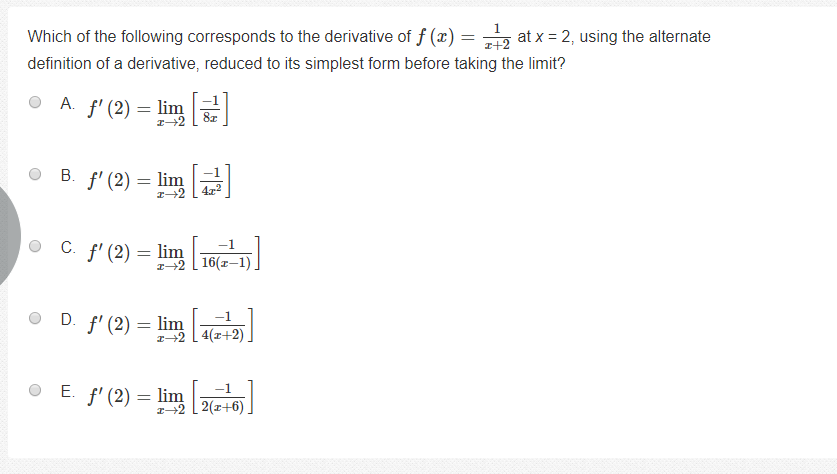
d for the other one?
 Mercury:
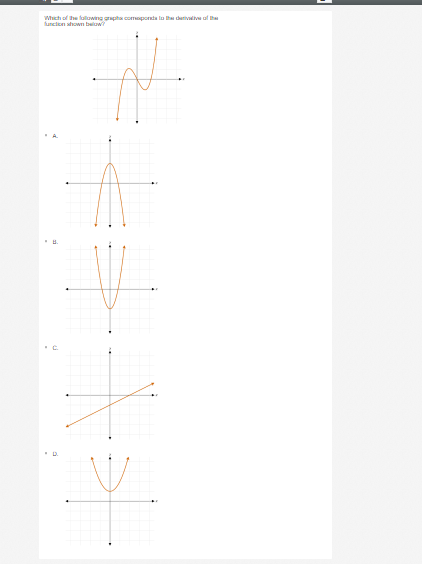
yeah that's what i got too
kaylak:
help some more?
 kaylak:
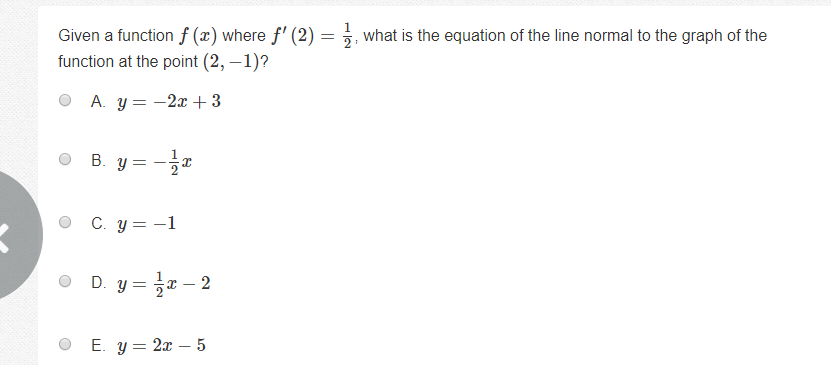
1 is d?
Mercury:
well if the derivative is 1/2 then the slope of the tangent line is also 1/2. since it's asking for the normal (aka perpendicular) the final slope must be the negative reciprocal -2
kaylak:
yay and 2 e I think
Mercury:
if the slope of the normal is -2 then D cannot be the answer.
kaylak:
oh okay
kaylak:
second one is also wrong hold on
Mercury:
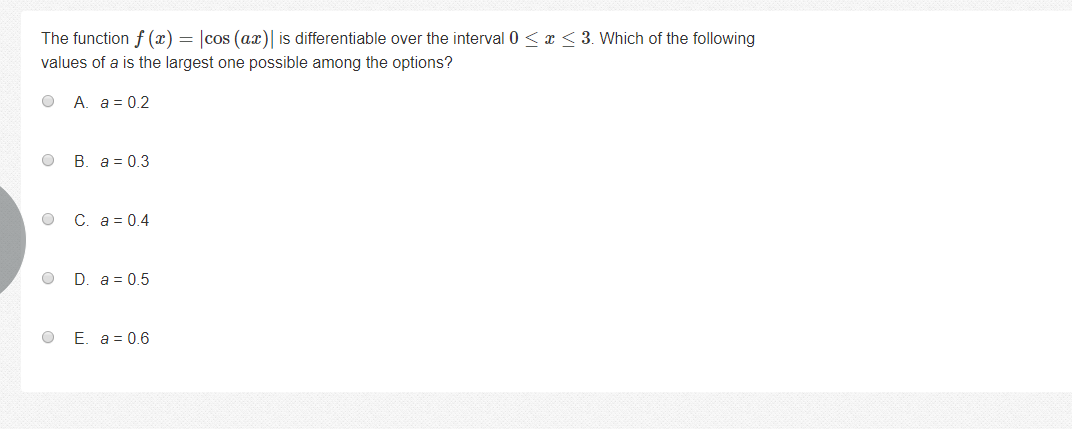
oh wait I see, you have to plug in |cos(ax)|, try each a-value one by one, and see which is the smallest a-value that still makes |cos(ax)| differentiable from 0 to 3
Mercury:
so you could start with B, |cos(0.3x)| and see if there the function is still differentiable across the entire interval 0 to 3 (no sharp edges) and if not, go up to the next higher a value
Mercury:
just use software to graph them and inspect visually for any sharp edges
kaylak:
so I'm confused is d the answer of no for 1 ?or is it a
Mercury:
it has to be A) since it's the only one with slope -2 if the slope of the tangent is 1/2 then the slope of the normal has to be -2
kaylak:
okay!
 Mercury:
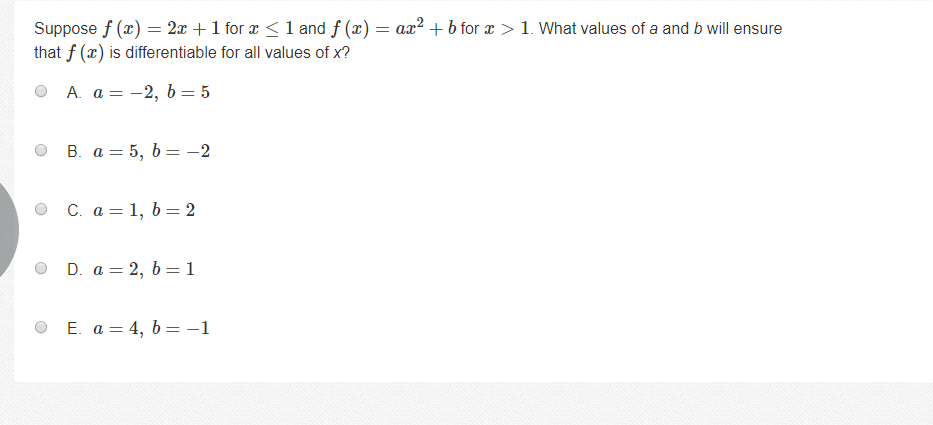
ok, it asks for a and b values that will make it differentiable across ALL values of x so you'd need to find which a value and b value makes 2x + 1 = ax^2 + b always true
Mercury:
idk i think i'm confusing myself with this one >>
 sillybilly123:
Your [piece-wise] function is: \(f(x) = \begin{cases} 2x+1 & x\ \le 1\\ ax^2 + b & x > 1 \end{cases} \) Meaning that: \(f'(x) = \begin{cases} 2 & x\ \le 1\\ 2ax & x > 1 \end{cases} \) So we have differentiated, but we want to know the [piece-wise] function, with actual values for \(a\) and \(b\) so that, the function is differentiable. Skipping some jargon, that means that it should have the same value and slope from both functions at \(x = 1\). IOW, if we say that \( f_1(x) = 2x+1\) and \(f_2(x) = ax^2 + b\), then we need to show this: \(\begin{cases} {value } & f_1(1) = f_2(1)\\ {slope} & f'_1(1) = f'_2(1) \end{cases} \) So we end up with this algebra: \( \begin{cases} \ {value} & 2(1) + 1 = a(1)^2 + b \\ {slope} & 2 = 2a(1) \end{cases} \) Or: \( \begin{cases} \ 3 = a + b \\ 1 = a \end{cases} \)
Join our real-time social learning platform and learn together with your friends!
 KBaby:
Verse 1 We left our names in the dust of the driveway Watched the old town shrink
KBaby:
Lyrics Generator Use AI to write the lyrics for a song. Suggested Genres: Pop Hip
KBaby:
Verse 1 We left our names in the dust of the driveway Watched the old town shrink
KBaby:
Lyrics Generator Use AI to write the lyrics for a song. Suggested Genres: Pop Hip
 aitexturegenerator:
How are you all handling AI-generated textures for 3D models and game assets without losing the hand-made feel? I've been doing a small stylized environment
aitexturegenerator:
How are you all handling AI-generated textures for 3D models and game assets without losing the hand-made feel? I've been doing a small stylized environment

 Demon25:
Woke up feeling like that girl and that dude well he still aint crap pluse the du
Demon25:
Woke up feeling like that girl and that dude well he still aint crap pluse the du
 playtsec:
how do I get rid of stress from teachers... I just feel like running out the classroom and leaving on my own.
playtsec:
how do I get rid of stress from teachers... I just feel like running out the classroom and leaving on my own.
 JohnnyLFowler0812:
What type of gamer would play something and then get off for a while. Why not sta
JohnnyLFowler0812:
Which is better? Metallica Rap Country R&B hiphop Medal Gospel Chill Which 3 opti
JohnnyLFowler0812:
What type of gamer would play something and then get off for a while. Why not sta
JohnnyLFowler0812:
Which is better? Metallica Rap Country R&B hiphop Medal Gospel Chill Which 3 opti