
 zarkam21:
Mg(NO3)2?
zarkam21:
Magnesium Nitrate?
 lowkey:
Mg=Magnesium NO3=nitrate You're correct (:
zarkam21:
BUt its NO NItrogen and Oxygen?
lowkey:
The NO3 is a polyatomic ion. Why do we know that? Because every compound has to be equal charges, and Nitrogen charge is -3 while Oxygen is -6, and that doesn't work because the charges aren't equal.
zarkam21:
OH okay so NO3 is nitrate then
lowkey:
Yes, so you were correct!
zarkam21:
NH4ClO3
zarkam21:
Ugh I really wanna figure this out on my own
zarkam21:
BUt this would be a polyatomic too?
lowkey:
Try it out! You were already right the first time for the first problem
lowkey:
Do you have to memorize the polyatomic ions, or no?
zarkam21:
no
zarkam21:
I mean I don't think kso
 lowkey:
What chemistry are you in? Most of the times, regular high school chemistry doesn't force you to remember them.
zarkam21:
Im in college chem
lowkey:
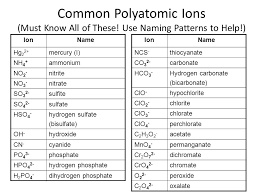
Using that polyatomics chart and what you know, try to form a formula.
zarkam21:
general chemistry
lowkey:
Prepare to memorize it, just a side note. I'm in college level chemistry in high school, and they made me remember them.
zarkam21:
Okay thanks for the chart i really appreciate it
zarkam21:
and I got umm ammonium chlorate?
lowkey:
Of course, that chart is your drugs to passing chemistry
lowkey:
And yes, you are right
zarkam21:
PbO would just be Lead oxide?
lowkey:
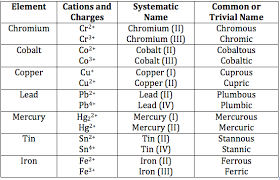
Partially right :P You see in the chart that Lead has multiple charges, right?
zarkam21:
NO :/
lowkey:
Oh, it doesn't say! I'm sorry.
lowkey:
if you have like a chemistry go-to folder, add that polyatomic list and this one.
 lowkey:
Now, looking at that chart you can see that Lead has multiple charges, am I correct>
zarkam21:
Yup I see it
lowkey:
It has charge 2 and 4. Since it is common sence (as oxygen charge is -2 and lead must be 2 because the ratio is 1:1) that the lead is charge 2, we still have to show that Lead has the charge of two in this compound because it could be four.
lowkey:
Kind of confusing, I know. But to show that Lead has the charge of plus 2, you can add a parenthesis after Lead and add the roman numeral of how many charges they have.
lowkey:
So the actual answer would be Lead (ll) Oxide You were almost right ;P
 gabethebabe:
its easier if you just draw it
zarkam21:
Give the systematic name for the compound Mg(NO3)2.
zarkam21:
Magnesium Nitrate?
zarkam21:
for this one
lowkey:
Yep!
zarkam21:
Fe2(SO4)3.
zarkam21:
I know the first one is Iron (ii) but not sure if it is sulfate or sulfide
lowkey:
No, the iron has either a charge 2 or 3, and in this case, it is a 3 because |dw:1539491364144:dw|
lowkey:
Does that make sence?
zarkam21:
A little
zarkam21:
So it would be Iron (III) Sulfate?
lowkey:
Since the charge of one sulfate ion is -2, and there are three of them, the overall charge is -6. The other element always has to have the same opposite charge, so Fe2 must be 6. There are two, and so we divide it by two, and so the charge of one iron is 3. So the formula is Iron (lll) sulfate
zarkam21:
OH i get it
zarkam21:
barium oxide.
zarkam21:
would be BaO
zarkam21:
?
lowkey:
yes, thats correct
zarkam21:
lead(II) phosphate is Pb^+2 P
lowkey:
Not quite. Remember the polyatomic ions, phosphate is PO4
zarkam21:
oh right so Pb^+2 PO4
lowkey:
Lead is Pb, and charge is either 2 or 3. Phosphate is PO4, and charge is -3. To balance, we have to find a common multiplier for 2 and 3, which is 6.
lowkey:
Lead must be charge three because phosphate is 2.
zarkam21:
Oh it always has to be in its balanced form
lowkey:
Yes
zarkam21:
Pb^+3 PO2
zarkam21:
:)
lowkey:
The formula for phosphate is PO4
zarkam21:
SO is it 3Pb 4PO4
lowkey:
it would be Pb3(PO4)2 You were very close.
lowkey:
The charges have to be equal, Pb charge is 2, multiply by 3=6 Phosphate charge is -3, multiply by 2=-6 They are both equal.
zarkam21:
is the 3 an expoonent?
lowkey:
No, there would be no exponents
lowkey:
\[Pb _{3}(PO _{4})_{2}\]
Join our real-time social learning platform and learn together with your friends!
 Demon25:
For a hoco proposal with a cheerleader and football player, what else should be a
Demon25:
For a hoco proposal with a cheerleader and football player, what else should be a

 Breathless:
TOC: "MGF any confirmation on the commander? we require confirmation as soon as[radio static].
Breathless:
TOC: "MGF any confirmation on the commander? we require confirmation as soon as[radio static].
 EdwinJsHispanic:
I wrote something that I don't know if I want it as a poem or song, Please let me know on yours thoughts about it, I'm still doing this! "Broken promises an
EdwinJsHispanic:
I wrote something that I don't know if I want it as a poem or song, Please let me know on yours thoughts about it, I'm still doing this! "Broken promises an
 thehearken:
hi um I don't know if this is the right section for this, but can someone go over my poem and tell me if its good enough to give my English professor for a
thehearken:
hi um I don't know if this is the right section for this, but can someone go over my poem and tell me if its good enough to give my English professor for a
 heartlessprophet:
Aye what's 19z%u00f74p=9u03c0 my teacher thinking of impossible questions for us
heartlessprophet:
Aye what's 19z%u00f74p=9u03c0 my teacher thinking of impossible questions for us
 kippppp:
does anyone have any good tips for writing stories? i'm trying to write a dnd campaign but i'm not that great of a writer yet.
kippppp:
does anyone have any good tips for writing stories? i'm trying to write a dnd campaign but i'm not that great of a writer yet.
 GRIZZLEY19:
Y'all let me know what y'all think about this beat I made I took me like a hour maybe rate it 0/10 https://drive.
GRIZZLEY19:
Y'all let me know what y'all think about this beat I made I took me like a hour maybe rate it 0/10 https://drive.
 Ultrilliam:
Welcome to the 10th Anniversary Update! (Part 2) Sorry this one passed the date a
Ultrilliam:
Welcome to the 10th Anniversary Update! (Part 2) Sorry this one passed the date a
 Twaylor:
was walking downtown and my adhd brain wanted to make some (rock?) lyrics: There'
Twaylor:
was walking downtown and my adhd brain wanted to make some (rock?) lyrics: There'