
 kaylak:
need calc help ASAP
 kittybasil:
@kaylak post your question content when you can ok? :) (Also please at least show effort in your questions, like your best guess. We can't do all the work for you)
kaylak:
I am and have a lot of the questions are already answered
 kaylak:
are the above correct?
 mhchen:
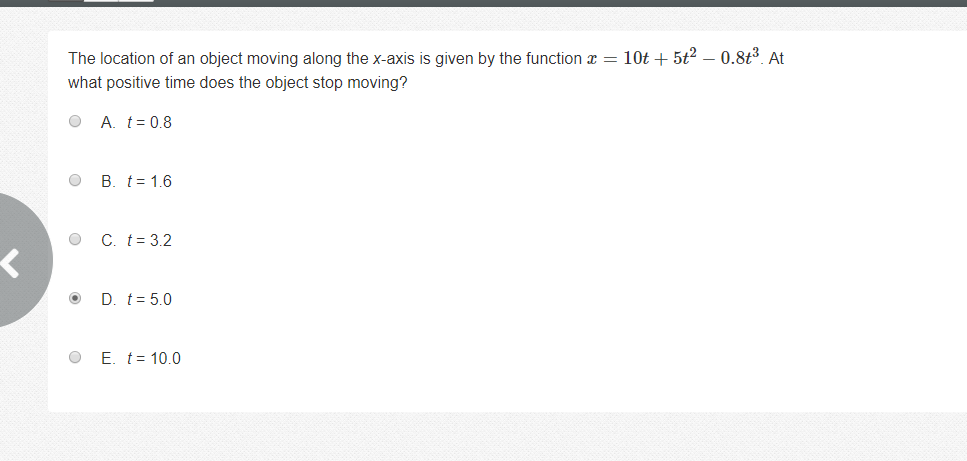
Okay let me check the first one. Derivative of x = 10t + 5t^2 -0.8t^3 is x' = 10 + 10t - 2.4t^2 Your answer: When t = 5: 0 = 10 + 10(5) - 2.4(5^2) = 10 + 50 - 2.4(25) = 60 - 60 = 0 Yes the first one is correct
kaylak:
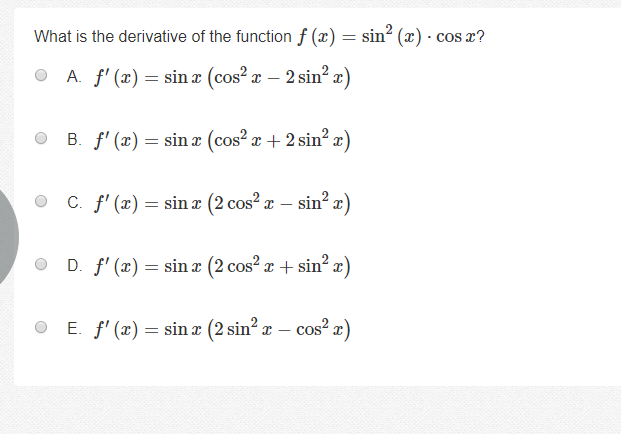
I want to say d for the first sone of the set and I know the derivative for the second just not sure how to factor it right
 mhchen:
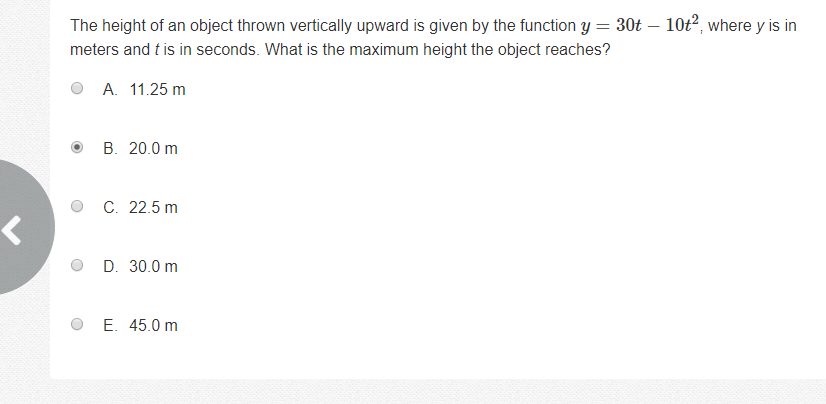
Second one: derivative of y = 30t - 10t^2 y' = 30 - 20t Maxiumum height is when the speed turns from positive to negative (when y' = 0) 0 = 30-20t t = (-30)/(-20) = 1.5 seconds Plugging that in y = 30(1.5) - 10(1.5)^2 = 45 - 22.5 = 22.5. I got a different answer.
kaylak:
oh the second to the set I put up is c nevermind
mhchen:
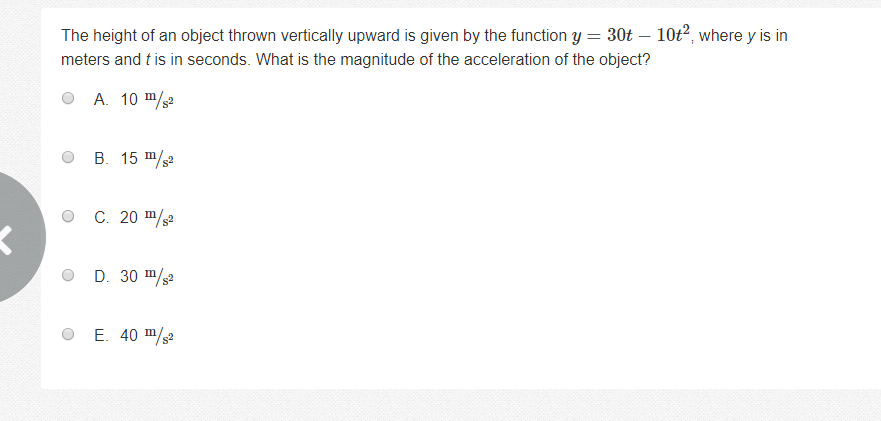
For the third one: I don't think it's D. The acceleration is just the derivative twice. Velocity: 30 - 20t Acceleration: -20 Magnitude of Acceleratoin: 20.
kaylak:
okay ty I think I understand it a bit more
kaylak:
so 4 is correct?
kaylak:
\(\color{#0cbb34}{\text{Originally Posted by}}\) @kaylak I want to say d for the first sone of the set and I know the derivative for the second just not sure how to factor it right \(\color{#0cbb34}{\text{End of Quote}}\) c
mhchen:
give me a second for the 4th one
 mhchen:
Yes. 4 is c. Although it's kinda complicated to get there. I used https://www.symbolab.com/solver/step-by-step/%5Cfrac%7Bd%7D%7Bdx%7D%5Cleft(sin%5E%7B2%7Dxcosx%5Cright) Symbolab is like a step-by-step calculator
kaylak:
cool the next 4 above most should be answered
kaylak:
1 c?
kaylak:
2 b
mhchen:
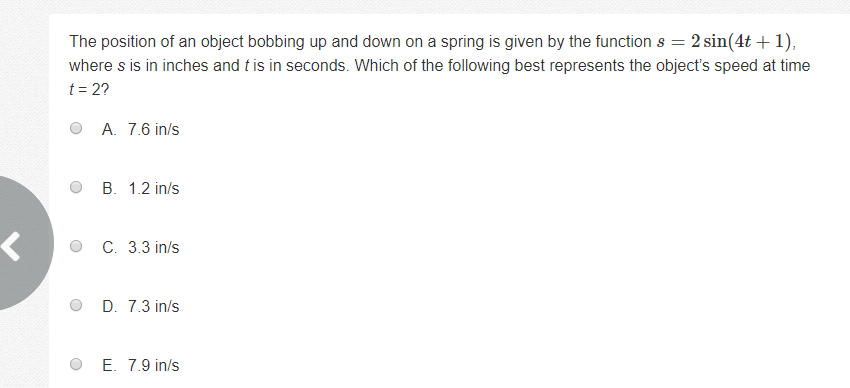
okay for the next 4: The first one: the speed is 2cos(4t+1)(4) = 8cos(4t+1) 8cos(4(2)+1) = 8cos(9) = 7.3 ish.
mhchen:
You know how to take derivatives of sin right?
kaylak:
sin is cos I believe right?
kaylak:
the derivative
mhchen:
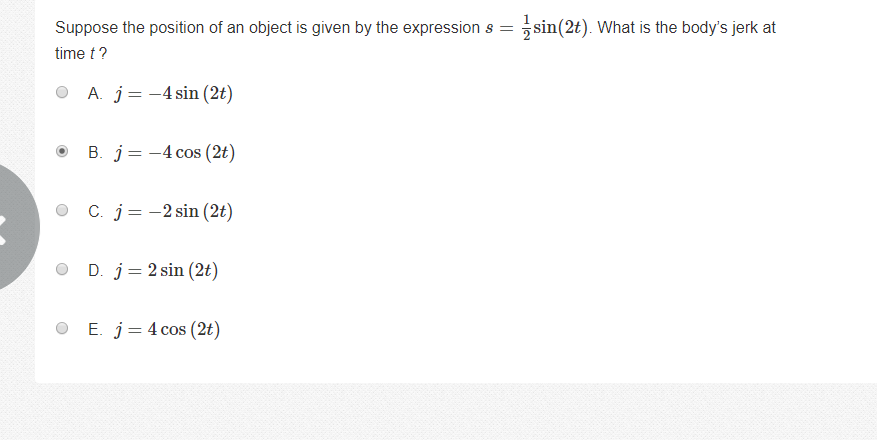
yeah I assume for 2. The 'jerk' is acceleration 1/2sin(2t) First derivative: cos(2t) Second derivative: 2(-sin(2t)) = -2sin(2t)
kaylak:
no jerk is 3rd derivative
mhchen:
oh well then
kaylak:
I think I calculated that one in mathway so it's okay
mhchen:
Yeah you're right then for 2.
kaylak:
3 not sure
kaylak:
4 is d
mhchen:
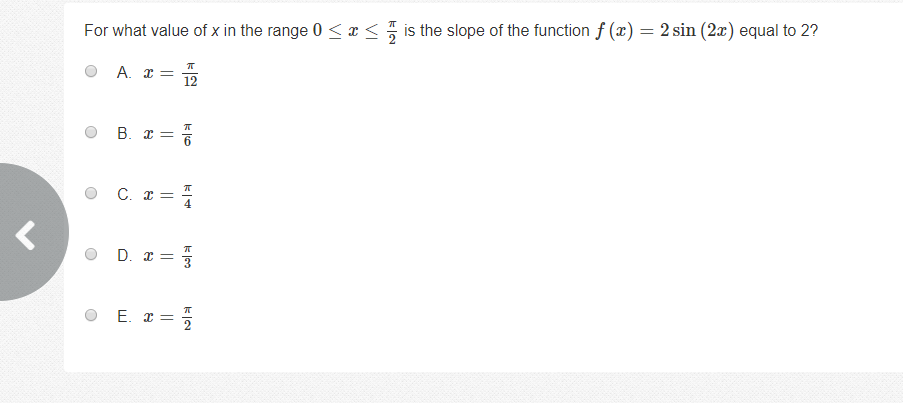
So the slope would be the value of the first derivative. Basically when is f'(x) = 2 f'(x) = 2cos(2x)*2 = 4cos(2x) Basically solve for x: 4cos(2x) = 2
kaylak:
so e?
mhchen:
uh well 4cos(2x) = 2 cos(2x) = 1/2 We know cos(a) = 1/2 then a = pi/3 So 2x = pi/3 x = pi/6 I think b
kaylak:
okay fair enough and 4 is d?
mhchen:
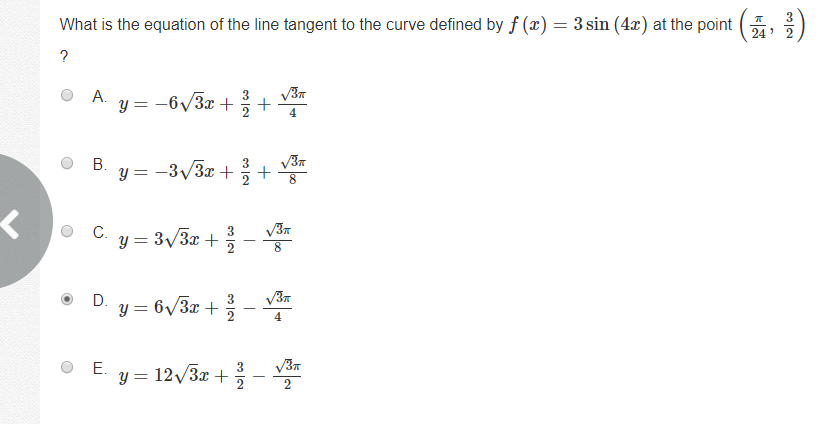
Yes. I got the slope to be 6 square-root of 3. So yah d
kaylak:
yay 5 more questions and I'm done!




 mhchen:
okay holy crap. For the first one there's division and we know (a/b)' = (a'b-ab')/(b^2)
mhchen:
So in your problem that'll be \[\frac{(x+a)'(x+b)-(x+a)(x+b)'}{(x+b)^2}\] are you able to simplify that?
kaylak:
give me a sec
mhchen:
(x+a)' is literally just 1. It should be very quick to simplify it
kaylak:
yes I am just writing it down because I have to show my work lol
mhchen:
okay lol
kaylak:
wouldn't it be like 1/x^2 or something
kaylak:
hold on it is -a-b/(b+x)^2
kaylak:
@mhchen
mhchen:
I got b-a on the numerator
kaylak:
oh crap the fundamental definition not a regular derivative
mhchen:
\[\frac{(x+b)-(x+a)}{(x+b)^2} = \frac{b-a}{(x+b)^2}\]
mhchen:
nah just simplifying mistakes
kaylak:
oh I got it I was about to ask how but I understand now lol
mhchen:
For the 2nd picture. You go the same thing. Find the derivative. Plug in (1) for x to get the slope. Then once you know the slope. 2 = (slope)(1) + b solve for b
kaylak:
derivative is 3x^2-1/2xsquare root x
kaylak:
slope is 1 ?
mhchen:
I got something completely different. \[\frac{(x^2+1)'(\sqrt{x})-(x^2+1)(\sqrt{x})'}{x}\] you started here right?
mhchen:
\[\frac{(2x)(\sqrt{x})-(x^2+1)(\frac{1}{2}x^{-\frac{1}{2}})}{x}\]
mhchen:
Plug in x=1: \[\frac{2-2*\frac{1}{2}}{1} = 2-1\] well yeah slope is still 1 lol
kaylak:
lol and b is 1 I guess lol
kaylak:
my formula I use was similar but not the exact same but I still got the answer lol
kaylak:
so what's the equation of the tangent line lol?
mhchen:
y = (slope)x + b y = 1x + 1 That's basically it
kaylak:
ah lol
kaylak:
3 more questions and then we are done
mhchen:
For the 3rd question: It's asking what x is when the speed is -10 So first we find the derivative: 30 - 10t And we find t when -10 = 30 - 10t What's t?
kaylak:
t=4
mhchen:
ye now we plug that back into the position function x = 30t - 5t^2
kaylak:
-50
mhchen:
x = 30(4) - 5(4^2) = 120 - 5(16) = 120 - 80 = 40
kaylak:
crap I forgot the other x
kaylak:
let me fix that
kaylak:
2 more
mhchen:
okay so for the 4th picture. It basically wants the derivative of the formula of a sphere. but then rewrite it in a V/r form this looks hard to me holy crap
mhchen:
okay I got. First what is the derivative of (4/3) * pi * r^3
kaylak:
4pir^2
mhchen:
yeah. Now we need to get it in a * V/r form To do that I did this: \[4\pi r^2 * (\frac{V}{r}*\frac{r}{V}) = 4\pi r^2 * (\frac{r}{\frac{4}{3}\pi r^3}) \frac{V}{r}\]
mhchen:
Can you simplify that? Leave the V/r alone of course
kaylak:
I got r=3square root 6vpi/2pi but now I'm confused is the formula wrong?
kaylak:
you deleted your comment
mhchen:
I got 3
mhchen:
\[\frac{4\pi r^{3}}{\frac{4}{3}\pi r^3}\] = 3
kaylak:
oh okay
kaylak:
we are going to have a new curriculum where we are taught better lol have to finish the old curriculum first
kaylak:
so now we have to get it in the v/r form?
kaylak:
@mhchen
mhchen:
It's already in V/r form 3 V/r
mhchen:
I left the V/r alone when I simplified my equation. So it's still there.
kaylak:
oh okay
kaylak:
last one!
mhchen:
alright last question: take the derivative of sinx + cosx twice and then plug pi/4 in it
kaylak:
-square root 2
kaylak:
?
kaylak:
@mhchen
mhchen:
ye
kaylak:
yay
kaylak:
ty so much!
mhchen:
np
Join our real-time social learning platform and learn together with your friends!
 Demon25:
For a hoco proposal with a cheerleader and football player, what else should be a
Demon25:
For a hoco proposal with a cheerleader and football player, what else should be a

 Breathless:
TOC: "MGF any confirmation on the commander? we require confirmation as soon as[radio static].
Breathless:
TOC: "MGF any confirmation on the commander? we require confirmation as soon as[radio static].
 EdwinJsHispanic:
I wrote something that I don't know if I want it as a poem or song, Please let me know on yours thoughts about it, I'm still doing this! "Broken promises an
EdwinJsHispanic:
I wrote something that I don't know if I want it as a poem or song, Please let me know on yours thoughts about it, I'm still doing this! "Broken promises an
 thehearken:
hi um I don't know if this is the right section for this, but can someone go over my poem and tell me if its good enough to give my English professor for a
thehearken:
hi um I don't know if this is the right section for this, but can someone go over my poem and tell me if its good enough to give my English professor for a
 heartlessprophet:
Aye what's 19z%u00f74p=9u03c0 my teacher thinking of impossible questions for us
heartlessprophet:
Aye what's 19z%u00f74p=9u03c0 my teacher thinking of impossible questions for us
 kippppp:
does anyone have any good tips for writing stories? i'm trying to write a dnd campaign but i'm not that great of a writer yet.
kippppp:
does anyone have any good tips for writing stories? i'm trying to write a dnd campaign but i'm not that great of a writer yet.
 GRIZZLEY19:
Y'all let me know what y'all think about this beat I made I took me like a hour maybe rate it 0/10 https://drive.
GRIZZLEY19:
Y'all let me know what y'all think about this beat I made I took me like a hour maybe rate it 0/10 https://drive.
 Ultrilliam:
Welcome to the 10th Anniversary Update! (Part 2) Sorry this one passed the date a
Ultrilliam:
Welcome to the 10th Anniversary Update! (Part 2) Sorry this one passed the date a
 Twaylor:
was walking downtown and my adhd brain wanted to make some (rock?) lyrics: There'
Twaylor:
was walking downtown and my adhd brain wanted to make some (rock?) lyrics: There'