
 zarkam21:
limits?
 Vocaloid:
do you have any specific questions?
zarkam21:
Maybe just a defintion first :S
zarkam21:
I actually can make a "cheat sheet" and put whatever I want on the sheet
zarkam21:
And my professor gave us a list of topics and the first is limits so I know I should put examples on there
zarkam21:
but like idk where to start :S
zarkam21:
:/
Vocaloid:
"the value that a function approaches as the domain approaches a certain value"?
Vocaloid:
if your prof. uses delta/epsilon definitions, include those as well
zarkam21:
no he doesn't use those
zarkam21:
its calc IA so
Vocaloid:
|dw:1541119790020:dw| alright what else do you want to know?
zarkam21:
maybe some examples of problems with limits :S
zarkam21:
Ugh I'm not sure
Vocaloid:
https://www.math.ucdavis.edu/~kouba/ProblemsList.html try the first two links "limit of a function as x approaches a constant" and "limit of a function as x approaches infinity"
Vocaloid:
but the general approach: first you try plugging in x, if you get something undefined from that, try other techniques like l'hopital's or re-writing the function
 zarkam21:
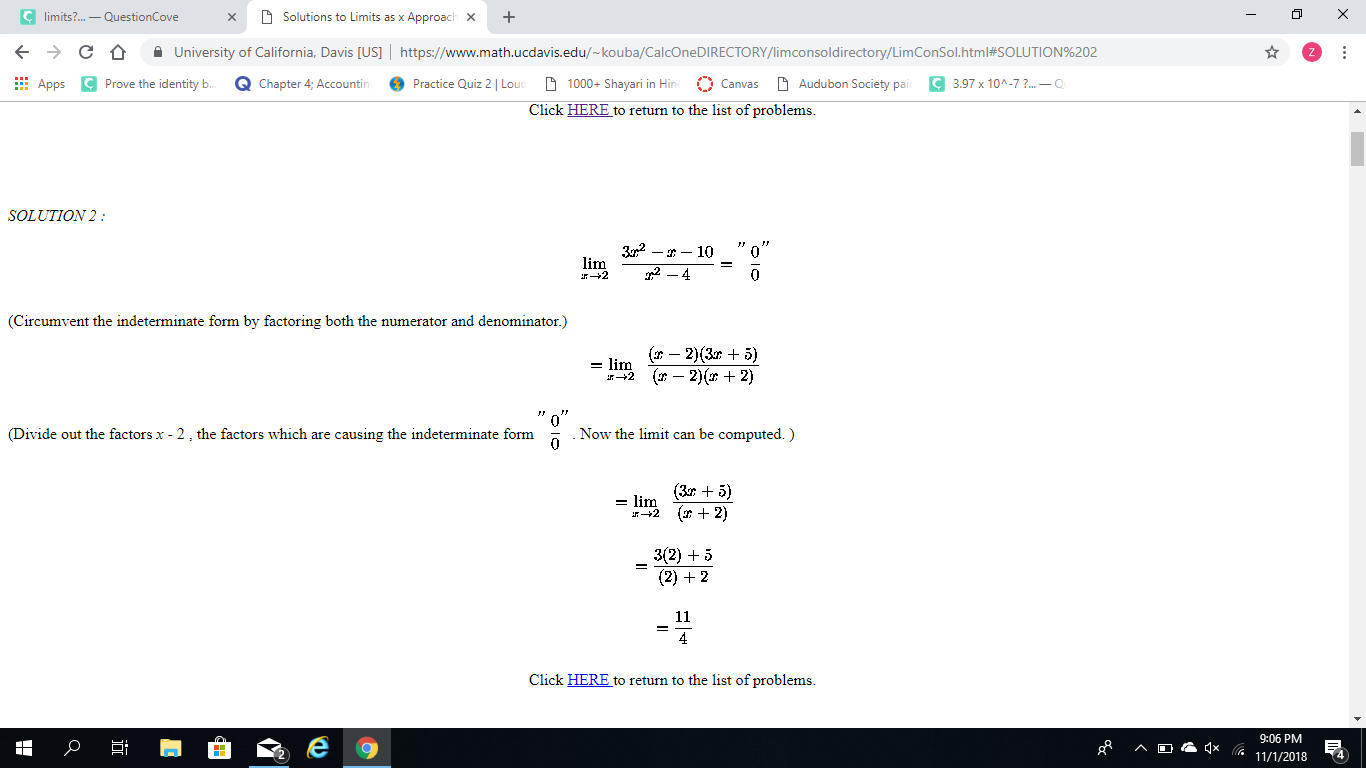
SO for this i got the 0 over o part but Idk what is going on after could you just explain it to me
Vocaloid:
since 0/0 is undefined they factored the numerator and denominator, cancelled out then they cancelled out the (x-2) from the numerator and denominator after that, you can now plug in x = 2 and get something defined
Vocaloid:
special note: 0/0 is called indeterminate form
zarkam21:
oh so basically just take the dactored form and subsitute in that
Vocaloid:
yes
zarkam21:
Gonna just do a few more practice problems and then I'll be back in like 5 mins
 zarkam21:
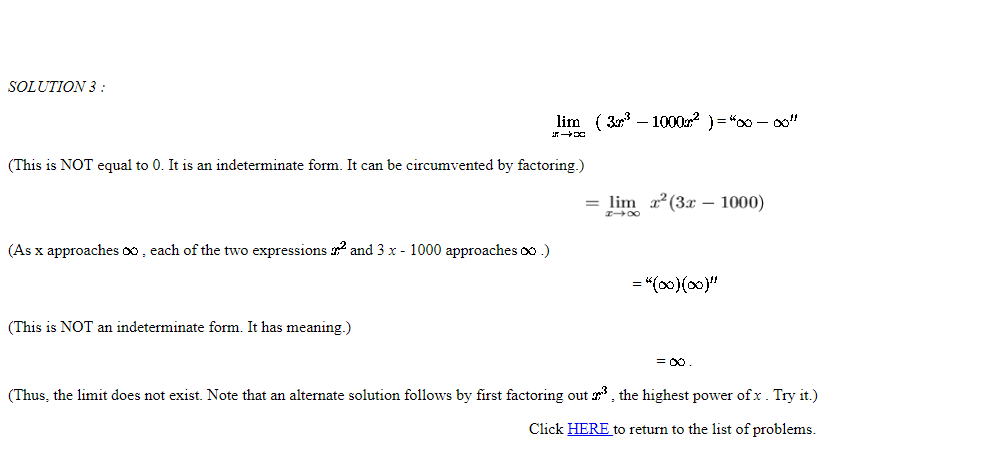
Don't get how this wouldn't be zero
Vocaloid:
infinity's not really a number so "infinity minus infinity" isn't really 0 in this case the higher exponent, at very very high values, makes the lower exponent kind of irrelevant, so the function will just keep increasing at x ---> infinity
zarkam21:
Next topic product rule =)
Vocaloid:
for derivatives?
zarkam21:
Yes
Vocaloid:
|dw:1541122317347:dw|
Vocaloid:
if you have a specific example we can work through it together i gues
Vocaloid:
would def. recommend memorizing this or writing it down on your cheat sheet
zarkam21:
Yeh, I just wrote it
zarkam21:
OKay I have handouts he gave so I can just show that and we can work through that and I will just write them as "practice problems" on the cheat sheet?
zarkam21:
Do you think that woul dbe good
zarkam21:
or should I do something else to practice product rule
Vocaloid:
idk if you should put them on the cheat sheet (that takes up valuable space) but working through them would be good
 zarkam21:
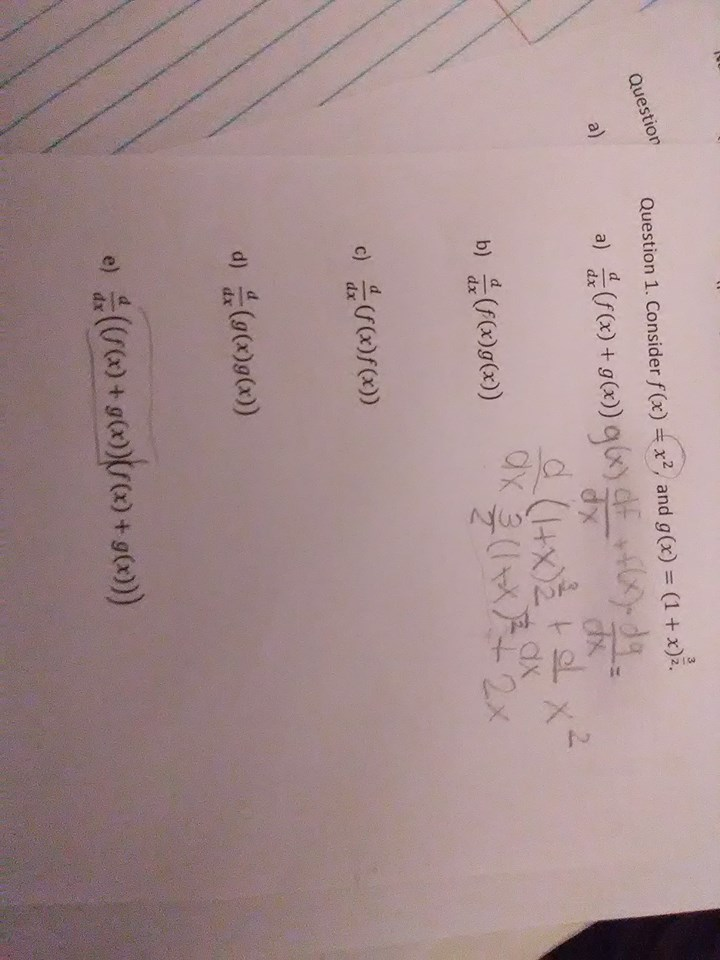
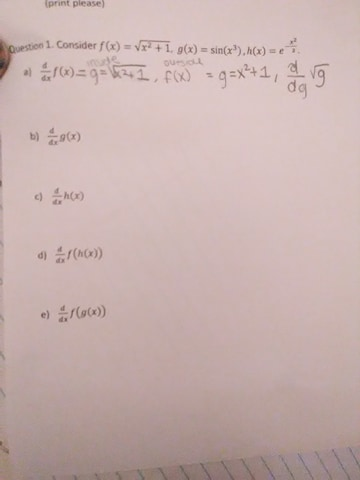
I have the handouts all mixed up but this would be on where i would use product rule right
Vocaloid:
yes
Vocaloid:
a) is asking for the derivative of the sum, not the product but for the rest, you should use the product rule
zarkam21:
sorry trying to take notes as I go
zarkam21:
the derivate of x^2 is 2x right
zarkam21:
and the derivative of g(x) is um 3/2+1
Vocaloid:
g(x) = (1+x)^(3/2) bring the exponent down --> (3/2) reduce the original exponent by 1 ---> (1+x)^(1/2) take the derivative of the base ---> derivative of 1 + x is just 1 so g'(x) = (3/2)(1+x)^(1/2) * 1
zarkam21:
okay for the sum I just do( (3/2)(1+x)^(1/2) * 1) + (2x)
Vocaloid:
yes
zarkam21:
do i actually solve or leave as is
Vocaloid:
there's nothing to solve for, it's asking for the derivative so that's it
zarkam21:
okay b would be ((2x) * (1+x)^3/2) + (3/2(1+x)^1/2*1)*x^2
Vocaloid:
yeah idk how picky they are with simplifying, but that's mathematically correct
zarkam21:
im not sure how to do c
Vocaloid:
it's the same logic as c, but instead of g(x) you just use f(x) again so derivative of f(x)*f(x) = f'(x)*f(x) + f(x)*f'(x)
Vocaloid:
remember that f and g are just arbitrary labels for the two component functions
zarkam21:
2x*x^2 + x^2 * 2x
Vocaloid:
good in this case, the algebraic simplification is very easy so they would probably expect you to simplify this down to 4x^3
zarkam21:
okay so for D it woul just be (3/2(1+x)^1/2*1 * (1+x)^3/2) + (1+x)^3/2) * (3/2(1+x)^1/2*1
Vocaloid:
yes since both terms are like terms you can add them to get 3(1+x)^1/2 * (1+x)^3/2) = 3(x+1)^2
Vocaloid:
if you're in a rush just try to get the derivative part right, and only simplify if you have time
zarkam21:
Yeah thats what Im gonna do like at the end if I have time ill simplify
zarkam21:
okay so for e : it woul djust be (f' * g )+(g'*f)(f' * g )+(g'*f)
zarkam21:
?
Vocaloid:
good attempt but you need to treat "f(x) + g(x)" as one whole unit derivative of [(f(x) + g(x)) * (f(x) + g(x))] ---> [ f(x) + g(x) ]' * [f(x) + g(x)] + [ f(x) + g(x) ] * [ f(x) + g(x) ]'
zarkam21:
I'm not sure where i would use prime and where not :S
Vocaloid:
just fill in [ f(x) + g(x) ]' with your solution from part a) since you've already done that
zarkam21:
oh okay
zarkam21:
( (3/2)(1+x)^(1/2) * 1) + (2x) * ( (3/2)(1+x)^(1/2) * 1) + (2x)
Vocaloid:
gonna use different variables to make this more clear d/dx of a(x) * b(x) --> a'(x)b(x) + a(x)b'(x) replace a(x) with "f(x) + g(x)" replace b(x) with "f(x) + g(x)" d/dx of [f(x) + g(x)] * [f(x) + g(x)] --> [f(x) + g(x) ]'[f(x) + g(x)] + [ f(x) + g(x) ]'[f(x) + g(x)]
Vocaloid:
uh
zarkam21:
it would just be the answer from part a being multiplies by each othr rigt
zarkam21:
because part a is asking for f(x)+g(x)
Vocaloid:
no it's a little more complicated than that
Vocaloid:
so we know that f(x) + g(x) = x^2 + (1+x)^(3/2) and [f(x) + g(x)]' = 2x + (3/2)(1+x)^(1/2) so plugging both of these into the product rule: [f(x) + g(x) ]'[f(x) + g(x)] + [ f(x) + g(x) ]'[f(x) + g(x)] ---> [x^2 + (1+x)^(3/2)]*[ 2x + (3/2)(1+x)^(1/2) ] + [ 2x + (3/2)(1+x)^(1/2) ] * [x^2 + (1+x)^(3/2)]
zarkam21:
oh okay so we don't only take the answer from part one but combine them to get it
zarkam21:
I see
zarkam21:
do you think there will be problems with the product rule with actual numbers?
zarkam21:
wait Water these are numbers
zarkam21:
wth*
zarkam21:
Sorry my brain is fried
zarkam21:
okay i think I got the product rukle down
Vocaloid:
have you learned quotient rule yet? that's another good one to add
zarkam21:
That was gonna be next =)
Vocaloid:
|dw:1541125431921:dw| the lo d hi stuff is a mnemonic device, just write down the top part
 zarkam21:
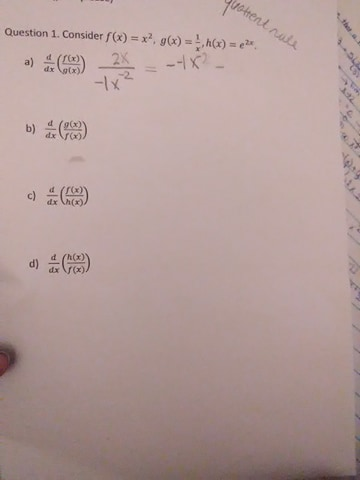
which one is the qr one
Vocaloid:
the one where you're asked to take the derivative of a quotient (f(x)/g(x)) or something similar
Vocaloid:
just be aware you can't just take the derivative of the numerator/derivative of the denominator and call it a day, it follows a very specific format (see above)
zarkam21:
ut would it be similar. I would start by just taking the individuals derivatives of f(x), g(x), and h(x) right
Vocaloid:
yes
zarkam21:
the derivative of 1/x = 1/(x^2) :S ??
Vocaloid:
almost, -1/x^2
Vocaloid:
1/x = x^(-1) bring the exponent down --> -1 reduce the exponent by 1 --> x^(-2) so -1/x^2
zarkam21:
and then 2x e ?
zarkam21:
then we would do for a (2x/(-1/x^2))
Vocaloid:
again, you cannot just take derivative of numerator/derivative of denominator|dw:1541126393673:dw|
Vocaloid:
derivative of f(x) = 2x derivative of g(x) = (-1/x^2) so derivative of f(x)/g(x) ---> [ (1/x)*2x - x^2*(-1/x^2) ] / (1/x)^2
Vocaloid:
|dw:1541126523002:dw|
zarkam21:
Oh I see
zarkam21:
Basically just go by the formual and don't worry about whay they gvie
Vocaloid:
yes
zarkam21:
|dw:1541126920773:dw|
zarkam21:
Isn't this number supposed to be 2x because f' is 2x
Vocaloid:
in your specific situation, yes
zarkam21:
\(\color{#0cbb34}{\text{Originally Posted by}}\) @Vocaloid derivative of f(x) = 2x derivative of g(x) = (-1/x^2) so derivative of f(x)/g(x) ---> [ (1/x)*2x - x^2*(-1/x^2) ] / (1/x)^2 \(\color{#0cbb34}{\text{End of Quote}}\)
Vocaloid:
wait a sec
Vocaloid:
oh wow that graphic actually has a typo
Vocaloid:
|dw:1541127066769:dw|
zarkam21:
f(x)/g(x) ---> [ (1/x)*2x - 2x*(-1/x^2) ] / (1/x)^2
zarkam21:
Lol what
Vocaloid:
the numerator should be g(x) * f'(x) - f(x) * g'(x) not g(x) * f'(x) - f'(x) * g(x)
zarkam21:
so (1/x)*(2x) - (x^2)*(-1/x^2) / (1/x)^2
Vocaloid:
yes just be careful with parentheses [(1/x)*(2x) - (x^2)*(-1/x^2)] / (1/x)^2
zarkam21:
okay so for b same thing right
zarkam21:
jusgt swtich the letters
zarkam21:
the values I mean
Vocaloid:
yes
zarkam21:
so would it be f(x)g'(x) - g(x)f'(x) / (f(x))^2
Vocaloid:
yes
zarkam21:
okaay and what about if we were to use f(x)/h (x)
zarkam21:
h would just take the place of g?
Vocaloid:
yes
zarkam21:
Okay I think we can move on , do you think this is all I needed to know for quotient rule?
Vocaloid:
yes, just know what the rule is and how to use it
zarkam21:
Okay should we up a new post ? or is this good
Vocaloid:
new post would be good
Join our real-time social learning platform and learn together with your friends!
 KBaby:
Verse 1 We left our names in the dust of the driveway Watched the old town shrink
KBaby:
Lyrics Generator Use AI to write the lyrics for a song. Suggested Genres: Pop Hip
KBaby:
Verse 1 We left our names in the dust of the driveway Watched the old town shrink
KBaby:
Lyrics Generator Use AI to write the lyrics for a song. Suggested Genres: Pop Hip

 aitexturegenerator:
How are you all handling AI-generated textures for 3D models and game assets without losing the hand-made feel? I've been doing a small stylized environment
aitexturegenerator:
How are you all handling AI-generated textures for 3D models and game assets without losing the hand-made feel? I've been doing a small stylized environment

 Demon25:
Woke up feeling like that girl and that dude well he still aint crap pluse the du
Demon25:
Woke up feeling like that girl and that dude well he still aint crap pluse the du
 playtsec:
how do I get rid of stress from teachers... I just feel like running out the classroom and leaving on my own.
playtsec:
how do I get rid of stress from teachers... I just feel like running out the classroom and leaving on my own.
 JohnnyLFowler0812:
What type of gamer would play something and then get off for a while. Why not sta
JohnnyLFowler0812:
Which is better? Metallica Rap Country R&B hiphop Medal Gospel Chill Which 3 opti
JohnnyLFowler0812:
What type of gamer would play something and then get off for a while. Why not sta
JohnnyLFowler0812:
Which is better? Metallica Rap Country R&B hiphop Medal Gospel Chill Which 3 opti