
 zarkam21:
Chain Rule
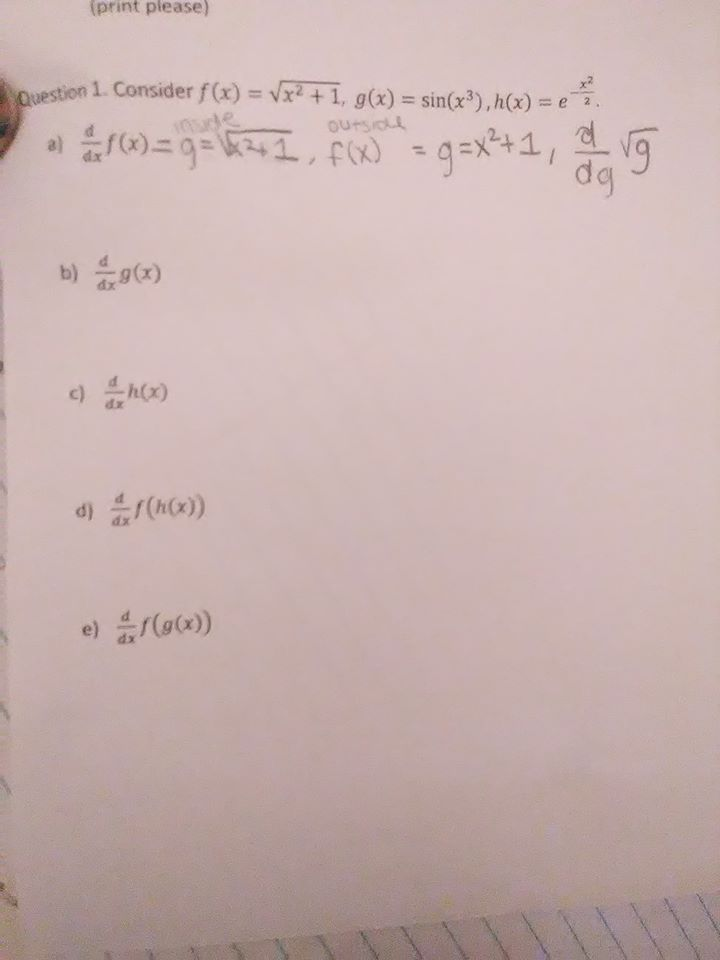 zarkam21:
Is this the chain rule one
 Vocaloid:
yes but pay attention to what the question is actually asking a, b, and c do not require the chain rule as they are not compositions of functions
Vocaloid:
a, b, and c are just straightforward derivatives of f, g, and h separately for d) you will apply the chain rule to f(h(x)) and for e) you will apply the chain rule to f(g(x))
zarkam21:
derivative of f(x) woild be 2x?
zarkam21:
because 1 is constant so 0
Vocaloid:
no, the square root makes a big difference here f(x) = (x^2+1)^(1/2) f'(x) = (1/2)(x^2+1)^(-1/2)*(2x)
zarkam21:
wait where's the hLF?
zarkam21:
isn't it just sqrt x^2+1
Vocaloid:
sqrt (x^2+1) = (x^2+1)^(1/2)
Vocaloid:
|dw:1541128952383:dw|
Vocaloid:
my reasoning for re-writing sqrt (x^2+1) as (x^2+1)^(1/2) makes it easier to take the derivative using the power rule
zarkam21:
GOt it
zarkam21:
the derivative for sin 3x would be 3xsin?
zarkam21:
(3x) sin ^2
Vocaloid:
have to apply chain rule for sin(A), change sin to cos, then multiply by the derivative of A so derivative of sin(x^3) --> cos(x^3) * the derivative of x^3
zarkam21:
oh okay so the dr of sin x^3 is cos x^3
Vocaloid:
"cos(x^3) * the derivative of x^3" so not just cos(x^3), cos(x^3) * 3x^2
zarkam21:
oh oksy
Vocaloid:
depending on what you've covered in class you may want to add at least the first three to your cheat sheet |dw:1541129803699:dw|
zarkam21:
okay and when i find the derivaitver its like the = whatever * derivative of x as the answer right
Vocaloid:
* derivative of what's inside the trig function, yes
Vocaloid:
so like, d/dx sin(A) = cos(A) * A'
Vocaloid:
it won't always be x, gotta apply to what you are given
zarkam21:
right
zarkam21:
can we just do maybe one or two more examples of the chain rule, not 100% on it yet :S
Vocaloid:
have you tried the other problems on your WS?
zarkam21:
OH forgot about those okay so for d :
zarkam21:
f(h(x)) = it would jutbe (1/2)(x^2+1)^-1/2 (2x)
Vocaloid:
f(h(x)) derivative ---> f'(h(x)) * h'(x)
zarkam21:
it would just be one inside the other right
Vocaloid:
f'(x) = (1/2)(x^2+1)^(-1/2)*(2x) as we calculated from step a) f'(h(x)) is therefore (1/2)([e^(-x^2/2)]^2+1)^(-1/2)*(2[e^(-x^2/2)]^2) then you will have to multiply this whole expression by the derivative of h(x)
zarkam21:
UGh not understanding how you got the equation f'(h(x))
Vocaloid:
|dw:1541130865216:dw| it's part of the definition of the chain rule
zarkam21:
Still here just writing notes
zarkam21:
\(\color{#0cbb34}{\text{Originally Posted by}}\) @Vocaloid f'(x) = (1/2)(x^2+1)^(-1/2)*(2x) as we calculated from step a) f'(h(x)) is therefore (1/2)([e^(-x^2/2)]^2+1)^(-1/2)*(2[e^(-x^2/2)]^2) then you will have to multiply this whole expression by the derivative of h(x) \(\color{#0cbb34}{\text{End of Quote}}\)
zarkam21:
SO this is the definition of chain rule
Vocaloid:
\(\color{#0cbb34}{\text{Originally Posted by}}\) @Vocaloid f(h(x)) derivative ---> f'(h(x)) * h'(x) \(\color{#0cbb34}{\text{End of Quote}}\) this is the chain rule
Vocaloid:
the next post is just me going through the steps to calculate exactly what f'(h(x)) * h'(x) is
zarkam21:
Okay can we do e
zarkam21:
It would be
zarkam21:
f'(g(x)) * g'(x) f'(g(x)) * g'(x) is (1/2)(x^2+1)^-1/2(2x) * (sin(x^3) * (cos x ^3*3x^2)
Vocaloid:
almost "f'(g(x)) " so you have to plug g(x) into x for the derivative of f(x)
Vocaloid:
f'(x) = (1/2)(x^2+1)^-1/2(2x) so f'(g(x)) = (1/2)(g(x)^2+1)^(-1/2)(2*g(x))) then replace "g(x)" with the sin(x^3) since that's what g(x) is
Vocaloid:
then all of that * (cos x ^3*3x^2)
zarkam21:
so f'g(x)) would be f prime along with g of x
Vocaloid:
f'(g(x)) means take the derivative of f(x), then replace all the x's with g(x)
zarkam21:
okay next is implicit differentiation
Vocaloid:
|dw:1541132616187:dw|
Vocaloid:
|dw:1541132672962:dw|
zarkam21:
Can we try another example I am not getting the pictutre :S
Vocaloid:
you just take the derivative of both sides w.r.t x as normal if you have a mixed term like xy, you just apply the product rule to get x'y + y'x since you're solving for dy/dx (in other words, y') simplify everything except y' and then at the end, solve for y'
zarkam21:
intermeidate value theornm
zarkam21:
Ughim falling aaslpee
Vocaloid:
if a function is continuous between a and b such that f(a) < N < f(b) then there must be some value c in between a and b such that f(c) = N
Vocaloid:
another way to think about it: if the function is continuous then it must hit every possible value between f(a) and f(b)
zarkam21:
example ?
Vocaloid:
let's say f(x) is continuous between [1,2] f(1) = 1 f(2) = 2 we know there must be some x-value such that f(x) = 1.5 since 1.5 is between the two function values
Vocaloid:
|dw:1541133719905:dw|
Vocaloid:
|dw:1541133751142:dw|
zarkam21:
oh thats all its just picking a value in between? and showing it
Vocaloid:
yes, the IVT lets us prove that a certain x-value exists for a desired y-value
zarkam21:
could htis be possible with 1.3
zarkam21:
or maybe even 1.7
zarkam21:
and the value we come up with is y?
zarkam21:
what would be the x
Vocaloid:
yes, 1.3 and 1.7 are both within the bounds the IVT doesn't let us solve for x, it just lets us know that there's an x-value that exists for that y-value
zarkam21:
okay next is mean value theorem
zarkam21:
can open a new post? if you want
Vocaloid:
|dw:1541134136395:dw|
Vocaloid:
tbh i don't know how to use this practically, i just know that this exists
zarkam21:
Thats okay I'll study that one myself
zarkam21:
Linear and Quadratic Approx
zarkam21:
I have a handout for these
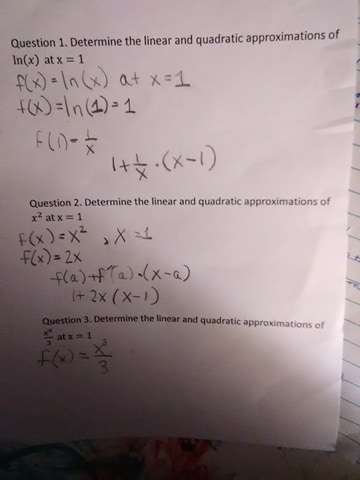 Vocaloid:
yeah you've pretty much got it
zarkam21:
Copied these from what my professor wrote :x
zarkam21:
Idk what I'm doing
Vocaloid:
just stick the formulas for linear and quadratic formulas on your cheat sheet
zarkam21:
:(
Vocaloid:
linear approximation y = f(a) + f'(a) * (x-a) at f(x) for x = a applying this logic to f(x) = ln(x) at x = 1 y = ln(1) + ln'(1) * (x-1)
Vocaloid:
slides 3-4 have the definitions you need http://www.math.tamu.edu/~shatalov/MATH%20151%20Project.pdf
zarkam21:
OKay what about critical and inflection points?
Vocaloid:
critical points = points where the derivative is 0 inflection points = points where the second derivative is 0
zarkam21:
Continuity?
Vocaloid:
|dw:1541135251075:dw|
Vocaloid:
there's a lot to know for this tbh
Vocaloid:
|dw:1541135283484:dw|
Vocaloid:
big thing: if a function is known to be differentiable on some interval it must be continuous but if a function is known to be continuous that doesn't necessarily mean its differentiable
Vocaloid:
ex: f(x) = |x| is continuous but not differentiable at x = 0
zarkam21:
and differentiable is just that a point exists right
Vocaloid:
differentiable = the derivative exists
zarkam21:
okay and last thing ,, graphing funcation at f' and f''
Vocaloid:
any examples?
zarkam21:
yes one sec
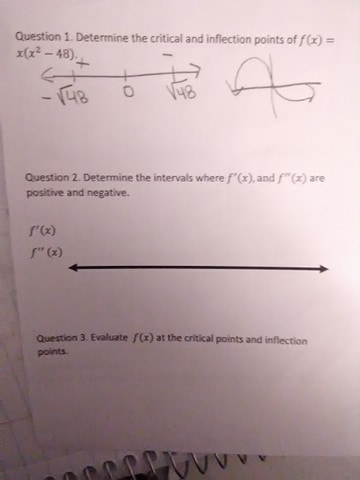
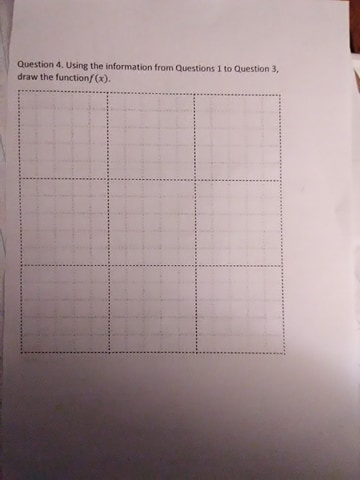 Vocaloid:
like, if they give you a graph f(x) and ask you to graph f'(x) you would graph the derivative |dw:1541135867652:dw|
Vocaloid:
oh well you have x(x^2-48) to find the critical points, find where the derivative is 0 and to find the inflection points find where the second derivative is 0
Vocaloid:
f'(x) = 3x^2 - 48 = 0 so the critical points are x = -4 and x = 4
Vocaloid:
for the intervals where f'(x) is +, -, or 0, we have to set up the number line: |dw:1541136044503:dw|
Vocaloid:
|dw:1541136071950:dw|
Vocaloid:
that tells you the function is increasing from -infinity to -4 decreasing from -4 to 4 increasing from 4 to infinity
Vocaloid:
same logic with the second derivative but instead of telling you where the function is increasing/decreasing, it tells you where the function is concave up or down
zarkam21:
Got it
Vocaloid:
|dw:1541136214437:dw| then once you have all the pieces, just put them together to make a function
zarkam21:
IIs that all?
Vocaloid:
yeah
Join our real-time social learning platform and learn together with your friends!
 KBaby:
Verse 1 We left our names in the dust of the driveway Watched the old town shrink
KBaby:
Lyrics Generator Use AI to write the lyrics for a song. Suggested Genres: Pop Hip
KBaby:
Verse 1 We left our names in the dust of the driveway Watched the old town shrink
KBaby:
Lyrics Generator Use AI to write the lyrics for a song. Suggested Genres: Pop Hip

 aitexturegenerator:
How are you all handling AI-generated textures for 3D models and game assets without losing the hand-made feel? I've been doing a small stylized environment
aitexturegenerator:
How are you all handling AI-generated textures for 3D models and game assets without losing the hand-made feel? I've been doing a small stylized environment

 Demon25:
Woke up feeling like that girl and that dude well he still aint crap pluse the du
Demon25:
Woke up feeling like that girl and that dude well he still aint crap pluse the du
 playtsec:
how do I get rid of stress from teachers... I just feel like running out the classroom and leaving on my own.
playtsec:
how do I get rid of stress from teachers... I just feel like running out the classroom and leaving on my own.
 JohnnyLFowler0812:
What type of gamer would play something and then get off for a while. Why not sta
JohnnyLFowler0812:
Which is better? Metallica Rap Country R&B hiphop Medal Gospel Chill Which 3 opti
JohnnyLFowler0812:
What type of gamer would play something and then get off for a while. Why not sta
JohnnyLFowler0812:
Which is better? Metallica Rap Country R&B hiphop Medal Gospel Chill Which 3 opti