
 kaylak:
help @shadow calc
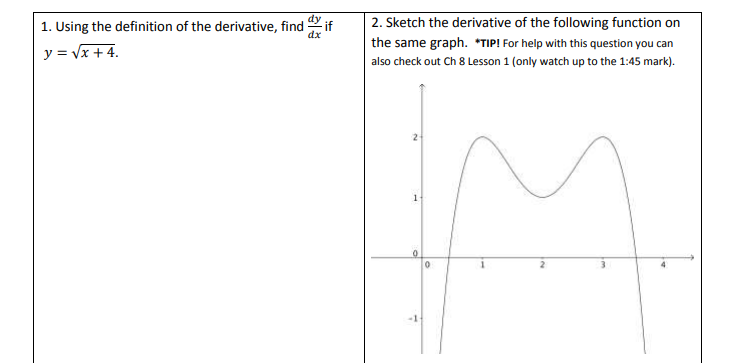 kaylak:
@mhchen
kaylak:
isn't it like 180 degrees of the graph sorta
 mhchen:
|dw:1541565888694:dw|
mhchen:
|dw:1541565932427:dw| Here's where the derivatives are 0
mhchen:
|dw:1541565957973:dw| and there's your slope graph
kaylak:
oh ok
kaylak:
up for 4 more problem? 1 is just an explaining something I have to record myself joy lol
 kittybasil:
Kayla, Shadow doesn't help with calculus. Try SmokeyBrown or sillybilly123 instead.
kaylak:
@Falconmaster yu said to tag you but I don't know if you do calc
 Falconmaster:
i do geometry but i can try
kaylak:
I have to show my work
Falconmaster:
it should show you the work -think emoji here-
kaylak:
not for free
Falconmaster:
hm idk im sorry Brainly?
kaylak:
@mhchen
mhchen:
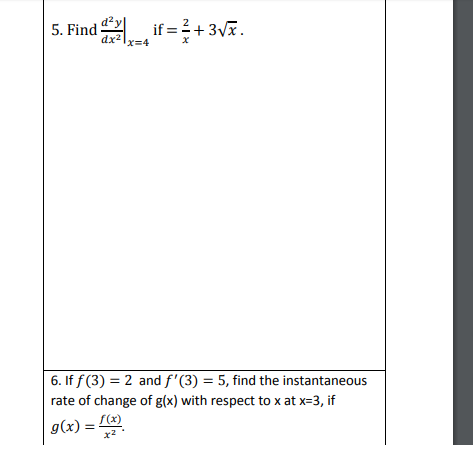
Okay so problem 5.
mhchen:
Basically find the second derivative of \[\frac{2}{x}+3\sqrt{x}\]
kaylak:
okay
mhchen:
You can re-write that as: \[2x^{-1}+3x^{\frac{1}{2}}\] Are you able to find the first derivative of that?
kaylak:
3/2x^1/2-2/x^2
kaylak:
second derivative is 4/x^3-3/4x^3/2
mhchen:
woah hold on. the first one should be 3/2^(-1/2) - 2/x^2
mhchen:
You see how the exponent is -1/2 instead of 1/2?
kaylak:
you're right
kaylak:
my teacher gave us the answers but basically wants us to show work to get them
kaylak:
so -3/2?
mhchen:
Yeah
kaylak:
but the rest is correct?
mhchen:
4/x^3-3/4x^(-3/2)
kaylak:
okay
kaylak:
then plug in 4?
mhchen:
Yup
mhchen:
I got -1/32
kaylak:
getting there but yes that's the answer lol
kaylak:
I got it lol
mhchen:
onto problem 6. Instantaneous rate of change just means the derivative. Can you find the derivative of f(x)/x^2
kaylak:
-f/y^2?
mhchen:
it should be like this: \[\frac{f'(x)x^2 - f(x)(x^2)'}{(x^2)^2}\] You know the formula for finding the derivative of division stuff right?
kaylak:
oh yeah I do remember that
kaylak:
and then would I plug x in ?
kaylak:
okay so I did something wrong I go 1/3 and need to have 11/27
mhchen:
yah
mhchen:
uh lemme try it myself
kaylak:
I plugged in the appropriate numbers for x f' and f
mhchen:
\[\frac{f'(3)(3)^2-f(3)(2(3))}{(3)^4} = \frac{(5)(9)-(2)(6)}{81}=\frac{45-12}{81}=\frac{33}{81}\]
kaylak:
oh hold on
kaylak:
got it now number 10
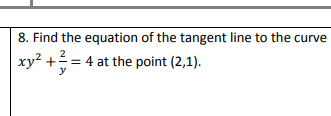 kaylak:
it is supposed to be x-2 not +2
mhchen:
|dw:1541613940118:dw|
mhchen:
oh uh lemme check 8 first then
mhchen:
I completely forgot how to do 8.
kaylak:
lol
kaylak:
I mean if you plugged in what I have it would still work
kaylak:
let's do 10 lol
mhchen:
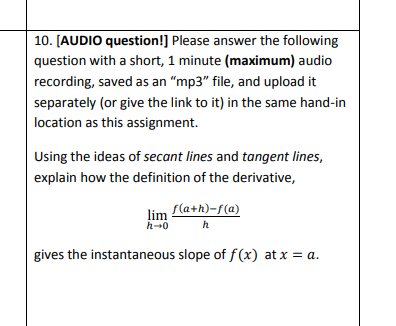
|dw:1541614275555:dw| This is a secant.
mhchen:
You see how 'a' is the starting point, and 'h' is how far away it goes
kaylak:
oh I see how 8 is correct
kaylak:
yes
mhchen:
So if you bring 'h' to 0, basically it becomes like this: |dw:1541614370964:dw|
mhchen:
That's a tangent line, AND it's the instantaneous slope at 'a'.
kaylak:
so f(a) is a secant?
kaylak:
just trying to write this down so I can record myself and explain lol
mhchen:
f(a) is just a point. Look at my first picture.|dw:1541614550531:dw| That line there is a secant, and it's made by \[\frac{f(a+h)-f(a)}{h}\] Here is the tangent (and instantaneous slope: |dw:1541614608605:dw| As you can see h is gone because this is \[lim_{h->0}\frac{f(a+h)-f(a)}{h}\]
kaylak:
is that h->0 in other words say it is going further away from 0?
kaylak:
in the negative
mhchen:
It's going towards 0.
mhchen:
It was positive before. But now it's getting smaller towards 0.
kaylak:
okay was a little confused for a sec but ty for the help!
kittybasil:
btw Symbolab is great for basic step-by-step walkthroughs of most calculus problems
Join our real-time social learning platform and learn together with your friends!
 KBaby:
Verse 1 We left our names in the dust of the driveway Watched the old town shrink
KBaby:
Lyrics Generator Use AI to write the lyrics for a song. Suggested Genres: Pop Hip
KBaby:
Verse 1 We left our names in the dust of the driveway Watched the old town shrink
KBaby:
Lyrics Generator Use AI to write the lyrics for a song. Suggested Genres: Pop Hip
 aitexturegenerator:
How are you all handling AI-generated textures for 3D models and game assets without losing the hand-made feel? I've been doing a small stylized environment
aitexturegenerator:
How are you all handling AI-generated textures for 3D models and game assets without losing the hand-made feel? I've been doing a small stylized environment

 Demon25:
Woke up feeling like that girl and that dude well he still aint crap pluse the du
Demon25:
Woke up feeling like that girl and that dude well he still aint crap pluse the du
 playtsec:
how do I get rid of stress from teachers... I just feel like running out the classroom and leaving on my own.
playtsec:
how do I get rid of stress from teachers... I just feel like running out the classroom and leaving on my own.
 JohnnyLFowler0812:
What type of gamer would play something and then get off for a while. Why not sta
JohnnyLFowler0812:
Which is better? Metallica Rap Country R&B hiphop Medal Gospel Chill Which 3 opti
JohnnyLFowler0812:
What type of gamer would play something and then get off for a while. Why not sta
JohnnyLFowler0812:
Which is better? Metallica Rap Country R&B hiphop Medal Gospel Chill Which 3 opti