
 kaylak:
calc help
kaylak:
@Vocaloid
 Vocaloid:
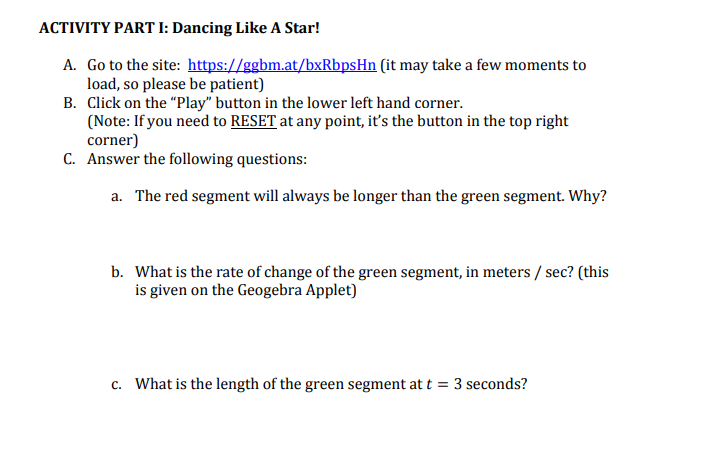
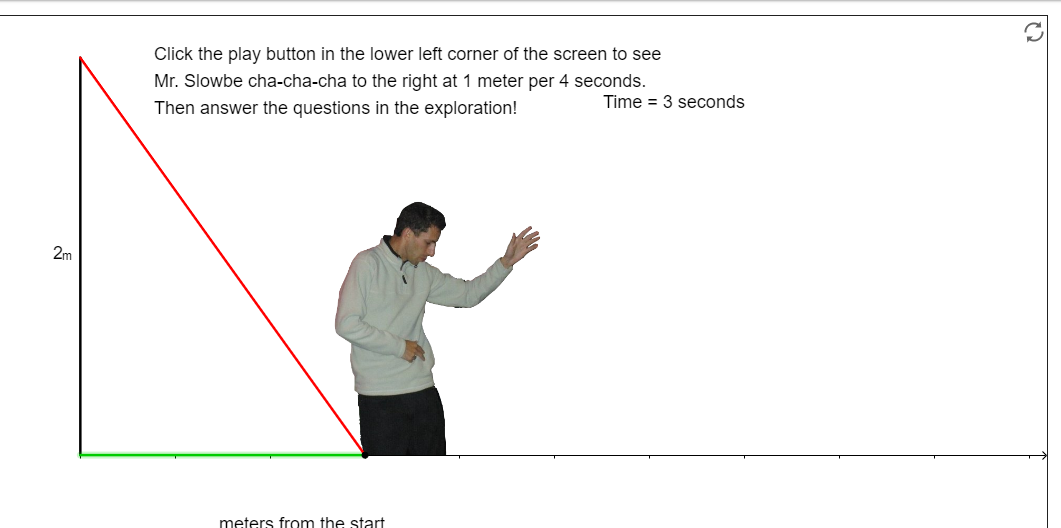
a) the red segment is the hypotenuse so naturally it will be longer than the green segment b) you have to get this using your program c) assuming he starts at x = 0, goes 1m/4 seconds, use distance = rate*time to calculate the distance after 3 secs.
kaylak:
the program doesn't give me anything unless I have to assume the dashes as a 0.25 meter so is the distance then 0.75?
kaylak:
@Vocaloid
Vocaloid:
ah yes
kaylak:
so I'm correct on that part?
Vocaloid:
for c yes
kaylak:
so I'm correct on that part?
kaylak:
so I'm correct?
Vocaloid:
yes.
 kaylak:
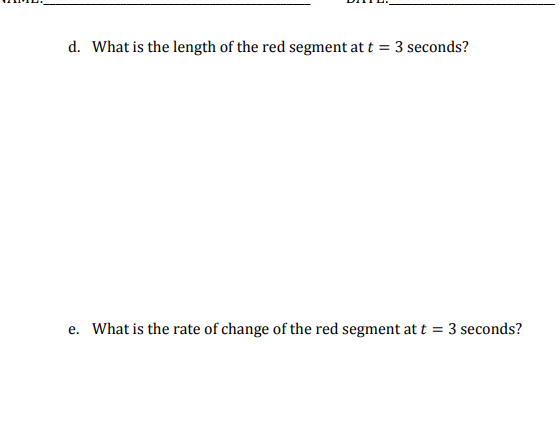
for d use trig and do opp/adj
kaylak:
tan
Vocaloid:
d. pythagorean theorem e. once you have the leg lengths, the rate of change wrt t for both legs, take the derivative of the pythagorean theorem wrt t and solve for dc/dt
kaylak:
d=about 2.14?
Vocaloid:
yeah that's what i got too
kaylak:
so do I still need to do opposite over adjacent and then take derivative?
Vocaloid:
a^2 + b^2 = c^2 2a * da/dt + 2b * db/dt = 2c * dc/dt da/dt 0 since the black segment is constant db/dt should be your solution from part b you should have a,b,c from the pythagorean theorem
kaylak:
so 1.125x0=0+2*2=4*0.25=1
Vocaloid:
... what
kaylak:
or wait I still have to take the derivative
kaylak:
trying to plug in all the numbers
Vocaloid:
no, I gave you the derivative, plug in and solve for dc/dt
kaylak:
okay then 2a*da/dt+2b*db/dt=2c*dc/dt 2*0.75=1.125x0=0 2*2=4*0.25=1 2c=4.28 now to figure out what dc/dt is
Vocaloid:
you should already know what c is. since you know what the two legs a and b are you can use the pythagorean theorem to solve for c once everything is plugged in, solve for dc/dt
kaylak:
what I plugged in was the legs and stuff is d distance and t time? I am kinda confused now
kaylak:
@Vocaloid
kaylak:
@Hero
kaylak:
@Vocaloid
Vocaloid:
d means derivative.
kaylak:
am I soling the entre thing wrng then or am I finding the derivative of c?
Vocaloid:
start with the pythagorean theorem a^2 + b^2 = c^2 take the derivative of both sides wrt t to get 2a*da/dt+2b*db/dt=2c*dc/dt plug in everything except dc/dt
Vocaloid:
da/dt is the rate at which side a changes (notice how side a, the black side, is fixed so the da/dt is 0 db/dt is the rate at which side b changes (the green side) which you should have from step C b) a, b, and c are the side lengths therefore you can plug everything in and solve for dc/dt
kaylak:
so 1.125 *0=0
kaylak:
@Vocaloid
Vocaloid:
what are you plugging in? what do these numbers represent?
kaylak:
2x.75
Vocaloid:
that's side b not side a 2a * da/dt should be the black side (2m) * da/dt
kaylak:
so .28
kaylak:
1.125*.25
kaylak:
2*2=4*0=0
Vocaloid:
|dw:1543355582211:dw|
Vocaloid:
0 + 2b * rate of change for the green side = 2c * dc/dt
kaylak:
.60?
Vocaloid:
show me the full equation with everything plugged in what is your db/dt value?
kaylak:
.25
Vocaloid:
ok then 2a*da/dt+2b*db/dt=2c*dc/dt becomes 0 + 2(0.75)(0.5) = 2(2.14)dc/dt
kaylak:
4.28
Vocaloid:
don't forget your algebra rules 0 + 2(0.75)(0.5) = 2(2.14)dc/dt becomes 0.75 = 4.28*dc/dt then you'd divide both sides by 4.28 to solve for dc/dt
kaylak:
.18
Vocaloid:
yeah that's what i got too
kaylak:
Which segment, red or green, grows at the fastest speed?
Vocaloid:
uh if our calculations are correct then you just need to compare which is greater, dc/dt or db/dt
kaylak:
so c?
kaylak:
wait no db/dt
Vocaloid:
yeah I think we got db/dt as the greater one so the green one grows a bit faster
kaylak:
At what time will the segments theoretically grow at exactly the same
Vocaloid:
got interrupted by something but 2b(db/dt) = 2c(dc/dt) if db/dt are both equal then b and c must both be equal (which is impossible for a right triangle) so I actually don't think they'll ever grow equally... hm. could be making a logical error here.
Join our real-time social learning platform and learn together with your friends!
 Demon25:
For a hoco proposal with a cheerleader and football player, what else should be a
Demon25:
For a hoco proposal with a cheerleader and football player, what else should be a

 Breathless:
TOC: "MGF any confirmation on the commander? we require confirmation as soon as[radio static].
Breathless:
TOC: "MGF any confirmation on the commander? we require confirmation as soon as[radio static].
 EdwinJsHispanic:
I wrote something that I don't know if I want it as a poem or song, Please let me know on yours thoughts about it, I'm still doing this! "Broken promises an
EdwinJsHispanic:
I wrote something that I don't know if I want it as a poem or song, Please let me know on yours thoughts about it, I'm still doing this! "Broken promises an
 thehearken:
hi um I don't know if this is the right section for this, but can someone go over my poem and tell me if its good enough to give my English professor for a
thehearken:
hi um I don't know if this is the right section for this, but can someone go over my poem and tell me if its good enough to give my English professor for a
 heartlessprophet:
Aye what's 19z%u00f74p=9u03c0 my teacher thinking of impossible questions for us
heartlessprophet:
Aye what's 19z%u00f74p=9u03c0 my teacher thinking of impossible questions for us
 kippppp:
does anyone have any good tips for writing stories? i'm trying to write a dnd campaign but i'm not that great of a writer yet.
kippppp:
does anyone have any good tips for writing stories? i'm trying to write a dnd campaign but i'm not that great of a writer yet.
 GRIZZLEY19:
Y'all let me know what y'all think about this beat I made I took me like a hour maybe rate it 0/10 https://drive.
GRIZZLEY19:
Y'all let me know what y'all think about this beat I made I took me like a hour maybe rate it 0/10 https://drive.
 Ultrilliam:
Welcome to the 10th Anniversary Update! (Part 2) Sorry this one passed the date a
Ultrilliam:
Welcome to the 10th Anniversary Update! (Part 2) Sorry this one passed the date a
 Twaylor:
was walking downtown and my adhd brain wanted to make some (rock?) lyrics: There'
Twaylor:
was walking downtown and my adhd brain wanted to make some (rock?) lyrics: There'