
 kaylak:
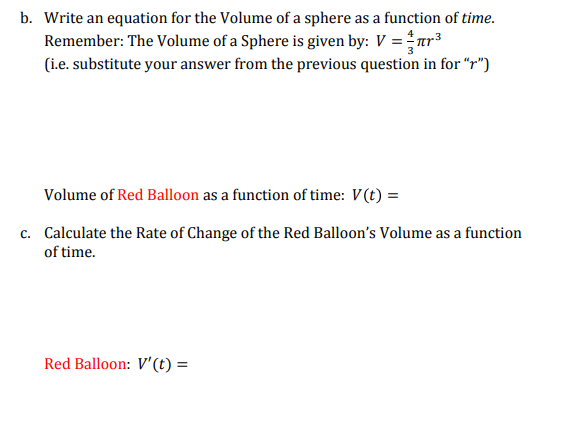
calc help Get an equation for the radius of the red balloon as a function of time. (Hint: Drag the slider to t=1, and then t=2, and then t=3, etc, noting each time what the radius of the Red Balloon is. See if you can spot the pattern, and come up with an equation. (the equation will look like: � = ___ �)
kaylak:
r=_t @Vocaloid
 Vocaloid:
well just try plugging in several values of t and see what sort of output values you get
kaylak:
the radius increases by .2 each time so .2t
kaylak:
Write an equation for the Volume of a sphere as a function of time. Remember: The Volume of a Sphere is given by: � = ! ! ��! (i.e. substitute your answer from the previous question in for “�”)
kaylak:
so r is .2
kaylak:
I guess v(t)=4/3pi.2^3
Vocaloid:
r = 0.2t as determined by the previous step V = (4/3)pi * r^3 so you can just plug r = 0.2t into the volume equation
Vocaloid:
since it asks for V in terms of t, your equation should have t in it
 kaylak:
okay
kaylak:
so the rate of change question wants the derivative of my equation
Vocaloid:
yup
kaylak:
isn't the derivative of a sphere like 4pi r ^2 or something
Vocaloid:
it wants it in terms of t not r from step b) you should have V = (4/3)pi * (0.2t)^3 take the derivative of this, with respect to t, to get c)
kaylak:
so dt/dv?
Vocaloid:
dV/dt
kaylak:
oh crud the rate changes after t=3
Vocaloid:
huh. weird.
kaylak:
nevermind
kaylak:
it doesn't thank god
kaylak:
2.513t^2
Vocaloid:
uh I think I got something a bit diff. V = (4/3)pi * (0.2t)^3 dV/dt = (4/3)(pi)(3)(0.2^3)t^2
Vocaloid:
I'd leave it in terms of pi
 Vocaloid:
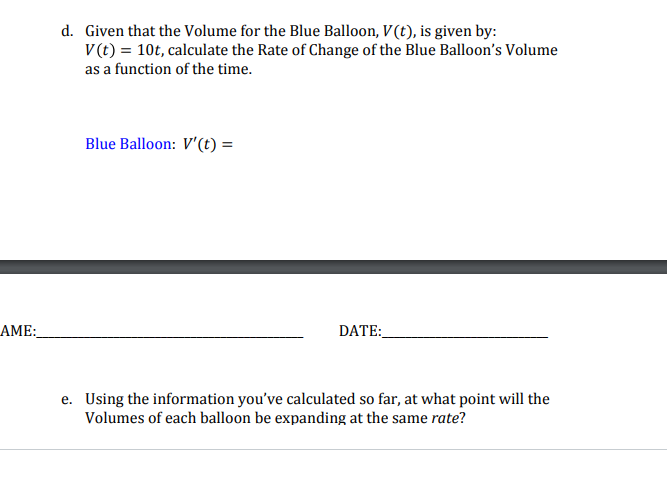
it's already in terms of V and t so just take the derivative
Vocaloid:
then for e) set the two V'(t) equations equal to each other and solve for t
kaylak:
is it dv/dt again?
kaylak:
I got 10
Vocaloid:
yes, good
kaylak:
e blue 10 20 30 40 etc red .03 .27 .9 2.14 4.19 7.24 11.49 17.16 24.43 33.51
Vocaloid:
you just need to solve dV/dt red = dV/dt blue dV/dt red = (4/3)(pi)(3)(0.2^3)t^2 = 0.032pi * t^2 then just set that equal to 10 and solve for t.
kaylak:
so plug in 10 at the equal sign?
Vocaloid:
dV/dt red = 0.032pi * t^2 dV/dt blue = 10 therefore 0.032pi * t^2 = 10
kaylak:
is that it ?
kaylak:
g is last question
Vocaloid:
like I said you need to solve for t.
kaylak:
oh crap okay
Vocaloid:
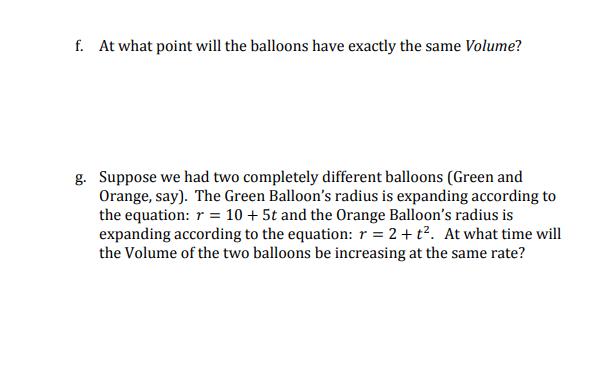
for g, you simply create two volume equations green and orange will both be V = (4/3)pi*r^3 then plug in the given expression for r into each equation, to generate two separate equations for V in terms of t, one for each balloon
kaylak:
t is about 10 it's not 9.8 let me see if it is 9.9
Vocaloid:
then set the derivatives equal to each other
Vocaloid:
I end up w/ t≈9.97356 for e
kaylak:
what did you do to get your answer 9.9 etc?
Vocaloid:
0.032pi * t^2 = 10 t^2 = 10/0.032pi t = sqrt(10/0.032pi)
kaylak:
green (4/3)pi*10+5t^3?
Vocaloid:
careful with your parentheses (4/3)pi*[10+5t]^3?
kaylak:
orange same idea with[]?
kaylak:
so what volume would the 2 increase at the same rate
Vocaloid:
\(\color{#0cbb34}{\text{Originally Posted by}}\) @Vocaloid then set the derivatives equal to each other \(\color{#0cbb34}{\text{End of Quote}}\)
Vocaloid:
set the derivatives equal to each other and solve for t
kaylak:
so are the equations I made the derivative or do I have t find it? slightly confused
Vocaloid:
the equations the volume equations in terms of t. you will then take the derivatives.
kaylak:
20pi/3
kaylak:
for green
kaylak:
gotta go in a bit but I hope I am doing it right
Vocaloid:
check your work again V = (4/3)pi*(10+5t)^3 apply chain rule dV/dt = (4/3)(pi)*3*(10+5t)^2 * (5)
kaylak:
200piy(10+5t)
kaylak:
I am lost and being rushed so I might have to do this later
Vocaloid:
sure
kaylak:
I have a few minutes if you could help me at least get the green side
kaylak:
@Vocaloid
Vocaloid:
that is the green one if you're talking about the orange one V(t) = (4/3)pi*(2+t^2)^3 chain rule V'(t) = (4/3)(pi)(3)(2+t^2)^2 * 2t
Vocaloid:
at that point you just have to set the two derivatives equal to get (4/3)(pi)(3)(2+t^2)^2 * 2t = (4/3)(pi)*3*(10+5t)^2 * (5), solve for t
 kaylak:
?
kaylak:
@Vocaloid
kaylak:
@Hero
kaylak:
@Vocaloid
kaylak:
the pic above is my answer is that correct
Vocaloid:
No, remember you are taking the derivative of both volume expressions
kaylak:
20pix(10+5t)^2 for green
Vocaloid:
Yes
kaylak:
really ?
Vocaloid:
Yes Now set it equal to the orange balloon derivative
kaylak:
I have 8pitx(2+t^2)^2 for orange
Vocaloid:
Good
kaylak:
is that it?
Vocaloid:
Again you have to set them equal to each other and solve for t
kaylak:
how do I do that like combine them like basic algebra?
Vocaloid:
Uh Solving it manually is kind of a pain because you have to expand everything and factor If possible I would recommend using a calculator
kaylak:
I literally got an error
kaylak:
I need this assignment done today could you just set the euation up for I can calculate it in terms of t
kaylak:
@Vocaloid
kaylak:
?
Vocaloid:
20pi*(10+5t)^2 = (4/3)(pi)(3)(2+t^2)^2 * 2t t≈4.7408
Join our real-time social learning platform and learn together with your friends!
 KBaby:
Verse 1 We left our names in the dust of the driveway Watched the old town shrink
KBaby:
Lyrics Generator Use AI to write the lyrics for a song. Suggested Genres: Pop Hip
KBaby:
Verse 1 We left our names in the dust of the driveway Watched the old town shrink
KBaby:
Lyrics Generator Use AI to write the lyrics for a song. Suggested Genres: Pop Hip
 aitexturegenerator:
How are you all handling AI-generated textures for 3D models and game assets without losing the hand-made feel? I've been doing a small stylized environment
aitexturegenerator:
How are you all handling AI-generated textures for 3D models and game assets without losing the hand-made feel? I've been doing a small stylized environment

 Demon25:
Woke up feeling like that girl and that dude well he still aint crap pluse the du
Demon25:
Woke up feeling like that girl and that dude well he still aint crap pluse the du
 playtsec:
how do I get rid of stress from teachers... I just feel like running out the classroom and leaving on my own.
playtsec:
how do I get rid of stress from teachers... I just feel like running out the classroom and leaving on my own.
 JohnnyLFowler0812:
What type of gamer would play something and then get off for a while. Why not sta
JohnnyLFowler0812:
Which is better? Metallica Rap Country R&B hiphop Medal Gospel Chill Which 3 opti
JohnnyLFowler0812:
What type of gamer would play something and then get off for a while. Why not sta
JohnnyLFowler0812:
Which is better? Metallica Rap Country R&B hiphop Medal Gospel Chill Which 3 opti