
 kaylak:
calc help @angel
kaylak:
wrong person oops
 kaylak:
@Shadow
 Vocaloid:
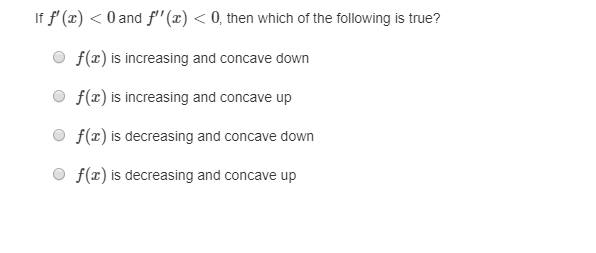
1. you need to know what the signs of the derivatives mean > first derivative positive = function is increasing > second derivative positive = function is concave up > first derivative negative = function is decreasing > second derivative negative = function is concave down
Vocaloid:
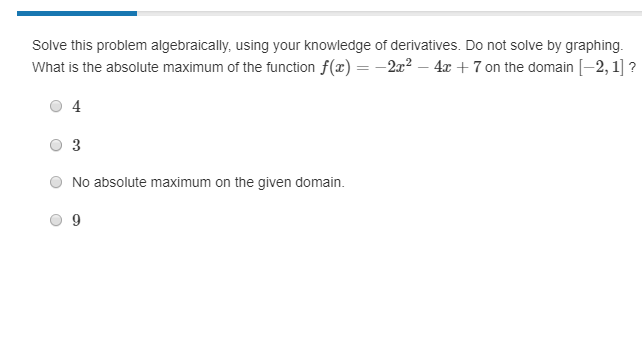
2. to find any extrema within that interval, take the derivative and set it equal to 0, solve for x. any x-values between -2 and 1 should be considered, and evaluted to see which one gives you the absolute max when plugged back into the original function (not the derivative, the original function)
Vocaloid:
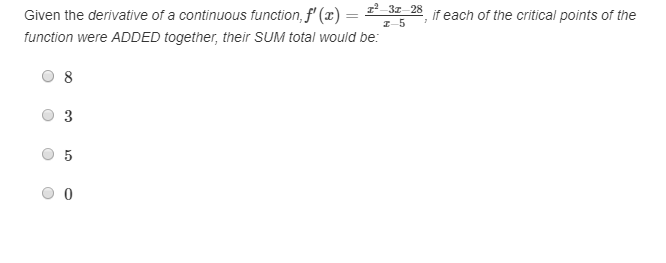
3. you already have the derivative so solve for f'(x) = 0 and add up all the x-values, being mindful of signs
Vocaloid:
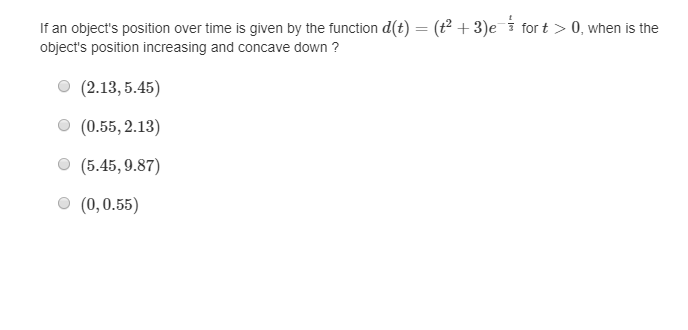
4. you will have to find the range of t-values where the first derivative is pos. and the second deriv. is negative
kaylak:
is 1 c then? how would I sow my work for that question
Vocaloid:
it's a definition question so you could just write "definition of derivatives and concavity"
Vocaloid:
"first derivative is negative so the function must be decreasing since first derivative gives rate of change" "second derivative is negative so the function must be decreasing according to the definition of concavity"
kaylak:
I am right yay!
kaylak:
2 x=-1
Vocaloid:
good start but now you have to plug that into the function to get the y-value
kaylak:
13
Vocaloid:
check your calculations again, you probably missed a negative sign somewhere -2(-1)^2 -4(-1) + 7 =
kaylak:
9
kaylak:
is that the answer?
Vocaloid:
yes
kaylak:
3
Vocaloid:
ah for 3) I forgot to mention, critical points can also happen when the derivative is undefined so since you have x - 5 in the denominator, x = 5 is another critical point so 3+ 5 = 8 = your solution
kaylak:
for 4 do I just plug in values?
kaylak:
after takinf the derivative?
Vocaloid:
you'd find the critical points first then yes, you can plug in values to see what the signs are
kaylak:
but I do take the derivative right?
kaylak:
and =0?
Vocaloid:
yes, first and second
Vocaloid:
yes, set them equal to 0
kaylak:
I'm working hold on lol and then 5 more after this and then no more calc for the semester that you have to help me with
kaylak:
wait the first and second derivative are the same?
kaylak:
without the x?
Vocaloid:
first derivative is -1/3 e^(-x/3) (x^2 - 6 x + 3) take the derivative again to get the second derivative
kaylak:
oh it's 0 and first is 2x/3sqrt e
kaylak:
how did you get first answer have to show work I'll work on second derivative
Vocaloid:
product rule
 Vocaloid:
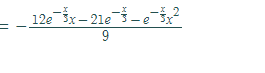
(t^2+3)e^(-t/3) (t^2+3)e^(-t/3) * (-1/3) + (2t)e^(-t/3) factor out (-1/3)e^(-t/3) (-1/3)e^(-t/3) * (t^2 + 3 - 6t)
kaylak:
for first derivative?
Vocaloid:
yes.
kaylak:
is my answer for second derivatve correct?
Vocaloid:
yes
kaylak:
so now set to 0?
Vocaloid:
yes
Vocaloid:
if you're using software, to save some time, set first derivative > 0 and second derivative < 0
Vocaloid:
you will end up with two x-intervals, then find the appropriate x-intervals that are satisfied by both inequalities
kaylak:
It's all written on paper unfortunately
kaylak:
let me what I can do
Vocaloid:
hm. I wouldn't really know how to solve these by hand easily
kaylak:
hmm it won't let me what site do I use?
Vocaloid:
oh, duh (-1/3)e^(-t/3) * (t^2 + 3 - 6t) for the first derivative you just have to consider this part (t^2 + 3 - 6t) since e^(t/3) will never be 0 so set (t^2 + 3 - 6t) = 0 and use the quadratic formula to find the zero's
kaylak:
3+-sqrt6
Vocaloid:
good so you have three intervals x < 3 - sqrt(6) 3 - sqrt(6) < x < 3 + sqrt(6) and x > 3 + sqrt(6) you can just start plugging in x values to see where it's positive
Vocaloid:
as a hint, just pick something absurd like -100 and 100 for the outer intervals x < 3 - sqrt(6) and x > 3 + sqrt(6) and 3 for the inside interval 3 - sqrt(6) < x < 3 + sqrt(6)
Vocaloid:
keep in mind you don't have to come up with an exact value, just whether the result is positive or negative
kaylak:
.55 5.44
Vocaloid:
good, so you know the first derivative is positive between .55 and 5.44
Vocaloid:
now repeat the process to find where the second derivative is negative
kaylak:
the whole thing or part because there isn't a solution fot the entire second derivative
Vocaloid:
there should be a solution try factoring it
Vocaloid:
1/9 e^(-t/3) (t^2 - 12 t + 21) = 0 solve for t then use it to find where the second derivative is negative
kaylak:
still no solution that's weird
Vocaloid:
like before, we know that 1/9 e^(-t/3) can never equal 0 due to being an exponential function use the quadratic function on (t^2 - 12 t + 21) = 0
Vocaloid:
*quadratic formula
kaylak:
-t^2-21/12
Vocaloid:
-b +/- sqrt(b^2 - 4ac) / (2a) apply this logic to (t^2 - 12 t + 21) = 0
kaylak:
6+-sqrt15
Vocaloid:
yup, so once again you have three intervals x > 6-sqrt(15) 6 - sqrt(15) < x < 6 + sqrt(15) x > 6 + sqrt(15) see which of these intervals makes the second derivative negative
kaylak:
2.13 9.87
kaylak:
so b or c
Vocaloid:
so what we have so far .55 < x < 5.44 2.13 <x < 9.87 which answer choice satisfies both of these intervals?
kaylak:
c
Vocaloid:
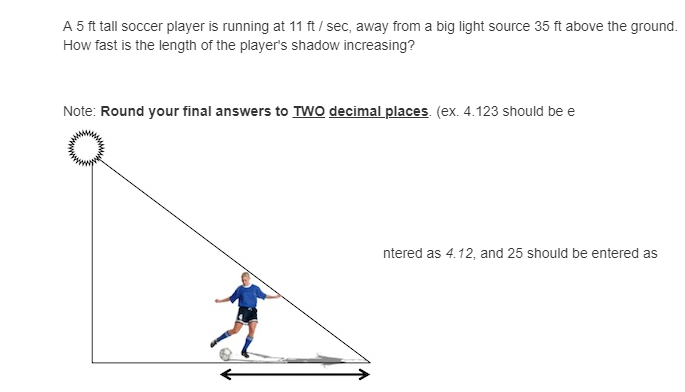
.55 < x < 5.44 so x < 5.44

 Vocaloid:
the answer to 4 is not c, check again and make sure BOTH intervals are satisfied
kaylak:
well 5.44 is actually 5.45 rounded
Vocaloid:
.55 < x < 5.44 2.13 <x < 9.87 so x must be greater than 2.13 or less than 5.44 for BOTH to be satisfied
Vocaloid:
anything less than 2.13 violates the second interval and anything greater than 5.45 violates the second interval
kaylak:
a?
Vocaloid:
good
kaylak:
number 5
Vocaloid:
uh i'd have to think on this one for a bit
Vocaloid:
|dw:1544217821425:dw|
Vocaloid:
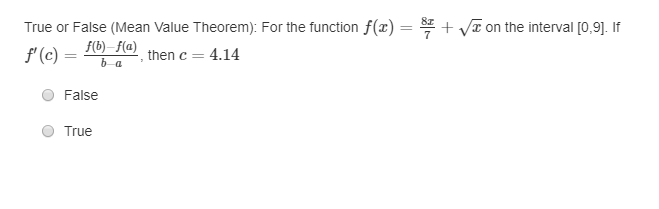
your a and b values are 0 and 9 respectively so find c where f'(c) = [ f(9) - f(0) ] / (9 - 0)
kaylak:
so take derivative of function and plug in 9 and 0 ?
Vocaloid:
if you notice [ f(9) - f(0) ] / (9 - 0) doesn't involve the derivative so calculate [ f(9) - f(0) ] / (9 - 0) using the regular function, not the derivative
Vocaloid:
then once you have that value you can calculate the derivative, plug in c, and solve for c where f'(c) = [ f(9) - f(0) ] / (9 - 0)
Vocaloid:
f(x) = 8x/7 + sqrt(x) x = 0 ----> f(0) = 0 x = 9 ----> f(9) = (8*9)/7 + 3 [ f(9) - f(0) ] / (9 - 0) = [ (8*9)/7 + 3 ] / 9 = (8/7) + (1/3) then solve f'(c) = (8/7) + (1/3) for c
kaylak:
is the answer false?
kaylak:
I got 1.48?
Vocaloid:
so the derivative ends up being (8/7) + (1/2)x^(-1/2) right? (8/7) + (1/2)x^(-1/2) = (8/7) + (1/3) cross out 8/7 on both sides (1/2)x^(-1/2) = 1/3 2x^(1/2) = 1/3 x^(1/2) = 1/6 so yeah it's not 4.14 so the answer is false
Vocaloid:
anyway for the arrow question I believe you'd take the derivative of tan (theta) wrt
Vocaloid:
|dw:1544219541780:dw|
kaylak:
so tan 36 is .73
Vocaloid:
good keep going
kaylak:
is b 230?
Vocaloid:
uh hold on
Vocaloid:
tan(36) = b/a tan(36)*a = b tan(36) * da/dt = db/dt so no, 230 is db/dt, solve for da/dt
Vocaloid:
after you have da/dt I think you can solve for dc/dt
kaylak:
how do I find a?
Vocaloid:
tan(36) * da/dt = db/dt we defined db/dt as 230 so tan(36) * (da/dt) = 230 solve for da/dt
kaylak:
315.07
Vocaloid:
check your rounding again, 230/tan(36) is a bit closer to 316.57
Vocaloid:
after that I believe it's just the pythagorean theorem 316.57^2 + 230^2 = (dc/dt)^2
kaylak:
76558.28?
Vocaloid:
square root of that
Vocaloid:
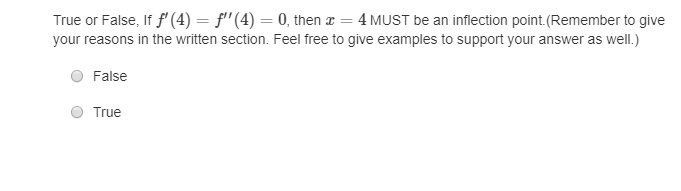
anyway I really can't spend all day on this for 3 it might not necessarily be an inflection point if there's no sign change
kaylak:
276.69
kaylak:
just 3 more questions I don't believe they are too hard
kaylak:
so 8 is false for inflection because of no sign of change?
Vocaloid:
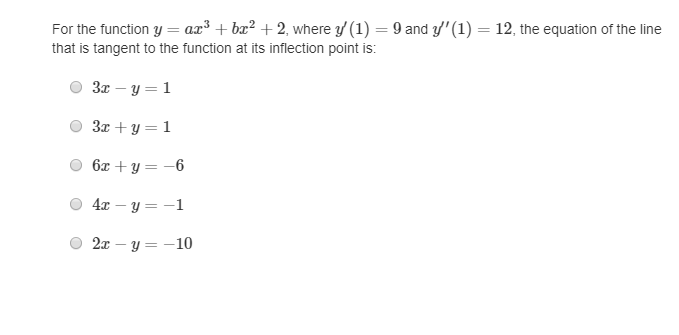
for 4. take the second derivative, plug in x = 1 and y =12 to solve for a, then take the first derivative and solve for b, then once you have both a and b, solve for the slope at the inflection point (where the second derivative is set to 0) and see which function has the equivalent slope
Vocaloid:
don't really know 5 sorry
kaylak:
so 8 is correct right and first for 9 is 3ax^2+2bx and second is 6ax+2b
kaylak:
@Vocaloid
kaylak:
@mhchen
kaylak:
could you help 1 1/2 questions left
kaylak:
@Hero
kaylak:
@Vocaloid is 9 c?
kaylak:
or 4 c
 Hero:
Hero:
Post your question as a separate question.
Join our real-time social learning platform and learn together with your friends!
 KBaby:
Verse 1 We left our names in the dust of the driveway Watched the old town shrink
KBaby:
Lyrics Generator Use AI to write the lyrics for a song. Suggested Genres: Pop Hip
KBaby:
Verse 1 We left our names in the dust of the driveway Watched the old town shrink
KBaby:
Lyrics Generator Use AI to write the lyrics for a song. Suggested Genres: Pop Hip
 aitexturegenerator:
How are you all handling AI-generated textures for 3D models and game assets without losing the hand-made feel? I've been doing a small stylized environment
aitexturegenerator:
How are you all handling AI-generated textures for 3D models and game assets without losing the hand-made feel? I've been doing a small stylized environment

 Demon25:
Woke up feeling like that girl and that dude well he still aint crap pluse the du
Demon25:
Woke up feeling like that girl and that dude well he still aint crap pluse the du
 playtsec:
how do I get rid of stress from teachers... I just feel like running out the classroom and leaving on my own.
playtsec:
how do I get rid of stress from teachers... I just feel like running out the classroom and leaving on my own.
 JohnnyLFowler0812:
What type of gamer would play something and then get off for a while. Why not sta
JohnnyLFowler0812:
Which is better? Metallica Rap Country R&B hiphop Medal Gospel Chill Which 3 opti
JohnnyLFowler0812:
What type of gamer would play something and then get off for a while. Why not sta
JohnnyLFowler0812:
Which is better? Metallica Rap Country R&B hiphop Medal Gospel Chill Which 3 opti