
 kaylak:
help
 kaylak:
@Vocaloid is 1 c?
kaylak:
@Hero
kaylak:
@Shadow plz help
 Hero:
Hero:
Check your messages
kaylak:
@Vocaloid
 Angle:
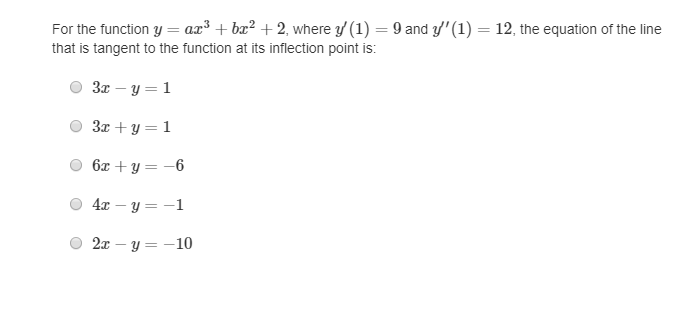
C for the first question is incorrect
Angle:
here is an example of the process of the problem if you already had \(a\) and \(b\) http://mathcentral.uregina.ca/QQ/database/QQ.09.04/louise1.html of course, without knowing \(a\) and \(b\) makes this problem more confusing
Angle:
I'll list how the general process for this kind of problem first, then we can plug in specific numbers: \(\rightarrow\) (Step 1) First, we want to take the first and second derivatives of \(y\) what do you get? \(\rightarrow\) (Step 2) Next, the question asks about the inflection point Inflection points are where the second derivative, \(y''\), equals zero (we solve for x in terms of a and b) \(\rightarrow\) (Step 3) Then, we plug in the mess of what x equals into the first derivative and get another expression made up of a's and b's \(\rightarrow\) (Step 4) Take a step back now, let's consider the information they gave us: that \(y'(1) = 9\) and \(y''(1) = 12\) when we plug this into the derivatives we calculated in the first step... \(y'(1) = 9 = 3a(1)^2 + 2b(1)\) and \(y''(1) = 12 = 6a(1) + 2b\) (notice I plugged in x = 1 which might be why it looks a little weird) Then you can solve the system of two equations to get values for a and b \(\rightarrow\) (Step 5) And now for the mess... You plug in your values of a and b into the thing you got from (Step 3). This will be the slope of your tangent equation \(\rightarrow\) (Step 6) Also plug in the a and b into the thing you got from (Step 2). This will result in an x = something which you can plug in to the original equation to get a y value. This will give you your (x, y) coordinates for where your tangent line goes through \(\rightarrow\) So from (Step 5) and (Step 6) you now have a slope and a point which your line goes through. You can use the point-slope form, or slope-intercept form to get the equation of your line. As you can see, this has been a lot of steps and can get a bit confusing. Let me know if you're stuck on any part of this. Although, I feel like it will make a lot more sense once we start plugging in numbers.
Join our real-time social learning platform and learn together with your friends!
 KBaby:
Verse 1 We left our names in the dust of the driveway Watched the old town shrink
KBaby:
Lyrics Generator Use AI to write the lyrics for a song. Suggested Genres: Pop Hip
KBaby:
Verse 1 We left our names in the dust of the driveway Watched the old town shrink
KBaby:
Lyrics Generator Use AI to write the lyrics for a song. Suggested Genres: Pop Hip
 aitexturegenerator:
How are you all handling AI-generated textures for 3D models and game assets without losing the hand-made feel? I've been doing a small stylized environment
aitexturegenerator:
How are you all handling AI-generated textures for 3D models and game assets without losing the hand-made feel? I've been doing a small stylized environment

 Demon25:
Woke up feeling like that girl and that dude well he still aint crap pluse the du
Demon25:
Woke up feeling like that girl and that dude well he still aint crap pluse the du
 playtsec:
how do I get rid of stress from teachers... I just feel like running out the classroom and leaving on my own.
playtsec:
how do I get rid of stress from teachers... I just feel like running out the classroom and leaving on my own.
 JohnnyLFowler0812:
What type of gamer would play something and then get off for a while. Why not sta
JohnnyLFowler0812:
Which is better? Metallica Rap Country R&B hiphop Medal Gospel Chill Which 3 opti
JohnnyLFowler0812:
What type of gamer would play something and then get off for a while. Why not sta
JohnnyLFowler0812:
Which is better? Metallica Rap Country R&B hiphop Medal Gospel Chill Which 3 opti