
 lock:
lock:
how to divide these help
 Hero:
Hero:
You should factor them first
lock:
individually?
Hero:
There are two expressions. Factor both completely first.
lock:
1,-1
Hero:
?
lock:
my bad (x-1)(x-1)
Hero:
Can you post the steps to how you got that?
lock:
sorry i used a calc
lock:
i will look up an example and try to solve it give me a sec
lock:
for the second one is it (x-1)^2
Hero:
correct
lock:
and the first one is the same but with a ^3?
lock:
(x-1)^3
Hero:
What do you mean? Show all your steps
Hero:
no thatsnot right
lock:
oh
lock:
hm
Hero:
What does \(x^3 - 3x^2\) factor to?
lock:
x^2(x-3)
lock:
nvm
Hero:
Hang on a minute let me post these there.
Hero:
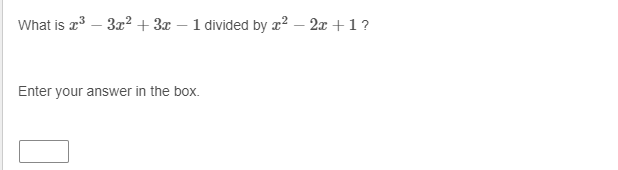
lock:
much better
Hero:
Okay now we will deal with this right. \(x^3 - 3x^2 + 3x -1\)
lock:
correct
Hero:
Give me a minute...
lock:
take your time
Hero:
Let's see what happens if we do it this way: \(x^3 - 1 - 3x^2 + 3x\)
Hero:
If we re-write it this way then the first two terms is a difference of cubes since \(1^3 = 1\) so: \(x^3 - 1^3 - 3x^2 + 3x\)
Hero:
Remember that formula for difference of cubes is \(a^3 - b^3 = (a - b)(a^2 + ab + b^2)\)
lock:
can we rewrite it this way for every factoring question ?
Hero:
In other words, we can re-write the expression as: \((x - 3)(x^2 - x + 1) - 3x^2 + 3x\)
Hero:
No, there's different polynomials that require different approaches.
lock:
oh ok
Hero:
Anyway, the next step is to factor the last two terms. Wanna give it a try? Don't use a calc though
Hero:
Oh I made a mistake
Hero:
The difference of cubes for the first two terms factor to: \((x - 1)(x^2 - x + 1) - 3x^2 + 3x\)
Hero:
There we go, now we can factor the last two terms.
lock:
how do i factor this (x−1)(x2−x+1)−3x2+3x? like how would i divide it?
Hero:
Don't worry about dividing right now. We're factoring. I asked you to factor the last two terms of that expression. And please use \(\LaTeX\) to write. It's bad style to write the expressions the way you do without using caret symbols for the exponent.
lock:
ok
lock:
3x(x+1)
Hero:
I can't even be mad with you because I made another mistake with my factorization, but with yours, you factored out $3x$ instead of $-3x$
lock:
lol
lock:
oh so 3x(-x+1)
Hero:
Here's the correct factorization: \(\begin{align*} x^3 - 3x^3 + 3x - 1&=x^3 - 1^3 - 3x^3 + 3x \\ &=(x - 1)(x^2 + x + 1) - 3x(x - 1)\\ &=(x - 1)(x^2 + x + 1) \end{align*}\)
Hero:
You factor out \(-3x\) because its common to both terms
Hero:
Now that we have the correct factors, NOW we can divide: \( \begin{align*} \dfrac{x^3 - 3x^2 + 3x - 1}{x^2 - 2x + 1}&=\dfrac{(x - 1)(x^2 + x + 1)}{(x - 1)^2} \end{align*} \)
lock:
my eyes
Hero:
And when you divide, you're mostly cancelling factors of one. Notice we can re-write what we factored as a product of one and the remaining factors \( \begin{align*} \dfrac{(x-1)(x^2 + x + 1)}{(x - 1)^2} = \dfrac{x - 1}{x - 1} \cdot \dfrac{(x^2 + x + 1)}{x - 1} \end{align*} \)
Hero:
And of course the factors of one cancel to get just: \(\dfrac{x^2 + x + 1}{x - 1}\)
Hero:
Which cannot be factored any further.
lock:
i cant cancel out variables?
Hero:
You can only cancel out matching factors in the numerator and denominator but we canceled those already.
lock:
what about the two x's?
lock:
there is a positive one on the num and denom
Hero:
you should really review your factoring. You should not be attempting to divide polynomials without mastering how to factor them.
lock:
yes will do thank you verry much !
Join our real-time social learning platform and learn together with your friends!
 KBaby:
Verse 1 We left our names in the dust of the driveway Watched the old town shrink
KBaby:
Lyrics Generator Use AI to write the lyrics for a song. Suggested Genres: Pop Hip
KBaby:
Verse 1 We left our names in the dust of the driveway Watched the old town shrink
KBaby:
Lyrics Generator Use AI to write the lyrics for a song. Suggested Genres: Pop Hip
 aitexturegenerator:
How are you all handling AI-generated textures for 3D models and game assets without losing the hand-made feel? I've been doing a small stylized environment
aitexturegenerator:
How are you all handling AI-generated textures for 3D models and game assets without losing the hand-made feel? I've been doing a small stylized environment

 Demon25:
Woke up feeling like that girl and that dude well he still aint crap pluse the du
Demon25:
Woke up feeling like that girl and that dude well he still aint crap pluse the du
 playtsec:
how do I get rid of stress from teachers... I just feel like running out the classroom and leaving on my own.
playtsec:
how do I get rid of stress from teachers... I just feel like running out the classroom and leaving on my own.
 JohnnyLFowler0812:
What type of gamer would play something and then get off for a while. Why not sta
JohnnyLFowler0812:
Which is better? Metallica Rap Country R&B hiphop Medal Gospel Chill Which 3 opti
JohnnyLFowler0812:
What type of gamer would play something and then get off for a while. Why not sta
JohnnyLFowler0812:
Which is better? Metallica Rap Country R&B hiphop Medal Gospel Chill Which 3 opti