
 CC12:
CC12:
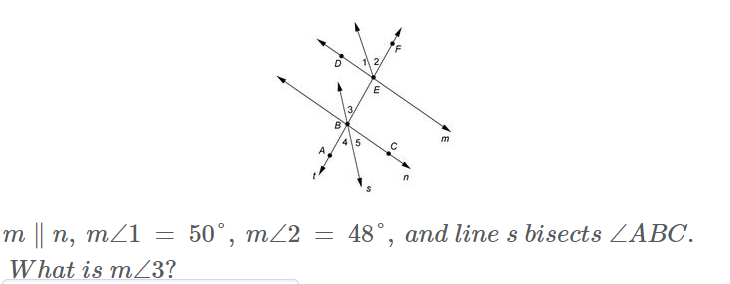
Math help please
 CC12:
CC12:
@dude
CC12:
82?
 dude:
dude:
Uh I am assuming \\(\angle 3\) is this part
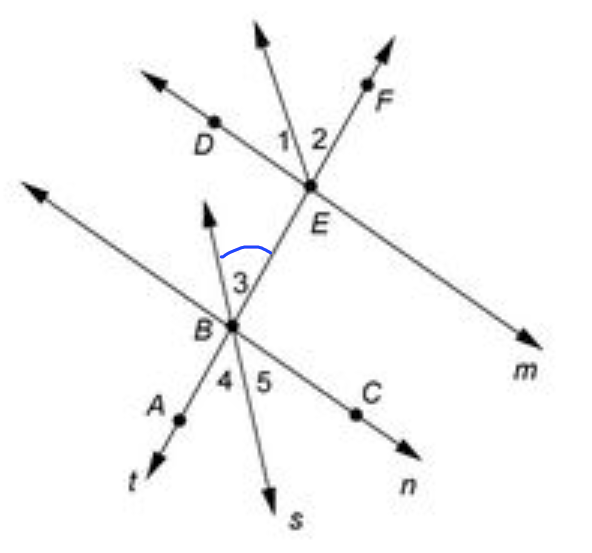 That is not greater than 90º
CC12:
yes
CC12:
Im confused on it
dude:
|dw:1545001590030:dw|
dude:
Do you know what the sum of angles 1 and 2 are?
CC12:
yes 98
dude:
Since it states that s \(\bf bisects\) the lines, it is spilt into 2 equal angled sides
CC12:
49
CC12:
@dude
CC12:
@Vocaloid can you please help im confused
 Hero:
Hero:
@CC12 if \(m \parallel n\), what what kind of line is \(t\)?
CC12:
i dont know
Hero:
Ever heard of a transversal?
CC12:
yes
Hero:
That's what \(t\) is; a transversal. Do you remember the kinds of angles that are created as a result of a transversal intercepting two parallel lines?
Hero:
Are you ready to continue @CC12
CC12:
yes
Hero:
Okay, so basically the transversal \(t\) creates corresponding angles here: |dw:1545014746170:dw|
Hero:
Angle \(m\) corresponds to angle \(DEF\) Your diagram makes it difficult to describe angle \(n\) but it includes angle \(3\). Do you understand this?
Hero:
angles \(m\) and \(n\) are corresponding angles.
Hero:
Likewise for the angles depicted in the diagram. I hope you're not too confused, but I'll help you out since the problem was setup to confuse you
CC12:
yes i sorta understand
Hero:
|dw:1545014961189:dw| Let's say \(\angle m = \angle 1 + \angle 2\) and \(n = \angle 3 + \angle 5\)
CC12:
ok
Hero:
\(m = n\) In other words \(\angle 1 + \angle 2 = \angle 3 + \angle 5\)
Hero:
Oops. I didn't see that they already included an angle 5. smh
Hero:
Now I have to change everything to angle six.
Hero:
|dw:1545015185831:dw|
Hero:
\(\angle 1 + \angle 2 = \angle 3 + \angle 6\) We already know the measure of \(\angle 1\) and \(\angle 2\)
Hero:
I should also mention that after reviewing you should be familiar with alternate exterior angles.
CC12:
find angle 3 and 6 now or
Hero:
Alternate Exterior Angles are also congruent
Hero:
In other words \(\angle1 + \angle 2 = \angle 4 + \angle 5 \)
Hero:
This is where it gets complicated, because we have to make sure we distinguish which angles are congruent to which
Hero:
I'll explain later, but basically \(\angle 1\) corresponds to \(\angle 5\) and \(\angle 2\) corresponds to \(\angle 4\)
Hero:
If you were familiar with vertical angles, then you'd also know that \(\angle 4 \cong \angle 3\)
Hero:
So in essence, \(\angle 2 \cong \angle 4 \cong \angle 3\)
CC12:
sorry i was writing the problem out and i got angle 3 =49 degrees
Hero:
How did you get that? Show your work please
Hero:
If I'm being completely honest though, there is no way to actually prove those angles are truly congruent.
CC12:
you add angle 1 and angle 2 which is 98 angle 4 is 98/2= 49 degrees
Hero:
Yeah, that's probably right. I should never have taken a nap. That was my reasoning the first time.
Hero:
I forgot my own reasoning, but I suspect @dude helped you with this.
CC12:
you get 49 degrees because angle 3 and 4 are vertical angles
CC12:
i think thats right
Hero:
You don't even need vertical angles for it.
dude:
Yeah haha Take a nap, we need a good nights rest ;p
CC12:
oh you dont
Hero:
Nope, you don't. You just need to know that \(\angle 1\) and \(\angle 2\) corresponds to the blank angle plus angle 3
Hero:
Since \(s\) bisects the blank angle and angle 3 are congruent
CC12:
oh ok
Hero:
\(\angle 1 + \angle 2 = 98\) and \(\angle b + \angle 3 = 98\) as well. But \(\angle b = \angle 3\) so you can just divide by \(2\) to get the result
Hero:
Anyways, I've confused you enough.
CC12:
Thank you so so much for explaing it to me
Join our real-time social learning platform and learn together with your friends!
 KBaby:
Verse 1 We left our names in the dust of the driveway Watched the old town shrink
KBaby:
Lyrics Generator Use AI to write the lyrics for a song. Suggested Genres: Pop Hip
KBaby:
Verse 1 We left our names in the dust of the driveway Watched the old town shrink
KBaby:
Lyrics Generator Use AI to write the lyrics for a song. Suggested Genres: Pop Hip

 aitexturegenerator:
How are you all handling AI-generated textures for 3D models and game assets without losing the hand-made feel? I've been doing a small stylized environment
aitexturegenerator:
How are you all handling AI-generated textures for 3D models and game assets without losing the hand-made feel? I've been doing a small stylized environment

 Demon25:
Woke up feeling like that girl and that dude well he still aint crap pluse the du
Demon25:
Woke up feeling like that girl and that dude well he still aint crap pluse the du
 playtsec:
how do I get rid of stress from teachers... I just feel like running out the classroom and leaving on my own.
playtsec:
how do I get rid of stress from teachers... I just feel like running out the classroom and leaving on my own.
 JohnnyLFowler0812:
What type of gamer would play something and then get off for a while. Why not sta
JohnnyLFowler0812:
Which is better? Metallica Rap Country R&B hiphop Medal Gospel Chill Which 3 opti
JohnnyLFowler0812:
What type of gamer would play something and then get off for a while. Why not sta
JohnnyLFowler0812:
Which is better? Metallica Rap Country R&B hiphop Medal Gospel Chill Which 3 opti