
 haleyelizabeth2017:
Integral Calculus D:
 Zepdrix:
\[\large\rm A(\color{orangered}{x})=\int\limits_{-2}^{\color{orangered}{x}}f(t)dt\qquad\qquad\qquad\qquad F(\color{orangered}{x})=\int\limits_4^{\color{orangered}{x}}f(t)dt\]
Zepdrix:
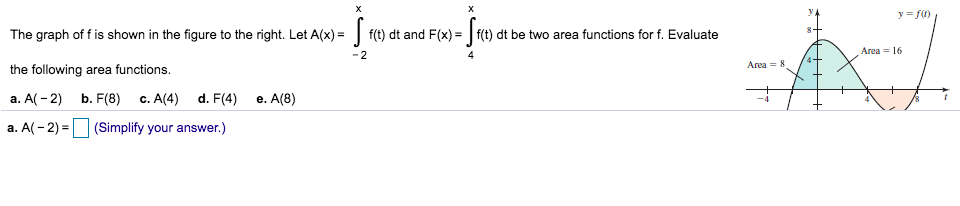
a. A(-2)\[\large\rm A(\color{orangered}{-2})=\int\limits\limits_{-2}^{\color{orangered}{-2}}f(t)dt\]See how the x value doesn't change? We won't have a "base" for our area. This is always zero.\[\large\rm A(-2)=0\]
Zepdrix:
b. F(8)\[\large\rm F(\color{orangered}{8})=\int\limits\limits_4^{\color{orangered}{8}}f(t)dt\]This is defined to be the area under the graph f(t), from t=4 to t=8. In the illustration provided, that corresponds to the orange area. The value got cut off when you shared it though, so whatever that line pointing to the orange area says. \[\large\rm F(8)=orange~area\]
Zepdrix:
c. A(4)\[\large\rm A(\color{orangered}{4})=\int\limits\limits_{-2}^{\color{orangered}{4}}f(t)dt\]|dw:1547522571857:dw| Notice that the blue area is the integral of f(t), from t=-2 to t=0, and the green area is the integral of f(t), from t=0 to t=4. So together they give us the area under f(t), from t=-2 to t=4.\[\large\rm A(4) = blue~area~+~green~area\]
Zepdrix:
Think you can do the rest? Math is fun, yayyyy :D
Join our real-time social learning platform and learn together with your friends!
 KBaby:
Verse 1 We left our names in the dust of the driveway Watched the old town shrink
KBaby:
Lyrics Generator Use AI to write the lyrics for a song. Suggested Genres: Pop Hip
KBaby:
Verse 1 We left our names in the dust of the driveway Watched the old town shrink
KBaby:
Lyrics Generator Use AI to write the lyrics for a song. Suggested Genres: Pop Hip

 aitexturegenerator:
How are you all handling AI-generated textures for 3D models and game assets without losing the hand-made feel? I've been doing a small stylized environment
aitexturegenerator:
How are you all handling AI-generated textures for 3D models and game assets without losing the hand-made feel? I've been doing a small stylized environment

 Demon25:
Woke up feeling like that girl and that dude well he still aint crap pluse the du
Demon25:
Woke up feeling like that girl and that dude well he still aint crap pluse the du
 playtsec:
how do I get rid of stress from teachers... I just feel like running out the classroom and leaving on my own.
playtsec:
how do I get rid of stress from teachers... I just feel like running out the classroom and leaving on my own.
 JohnnyLFowler0812:
What type of gamer would play something and then get off for a while. Why not sta
JohnnyLFowler0812:
Which is better? Metallica Rap Country R&B hiphop Medal Gospel Chill Which 3 opti
JohnnyLFowler0812:
What type of gamer would play something and then get off for a while. Why not sta
JohnnyLFowler0812:
Which is better? Metallica Rap Country R&B hiphop Medal Gospel Chill Which 3 opti