
 Ballery1:
Need quick help plz :)
Ballery1:
I’m trying to plugin values for x into the following function... plz check my zebra..\[Y = \left( 1+x \right)^{3/2}\]
Ballery1:
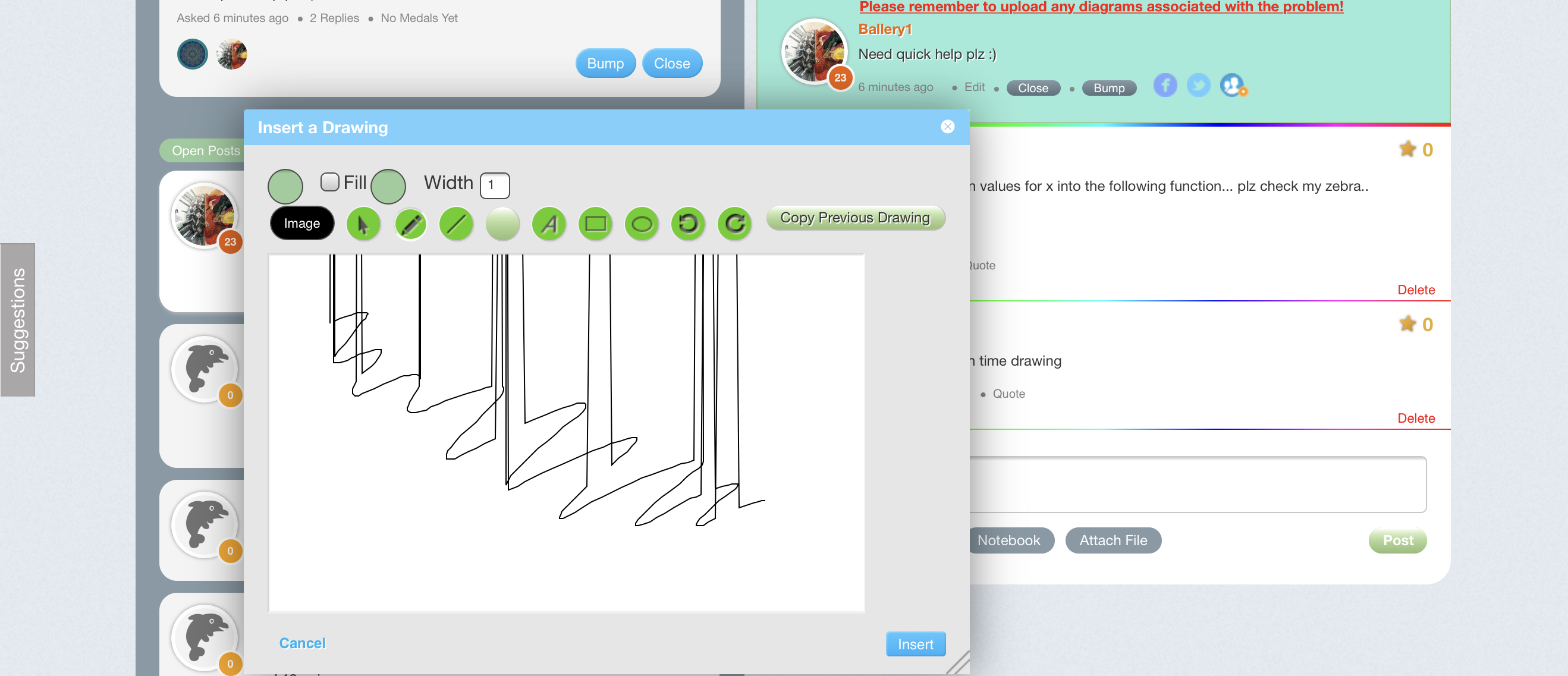
I’m having a tough time drawing
 Ballery1:
|dw:1560698691377:dw|
Ballery1:
Let me rearrange the function so we can plugin the x-values
 Hero:
Hero:
I don't know what is wrong with your drawing pad, but in terms of graphing, you should try plugging in really large negative and positive values to get a sense for the long term behavior of the function.
Hero:
Those large values might also help you determine if there are any asymptotes.
Ballery1:
|dw:1560698753604:dw|
Ballery1:
Keep going?
Hero:
Glad its working for you now
Hero:
Yes keep going, but remember what I told you as well
Ballery1:
Let’s find out if I remember lol
Hero:
Hold up...
Hero:
You've changed the computation
Ballery1:
I did? :# sorry ;-;
Hero:
Be careful how you use parentheses.
Ballery1:
Ok let me fix that in the net drawing
Ballery1:
|dw:1560699027075:dw|
Hero:
Parentheses always occur in pairs. You have five, but you only need four.
Hero:
Parentheses open and close expressions. You have an expression that is being cubed. The expression being cubed needs to be enclosed with a set of parentheses. Then you've entered a value for \(x\) that also needs to be enclosed with a set of parentheses. No other parentheses are necessary
Hero:
\(f(-2) = \sqrt{(1 + (-2))^3}\)
Hero:
That's what you want
Hero:
If we do it the way you posted above we get a different result
Hero:
Because it looks like you're trying to cube the negative 2 only, but you have to add before you can cube
Ballery1:
|dw:1560699198640:dw|
Hero:
Looks right
Ballery1:
Sooo how do we go about figuring out the domain and range of that thing
Ballery1:
Keep it short tho ;-;
Hero:
Well, once again we have a square root function so keep that in mind. You have to figure out what the lowest extreme is. Try to figure out the lowest negative value of x that is included in the domain. Remember that the square root of a negative number is imaginary. So what negative number can you put into x that will yield a positive value under the square root?
Hero:
Once you figure out what the lowest negative number is for the domain, you'll know that the domain won't include any numbers that are more negative than the lowest negative number. Then from there, you can start trying numbers that are greater than the lowest negative number and work your way towards positive values. Then from there see if you can find any other restrictions on the domain.
Hero:
Your goal for the domain is to find the restrictions (values excluded from the domain) and the extremes (upper and lower values of the domain)
Hero:
Also, one more thing. It's probably a good idea to identify which kind of function is you're working with before even attempting to find the domain. I remember giving you a document that has the graphs of all the parent functions. Have you identified what kind of function you're graphing?
Hero:
Yes, that. And be sure to look carefully. There are some things on there that may trip you up or lead you to become confused.
Ballery1:
Wait, vertical asymptote has to do with domain right?
Hero:
Knowing the vertical asymptote can assist you in determining the domain of a function.
Ballery1:
Okie dokie
Hero:
https://assets.questioncove.com/attachments/1560700647-5d065d7c4425911ac3399000-ParentFunctions.png
Hero:
There's a direct link to the poster of parent functions. Save that link instead.
Ballery1:
Thanks super man
Ballery1:
Just realized that the value of x has to be either 0 or greater than 0 in order for the y-value to be a real number
Ballery1:
Anything below 0...lets say -1 will make the entire root undefined
Hero:
Yes, that's why I kept saying "Square root function"
Hero:
Are you not familiar with how square roots operate?
Ballery1:
So our domain is *x is the element of all real numbers, except x has to be either equal or bigger than 0*
Ballery1:
Maybe 😆
Hero:
Well, you still have to be careful. It is whatever that is under the square root that has to be greater than or equal to zero.
Hero:
To find the domain you have to set whatever is under the square root greater than or equal to zero, then solve for x
Ballery1:
Wait, what do you call this function tho??? \[Y = \left( 1+x ^{} \right)^{3/2}\]
Hero:
Well, let me explain...
Ballery1:
I literally tried a bunch of x values to realize that lol so yuhh x has to be greater then 0
Ballery1:
Is it just a twin sister of square root function? Just rearranged like that?
Hero:
There are a couple of ways to express the function. The way you have expressed it is the exponential form. A better way to express it is \(y = \sqrt{(1 + x)^3}\). In this way, you know that the expression \((1 + x)^3\) is under the square root. Therefore to find the domain you would set \((1 + x)^3 \ge 0\) then solve for \(x\). Furthermore \(y = \sqrt{(1 + x)^3}\) is equivalent to \(y = (1 + x)^{3/2}\) because of the rule of exponents that says \(a^{1/n} = \sqrt[n]{x}\)
Hero:
Hope that isn't too complicated or confusing for you
Ballery1:
I literally know all that
Ballery1:
So the domain is ....x has to be equal or greater than 0 right? Cuz any value less than 0 will result in undefined value for y
Hero:
I explained how to FIND the domain. Please read my previous post again. There's something you're overlooking for some strange reason.
Ballery1:
What tho?
Hero:
Let me highlight it for you
Ballery1:
Oh you mean the asymptote?
Hero:
There are a couple of ways to express the function. The way you have expressed it is the exponential form. A better way to express it is \(y = \sqrt{(1 + x)^3}\). In this way, you know that the expression \((1 + x)^3\) is under the square root. Therefore \(\boxed{\textbf{to find the domain you would set} (1 + x)^3 \ge 0\ \textbf{then solve for }x}\) Furthermore \(y = \sqrt{(1 + x)^3}\) is equivalent to \(y = (1 + x)^{3/2}\) because of the rule of exponents that says \(a^{1/n} = \sqrt[n]{x}\)
Ballery1:
Yes i did that already...wait let me draw.
Hero:
Read the entire paragraph again so that you understand completely
Hero:
If you did it already then you would know what the domain is
Ballery1:
|dw:1560702399021:dw|
Hero:
Nope that's not what I was asking you to do. If you were doing it the way that I asked, you would have started with this: |dw:1560702598940:dw| I clearly put in bold what to do
Ballery1:
Eye see..
Ballery1:
So you want me to only deal with what’s under the root...
Hero:
It is clear that you don't know how to solve for x. You don't solve for x by plugging in values for x. You solve for x by ISOLATING x on one side of the inequality.
Ballery1:
Sorry mate... let me try again..
Ballery1:
|dw:1560702886679:dw| How do i get rid of the freakin cube?
Hero:
Cube root both sides
Ballery1:
|dw:1560702941460:dw|
Hero:
Very good and can you please write x and just x and avoid using the weird canadian symbology? It hurts my eyes and does not look like an x at all
Ballery1:
|dw:1560702973626:dw|
Hero:
Very good
Hero:
That is the domain \(x \ge -1\)
Ballery1:
Eye see what u did there...
Ballery1:
What scenarios can i apply this in? Just the root functions?
Hero:
Even root functions
Ballery1:
Again, we can get this done much faster if u use simple instructions...and not math notations and stuff
Ballery1:
It makes me panic lol
Hero:
Certain things need to be explained first so that more confusion doesn't happen down the line.
Ballery1:
K, the next question is very similar... i’ll See if i can apply this method on that one..k
Ballery1:
One second, let me write errthing down... :)
Hero:
I have to go tend to my own work now. You're on your own until probably midnight.
Ballery1:
Okie dokie :)
Ballery1:
Thanks for everything hero :)
Hero:
yw
Ballery1:
How do i find the range of this function again?
Hero:
By testing values from the domain. Start with the lowest extreme value (x = -1). That will give you the lowest extreme value of the range. I have a question for you. What is the Upper extreme value of the domain?
Ballery1:
Idk what upper extreme value is...
Ballery1:
Tell me in simple words plz
Hero:
If the domain of the function is \(x \ge -1\) what is the highest possible value of \(x\). What I'm trying to get from you is "What are the upper and lower limit values of the x axis? What is the lowest possible value of x. What is the highest possible value of x?
Ballery1:
If x = -1 is the lowest extreme value, the highest could be any positive integer...
Hero:
The upper extreme of the domain is positive infinity.
Ballery1:
That’s what i was thinking but was too shy to say...
Ballery1:
Cuz there’s no limit to the function ....it can go as high as it wants
Hero:
And now you need to plot a few points to determine the direction of the graph.
Hero:
Is the graph trending upwards or downwards?
Ballery1:
Aaaa it doesn’t ask me to graph but it should go up...
Ballery1:
As high as it wants to go... all the way to positive infinite
Hero:
Let's back track for a minute. Did you find y when x = -1?
Hero:
Whatever that y value is, that is the low end of the range.
Hero:
The upper limit of the range is obviously infinity
Ballery1:
Yes i did...it was 0
Hero:
Okay great so the domain is \([-1,\infty)\) and the range is \([0, \infty)\)
Ballery1:
Ah icy
Hero:
So basically, when determining the range, you need to know three things: The direction of the graph, The lowest possible value of the range, the highest possible value of the range. You get those values by evaluating the function using the extreme values of the domain.
Hero:
So there you go. The easy way to find the range.
Hero:
Hope you're happy now.
Hero:
Nevertheless, this method only works if the graph is continuous.
Ballery1:
Thanks hero. :) you’re my avengers of maths :)
Hero:
If there are any restrictions on x, then there will be more work involved because you have to account for asymptotes and such.
Ballery1:
Yuhh...thank god i didnt have that for this question...
Hero:
In this case the domain did have a restriction, but it is continuous on the domain \([1, \infty)\)
Hero:
However, if it was not, you'd have to find the vertical asymptote and and exclude that value from the domain.
Ballery1:
As for the domain, can i say like x has to be equal or bigger than -1?
Ballery1:
I’ll keep that in mind :)
Hero:
\(x \ge -1\) means the same thing as \([-1, \infty)\) Both are describing the domain.
Ballery1:
Okie dokie
Hero:
Okay, I'm not coming back until midnight. I was just taking a break.
Ballery1:
Okay, thanks hero :)
Join our real-time social learning platform and learn together with your friends!
 KBaby:
Verse 1 We left our names in the dust of the driveway Watched the old town shrink
KBaby:
Lyrics Generator Use AI to write the lyrics for a song. Suggested Genres: Pop Hip
KBaby:
Verse 1 We left our names in the dust of the driveway Watched the old town shrink
KBaby:
Lyrics Generator Use AI to write the lyrics for a song. Suggested Genres: Pop Hip

 aitexturegenerator:
How are you all handling AI-generated textures for 3D models and game assets without losing the hand-made feel? I've been doing a small stylized environment
aitexturegenerator:
How are you all handling AI-generated textures for 3D models and game assets without losing the hand-made feel? I've been doing a small stylized environment

 Demon25:
Woke up feeling like that girl and that dude well he still aint crap pluse the du
Demon25:
Woke up feeling like that girl and that dude well he still aint crap pluse the du
 playtsec:
how do I get rid of stress from teachers... I just feel like running out the classroom and leaving on my own.
playtsec:
how do I get rid of stress from teachers... I just feel like running out the classroom and leaving on my own.
 JohnnyLFowler0812:
What type of gamer would play something and then get off for a while. Why not sta
JohnnyLFowler0812:
Which is better? Metallica Rap Country R&B hiphop Medal Gospel Chill Which 3 opti
JohnnyLFowler0812:
What type of gamer would play something and then get off for a while. Why not sta
JohnnyLFowler0812:
Which is better? Metallica Rap Country R&B hiphop Medal Gospel Chill Which 3 opti