
 lexi20041982:
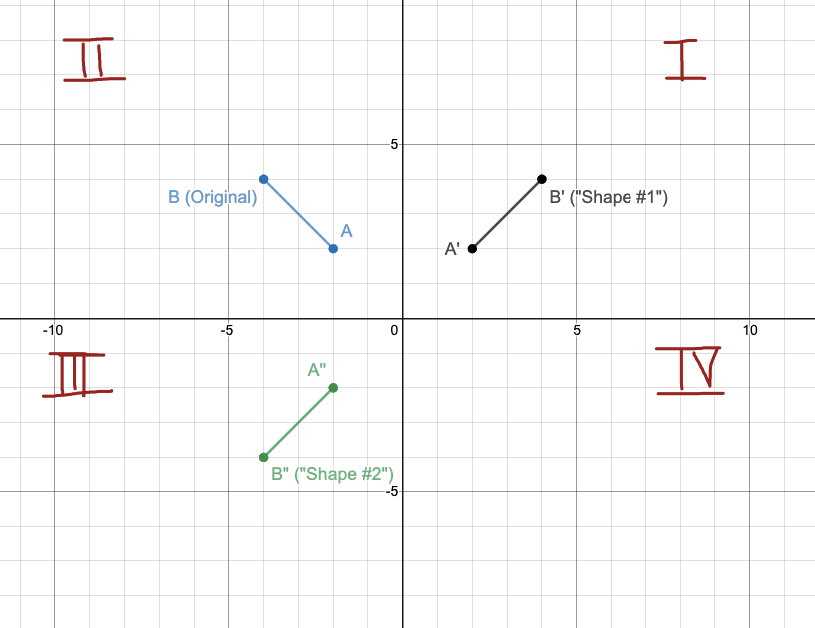
A figure is in Quadrant II. It is rotated 2004-01-04-04-00-v2_files/i0020000.jpg about the origin to create image 2004-01-04-04-00-v2_files/i0020001.jpg. The original figure is then rotated 2004-01-04-04-00-v2_files/i0020002.jpg about the origin to create image 2004-01-04-04-00-v2_files/i0020003.jpg. How does image 2004-01-04-04-00-v2_files/i0020004.jpg compare to image 2004-01-04-04-00-v2_files/i0020005.jpg? Describe the locations of image 2004-01-04-04-00-v2_files/i0020006.jpg and image 2004-01-04-04-00-v2_files/i0020007.jpg. Is there a way to map image 2004-01-04-04-00-v2_files/i0020008.jpg directly onto image 2004-01-04-04-00-v2_files/i0020009.jpg by using a rotation?
 dude:
dude:
Oh. Yes. Wonderful. Corrected Question: A figure is in Quadrant II. It is rotated 90º about the origin to create image #1. The original figure is then rotated -90º about the origin to create image #2. How does image #1 compare to image #2? Describe the locations of image #1 and image #2. Is there a way to map image #1 directly onto image #2 by using a rotation?
dude:
Since you're gone They would be reflected across from each other, so you can solve it by using reflection
 dude:
dude:
https://www.desmos.com/calculator/h9e46bkw14 (In case you want to see the equations, rotation rules)
 Gdeinward:
Dude, I gotta give you some respect. I would not have gone that far, at least without the help of the user.
Gdeinward:
@dude
Join our real-time social learning platform and learn together with your friends!
 KBaby:
Verse 1 We left our names in the dust of the driveway Watched the old town shrink
KBaby:
Lyrics Generator Use AI to write the lyrics for a song. Suggested Genres: Pop Hip
KBaby:
Verse 1 We left our names in the dust of the driveway Watched the old town shrink
KBaby:
Lyrics Generator Use AI to write the lyrics for a song. Suggested Genres: Pop Hip
 aitexturegenerator:
How are you all handling AI-generated textures for 3D models and game assets without losing the hand-made feel? I've been doing a small stylized environment
aitexturegenerator:
How are you all handling AI-generated textures for 3D models and game assets without losing the hand-made feel? I've been doing a small stylized environment

 Demon25:
Woke up feeling like that girl and that dude well he still aint crap pluse the du
Demon25:
Woke up feeling like that girl and that dude well he still aint crap pluse the du
 playtsec:
how do I get rid of stress from teachers... I just feel like running out the classroom and leaving on my own.
playtsec:
how do I get rid of stress from teachers... I just feel like running out the classroom and leaving on my own.
 JohnnyLFowler0812:
What type of gamer would play something and then get off for a while. Why not sta
JohnnyLFowler0812:
Which is better? Metallica Rap Country R&B hiphop Medal Gospel Chill Which 3 opti
JohnnyLFowler0812:
What type of gamer would play something and then get off for a while. Why not sta
JohnnyLFowler0812:
Which is better? Metallica Rap Country R&B hiphop Medal Gospel Chill Which 3 opti