
 TheConMan:
Find the domain and range of the following function.
TheConMan:
\[F(x) = \frac{ 1 }{ (7-x)(x^2-1) }\]
 dude:
dude:
For domain, the denominator cannot equal 0 So do \((7-x) = 0\) and \((x^2-1)=0\) This will tell you what cannot be part of the domain
TheConMan:
I see what you did. Let me try brb
dude:
If you need help solving for x, ask
TheConMan:
@hero i need his help. He’s the best. No offence tho :)
 Ferredoxin4:
So let me first ask you: what is the domain & range? and what is a discontinuity?
Ferredoxin4:
It's best that you understand the significance of what you're doing so then you can attack any question in any method and see the purpose behind it
TheConMan:
Domain the is relationship between independent variables and dependent variables. Domain shows if there’s a point y on the graph for every x value
Ferredoxin4:
in layman's, it's just the set of x values in a function. range is the set of y values, which are dependent on the domain values.
TheConMan:
Ok now how do we get the domain and range of that function?
TheConMan:
Why can’t we expand the denominator and find the zeros?
Ferredoxin4:
It's good to always know the end behavior of various functions (trig, trig inverse, power, exponential, etc) so you can visualize it in your mind how you should approach. For now, we can find the domain. Let's start with assuming that x exists for all real values. Now, we have to look for discontinuities. Do you know what is a discontinuity, and what discontinuity is likely in this function?
TheConMan:
Yes vertical and horizontal asymptotes where the curve of the graph approaches the restriction/asymptotes but never quite intersects
Ferredoxin4:
Yeah. So the vertical asymptote is a restriction on the domain, and the horizontal is a restriction on the range, correct?
TheConMan:
Bro, let’s speed this up, i have like 9 more freaky questions like these
TheConMan:
Yes, i know those things.
Ferredoxin4:
okay haha. So to find the vertical asymptote set the denominator to 0 and solve for x using the zero product property.
Ferredoxin4:
Did you get that?
TheConMan:
Yes sir, let me draw ...
TheConMan:
Don’t give me hints. Let me draw first
Ferredoxin4:
Sure sure. No need to draw/graph though, but if it helps you visualize, then it's great.
TheConMan:
Shoot, my pencil is out of juice. One second, let me charge it. Thanks
TheConMan:
I mean draw out the answer
Ferredoxin4:
ohhh. yeah ok
TheConMan:
|dw:1567558753889:dw|
Ferredoxin4:
check your second equation again. You brought the -1 over but forgot to change the sign.
Ferredoxin4:
x^2 - 1 = 0 +1 +1 x^2 = 1 so...
TheConMan:
|dw:1567558931188:dw|
Ferredoxin4:
Close. is that the only root of √1 ?
TheConMan:
So my pen was freaking out while i was drawing. Sorry
TheConMan:
|dw:1567559020019:dw|
TheConMan:
What do i do next?
Ferredoxin4:
There we go. So you got x=7, -1, and 1. So those are your vertical asymptotes
TheConMan:
That’s it? :O
Ferredoxin4:
Yeah. So your domain is X exists for all real numbers, x≠7, -1, 1.
TheConMan:
Alright, let’s find the horizontal asymptotes now :)
Ferredoxin4:
Now for your range, recall that the horizontal asymptote is a restriction on the range. So to find the horizontal asymptote, do you know the rules?
TheConMan:
Sorry bro, we have a thunderstorm here, it knocked out lights out for a bit. But yeah, i can’t recall the rule tho. Plz hep
TheConMan:
Omg i actually do
Ferredoxin4:
is it hurricane dorian? rules: 1. if the degree of the num < degree of denom, then y=0 is the horizontal asym. 2. if degree of num > degree of denom, it is a oblique asymptote (no horizontal, use synthetic devision to find it) 3. if degree of num = degree of denom, divide leading coefficients.
TheConMan:
If the leading degrees are equal, you divide leading coefficients Second rule is, if the degree in the numerator is bigger than the degree in the denominator, there’s no horizontal asy Finally, if the degree in the denominator is bigger than the numerator, the horizontal asym is y=0
Ferredoxin4:
yeah
TheConMan:
Do you really think i’d Be sitting here if we had hurricane Dorian ripping through our house? Lol
Ferredoxin4:
Yeah I was being sarcastic lmao but the Fla side of it isn't bad
TheConMan:
Ok so we have a 1/ (7-x)(x^2-1). The degree in the denominator is bigger than numerators...so horizontal asym is y = 0
Ferredoxin4:
yeah that's it
TheConMan:
Really? Damn, that was easy lol
TheConMan:
Let me write everything down...brb thanks tho :)
Ferredoxin4:
np
TheConMan:
Wait, hold on, why didn’t i get y=0 in the last question tho. The last question was y = 2/x^2+1
Ferredoxin4:
Well it should be y=0. You could prove it by plugging in the limit of x approaching to positive/negative infinity.
TheConMan:
Ok so when i try to find the vertical asymptote, i got imaginary number right.
Ferredoxin4:
Yeah. So that just means that there is no vertical asymptote.
Ferredoxin4:
If you solve for a vertical asymptote and you end with a complex solution, it means that there is no vertical asymptote. You could check by graphing or using limits.
TheConMan:
Then i try to find the horizontal asymptote, but it turned out i had to find the inverse of that function since the domain of the inverse is the range of the original function. So i have rewrite the equation in terms of x then isolated for y again and then simplified and did a combine fractioning. Then i tried to see what x values would make the sq root undef...and lastly, wrote the domain of the inverse function in terms of range of the original function....it was a pain.. x.x
Ferredoxin4:
Yeah there was no need for that
TheConMan:
You can later go in my profile and see the last question. It’s pretty long tho.
TheConMan:
Ok let me finish this and i’ll Be right back :) thanks
Ferredoxin4:
np
TheConMan:
What’s the difference when you write 1^0 and 1^1? They both equate to be 1 anyway.
Ferredoxin4:
That's something to ask the international congress of mathematicians because powers to 0 and 1 are commonly debated. Since the base is 1 they just somehow equate to the same. There's no difference i suppose other than the exponent itself
TheConMan:
Cuz the thing is, i’m Trying to count the power numerator and the denominator and idk what to do there since the denominator is in parentheses
Ferredoxin4:
Just compare the degrees, there's no reason to go any further than that. but what question is it?
TheConMan:
Same question...lol
Ferredoxin4:
the one we were just on? just always consider the exponent to the first power, because if it were any other whole number, you'd consider it the same.
TheConMan:
Got it
TheConMan:
So this is the range i got. |dw:1567562455324:dw|
Ferredoxin4:
yeah correct
TheConMan:
K next question. The aim is to find the domain and range of the following function. \[F(x) = \sqrt{x+3}\]
TheConMan:
What do you call this type of functions again?
Ferredoxin4:
Square root functions
TheConMan:
I see. Ok so how do we go about finding the domain?
TheConMan:
We know that i can’t plugin any negative values into the sq root function.
Ferredoxin4:
So this is why I mentioned it's important to know very well the behavior of several functions. So here, the part under the radicand must be greater than or equal to 0, as you know. There can't be any complex things graphed on a cartesian plane. So set the part inside the radicand to ≤0, solve for x. You'll get your domain.
TheConMan:
We also know that w/e number we plugin, must not make the resultant integer negative.
Ferredoxin4:
Square root functions have lower bound, no upper bound, and there is no sign of vertical transformation, so you can already infer the range from that.
TheConMan:
I think the domain is all real numbers except, x>0
TheConMan:
Actually wait... omg /.- i’m So stupiff
Ferredoxin4:
Range* and it's x≥0
TheConMan:
All real numbers except, x has to be equal to or greater than 3
Ferredoxin4:
Right
TheConMan:
Can you please use simple math language, i’m Having hard time trying to understand what you’re trying to say about the range of the root func
TheConMan:
\(\color{#0cbb34}{\text{Originally Posted by}}\) @Ferredoxin4 Square root functions have lower bound, no upper bound, and there is no sign of vertical transformation, so you can already infer the range from that. \(\color{#0cbb34}{\text{End of Quote}}\) Like i dont get this lol
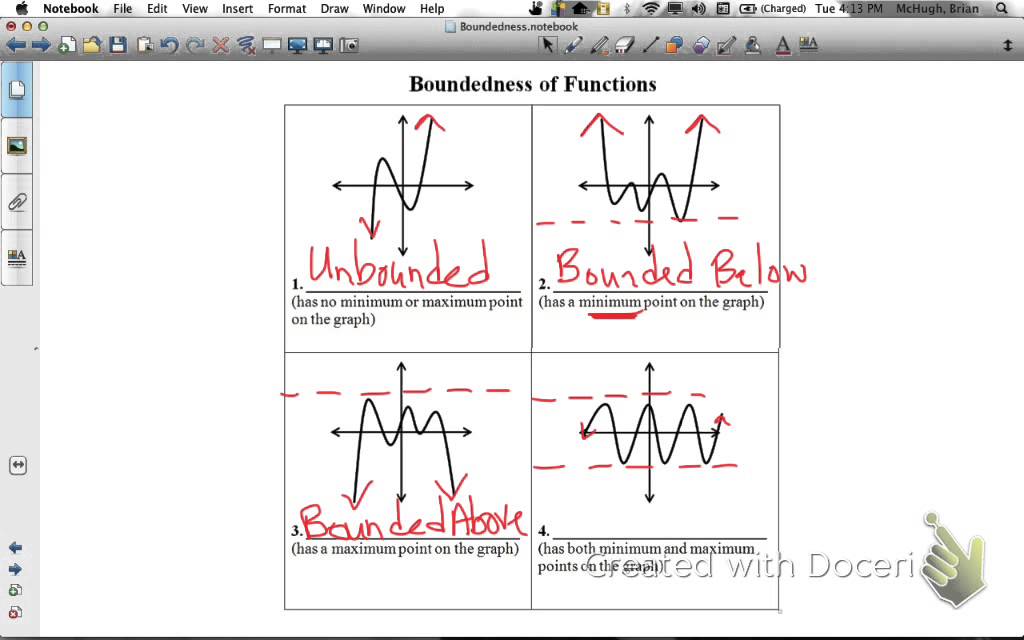 Ferredoxin4:
maybe @hero can take over
TheConMan:
Is the last graph *bounded both above and below*?
Ferredoxin4:
yeah
TheConMan:
I see. Thanks bro. Really appreacted your help :)
 Hero:
Hero:
Great job explaining @Ferredoxin4
Ferredoxin4:
Thank you (:
TheConMan:
How do i find the range of the root function again?
TheConMan:
Can someone hep?
TheConMan:
Is there a method to finding the range of the root func?
 akshay:
Ferredoxin explained it already, the function is bounded in the bottom. Naturally the range of the square root function is y≥0
akshay:
The method is to use limits. Otherwise know the behavior of those functions like Ferredoxin said and apply the transformations
TheConMan:
K got it. Thanks.
Join our real-time social learning platform and learn together with your friends!
 KBaby:
Verse 1 We left our names in the dust of the driveway Watched the old town shrink
KBaby:
Lyrics Generator Use AI to write the lyrics for a song. Suggested Genres: Pop Hip
KBaby:
Verse 1 We left our names in the dust of the driveway Watched the old town shrink
KBaby:
Lyrics Generator Use AI to write the lyrics for a song. Suggested Genres: Pop Hip
 aitexturegenerator:
How are you all handling AI-generated textures for 3D models and game assets without losing the hand-made feel? I've been doing a small stylized environment
aitexturegenerator:
How are you all handling AI-generated textures for 3D models and game assets without losing the hand-made feel? I've been doing a small stylized environment

 Demon25:
Woke up feeling like that girl and that dude well he still aint crap pluse the du
Demon25:
Woke up feeling like that girl and that dude well he still aint crap pluse the du
 playtsec:
how do I get rid of stress from teachers... I just feel like running out the classroom and leaving on my own.
playtsec:
how do I get rid of stress from teachers... I just feel like running out the classroom and leaving on my own.
 JohnnyLFowler0812:
What type of gamer would play something and then get off for a while. Why not sta
JohnnyLFowler0812:
Which is better? Metallica Rap Country R&B hiphop Medal Gospel Chill Which 3 opti
JohnnyLFowler0812:
What type of gamer would play something and then get off for a while. Why not sta
JohnnyLFowler0812:
Which is better? Metallica Rap Country R&B hiphop Medal Gospel Chill Which 3 opti