
 TheConMan:
Math help plz
TheConMan:
Find the domain and range of the following function. \[F(x) = (x-2)^{2/3}\]
TheConMan:
@Ferredoxin4
TheConMan:
Please tell me i don’t have to take the inverse of that monster. :/
 Ferredoxin4:
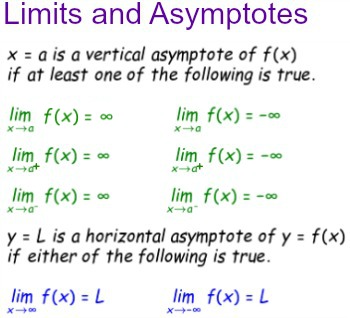
dude just take the limit of x approaching 2 and you'll find a critical point.
TheConMan:
Let me draw the solution and u check
Ferredoxin4:
ok
TheConMan:
It doesn’t ask me to use limits here
 Ferredoxin4:
Try all those and use those limit formulas to help you out in the future as well
Ferredoxin4:
I don't really know a way to do it without limits. If your teacher tells you not to use limits then you have a bad teacher because he/she making you do more work xD
TheConMan:
|dw:1567646939023:dw|
TheConMan:
Trust me when I do limits, i’ll Come back to these questions and take their souls
Ferredoxin4:
Another idea. Look for restrictions. Let me see myself
Ferredoxin4:
With limits all this would be a breeze
TheConMan:
Is my inverse correct tho?
Ferredoxin4:
lemme see
TheConMan:
Now that I have the inverse, i’m Going to look for restrictions now
Ferredoxin4:
yes it's right
TheConMan:
I feel like I deserve a medal for not making any mistakes in my solution.
TheConMan:
Now I’m going to plugging a few values of x and see what are the restrictions
TheConMan:
|dw:1567647311584:dw|
TheConMan:
Ok so i’ve Realized that x has to be equal or greater than 0 to have real numbers...anything below 0 will give undefined values
TheConMan:
Thus, domain is all real numbers except x has to be equal or greater than 0
Ferredoxin4:
Yeah true. I'll give you a suggestion if they allow it so you don't need to do a lot of work. Use mathematical induction. It's a root function, so try setting the terms inside the radicand to 0 and see what x can't equal. You'll get your domain. Then do the similar with range.
Ferredoxin4:
Can you use mathematical induction?
TheConMan:
Nope
TheConMan:
Can I use this method for both even and odd root functions?
Ferredoxin4:
Yeah what matters more here is the root in any case.
TheConMan:
When u say root, what do u mean?
Ferredoxin4:
√
TheConMan:
I see
TheConMan:
I’ve worked way to hard to learn this method...don’t lure me tho.
TheConMan:
Let’s do the range now
TheConMan:
Since we’ve found the domain of the inverse func, it’s the range of the original function
Ferredoxin4:
yeah
TheConMan:
So the range is ... y can be any real numbers except, it has to be bigger or equal to 0
Ferredoxin4:
yes
Ferredoxin4:
domain is all real numbers
TheConMan:
So to figure out the domain, do i plugin x values from the range back into the original function to find the domain?
Ferredoxin4:
I mean I just used limits here but yeah you could do that but just note it won't always work, it's just a nice strategy in understanding because of the Intermediate Value Theorem and understanding continuity.
Ferredoxin4:
1. Use Limits 2. Graph 3. Do it old school. Plug in values near critical points and know the end behavior, boundness, and restrictions of all functions. Notice function transformations.
Ferredoxin4:
That's the approach to domain and range
TheConMan:
/I’ll do that when i reach limits in my textbook. But for now, how to i get domain algebraically
Ferredoxin4:
You just have to spot the constraints
Ferredoxin4:
Let me ask you: How does your textbook approach this?
TheConMan:
Let me do one sample example from my textbook...they literally did it in two lines. No solution no nothing...
Ferredoxin4:
sorry, i meant 0<n<1 *
Ferredoxin4:
maybe @Hero knows a bit more to these questions, he can take over
TheConMan:
If \[G(x) = \sqrt{7-x} \], then, for an even root to be defined, the expression under the root must be nonnegative: \[7-x \ge 0, 7\ge x.\] Thus, \[Dom {G} = (-\infty ,7], \] or \[Dom {G} = {x \epsilon \mathbb{R} : x \le 7}\]
TheConMan:
This is literally how they do examples in 1 or 2 straight lines...
Ferredoxin4:
Yeah so that's actually what you need to do here. They are using end behavior to solve.
Ferredoxin4:
Odd radicals are Dom=xER, even radicals are always dom=xER: x≥0.
TheConMan:
I c
Ferredoxin4:
Convert it to radical form. Forget what's inside the radicand, look at the odd or even root. It's odd (3), so it is automatically all real numbers for domain.
Ferredoxin4:
They are just doing a transformation by squaring it. Don't get fooled by that.
TheConMan:
Can you explain what’s *transformation by squaring it* means?
Ferredoxin4:
\[\sqrt[3]{(x-2)^2}\] The term that is squared is just a transformation to the parent function, \[\sqrt[3]{x}\]
TheConMan:
Oh that transformation...i see now .
Ferredoxin4:
It's throwing you off. Pay attention to the parent function, not the radicand.
TheConMan:
Got it
Ferredoxin4:
First check if it is odd or even, then move on accordingly. Odd will finish your task easier for domain, but if it's even, you must set the radicand to 0 and see where x≥n
TheConMan:
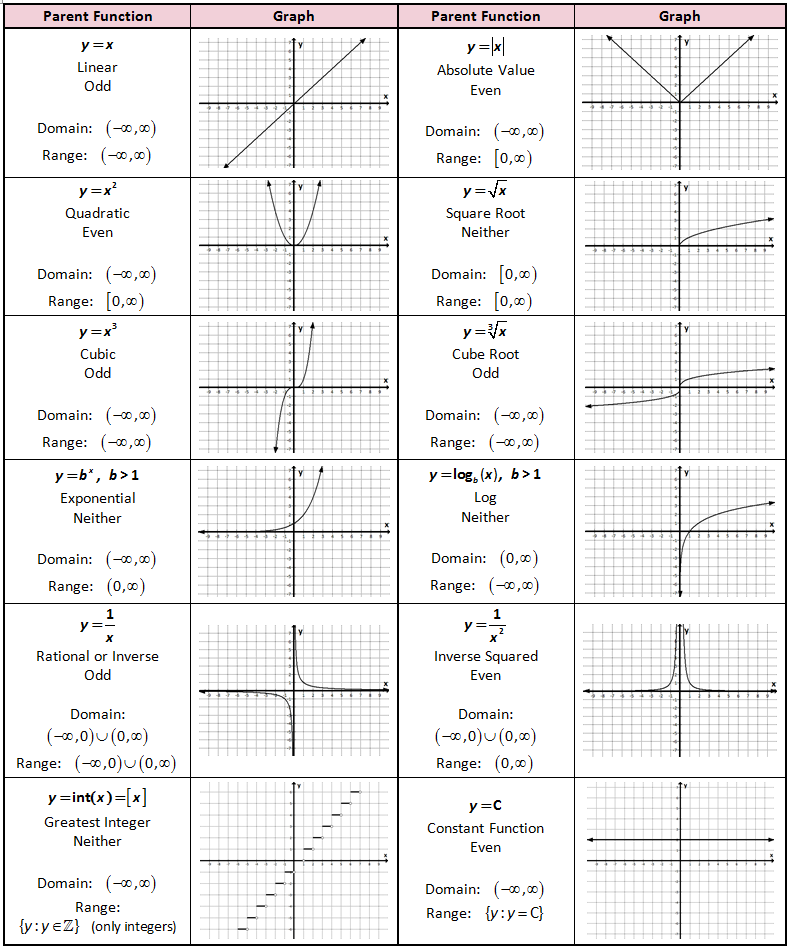
Can you get me a chart of all the parent functions there are in our galaxy? Thanks bro
TheConMan:
I see
 TheConMan:
Bless ur soul buddy
Ferredoxin4:
There's also trig and trig inverse functions, you can find that on your own i suppose.
TheConMan:
K so the thing is...there’s other rational functions that look really scary..
TheConMan:
|dw:1567650678352:dw|
TheConMan:
How do i find the domain and range of this beast?
TheConMan:
Do i have to find the vertical asymptote first?
TheConMan:
I know that the value of x in the denominator has to be equal to or bigger than 2
 Hero:
Hero:
To find the vertical asymptote, you would have to set the expression under the radical greater than or equal to zero, but in this case the expression can't equal zero either so use greater than zero instead. So set \(x - 1 > 0\)
Hero:
Or rather that is to find the domain.
TheConMan:
We can’t plugin the value of x = 1 in the denominator because that’d make the entire denominator equal to 0
Hero:
So that is your asymptote. Now use \(x - 1 > 0\) to find the domain
TheConMan:
|dw:1567651981431:dw|
TheConMan:
|dw:1567652030302:dw|
Hero:
Do you know the difference between \( >\) and \(\ge\) ?
TheConMan:
Ofc
Hero:
If you're using \(\ge\) you're saying that x can equal 1 which it cannot
TheConMan:
Oops That was a mistake
TheConMan:
|dw:1567652094032:dw|
Hero:
So that is your domain
TheConMan:
What bout range
Hero:
One second
TheConMan:
The power in the denominator is smaller than the power of numerator....so no horizontal asymptotes
Hero:
That is correct
TheConMan:
Nise
Hero:
So what you want to do to find the range, is to find the lower bound. To do that you have to try values of \(x\). Try x = 2 to find the lower bound
TheConMan:
Let’s first pray to the anime god to keep my internet alive so i can finish this question in my lifetime
TheConMan:
|dw:1567652622418:dw|
TheConMan:
Is that correct?
Hero:
It is correct
TheConMan:
What do i do next?
Hero:
And the upper bound is ??
TheConMan:
Infinite
Hero:
The process is always the same. Finding the upper and lower bounds
Hero:
To find the upper bound, you have to know which direction the graph of f(x) is going and whether there is an upper bound. Infinity means that f(x) continues to move in a positive direction and has no upper bound.
TheConMan:
Wait, are you telling me to memorize the parent function of the transformed function ???
Hero:
Infinity is what you put in place of an upper bound and just means that there is no upper bound. It means that the function continues in the positive direction forever
TheConMan:
...the behaviour our parent and its transformed function?
Hero:
The true way to find the upper bound is to apply the limit
TheConMan:
Yes, that’s precisely why i said infinite because i thought the curve of our transformed function would go on for ever
TheConMan:
I’m not at limit’s chapter mate. ...
TheConMan:
So how do i fine the upper bound of our domain ?
TheConMan:
I mean range
Hero:
You don't have to use limits, but if I were you I would learn it so that you can justify what is happening as x gets larger and larger. For now, you can just use values such as x = 10, 100, 1000, 10000, 100000
Hero:
You have to justify using infinity in place of the upper bound. That is, if you are not allowed to use a graphing utility to observe the graph.
TheConMan:
That’s true, i’m Not allowed to use a graphing Calc in our class.
TheConMan:
I’ll lurn limits when i get to the limits chapter
Hero:
Help, then use that method. Keep using bigger and bigger values of x in your function and find the value of f(x) for each value of x to justify infinity since you can't graph or use limits.
TheConMan:
I’ll comeback and do these questions all over again...
Hero:
Once you find the value for x = 1,000,000, then you end by saying, As x gets larger and larger, f(x) approaches infinity
Hero:
So the or rather in this case you're demonstrating that x has no upper bound so the domain is \((1, \infty)\)
TheConMan:
I’ll just look at the parent function and it’s transformation and make my judgements from there. I ain’t going to manually plugging a million x values into the function just to find their f(x)
Hero:
It's just seven computations. But technically that is the correct way to do it. That function is not on any of those parent function graphs. There's no function that has a square root in the denominator.
TheConMan:
Hero. I have a major question for you....
TheConMan:
A function like the following... what’s the parent function of that bro?? |dw:1567653511872:dw|
TheConMan:
What’s their parent functions look like?
Hero:
That's what I'm trying to tell you. There's no parent function for every function. Some of them you have to do tedious work to find domain and range
TheConMan:
......:/
Hero:
However, here's the thing. All you have to do is just identify the restrictions.
TheConMan:
What’s the shortest way to solve these questions? Limits?
Hero:
In the case of \(f(x) = \dfrac{\sqrt{x-2}}{(x -5)(x + 2)}\) you know that there are two values in the denominator that \(x\) cannot equal. In the numerator you know that \(x - 2 \ge 0\)
Hero:
So you can use that information to help you figure out the domain.
TheConMan:
Set each parentheses equal to zero and solve for x? That’d be my asymptotes
Hero:
Correct. The asymptotes will tell you at least two values are excluded from the domain. Meanwhile, \(x - 2 \ge 0\) will tell you the rest of the values that are excluded from the domain and all of that together will tell you what the domain is.
TheConMan:
I see....and lastly...how do i find the domain of the following function... |dw:1567653990285:dw|
TheConMan:
I have the inverse..
Hero:
For that you should ask yourself if there is anything that is restricting x i.e \(x\) being in the denominator or restricted by a root.
Hero:
One thing at a time bro.
Hero:
We only use the inverse for finding the range
TheConMan:
|dw:1567654091055:dw|
Hero:
Find the domain before you find the range
Hero:
We don't need the inverse to find the domain of the original.
Hero:
That may confuse you though
TheConMan:
Let’s not confuse me...
TheConMan:
So i’ve Figured out the range of that function... and it’s y can be any real number except y has to be equal to or bigger than 0
Hero:
Use \(f(x) = (x - 2)^{2/3}\) to find the domain Use \(f^{-1}(x)\) (the inverse) to help find the range.
Hero:
Have you found the domain yet?
TheConMan:
I have the range of that function but no domain :/ that’s what i need your help for
Hero:
The order in which to find these sets are to find the domain BEFORE finding the range.
TheConMan:
You mean domain of the inverse? Yes
Hero:
Nope, I mean the domain of the original function. I see that you are really confused now.
Hero:
We've always found the domain or the original function first before attempting to find the range.
Hero:
You're trying to do something different here.
TheConMan:
Wait, let’s stop. Let me draw the answer and we’ll go from there.
Hero:
I'm trying to help you avoid disaster if you take a test. Attempting to find the range first before the domain is mathematically illogical
TheConMan:
|dw:1567654488685:dw|
Hero:
We need to use \(f(x) = (x - 2)^{2/3}\) to find the domain first.
TheConMan:
Ok let’s do that
Hero:
Okay, so what are the restrictions on \(x\) if any?
Hero:
Is there any x value you can put into the function that will lead to an undefined output?
TheConMan:
Umm... let me check.. one sec
Hero:
Whenever there is a restriction on \(x\) what are the usual conditions?
TheConMan:
Bro I think there’s something wrong with my calculator... I’m getting 1 for pretty much every x value...
TheConMan:
I don’t really have a power button that can do a power of 2/3 so I divide 2/3 and use the decimal version of the 2/3 power to solve for the x but i’m Getting 1 for everything over here
Hero:
Can you square the value then apply the third root?
TheConMan:
So negative x values r giving me errors..
Hero:
Take a screenshot of your calculator and upload it here
Hero:
I want to see what kind of calculator you're working with
TheConMan:
You don’t wanna see my calc
Hero:
I do actually
TheConMan:
No u dont
Hero:
Will you just upload it bro. No one is going to judge the calculator
TheConMan:
Let me tell u the name it’s Casio fx-260 solar
TheConMan:
It’s a monster
Hero:
You have an \(a^{b/c}\) function. You need to learn how to use that
Hero:
Let me see if I can find an emulator
TheConMan:
I see it
TheConMan:
So it makes fractions
Hero:
Correct
Hero:
Exponential fractions
Hero:
If you think you've figured it out then evaluate f(3) and f(10) let me know what you get
TheConMan:
Hold up..I need u to check if I did this right... 4-2 raised to the power of 2/3 i got 1.58
Hero:
bro, evaluate f(3) and f(10)
TheConMan:
Ok
TheConMan:
For f(10) I got 3.65
Hero:
Nope, that is not correct
Hero:
You're doing something different from what you did the first time
Hero:
Make sure you are entering \((10 - 2)^{2/3}\)
TheConMan:
Just to be on the same page we r doing this right?|dw:1567655558180:dw|
Hero:
Yes, you can actually evaluate that manually
Hero:
and if you can do it manually and get the result, the calculator should match what you get manually
TheConMan:
4
Hero:
Boom!
Hero:
Some of your woes are resolved
TheConMan:
I wasn’t using the brackets
Hero:
Yep, you gotta use them
TheConMan:
What’s woes?
Hero:
Not knowing how to evaluate functions with exponential fractions
Hero:
or rather fractional exponents
Hero:
on your calculator that is
Hero:
Anyways, where were we
TheConMan:
K let’s focus...
TheConMan:
Restrictions
Hero:
Right find a restriction on \(x\). My question to you was whenever there are restrictions what are the usual conditions?
TheConMan:
Let me check if there r any restrictions in the domain
TheConMan:
What do u mean by usual conditions?
TheConMan:
X can be either smaller, bigger or equal to n
Hero:
I'll just give you this one. Usually when there are restrictions, x is either in the denominator of a fraction or under a root.
Hero:
If \(x\) isn't restricted by an even root or a denominator then there is no restriction
Hero:
Which means what for the domain if there is no restriction?
TheConMan:
There r no asymptotes or graph where x doesn’t have a value for fx
Hero:
So ultimately what does that mean for the lower and upper bound of the domain?
Hero:
If there is no restriction on x
TheConMan:
If there r no restrictions that means there’s a value for y for every x value
TheConMan:
There’s no discontinuity
TheConMan:
Am I getting this wrong?
Hero:
How would you express the domain for a function with no restrictions on \(x\)
TheConMan:
Omg.... all real numbers
Hero:
Thank you
TheConMan:
I’m a simple man, ask me in simple terms
Hero:
Mathematically that is equivalent to writing \((-\infty, \infty)\)
Hero:
Now we can find the range
TheConMan:
Sure
TheConMan:
I gave u the inverse
TheConMan:
|dw:1567656461272:dw|
Hero:
One second ...
TheConMan:
I really wanna sleep tonight tho
TheConMan:
Can we hurry this?
Hero:
Okay, so you found that \(f^{-1}(x) = \sqrt{x^3} + 2\)
Hero:
Tell me, how do we find the restrictions on \(x\) in this case?
TheConMan:
Plugin a few points and see what makes the function undefined
TheConMan:
X has to be equal to or bigger than 0
Hero:
Have you not been taught to set the expression under the radical greater than or equal to zero? In other words, have you set \(x^3 \ge 0\) ?
Hero:
In order to find the domain?
TheConMan:
I haven’t touched math in 10 year
TheConMan:
I’ve already tested the x values ....
Hero:
Bro, we just did several of these problems involving finding a domain and anytime you have an expression under an even root you're supposed to set it greater than or equal to zero to find the domain. We did at least five problems like this. I was giving you time to figure it out for yourself
TheConMan:
I’ve a,ready done that part bro
Hero:
What do you mean you've already done it?
TheConMan:
I’ve tried a few values of x in the inverse function..
Hero:
I don't want you to do it that way. I want you to solve this \(x^3 \ge 0\)
TheConMan:
Oh is it bcuz it’s an even root function....omg /.- ok lets draw this baby
TheConMan:
|dw:1567657077826:dw|
TheConMan:
So I was right..x has to be equal or greater than zero
Hero:
Well actually we have to replace x with y then it is correct.
Hero:
The range is \(y \ge 0\)
TheConMan:
We did it.
TheConMan:
🎉
Hero:
I mean finding the range is confusing for you if we use the inverse method.
TheConMan:
The only thing that’s eating my soul is to remember how to approach an even or odd root of inverse function...that’s something I have to remember from here on
Hero:
I think there is a reason most avoid the inverse method.
TheConMan:
Apart from that...finding the inverse of a original function is no problem for me
TheConMan:
I’m going to make notes with enough detail on this topic that even an ape will be able to do it
TheConMan:
Anyways...appreciated ur help. God bless u
TheConMan:
Have a good night...I’m going to finish making notes here
TheConMan:
Ciao
TheConMan:
Thanks bud.
Hero:
But there doesn't seem to be a resource for fractional exponent expressions
Hero:
That's the only draw back however
TheConMan:
It’s ok
Hero:
If you have something like \(f(x)= (x - 1)^{3/2}\) if you re-write the function as \(f(x) = \sqrt[2]{(x - 1)^3}\) then you will see that the \(x\) is not restricted but the range is restricted.
Hero:
Because of the square root
Hero:
Okay, that was confusing. I was wrong about that
Hero:
The domain is restricted and the range is restricted as well
Hero:
Basically if you have an even root you are going to have restrictions in the domain AND the range
TheConMan:
But it’s less work tho
TheConMan:
If it’s a radicand function, i can just take w/e is under the radicand and set that to inequality and go from there..
TheConMan:
Anyways.. i wanna sleep now. Lol
Hero:
You can find the domain, but finding the range is always confusing for you
Hero:
Your life would be a lot easier if you learned how to graph some of these
Hero:
You need to learn how to graph the original function AND the inverse function.
TheConMan:
Actually it’s the other way...cuz i know how to take the inverse of the original function and i can judge what x values will make the function undefined...so the domain of the inverse aka the range is easy for me it’s the freakin domain that eats my brains
Hero:
Nah, the domain is easier than the range. I guess you won't know for sure until you take a test and get the results back.
Hero:
You already know how to find a domain.
Hero:
If an expression is in the denominator, then that expression cannot be zero. If an expression is under an even root then that expression must be greater than or equal to zero
TheConMan:
It’s hard to find the domain of the original root functions for me... cuz i don’t know where to start from??? Do I plugin the range values of the original function back into the function to find the domain or what??
Hero:
Easy, now to describe how to find the range (at least whenever it is not feasible) to use the inverse method, then describing the range might be more difficult
Hero:
If you have an odd function \(f(x) = (x - 1)^{1/3}\) then the domain is all real numbers
TheConMan:
I can find the range, help me find the domain of root functions... and weird functions..
Hero:
If it's an even root \(f(x) = (x - 1)^{1/2}\) then set \(x - 1 \ge 0\) that's easy
TheConMan:
Does having all real numbers mean i won’t have any restrictions in the domain ??? Is that always the case that i’ll Be all real numbers without restrictions ?
Hero:
Trust me domain is easier than range
TheConMan:
I find range easier than domain tbh ..
Hero:
Okay let me prove you that the range is harder
TheConMan:
Yeah, finding the domain of even root function is easy...but just gotta remember it applies to the inverse functions as well.
Hero:
\(f(x) = \dfrac{\sqrt[4]{x - \sqrt{x}}}{(2x - 5)(3x + 8)}\)
Hero:
Find the range of that
TheConMan:
Bro, who even give questions like that for homework or tests?
Hero:
I should have put a root in the denominator
TheConMan:
Be a little more practical with your examples lol
Hero:
You told me finding the range is easy. What's the problem now?
TheConMan:
Bro, there’s a limit to *i find range easy* lol
Hero:
right.
Hero:
Finding the range ain't as easy as you think. That's the moral
TheConMan:
Anyways...i gotta finish this up and sleep sleep... it’s almost 1 am here lol
Ferredoxin4:
\(\color{#0cbb34}{\text{Originally Posted by}}\) @TheConMan Bro, there’s a limit to *i find range easy* lol \(\color{#0cbb34}{\text{End of Quote}}\) Sorry to interrupt..is the pun intended xD
TheConMan:
Fully intended
Hero:
Okay off to bed everyone
Hero:
I think we've all overstayed our limit
TheConMan:
K thanks for your help guys. I owe my math marks to wo guys
Ferredoxin4:
it's time to discontinue XD
Hero:
^ this
TheConMan:
We’ve reached our limits lol
TheConMan:
Goodnight :)
Join our real-time social learning platform and learn together with your friends!
 Demon25:
For a hoco proposal with a cheerleader and football player, what else should be a
Demon25:
For a hoco proposal with a cheerleader and football player, what else should be a

 Breathless:
TOC: "MGF any confirmation on the commander? we require confirmation as soon as[radio static].
Breathless:
TOC: "MGF any confirmation on the commander? we require confirmation as soon as[radio static].
 EdwinJsHispanic:
I wrote something that I don't know if I want it as a poem or song, Please let me know on yours thoughts about it, I'm still doing this! "Broken promises an
EdwinJsHispanic:
I wrote something that I don't know if I want it as a poem or song, Please let me know on yours thoughts about it, I'm still doing this! "Broken promises an
 thehearken:
hi um I don't know if this is the right section for this, but can someone go over my poem and tell me if its good enough to give my English professor for a
thehearken:
hi um I don't know if this is the right section for this, but can someone go over my poem and tell me if its good enough to give my English professor for a
 heartlessprophet:
Aye what's 19z%u00f74p=9u03c0 my teacher thinking of impossible questions for us
heartlessprophet:
Aye what's 19z%u00f74p=9u03c0 my teacher thinking of impossible questions for us
 kippppp:
does anyone have any good tips for writing stories? i'm trying to write a dnd campaign but i'm not that great of a writer yet.
kippppp:
does anyone have any good tips for writing stories? i'm trying to write a dnd campaign but i'm not that great of a writer yet.
 GRIZZLEY19:
Y'all let me know what y'all think about this beat I made I took me like a hour maybe rate it 0/10 https://drive.
GRIZZLEY19:
Y'all let me know what y'all think about this beat I made I took me like a hour maybe rate it 0/10 https://drive.
 Ultrilliam:
Welcome to the 10th Anniversary Update! (Part 2) Sorry this one passed the date a
Ultrilliam:
Welcome to the 10th Anniversary Update! (Part 2) Sorry this one passed the date a
 Twaylor:
was walking downtown and my adhd brain wanted to make some (rock?) lyrics: There'
Twaylor:
was walking downtown and my adhd brain wanted to make some (rock?) lyrics: There'