
 Ballery1:
Plz check math question thank you!
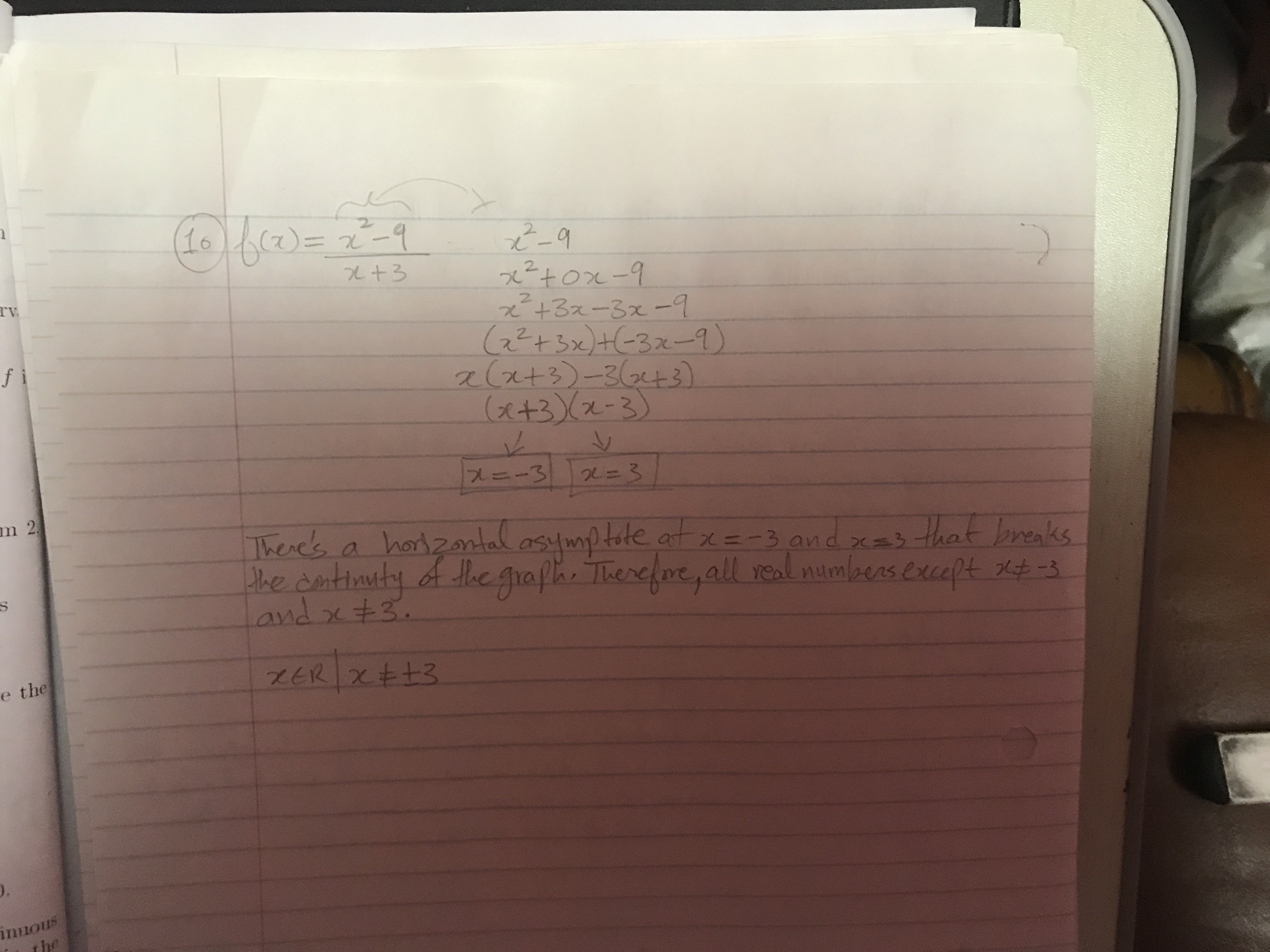 Ballery1:
@Hero
Ballery1:
also x can't be -3 in the denominator
 Hero:
Hero:
Basically, you have it right. One of the x's are vertical asymptote. The other is a removable discontinuity
Ballery1:
what does *removable discont* is??? i mean i did solve a bunch of questions related to that on ilx but didnt have the energy to read through...however i did manage to get through all test questions tho
Hero:
It's basically a graph with a hole at a point
Ballery1:
open or close ?
Ballery1:
open?
Hero:
Open point
Ballery1:
kkk thanks bro
Ballery1:
btw the answer is -3
Hero:
Interesting
Ballery1:
x= -3
Ballery1:
thats it
Hero:
But not x = 3. Interesting.
Hero:
Hang on a minute.
Ballery1:
i dont see no x = 3 there
Ballery1:
yup just x=-3
Hero:
Ah, because the graph is linear. So of course it will only be discontinous at only the one point
Hero:
Check this out...
Ballery1:
k
Hero:
Here's what to do next time...
Hero:
\(f(x) = \dfrac{x^2 - 9}{x + 3}\) Factor the numerator to get \(f(x) = \dfrac{(x + 3)(x - 3)}{x + 3}\) Then cancel the factor of one: \(f(x) = \dfrac{\cancel{(x + 3)}(x - 3)}{\cancel{x + 3}}\)
Hero:
Which will leave you with just \(f(x) = x - 3\)
Ballery1:
Aah icy
Hero:
This is equivalent to \(y = x - 3\) which is a linear function
Ballery1:
but who even writes factors like that in the numerator tho???
Hero:
After that, all you have to do is remember there will be a hole in the graph when the denominator is equal to zero. x + 3 = 0 x = -3
Hero:
Everybody factors like that
Ballery1:
that basically mean the graph is continuous except for x = -3 rite
Hero:
Because you have to remember difference of squares very important: \(a^2 - b^2 = (a + b)(a - b)\)
Hero:
Yes correct.
Ballery1:
okie doker
Hero:
Write down difference of squares. You will see it a lot in many different forms
Hero:
That one you have to remember by heart.
Ballery1:
bro i did factor in my solution tho.
Hero:
I saw that. But difference of squares is simpler
Ballery1:
okie dokie
Ballery1:
thanks bro.
Hero:
When you get to more difficult math, you'll want to have it handy
Ballery1:
i'll write it down. thanks
Ballery1:
omg :O |dw:1568876348623:dw|
Ballery1:
wouldn't it be x=3 rather than x=-3?
Ballery1:
@hero sorry to bother you but can u plz look at that^^
Hero:
Well, is that the same problem because beforehand I could have sworn x + 3 was in the denominator or is that a different problem.
Ballery1:
\(\color{#0cbb34}{\text{Originally Posted by}}\) @Hero \(f(x) = \dfrac{x^2 - 9}{x + 3}\) Factor the numerator to get \(f(x) = \dfrac{(x + 3)(x - 3)}{x + 3}\) Then cancel the factor of one: \(f(x) = \dfrac{\cancel{(x + 3)}(x - 3)}{\cancel{x + 3}}\) \(\color{#0cbb34}{\text{End of Quote}}\)
Hero:
The one you did you put x - 3 in the denominator
Ballery1:
the original problem has x+3 in the donom
Ballery1:
even looked at the book
Hero:
Okay
Ballery1:
omg i made a mistake /.-
Ballery1:
|dw:1568876963669:dw|
Hero:
Okay very good. We already went over it then.
Ballery1:
If u look at the solution i posted as a picture does contain the right question
Hero:
Yup
Ballery1:
My only questions is this... let me draw one second
Ballery1:
|dw:1568877132121:dw|
Ballery1:
Wouldn’t you set the x-3 = 0 and solve for x?
Ballery1:
Because the textbook does say x=-3
Hero:
You set the denominator equal to zero.
Hero:
Then solve for x. You're making it more complicated than it is
Hero:
Set the denominator equal to zero \(x + 3 = 0\) Subtract three from both sides. \(x = -3\)
Ballery1:
Can you give me another similar example? Plz
Hero:
It's simple. You're just getting confused over signs for some weird reason.
Ballery1:
I was just asking because you canceled out the (x+3) both from the numerator and denominator and the remainder was just x-3...so i thought wouldn’t we set that equal to 0 and solve for x? :/
Hero:
But you still have to set the denominator equal to zero. x + 3 is in the denominator not x - 3
Hero:
x - 3 is the linear expression. It has nothing to do with finding the discontinuity
Ballery1:
Okie dokie. I got it. Thanks bro :) <3
Join our real-time social learning platform and learn together with your friends!
 KBaby:
Verse 1 We left our names in the dust of the driveway Watched the old town shrink
KBaby:
Lyrics Generator Use AI to write the lyrics for a song. Suggested Genres: Pop Hip
KBaby:
Verse 1 We left our names in the dust of the driveway Watched the old town shrink
KBaby:
Lyrics Generator Use AI to write the lyrics for a song. Suggested Genres: Pop Hip

 aitexturegenerator:
How are you all handling AI-generated textures for 3D models and game assets without losing the hand-made feel? I've been doing a small stylized environment
aitexturegenerator:
How are you all handling AI-generated textures for 3D models and game assets without losing the hand-made feel? I've been doing a small stylized environment

 Demon25:
Woke up feeling like that girl and that dude well he still aint crap pluse the du
Demon25:
Woke up feeling like that girl and that dude well he still aint crap pluse the du
 playtsec:
how do I get rid of stress from teachers... I just feel like running out the classroom and leaving on my own.
playtsec:
how do I get rid of stress from teachers... I just feel like running out the classroom and leaving on my own.
 JohnnyLFowler0812:
What type of gamer would play something and then get off for a while. Why not sta
JohnnyLFowler0812:
Which is better? Metallica Rap Country R&B hiphop Medal Gospel Chill Which 3 opti
JohnnyLFowler0812:
What type of gamer would play something and then get off for a while. Why not sta
JohnnyLFowler0812:
Which is better? Metallica Rap Country R&B hiphop Medal Gospel Chill Which 3 opti