
 xXMarcelieXx:
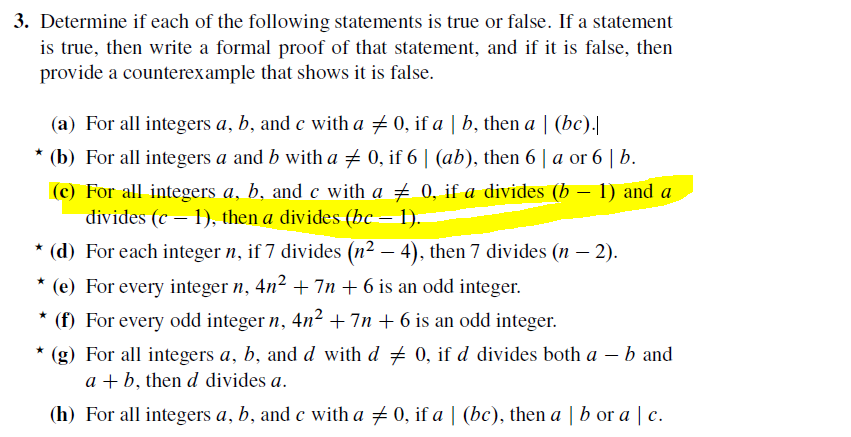
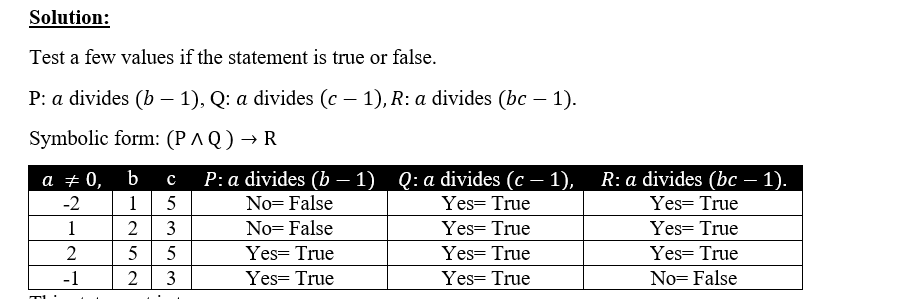
someone help me out. I am confuse on this math problem. How do i know if its true or false? I already tested out some values
 imqwerty:
a divides (b-1)*(c-1)
 Ballery1:
it's working for me
Ballery1:
let me draw
xXMarcelieXx:
hmm did i make an error?
xXMarcelieXx:
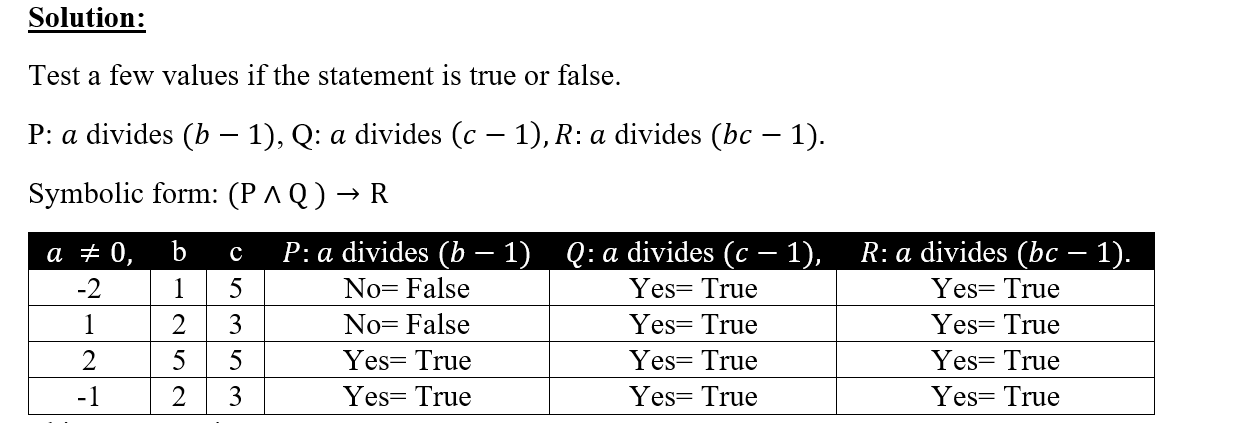
oh wait, i did a mistake on the last row. I just fixed it . Therfore this statement is true?
 Hero:
Hero:
It's an AND statement right?
Hero:
@xXMarcelieXx are you here?
xXMarcelieXx:
yes
Hero:
There's a way to know whether it is true or false before you even start creating your table
Hero:
\((bc - 1)\) must be a factor of \((b - 1)(c - 1)\) which it is not.
Hero:
So ultimately it will fail
Hero:
You just have to find the value where it fails
xXMarcelieXx:
you usually get the conclusion to test if it factors out?
Hero:
I don't understand your question.
Ballery1:
all i wanted to know was...when they say *(bc-1), do they mean (b-1)(c-1)..or is the expression is given as is...
Hero:
no
xXMarcelieXx:
meaning, when do we usually factor out things ?
Hero:
We're not factoring anything. It's just that if \(a\) is dividing both \((b - 1)\) and \((c - 1)\) then surely it will divide the product of \((b - 1)(c - 1)\) but \((bc - 1)\) is not a factor of any of those numbers.
Ballery1:
AAAAAAAAA icy now
Ballery1:
i tried a = -2 both the individual and the product gave me the same answer....
xXMarcelieXx:
so, is this statement false? I thought it was true
Ballery1:
try more points
Ballery1:
wait, let me draw.
Hero:
Does it work for negative numbers?
Hero:
@xXMarcelieXx always test all possibiities
Ballery1:
wait, the values of *b* and *c* remain constant right ?
Ballery1:
we're only changing the values of *a* here right??
Hero:
Test a negative number for b and a positive number for c
Hero:
see if that works
xXMarcelieXx:
i tested negative numbers and it seems to be true but unless i did some algebra errors. like a= -3, b= -2 and c= -4
Hero:
Test negative and positive numbers mixed
Hero:
Don't test all positive and all negative
xXMarcelieXx:
okay, i just tested some values like that and it turned out to be true for some reason
Hero:
Yep, It's probably true. Just need to prove why
xXMarcelieXx:
okay, i'll do it right now
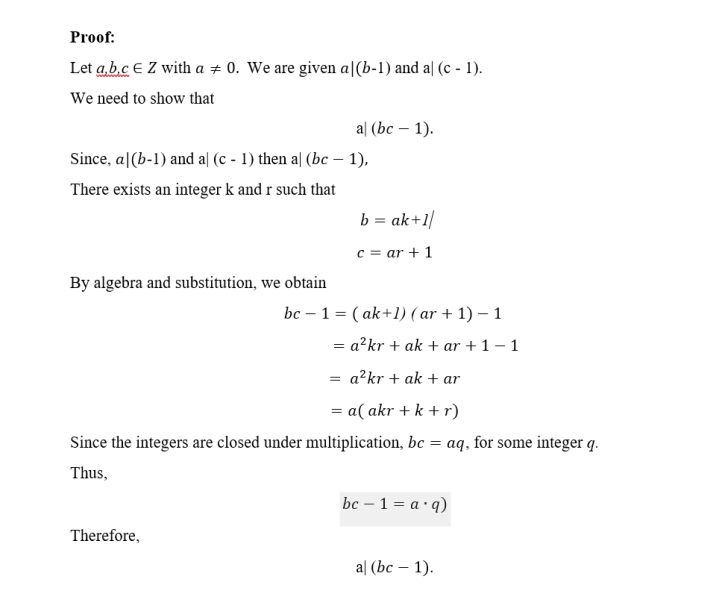 Hero:
Hero:
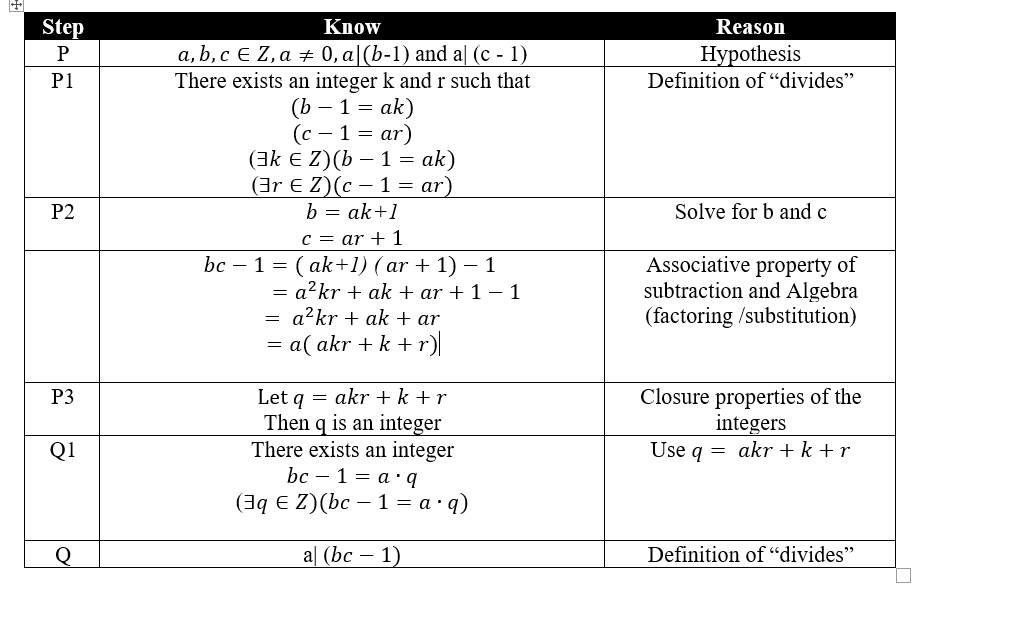
You forgot to define q
Hero:
that's the only flaw I see
Hero:
Actually I see another mistake
xXMarcelieXx:
oh, hmm where do i define
xXMarcelieXx:
Q*
Hero:
Well the q seems to appear out of nowhere. It is not linked to the rest of your proof.
xXMarcelieXx:
q is q= akr+k+r
Hero:
Exactly. I'm pretty sure you need to define it explicitly somewhere.
Hero:
But then I see that you have bc = aq and also that bc - 1 = aq
Hero:
Both can't be true.
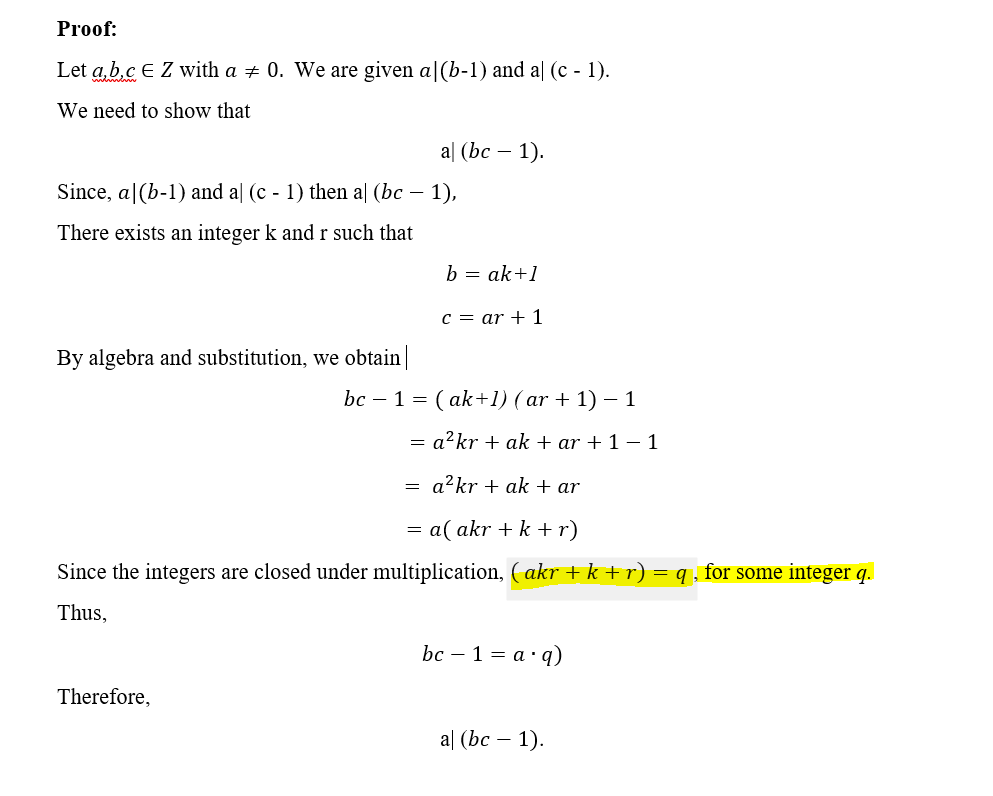 Hero:
Hero:
Better but now you have an open parentheses left hanging
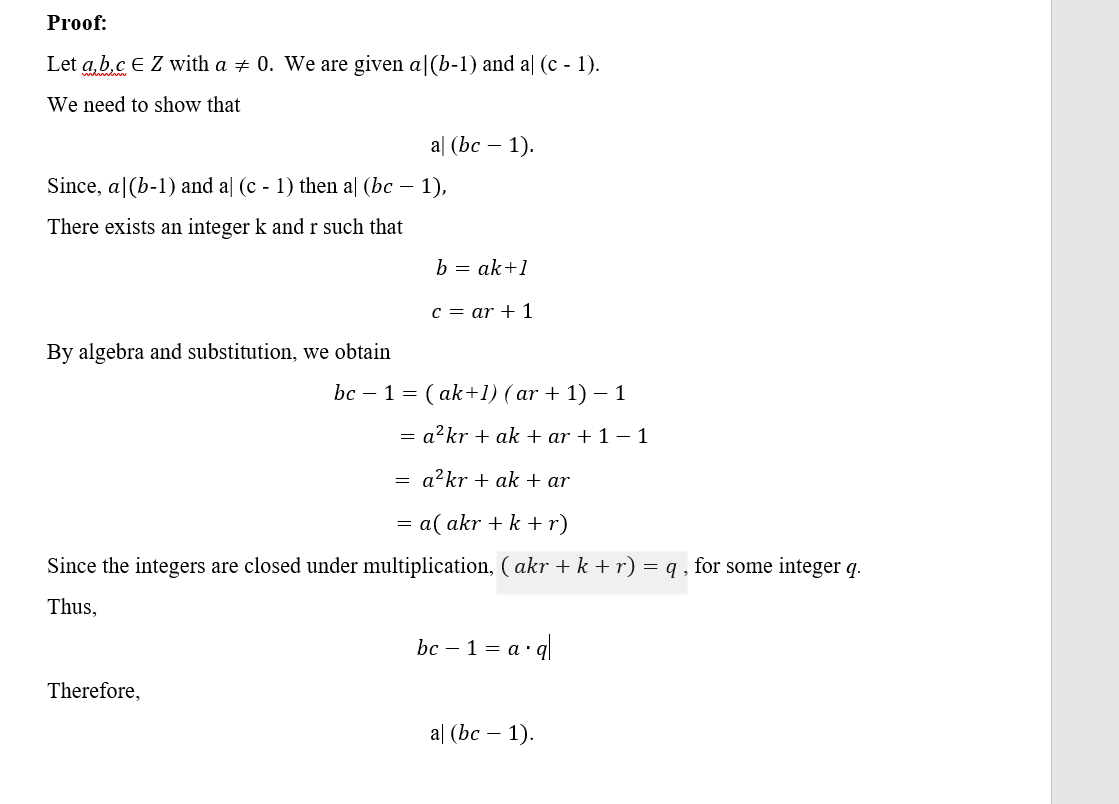 Hero:
Hero:
The part about closed under multiplication is it in the right place? We're just defining q.
xXMarcelieXx:
so should i delete it ? I think theres one where we say "since the integers are closed under addition or multiplication"?
Hero:
Yes integers are closed under multiplication and addition, but there should be a reason for mentioning it.
Hero:
It's not because you're defining q
xXMarcelieXx:
oh i see. so then what can i say on for that one
Hero:
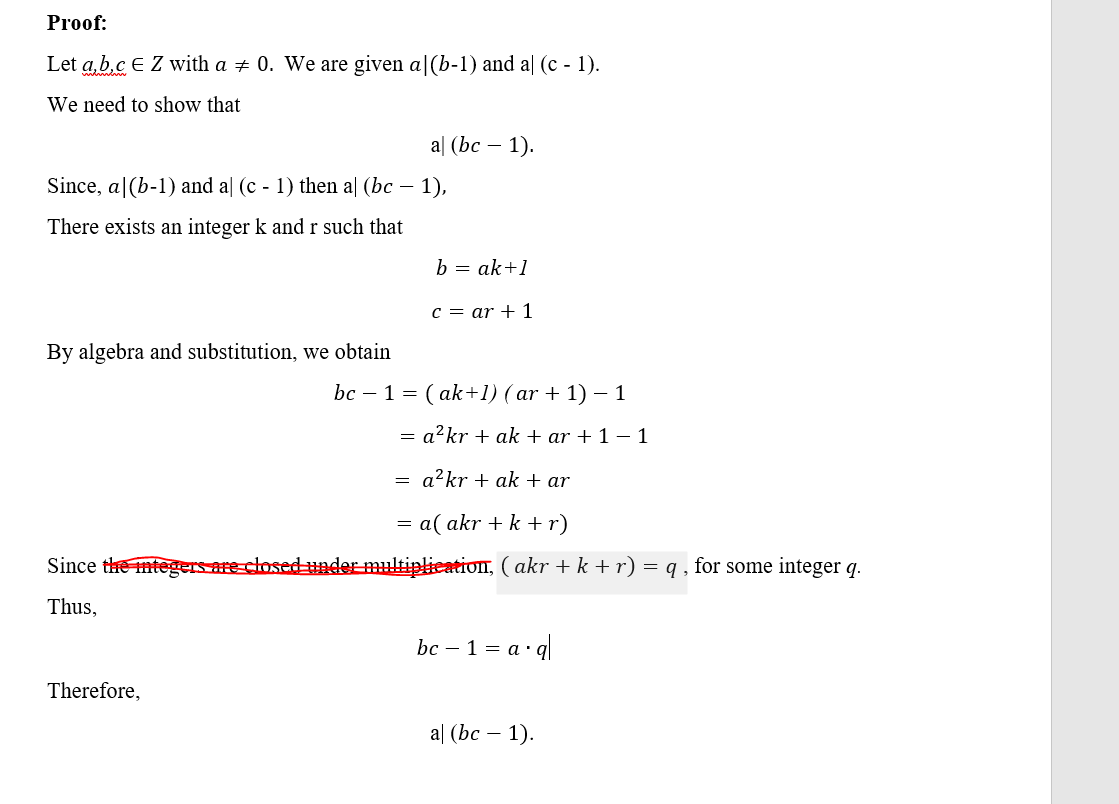
Nothing more than what you've already said minus the integers closed under multiplication part
Hero:
One second. Let me try something real quick
xXMarcelieXx:
okie
Hero:
Okay nevermind. You should be good to go. Let me know what feedback you get on that one.
Hero:
Hang on, I did find a flaw
Hero:
a can't be zero, but b or c can
Hero:
Nope, nevermind, if b or c is 0, then a has to be 1 or -1
Hero:
Goodnight
xXMarcelieXx:
so do i just leave the statement " since the integers are closed under multiplication" sorry i got confused lol
Hero:
It doesn't fit with the rest of the sentence.
Hero:
It isn't used for defining variables
Hero:
It's just used to state that if you multiply two integers the result will also be an integer.
Hero:
Anyways, I'm off.
 xXMarcelieXx:
no dont leave yet loll
Hero:
I would write it as let q be an integer such that q = (akr + k + r). Since integers are closed under multiplication, we can say that aq is also an integer. Thus bc - 1 = aq. Therefore a|(bc - 1)
Hero:
Something like that
xXMarcelieXx:
oh okay, got it :)
Join our real-time social learning platform and learn together with your friends!
 KBaby:
Verse 1 We left our names in the dust of the driveway Watched the old town shrink
KBaby:
Lyrics Generator Use AI to write the lyrics for a song. Suggested Genres: Pop Hip
KBaby:
Verse 1 We left our names in the dust of the driveway Watched the old town shrink
KBaby:
Lyrics Generator Use AI to write the lyrics for a song. Suggested Genres: Pop Hip

 aitexturegenerator:
How are you all handling AI-generated textures for 3D models and game assets without losing the hand-made feel? I've been doing a small stylized environment
aitexturegenerator:
How are you all handling AI-generated textures for 3D models and game assets without losing the hand-made feel? I've been doing a small stylized environment

 Demon25:
Woke up feeling like that girl and that dude well he still aint crap pluse the du
Demon25:
Woke up feeling like that girl and that dude well he still aint crap pluse the du
 playtsec:
how do I get rid of stress from teachers... I just feel like running out the classroom and leaving on my own.
playtsec:
how do I get rid of stress from teachers... I just feel like running out the classroom and leaving on my own.
 JohnnyLFowler0812:
What type of gamer would play something and then get off for a while. Why not sta
JohnnyLFowler0812:
Which is better? Metallica Rap Country R&B hiphop Medal Gospel Chill Which 3 opti
JohnnyLFowler0812:
What type of gamer would play something and then get off for a while. Why not sta
JohnnyLFowler0812:
Which is better? Metallica Rap Country R&B hiphop Medal Gospel Chill Which 3 opti