
 Ballery1:
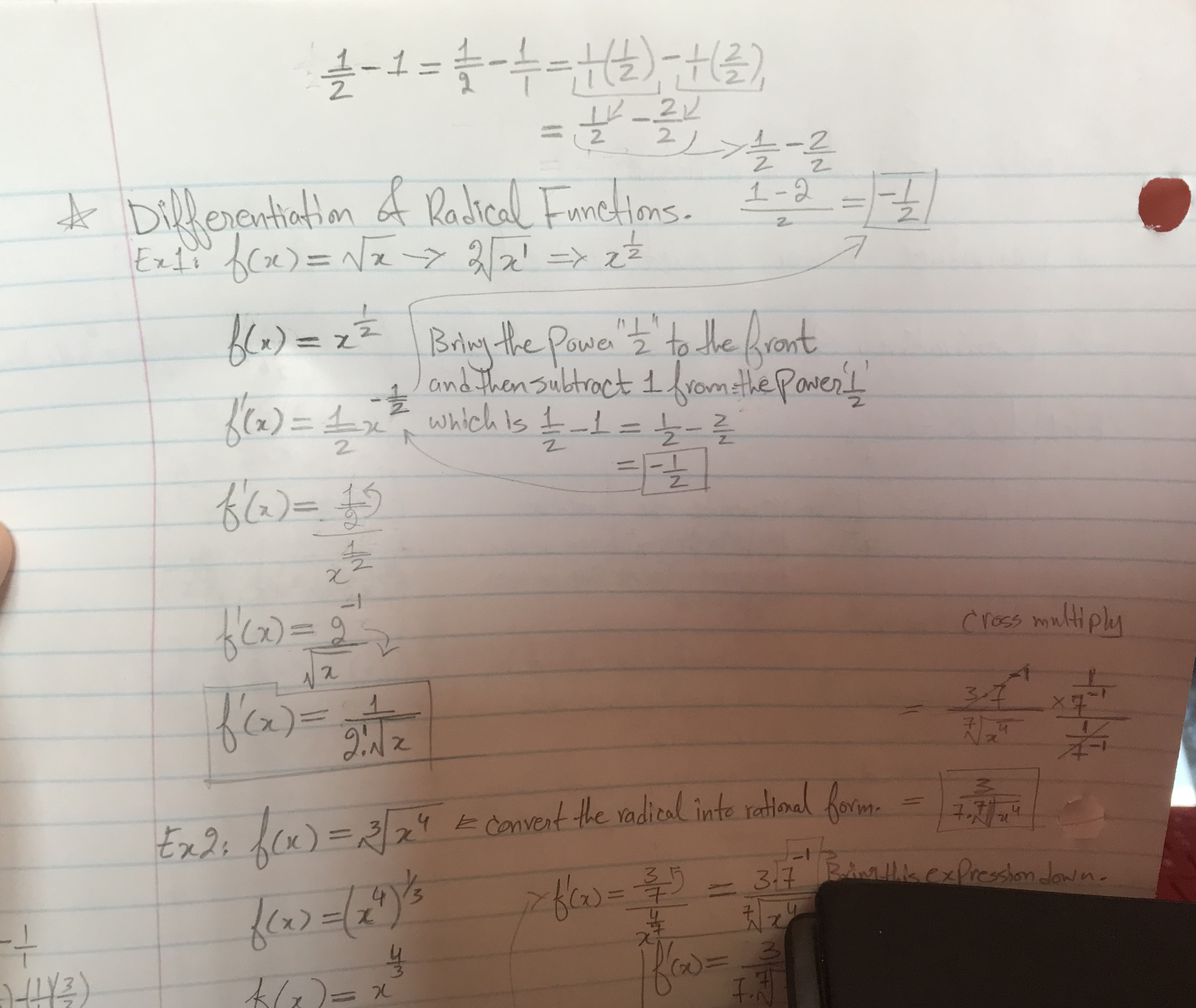
I have a question in regards to derivatives and differentiation...
 katwhirles:
what is your question
 Ballery1:
@Hero
 Hero:
Hero:
\(\sqrt{2}\) is a constant. \(\sqrt{x}\) is not
Ballery1:
So does that mean...i can’t convert the radical of 2 to ration and find it’s derivative from there?
Hero:
You can convert \(\sqrt{x}\) to \(x^{-1/2}\) to find its derivative. Since the derivative of \(\sqrt{2}\) is zero, it is not necessary to convert it to exponent form.
Ballery1:
Ok i think i got it now. Thanks bro
Ballery1:
For the sake of curiosity....i feel like i need to ask you a question...
Ballery1:
So are you telling me that if i convert the radical of 2 to rational form and apply the power rule..and get 1/2.sq(2)....that won’t be on a graph?
Ballery1:
....apply the power rule and some algebra to get 1/2.sq(2)****
Hero:
If the function is \(f(x) = \sqrt{x} + \sqrt{2}\) and then you find \(f'(x)\) then the constant will become zero which will not be on the graph of \(f'(x)\)
Hero:
The power rule is \(\dfrac{d}{x}(x^n) = nx^{n-1}\). This implies that the power rule applies to terms with \(x\) as the variable.
Ballery1:
|dw:1569175848355:dw|
Hero:
\(\sqrt{2}\) does not include \(x\)
Ballery1:
Oooooo I see now...so the power rule applies to variables... and not x values... i see now.
Hero:
I was with you until you said "and not x values". You sound confused.
Hero:
\(x\) IS a variable
Ballery1:
When i say x-values.. i mean integers...
Ballery1:
Integers/constants
Join our real-time social learning platform and learn together with your friends!
 KBaby:
Verse 1 We left our names in the dust of the driveway Watched the old town shrink
KBaby:
Lyrics Generator Use AI to write the lyrics for a song. Suggested Genres: Pop Hip
KBaby:
Verse 1 We left our names in the dust of the driveway Watched the old town shrink
KBaby:
Lyrics Generator Use AI to write the lyrics for a song. Suggested Genres: Pop Hip
 aitexturegenerator:
How are you all handling AI-generated textures for 3D models and game assets without losing the hand-made feel? I've been doing a small stylized environment
aitexturegenerator:
How are you all handling AI-generated textures for 3D models and game assets without losing the hand-made feel? I've been doing a small stylized environment

 Demon25:
Woke up feeling like that girl and that dude well he still aint crap pluse the du
Demon25:
Woke up feeling like that girl and that dude well he still aint crap pluse the du
 playtsec:
how do I get rid of stress from teachers... I just feel like running out the classroom and leaving on my own.
playtsec:
how do I get rid of stress from teachers... I just feel like running out the classroom and leaving on my own.
 JohnnyLFowler0812:
What type of gamer would play something and then get off for a while. Why not sta
JohnnyLFowler0812:
Which is better? Metallica Rap Country R&B hiphop Medal Gospel Chill Which 3 opti
JohnnyLFowler0812:
What type of gamer would play something and then get off for a while. Why not sta
JohnnyLFowler0812:
Which is better? Metallica Rap Country R&B hiphop Medal Gospel Chill Which 3 opti