
 katwhirles:
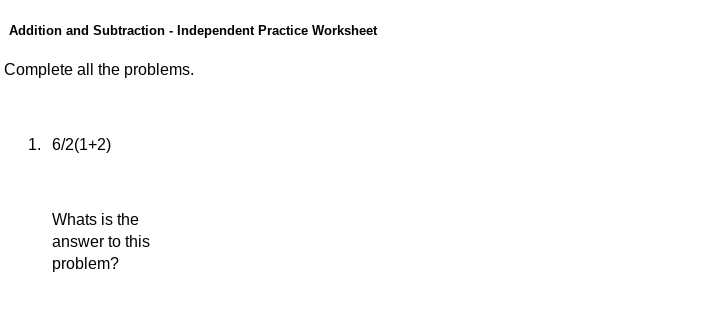
6/2(1+2)= whats this equal
 CoolRekterizer:
What do you think?
katwhirles:
i need help answering it I forget how to do it
CoolRekterizer:
Well, 6/2 = 3 when you simplify it, and 1 + 2 = 3. Of course, you need to multiply both those numbers, and the answer would give you 9.
katwhirles:
thats what i was thinking to
CoolRekterizer:
@gracie101507 1 would not be the answer...
gracie101507:
how did you get 9
katwhirles:
but wouldnt you do 2 times 1 first
CoolRekterizer:
You got to put it like this, (6/2) x (1+2)
CoolRekterizer:
Do PEMDAS and you can get your answer.
 Shadow:
\[6/2(1+2)= ?\] According to PEMDAS: Parentheses Exponents Multiplication Division Addition Subtraction We look to the parentheses first, simplifying to -> \[6/2(3)= ?\]| Since the only thing remaining is multiplication and division, we can do them in either order. Starting with division is 'prettier' though. \[3(3) = 9\]
CoolRekterizer:
Just like Shadow did.
katwhirles:
but wouldn't you do 2 times whats in the parenthesis first
CoolRekterizer:
Shadow is right, just look at the steps...
Shadow:
PEMDAS means you start what's INSIDE the parentheses first, not outside.
katwhirles:
ok thanks
Shadow:
No problem
katwhirles:
ok im still confused
Shadow:
With?
katwhirles:
that same question
gracie101507:
with that same question
Shadow:
What part of the question is confusing you?
gracie101507:
everything
gracie101507:
i still dont really know if it is 9
katwhirles:
the part where it says parenthesis first
katwhirles:
if you didn't do that you would have got 1
Shadow:
Nevermind I see the problem
katwhirles:
whats the problem
Shadow:
We were viewing it as a division function, which in reality, it's a fraction.
Shadow:
Actually wait, that doesn't make sense.
katwhirles:
|dw:1569359974952:dw|
 Hero:
Hero:
This is one of those "screenshot if from the book" questions
Shadow:
Lol
katwhirles:
no i just did that
Shadow:
Oh I see
Shadow:
You did the Distributive Property
katwhirles:
yea
Shadow:
I think the Distributive Property counts as multiplication, as opposed to being considered a parentheses function. Which is why you would do the addition inside of the parentheses first.
Shadow:
Since parentheses is ranked higher than multiplication in PEMDAS.
Hero:
I don't see where it was screenshot from the original text
Hero:
The way you wrote the original problem is ambiguous
Shadow:
Yeah if you can take a picture and upload it, or take a screenshot, that'd clear things up @katwhirles
katwhirles:
ok
Hero:
Since some will interpret it as \(\dfrac{6}{2}(1 + 2)\) and others will interpret it as \(\dfrac{6}{2(1 + 2)}\) which are two completely different expressions
Shadow:
Yeah but in order for it to be the second, the parentheses would have to include 2 and the 1 + 2, so that it would all be in the denominator, under 6. But it's just 6/2 multiplied by (1+2).
Shadow:
Of course, taking what @katwhirles wrote as what the textbook/problem depicts.
 gracie101507:
i think it is 1
gracie101507:
do u think it is 1?????
Join our real-time social learning platform and learn together with your friends!
 KBaby:
Verse 1 We left our names in the dust of the driveway Watched the old town shrink
KBaby:
Lyrics Generator Use AI to write the lyrics for a song. Suggested Genres: Pop Hip
KBaby:
Verse 1 We left our names in the dust of the driveway Watched the old town shrink
KBaby:
Lyrics Generator Use AI to write the lyrics for a song. Suggested Genres: Pop Hip
 aitexturegenerator:
How are you all handling AI-generated textures for 3D models and game assets without losing the hand-made feel? I've been doing a small stylized environment
aitexturegenerator:
How are you all handling AI-generated textures for 3D models and game assets without losing the hand-made feel? I've been doing a small stylized environment

 Demon25:
Woke up feeling like that girl and that dude well he still aint crap pluse the du
Demon25:
Woke up feeling like that girl and that dude well he still aint crap pluse the du
 playtsec:
how do I get rid of stress from teachers... I just feel like running out the classroom and leaving on my own.
playtsec:
how do I get rid of stress from teachers... I just feel like running out the classroom and leaving on my own.
 JohnnyLFowler0812:
What type of gamer would play something and then get off for a while. Why not sta
JohnnyLFowler0812:
Which is better? Metallica Rap Country R&B hiphop Medal Gospel Chill Which 3 opti
JohnnyLFowler0812:
What type of gamer would play something and then get off for a while. Why not sta
JohnnyLFowler0812:
Which is better? Metallica Rap Country R&B hiphop Medal Gospel Chill Which 3 opti