
 silvernight269:
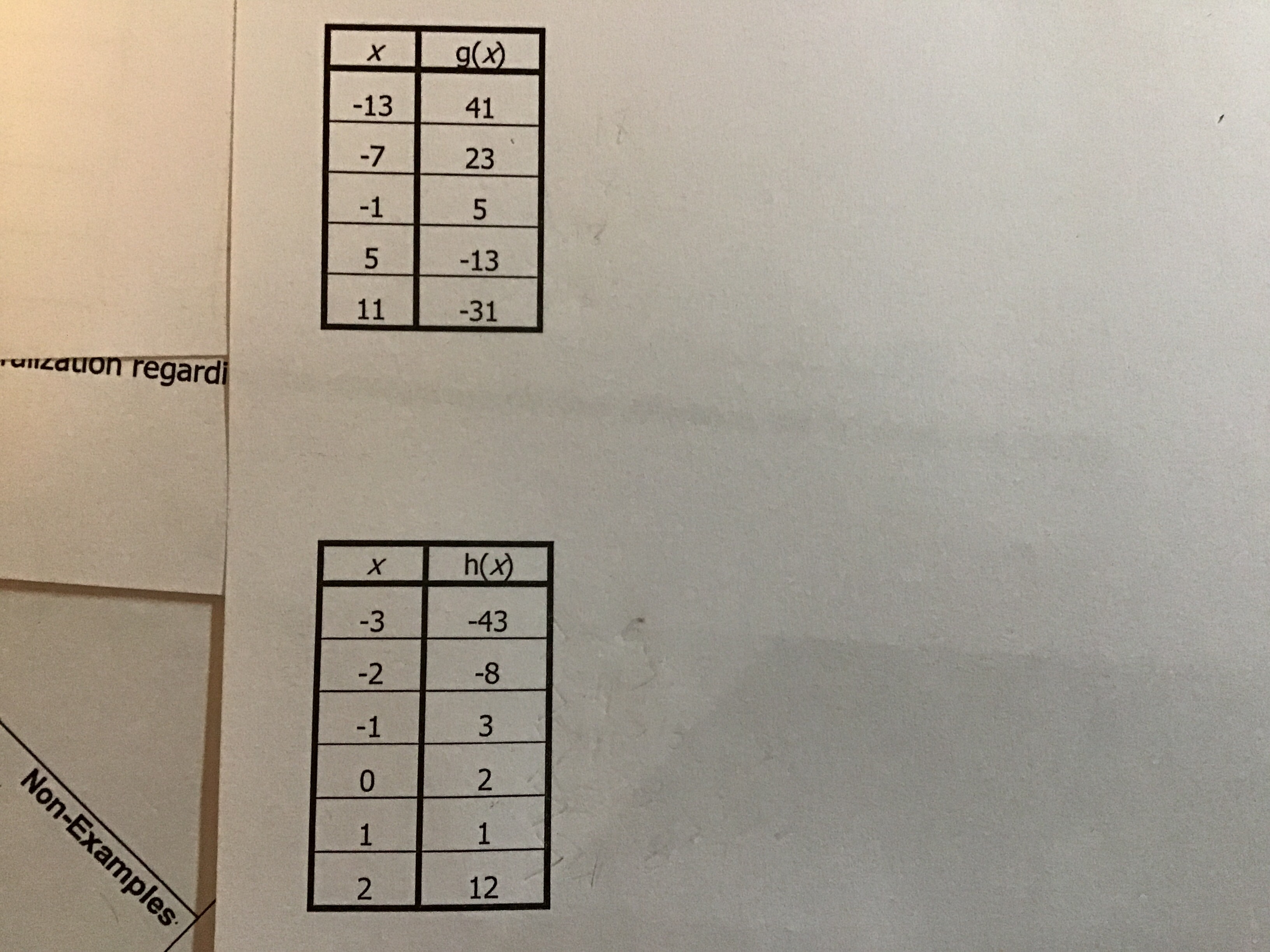
find the constant difference for each of the tables below. use these results to determine if each table represents a linear, quadratic, or a cubic function. then find the equation of each function.
 silvernight269:
@dude
 dude:
dude:
Sorry for the late response First find the slope for the first table Chose any 2 points (preferably ones next to each other) Say for example you choose (-13,41) and (-7,23) ( x\(_1\),\(y_1\)) (x\(_2\), \(y_2\)) Use the equation to find slope \(\large\frac{y_2-y_1}{x_2-x_1}=\frac{23-41}{-7-(-13)}\) Once you do that choose another two points Lets say you choose (-7,23) and (-1,5) ( x\(_1\),\(y_1\)) (x\(_2\), \(y_2\)) And use the same equation \(\large\frac{y_2-y_1}{x_2-x_1}=\frac{5-23}{-1-(-7)}\) If they are the same, then it is a linear function (they have the same slope)
dude:
From them you can just use any point (from the table) and substitute what you have to find the y-intercept
dude:
For the second table we can clearly see that they are not going on a constant rate In terms of it being a quadratic function, the points would be the same on both positive and negative values after it reaches its vertex
dude:
So it is automatically a cubic function (I am not sure how to fully explain this however here is the graph and so I hope it does help, will try to explain though) https://www.desmos.com/calculator/uu5ygqwf24
Join our real-time social learning platform and learn together with your friends!
 Demon25:
For a hoco proposal with a cheerleader and football player, what else should be a
Demon25:
For a hoco proposal with a cheerleader and football player, what else should be a

 Breathless:
TOC: "MGF any confirmation on the commander? we require confirmation as soon as[radio static].
Breathless:
TOC: "MGF any confirmation on the commander? we require confirmation as soon as[radio static].
 EdwinJsHispanic:
I wrote something that I don't know if I want it as a poem or song, Please let me know on yours thoughts about it, I'm still doing this! "Broken promises an
EdwinJsHispanic:
I wrote something that I don't know if I want it as a poem or song, Please let me know on yours thoughts about it, I'm still doing this! "Broken promises an
 thehearken:
hi um I don't know if this is the right section for this, but can someone go over my poem and tell me if its good enough to give my English professor for a
thehearken:
hi um I don't know if this is the right section for this, but can someone go over my poem and tell me if its good enough to give my English professor for a
 heartlessprophet:
Aye what's 19z%u00f74p=9u03c0 my teacher thinking of impossible questions for us
heartlessprophet:
Aye what's 19z%u00f74p=9u03c0 my teacher thinking of impossible questions for us
 kippppp:
does anyone have any good tips for writing stories? i'm trying to write a dnd campaign but i'm not that great of a writer yet.
kippppp:
does anyone have any good tips for writing stories? i'm trying to write a dnd campaign but i'm not that great of a writer yet.
 GRIZZLEY19:
Y'all let me know what y'all think about this beat I made I took me like a hour maybe rate it 0/10 https://drive.
GRIZZLEY19:
Y'all let me know what y'all think about this beat I made I took me like a hour maybe rate it 0/10 https://drive.
 Ultrilliam:
Welcome to the 10th Anniversary Update! (Part 2) Sorry this one passed the date a
Ultrilliam:
Welcome to the 10th Anniversary Update! (Part 2) Sorry this one passed the date a
 Twaylor:
was walking downtown and my adhd brain wanted to make some (rock?) lyrics: There'
Twaylor:
was walking downtown and my adhd brain wanted to make some (rock?) lyrics: There'