
 Ballery1:
Can someone rescue me from this problem?? I’m sick of it :/
Ballery1:
Find the zeros of the following function \[F(x)= e ^{-x+2}\] its derivative is \[F’(x) = -e ^{-x+2}\]....how do i find the critical points using the derivative???
Ballery1:
@Hero
Ballery1:
How do i show my work to prove that f’(x)<0?????
Ballery1:
I have proved that the function don’t have zeros
 akshay:
@JSVSL7 @mhchen
Ballery1:
|dw:1569551470178:dw|
akshay:
https://study.com/academy/lesson/finding-critical-points-in-calculus-function-graph-quiz.html Read this. Maybe it can help you
 mhchen:
This function is really interesting...I'm not even sure if it can be 0. \[0=-e^{-x+2}\]
mhchen:
Is there an option for 'no solution'
Ballery1:
Ummmm....all i’m Looking for are the points at which the graph changes from negative to positive but since the function have no zeros i need to show that f’(x) is less than zero which means that the curve of the function is always decreasing... sooo yeah :/
Ballery1:
I guess all i’m Trying prove is that f’(x) is less than zero.. that’s all i need
Ballery1:
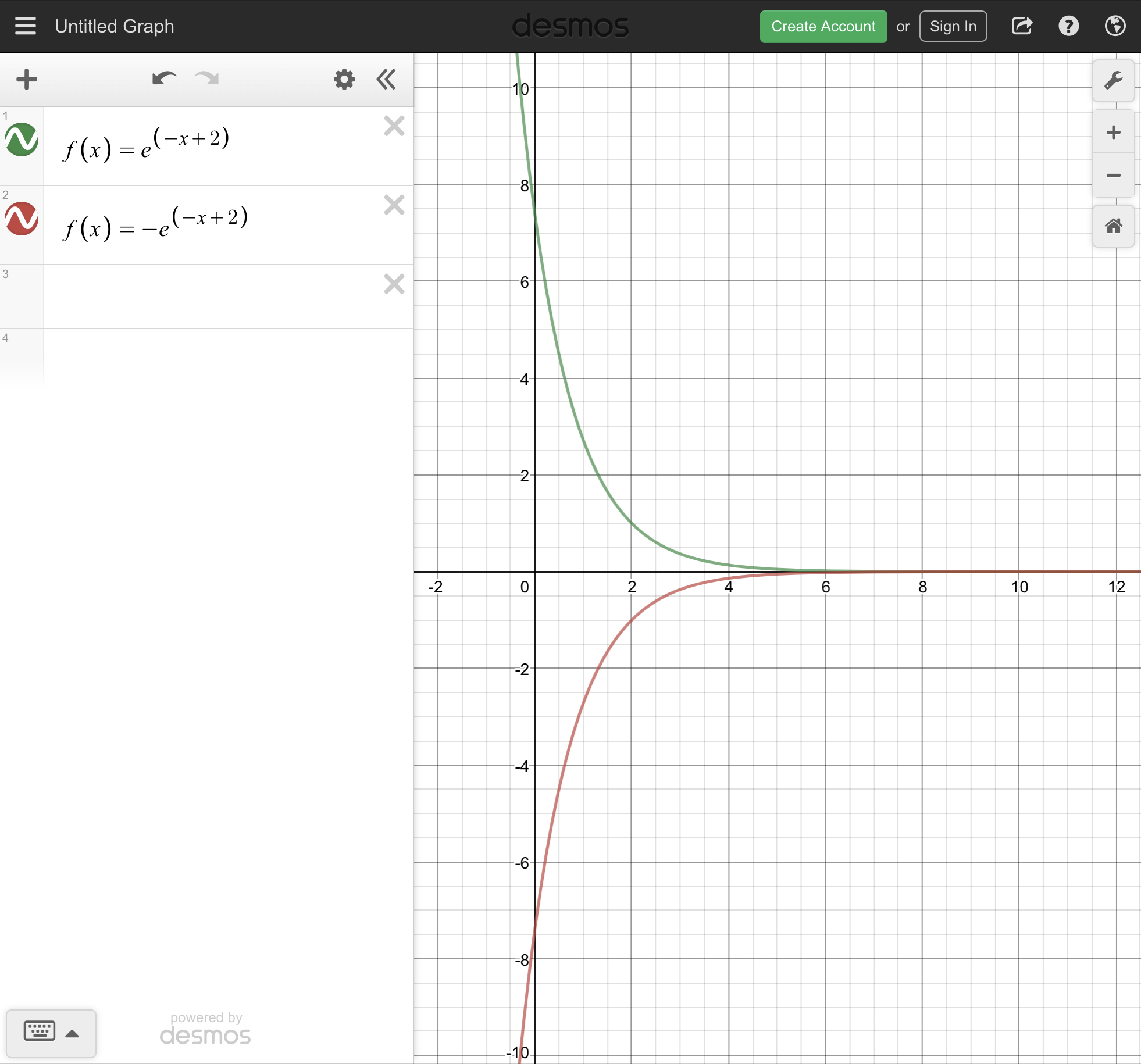
Oh and also why’s there a vertical asymptote at x = 0....why won’t the graph cross the x-axis line
 mhchen:
it did cross it. e^x works for all real numbers
Ballery1:
Bro there’s a horizontal asymptote at x = 0.... both functions don’t cross the x=axis
Ballery1:
|dw:1569552737757:dw|
Ballery1:
How do i algebraically figure out the asymptote ? :/
 DuarteME:
You can show \(y = 0\) is an asymptote of \(F'\) as \(x \to \infty\), by showing that \(\lim\limits_{x \to \infty} F'(x) = 0\). However, your problem is finding the critical points of \(F\), which you can do by computing the zeroes of \(F'\). But \(F'\) has to zeroes, as you've seen in your last question. Hence, \(F\) has no critical points.
Ballery1:
I need to show my work to prove that f’(x) is less than 0
Ballery1:
How do i do that ?
Ballery1:
|dw:1569553249704:dw|
Ballery1:
I can’t figure out one way to prove that the 2st prime is less than 0....
Ballery1:
1st prime**
Ballery1:
All i wanna know is how do i prove that is 1st prime is less than 0 and the curve of the function is always decreasing???
Ballery1:
Literally made a chat up there to show that some values of x do go over 0 tho..unless i’m Doing something wrong...
Ballery1:
|dw:1569553772305:dw|
Ballery1:
-e = -2.7182818284 right???
DuarteME:
You can simply say that \(\textrm{e}^x > 0\) for all \(x \in \mathbb{R}\), so \(\textrm{e}^{-x+2} > 0\) for all \(x \in \mathbb{R}\). Then ir follows that \(F'(x) = -\textrm{e}^{-x+2} < 0\) for all \(x \in \mathbb{R}\). If you prefer a more sophisticated argument, you can also use the Intermediate Value Theorem if you know it. First, notice that \(F'\) is continuous in \(\mathbb{R}\). If it were to change signs within an interval \([a,b] \subset \mathbb{R}\), then it would have to cross the \(x\)-axis in order to do so, due to Intermediate Value Theorem. But you already proved that \(F'\) has no zeroes. Hence, it is either positive or negative for all \(x \in \mathbb{R}\). So you can choose an arbitrary point, say \(x=2\) and show that \(F'(2) < 0\). Hence, \(F'(x) < 0\) for all \(x \in \mathbb{R}\).
DuarteME:
I'm not quite sure what you did in your last drawing. If you're evaluating the limit as \(x \to \infty\), you can't set \(x = -2\) and then take the limit.
Ballery1:
How do i do it then ?
Ballery1:
Please tell me how do i show algebraically that F’(2) is less than 0??
mhchen:
oh sorry, earlier I thought when you said x=0, you meant the vertical line.
DuarteME:
Well, you can simply compute it: \(F'(2) = -\textrm{e}^{-2+2} = -\textrm{e}^0 = -1 < 0\).
mhchen:
\[0=-e^{-x+2}\] I know you can't take natural log of both sides since ln(0) is undefined. I think in general, \[a^{x}\] will never be 0 if a is a positive number. I'd write that on your paper
DuarteME:
I agree with @mhchen above.
mhchen:
SOOOO since \[e^{-x+2}\] is always positive, then \[-e^{-x+2}\] is always negative since positive * negative is negative
Ballery1:
I was making a mistake in my algebra... i see now.. but how do i prove that there’s a horizontal asymptotes at y = 0
Ballery1:
How do I algebraically prove that there’s a horizontal asymptote
mhchen:
You could find the limit as x approaches infinity or negative infinity. The horizontal asymptote of the first derivative has nothing to do with critical points though consider this: |dw:1569554615889:dw| sin(x)/x has a horizontal asymptote at y=0 (since as x approaches infinity, sin(x)/x approaches 0 right?) But it also crosses the line
Ballery1:
I get that the HA has nothing to do with the critical points but when i need to draw the graph based on a given function...i mostly algebraically show that there’s a Vertical or horizontal asymptote..
mhchen:
o xd, then ye just find the limit of infinity and negative infinity
Ballery1:
I think Duarte gave me the answer earlier...sorry i didn’t see it....
Ballery1:
|dw:1569554975187:dw|
Ballery1:
\(\color{#0cbb34}{\text{Originally Posted by}}\) @DuarteME You can show \(y = 0\) is an asymptote of \(F'\) as \(x \to \infty\), by showing that \(\lim\limits_{x \to \infty} F'(x) = 0\). However, your problem is finding the critical points of \(F\), which you can do by computing the zeroes of \(F'\). But \(F'\) has to zeroes, as you've seen in your last question. Hence, \(F\) has no critical points. \(\color{#0cbb34}{\text{End of Quote}}\) Did i do something wrong there?
mhchen:
He said that F' has no zeroes, hence F has no critical points
mhchen:
\(\color{#0cbb34}{\text{Originally Posted by}}\) @DuarteME You can simply say that \(\textrm{e}^x > 0\) for all \(x \in \mathbb{R}\), so \(\textrm{e}^{-x+2} > 0\) for all \(x \in \mathbb{R}\). Then ir follows that \(F'(x) = -\textrm{e}^{-x+2} < 0\) for all \(x \in \mathbb{R}\). \(\color{#0cbb34}{\text{End of Quote}}\)
Ballery1:
I could do that but i wanna know how do i show that \[\lim_{x \rightarrow \infty} F’(x) = 0 \]
Ballery1:
Actually I figured it out... lol ....sorry guys but it’s one of those tedious questions...
mhchen:
lol I'm too sleepy now
Ballery1:
Sorry mate.. *~*
Ballery1:
Thanks guys!! I promise the rest of the questions will be much more straight forwards lol
Ballery1:
I’ll post my solutions plz check them :)
Ballery1:
God bless y’all!!
Join our real-time social learning platform and learn together with your friends!
 KBaby:
Verse 1 We left our names in the dust of the driveway Watched the old town shrink
KBaby:
Lyrics Generator Use AI to write the lyrics for a song. Suggested Genres: Pop Hip
KBaby:
Verse 1 We left our names in the dust of the driveway Watched the old town shrink
KBaby:
Lyrics Generator Use AI to write the lyrics for a song. Suggested Genres: Pop Hip
 aitexturegenerator:
How are you all handling AI-generated textures for 3D models and game assets without losing the hand-made feel? I've been doing a small stylized environment
aitexturegenerator:
How are you all handling AI-generated textures for 3D models and game assets without losing the hand-made feel? I've been doing a small stylized environment

 Demon25:
Woke up feeling like that girl and that dude well he still aint crap pluse the du
Demon25:
Woke up feeling like that girl and that dude well he still aint crap pluse the du
 playtsec:
how do I get rid of stress from teachers... I just feel like running out the classroom and leaving on my own.
playtsec:
how do I get rid of stress from teachers... I just feel like running out the classroom and leaving on my own.
 JohnnyLFowler0812:
What type of gamer would play something and then get off for a while. Why not sta
JohnnyLFowler0812:
Which is better? Metallica Rap Country R&B hiphop Medal Gospel Chill Which 3 opti
JohnnyLFowler0812:
What type of gamer would play something and then get off for a while. Why not sta
JohnnyLFowler0812:
Which is better? Metallica Rap Country R&B hiphop Medal Gospel Chill Which 3 opti