
 Ballery1:
I need math hep plz :)
Ballery1:
Management of a company manufacturing small refrigerators determines that the daily total cost of producing *x* units is given by the function \[C(x) = 0.0002x^3 -0.06x^2 + 120x+3000\] (dollars), where \[0 \le x \le 300\] a) Find the marginal Cost function C’(x) b) Find the intervals on which the function C’(x) is increasing and those on which it is decreasing. Interpret your results.
Ballery1:
|dw:1569703227868:dw|
Ballery1:
Part *B* is the main issue here... check my solution plz
Ballery1:
|dw:1569703461113:dw|
Ballery1:
|dw:1569703904874:dw|
Ballery1:
|dw:1569704120964:dw|
Ballery1:
@Nnesha
Ballery1:
@Hero
 Hero:
Hero:
Did you ever try graphing the original function?
Ballery1:
How do I figure out the intervals on which the C’(x) is increasing and those on whic it is decreasing.
Hero:
It would have given you an idea of what is going on with the graph before you started doing all that work.
Ballery1:
But i’m Not suppose to graph the equation tho
Ballery1:
It’s waaayyyy up there....i think the graph doesn’t touch the x axis...
Hero:
Graphing it won't stop you from doing the work. I meant to graph C(x) not C'(x)
Ballery1:
Ok one second plz :)
Hero:
Correction: Graphing it won't stop you from having to do the work, but it will change the way you might approach it and help you solve the problem more quickly.
Hero:
Whoever said don't graph it wants you to spend countless hours wasting time.
Ballery1:
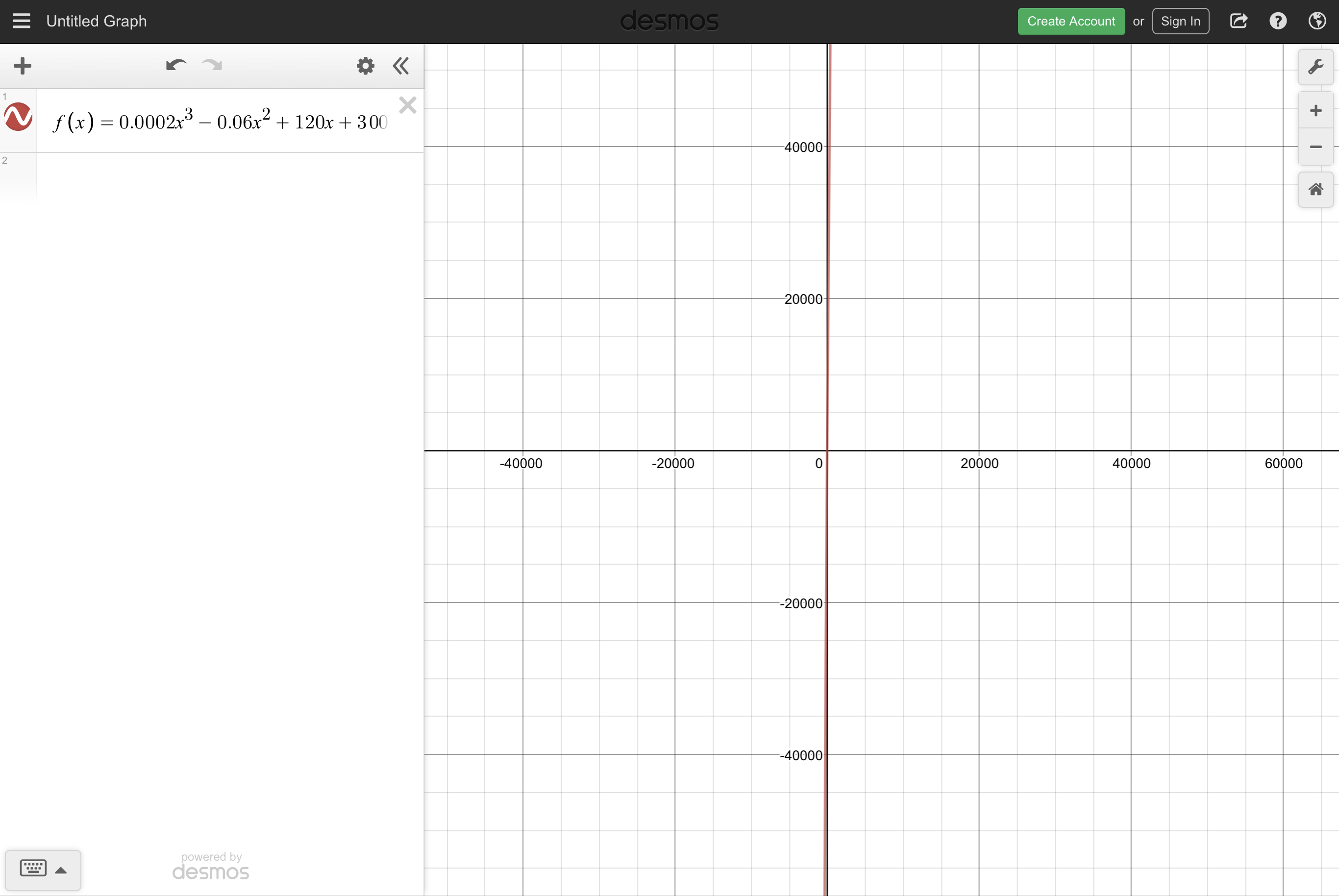
Btw i did try to graph the original function as well as its derivative before... the following is the graph of the original
 Ballery1:
Notice the scale... i did zoom out as far as i could
Hero:
The next step is to find the appropriate window for the graph
Ballery1:
Which is?
Hero:
Let me show you what it should look like when you choose the appropriate window. One second.
Hero:
I recommend using Geogebra for all your graphing
Ballery1:
Okie dokie
Ballery1:
How come my graph looks different than yours tho ?
Hero:
\(\textbf{Appropriate Window}\)
Hero:
It matters
Ballery1:
K so How do I figure out the intervals on which the C’(x) is increasing and those on whic it is decreasing.
Hero:
You mean when C(x) is increasing and decreasing.
Ballery1:
Let me type out the question again..
Ballery1:
Find the intervals on which the function C’(x) is increasing and those on which it is decreasing. Interpret your results
Hero:
I see. To do that, you'll have to find the derivative of C'(x)
Ballery1:
So you mean... C’’(x)??
Hero:
Correct
Ballery1:
Let’s do it...
Hero:
And then set C''(x) = 0 then solve for x
Ballery1:
|dw:1569708230350:dw|
Ballery1:
|dw:1569708355214:dw|
Hero:
You love dealing with decimals. I love avoiding them
Ballery1:
Opposite attracts u know :)
Hero:
I would rather have 12x = 1200 and then x = 1200/12 = 100
Ballery1:
K so I i need a bit more dealing about what we just did... how do i write this interval and is it increasing or decreasing??
Hero:
Well, you have the x value where C'(x) = 0
Hero:
And you know the graph of C'(x) is concave up since \(a\) > 0
Ballery1:
Yes
Hero:
Which means find y when x = 100
Ballery1:
How do we find y ?
Hero:
And then you can describe the graph appropriately. The interval to the left of \((100,C'(100))\) will be decreasing. The interval to the right of \((100,C'(100))\) will be increasing.
Hero:
Plug the x back into C'(x)
Ballery1:
I see.. let’s do that.. :)
Hero:
A smart thing to do is afterwards graph everything: C(x), C'(x) and C''(x) to make sure what you did algebraically is matching up geometrically.
Hero:
It IS Okay to graph after you've done all the work.
Hero:
It's for VERIFICATION
Hero:
That way, if something isn't matching you can go back and fix any mistakes.
Ballery1:
|dw:1569708791462:dw|
Ballery1:
Is this correct?
Ballery1:
For the decreasing interval it’s (0,100) and for the increasing interval, it’s (100, 300)
Ballery1:
That’s the answer according to my textbook
Hero:
You shouldn't have checked it until you were done
Hero:
They gave the intervals to the left and right of the point
Hero:
That's what you should have done
Ballery1:
I thought i was suppose to get 0 when i plugged in 100 back into the first prime..but instead we got 114..so i panicked and wrote out the answer
Hero:
The SLOPE of C"(x) is zero at the point (100,114). The coordinates of the point will not be zero.
Hero:
We set C''(x) equal to zero because we wanted to find the x value for when the slope of C''(x) is zero.
Hero:
Nothing about that implies that the coordinates of the point on C'(x) will be zero.
Ballery1:
Sooo what do we do now?
Hero:
One min. Let me check something
Hero:
Yeah, I don't know why they have those intervals. Mentally, I got a quadratic function for C'(x). And that the interval of decrease is \((-\infty, 100)\) and the interval of increase is \((100, \infty)\). I don't know why they're getting something other than that
Hero:
I graphed to confirm this
Ballery1:
Do you want me to post the answe maswer?
Hero:
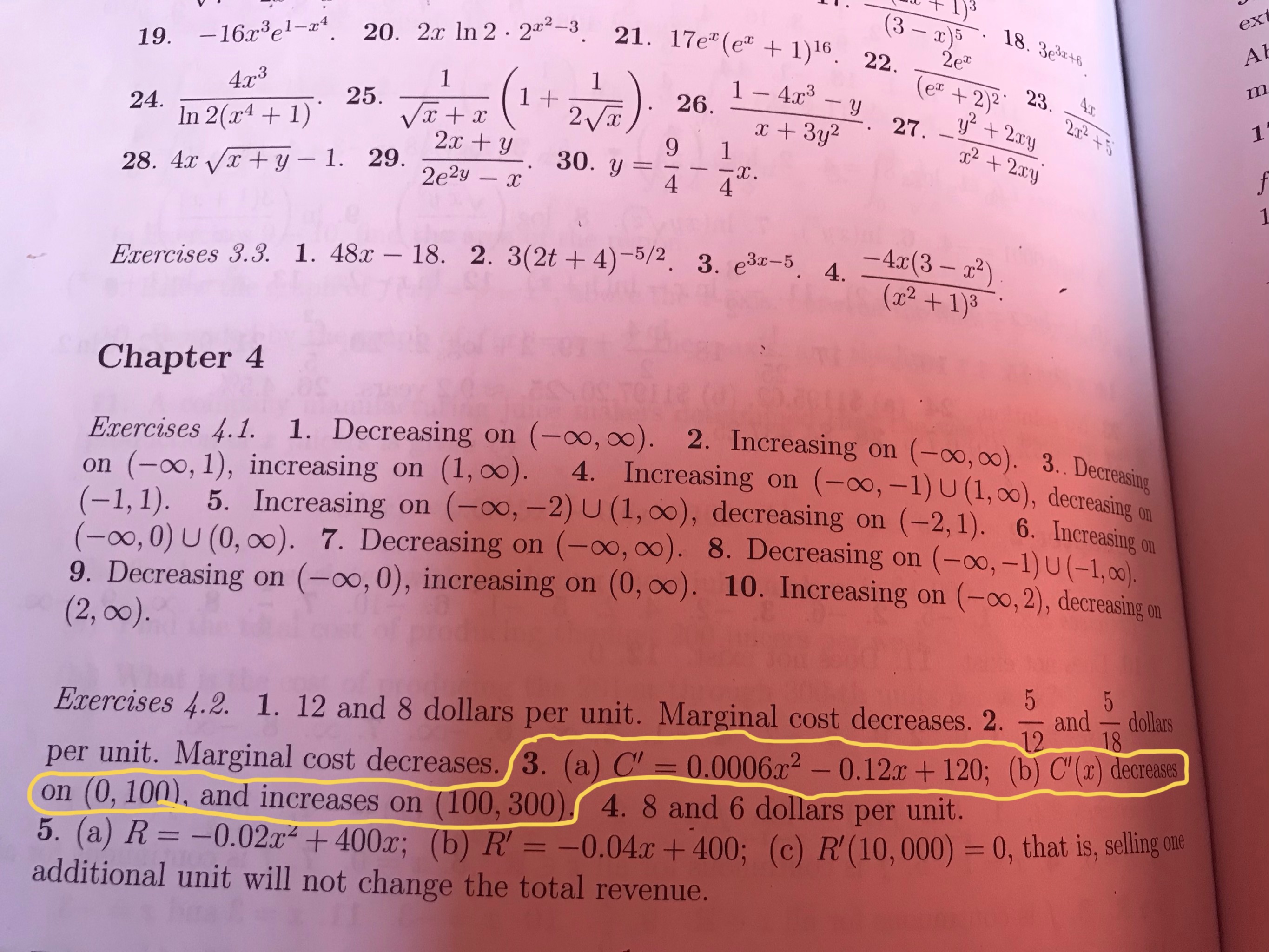
Ah, I see, the original function is restricted from \(0 \le x \le 300\) so that explains it
Hero:
So the book is correct. We always have to pay attention to those restrictions
Hero:
@Ballery1
 Hero:
Hero:
Yes, I just said the book is correct and we have to pay attention to the restriction given for the original function \(0 \le x \le 300\). Do you understand that the original function is restricted to that interval in this case?
Hero:
Going forward we have to consider the interval restriction of the original function. Let me graph it for you.
Ballery1:
yes... the x values have to be within 0 and 300... i see now
Ballery1:
so basically the company made units between 0 and 300?
Hero:
Restricting the graph to that interval causes this when we graph: https://www.geogebra.org/classic/ktqxmkrh
Hero:
So it looks something completely different
Hero:
Yes correct
Hero:
All of that you should do after you have done algebraic work.
Hero:
And then after, then you can check the back of the book.
Ballery1:
k so that curve and the point represents when the slope of C’’(x) is zero true?
Hero:
I did see that. Something seems off about it.
Hero:
C'(x) is supposed to be the slope of C(x)
Ballery1:
did i do something wrong in my calculations?
Hero:
I don't think it works the way I'm imagining. We did find the correct x value where the behavior of the function changes.
Hero:
I don't think we did anything wrong besides forget to restrict the interval
Ballery1:
ok but couldn’t we just figureout the point of vertex of the original graph by factoring the first derivative tho ??
Ballery1:
does the first derivative factor tho ??
Hero:
Vertex is usually used describing the lowest point on a parabola. I have not seen it used to describe a point on a cubic function.
Ballery1:
ok
Hero:
There is no point on the cubic function with a slope of zero
Hero:
Which would explain why when you tried to find the points, you got negative values for the discriminant.
Hero:
It is for these reasons, that when you come across a situation like this when you get something other than what you expect, the logical thing to do is to graph the function to see what is going on with it.
Ballery1:
yes but why can’t we get the decreasing point (0,100) tho??
Ballery1:
of the 1st derivative that is
Hero:
That's not a point. That's the interval for which C'(x) is decreasing. If you look at its graph, it is decreasing on that interval.
Hero:
Maybe I should post it again so it's clear. But do not confuse intervals with points. That would be bad
Hero:
I graphed all three functions: C(x), C'(x), and C"(x). You'll have to scroll to adjust the window to see the others. They're not going to graph well in the same window.
Ballery1:
did u draw the second prime tho?
Hero:
I did.
Ballery1:
i wanna see if the 1st prime is constant?
Hero:
I did say these are not going to graph well. No the first prime is not constant. Why are you getting that idea. C'(x) is a parabola.
Ballery1:
i thought that’s the range of the unit proucts between 0 and 300
Hero:
The domain of the units of products is \(0 \le x \le 300\)
Hero:
Its a domain not a range. I don't know why you're confusing yourself more here
Hero:
And then on the interval is split to two intervals \(0 \le x \le 100\) is the interval for which C'(x) is decreasing and \(100 \le x \le 300\) is the interval where C'(x) is increasing.
Ballery1:
k so the point 100,114 on the marginal curve is what?
Hero:
It's just the point where the slope of C'(x) is zero
Ballery1:
ok.. got it.
Hero:
I hope so. You said a lot of confusing stuff
Ballery1:
btw when i said *range* is between...0 and 300... it wasn’t in math terms...i was talking about the range as in the domain of x between 0 and 300
Hero:
I recommend making a "Things You Learned" list of do's and don'ts when tackling a problem like this.
Hero:
That would be essential to do when preparing for a test. If you don't, you might make a critical mistake.
Ballery1:
i will lol so what’s next?? we have the slope of zero of a marginal curve at point (100,114)...whats next?
Hero:
I don't know what's next. What's left for you to do for the problem?
Ballery1:
how do i algebraically figure out the invreasing internval of the first prime (0,100)??? we figured out the 100...soo how do i find the x??
Ballery1:
increasing interval*
Hero:
(0,100) is the interval of decrease. (100,300) is the interval of increase.
Ballery1:
but i need to show algebraically tho ?
Hero:
The function is given on the interval \(0 \le x \le 300\)
Hero:
That's the thing to make the mental note of.
Hero:
Somewhere along that interval the function is increasing and decreasing. To find the intervals, we had to find C"(x) which we did. Then we set C''(x) equal to zero and solved for x which we got x = 100.
Hero:
That told us that at the point \((100, C'(100))\) the slope is zero. (the function is neither increasing or decreasing at that point.
Ballery1:
i think i see it now... so that point (100,114) is the point where the slope of the derivative is 0. so by that logic... the invertal from (0 to 100) is the interval where the derivative was decreasing. and the interval where the derivative is increasing is poast the (100,114) so 100 to 300 on the RHS is the increasing interval....
Hero:
The next thing is to find the intervals of increase and decrease. To figure that out algebraically, you have to understand two things for C'(x): That it is a quadratic function with an expression of the form \(ax^2 + bx + c\) and that \(a > 0\). Because \(a > 0\), we know that the graph of the function is concave up. Which means that on the interval \(0, 100), the function will be decreasing and on the interval (100, 300) it will be increasing.
Ballery1:
am i right hero??
Hero:
Another way to do it is find the point \((0, C'(0))\) and point \((300, C'(300))\)
Hero:
When you find those points I will graph to show you what happens but you don't need to graph them to understand what happens.
Hero:
Yes that's the graph but suppose you can't graph and you're taking a test. Then you do it the way I am explaining
Ballery1:
yes master!
Hero:
You're posting too much stuff
Hero:
Check this out. We know the bounds of the interval of C'(x) is \(0 \le x \le 100\) Which means we can find \(C'(0)\) and \(C'(300)\) and look at the y values of those.
Ballery1:
do u want me to algebraically figure out the values of C’(0) and C’(300)? master
Hero:
You will see that the point (0, C'(0) is higher than (100, C'(100)) and then (300, C'(300)) is also higher than (100, C'(100))
Hero:
Which means (100, C'(100)) is the lowest point on that interval. The only way that happens is if the function is decreasing from (0,100) and increasing from (100, 300).
Hero:
If you wrote that on a test, the teacher has no choice but to give you the highest score.
Hero:
All you do is show you know what you're talking about.
Ballery1:
true true... k thanks a lot man. i freakin love you!! lol
Hero:
That's the point of a test
Ballery1:
wait, so in terms of units...what does it mean?
Ballery1:
the more products the company makes, the cheaper it costs them?
Hero:
If C'(x) is decreasing on (0,100) it means the marginal cost went down on that interval.
Hero:
If C'(x) is increasing on the interval (100,300) it means the marginal cost increased for those number of units.
Ballery1:
k so up to the point of (100,114) the marginal cost is 0
Hero:
Negative
Hero:
The point (100,114) is the point where the marginal cost stopped increasing or decreasing.
Ballery1:
so from zero to 100 units ..the marginal cost is decreasing... ?? from that point onwards..it costs the company more to make products...aka it gets expensive and more expensive fbeyounf the (100,114) point mark
Ballery1:
k i think i got it bro... thanks :) ily <3 :)
Hero:
You should describe it the way I suggested. Which is more mathematically. So use words like "on the interval", "marginal cost" "increasing and decreasing" providing those intervals of increase and decrease using the function notation when describing points etc. And add to your list of do's and don'ts to remember to make sure you recognize if (a, b) is referring to a point or an interval.
Hero:
Your do's and don'ts list should be pretty lengthy for this
Ballery1:
for shore
Ballery1:
most importantly i need to remember that not all functions are going to have roots and algebraic solutions..
Join our real-time social learning platform and learn together with your friends!
 KBaby:
Verse 1 We left our names in the dust of the driveway Watched the old town shrink
KBaby:
Lyrics Generator Use AI to write the lyrics for a song. Suggested Genres: Pop Hip
KBaby:
Verse 1 We left our names in the dust of the driveway Watched the old town shrink
KBaby:
Lyrics Generator Use AI to write the lyrics for a song. Suggested Genres: Pop Hip

 aitexturegenerator:
How are you all handling AI-generated textures for 3D models and game assets without losing the hand-made feel? I've been doing a small stylized environment
aitexturegenerator:
How are you all handling AI-generated textures for 3D models and game assets without losing the hand-made feel? I've been doing a small stylized environment

 Demon25:
Woke up feeling like that girl and that dude well he still aint crap pluse the du
Demon25:
Woke up feeling like that girl and that dude well he still aint crap pluse the du
 playtsec:
how do I get rid of stress from teachers... I just feel like running out the classroom and leaving on my own.
playtsec:
how do I get rid of stress from teachers... I just feel like running out the classroom and leaving on my own.
 JohnnyLFowler0812:
What type of gamer would play something and then get off for a while. Why not sta
JohnnyLFowler0812:
Which is better? Metallica Rap Country R&B hiphop Medal Gospel Chill Which 3 opti
JohnnyLFowler0812:
What type of gamer would play something and then get off for a while. Why not sta
JohnnyLFowler0812:
Which is better? Metallica Rap Country R&B hiphop Medal Gospel Chill Which 3 opti