
 celticcat:
How do you do this limit: Limit as x approaches 0 of {1^(1 / sin^2x) + 2^(1 / sin^2 x) + .... + n^(1/ sin^2 x) } ^sin^2 x. I thought it might be 1 because as x --> 0 then sin^2 x --> 0 but that seems to easy.
 JSVSL7:
It's an interesting question, shouldn't it be infinity? So you're right on the fact that sin^2 x is 0 when x=0. So simplifying that it would give 1^0 + 2^0 + 3^0 .... So that's all 1, so you're having an arithmetic series of 1 adding up, and it supposedly does not converge. So it's just infinity, but I'm not sure if I'm wrong.
JSVSL7:
Oh wait, I did not see the whole thing raised to another sin^2 x. Then I guess you are right because it's all raised to sin^2 x which when x approaches 0, it's 1. Sometimes they give questions that are too long but require 1 step. I've had those times too, just staring at the question for minutes.
JSVSL7:
What's the answer? Is it different?
celticcat:
I don't know the answer. I played around with some numbers though. If we make x small say 0.1 radians. then 2^ (1 / sin^2x) = about 1.598 * 10^30 . A huge number ! Now if you take that to the power sin^0.1 it works out to 2!. Then I tried the same calculation with 2^(1/ sin^20.1) + 3^(1 / sin^2 0.1) and it work out to 3. So maybe the anser is n???
celticcat:
The first term is 1 of course but the higher terms work out as enormous numbers I tried working out the 5th term but the calculator couldn't handle the huge number. - and 0.1 radians is not a very small value.
celticcat:
Limits can be tricky. I expect we could use a substitution here but can't think of an appropriate one.
celticcat:
@Hero can you help with this?
celticcat:
or @Vocaloid?
 Nnesha:
maybe the Question is designed to trick u...
Nnesha:
btw \[\large \rm 1^\frac{ 1 }{ \sin^2(x) } \cancel{=} 1^0\]
Nnesha:
\[\large \rm 1^\frac{ 1 }{ \sin^2(x) } = 1^\frac{1}{0}\]
Nnesha:
\[\Large \rm (1^\frac{ 1 }{ \sin^2(x) }+2^\frac{ 1 }{ \sin^2 (x)}+....n^\frac{ 1 }{ \sin^2(x)})^\color{Red}{{\sin^2(x)}}\] is this correct??
Nnesha:
\[\rm (anyting)^\color{Red}{\sin^2(0)}--> (anything)^\color{Red}{0}=1\]
celticcat:
Yes that was my initial thought on the question.
celticcat:
Yes i was wrong about the first term being = 1.
celticcat:
According to someone on Brainly the answer is n. I've lost the post to give the details. I'll look again.
Nnesha:
ok take a screenshot and post it here will see.
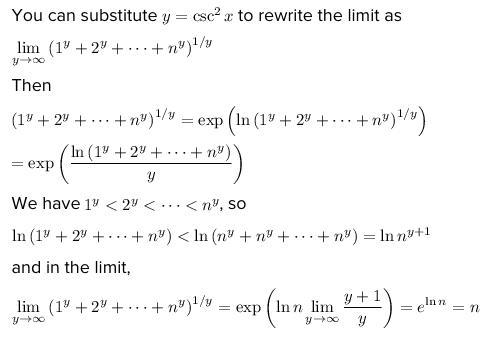 celticcat:
Don't know why it is so small .
celticcat:
You can just click on it to get a larger view. I'm afraid some of that math is beyond me.
Nnesha:
well for your question x approaches 0 not infinity.
celticcat:
I'll check that out.
celticcat:
Yes . The original question wanted the limit to 0, so the answerer misread the question.
Nnesha:
yeah. so when x approaches infinity the exponents sin2(x) will not be 0 anymore so the answer will be diff.
celticcat:
OK Thanks.
Nnesha:
np :=))
Nnesha:
I wonder if there is another way to solve this where we don't get 1/0 exponent or maybe we just have to ingore everything since it rasied to the power of sin^2(x) . also it really depends on the level of math u r taking.
celticcat:
I guess this one is degree level . I'm educated to advanced level (UK). I just came across this one in Brainly and found it interesting. I wonder if Wolframalpha could do this one????
Nnesha:
https://www.wolframalpha.com/input/?i=limit+as+x+approaches+0+of+%281%5E%281%2Fsin%5E2%28x%29%29%2B2%5E%281%2Fsin%5E2%28x%29%29%2B3%5E%281%2Fsin%5E2%28x%29%29%2B....%2Bn%5E%281%2Fsin%5E2%28x%29%29%29%5E%28sin%5E2%28x%29%29 I hope i typed it correclty
celticcat:
Yes it is correct . Answer 1!
Join our real-time social learning platform and learn together with your friends!
 KBaby:
Verse 1 We left our names in the dust of the driveway Watched the old town shrink
KBaby:
Lyrics Generator Use AI to write the lyrics for a song. Suggested Genres: Pop Hip
KBaby:
Verse 1 We left our names in the dust of the driveway Watched the old town shrink
KBaby:
Lyrics Generator Use AI to write the lyrics for a song. Suggested Genres: Pop Hip

 aitexturegenerator:
How are you all handling AI-generated textures for 3D models and game assets without losing the hand-made feel? I've been doing a small stylized environment
aitexturegenerator:
How are you all handling AI-generated textures for 3D models and game assets without losing the hand-made feel? I've been doing a small stylized environment

 Demon25:
Woke up feeling like that girl and that dude well he still aint crap pluse the du
Demon25:
Woke up feeling like that girl and that dude well he still aint crap pluse the du
 playtsec:
how do I get rid of stress from teachers... I just feel like running out the classroom and leaving on my own.
playtsec:
how do I get rid of stress from teachers... I just feel like running out the classroom and leaving on my own.
 JohnnyLFowler0812:
What type of gamer would play something and then get off for a while. Why not sta
JohnnyLFowler0812:
Which is better? Metallica Rap Country R&B hiphop Medal Gospel Chill Which 3 opti
JohnnyLFowler0812:
What type of gamer would play something and then get off for a while. Why not sta
JohnnyLFowler0812:
Which is better? Metallica Rap Country R&B hiphop Medal Gospel Chill Which 3 opti