
 Ballery1:
Implicit differentiation question.. Topic: Related Rates Suppose that x(t) and y(t) are related by xy = y^4-x for all *t* and t = 1, x(1) =0.5, y(1) = 1 and dx/dt = 7. Find dy/dt.
 celticcat:
I believe the implicit differentiation is : xy = y^4 - x y dx/dt + x dy/dt = 4y^3 dydt - dy/dx
 Nnesha:
try to simplify first then do substitution
Nnesha:
\[\rm x\cdot y=y^4-x\] \[\rm x\frac{dy}{dt}+y\frac{dx}{dt}=4y^3\frac{dy}{dt}-1\frac{dx}{dt}\]
Nnesha:
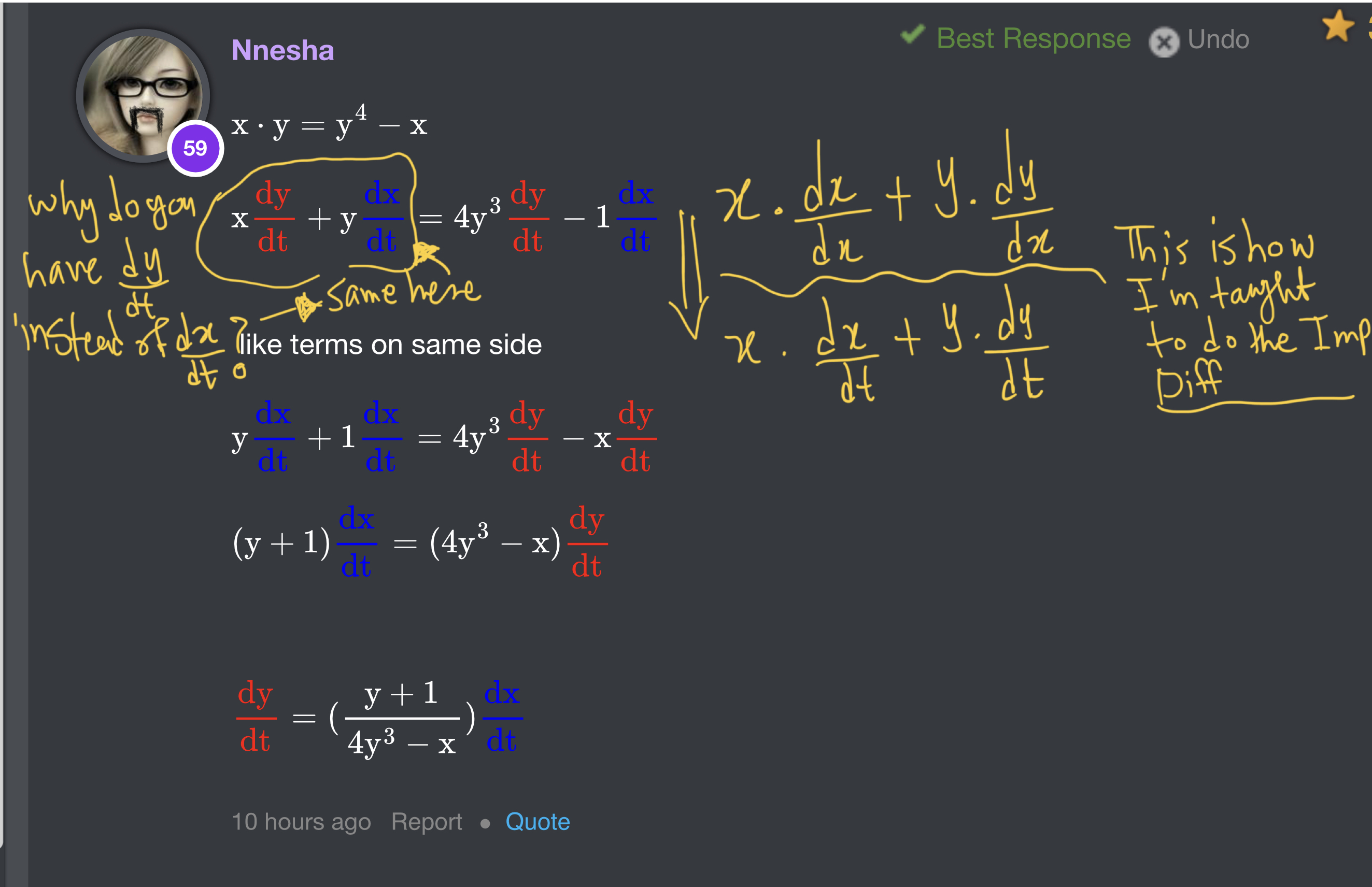
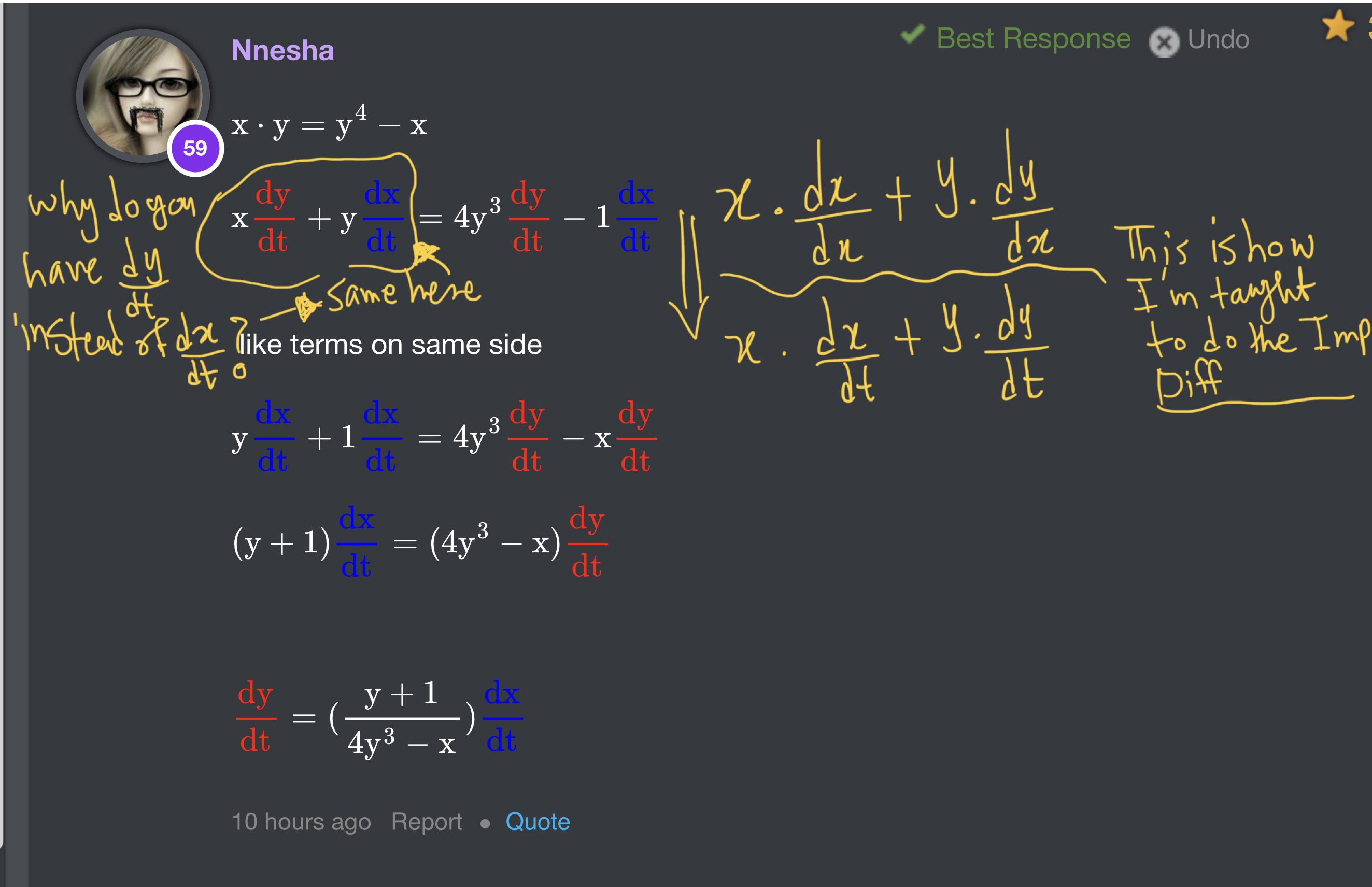
\[\rm x\cdot y=y^4-x\]\[\rm x\color{red}{\frac{dy}{dt}}+y\color{blue}{\frac{dx}{dt}}=4y^3\color{Red}{\frac{dy}{dt}}-1\color{blue}{\frac{dx}{dt}}\] like terms on same side \[\rm y\color{blue}{\frac{dx}{dt}}+1\color{blue}{\frac{dx}{dt}}=4y^3\color{red}{\frac{dy}{dt}}-x\color{Red}{\frac{dy}{dt}}\]\[\rm (y+1)\color{blue}{\frac{dx}{dt}}=(4y^3-x)\color{Red}{\frac{dy}{dt}}\] \[\rm\color{reD}{\frac{ dy }{ dt }}=(\frac{y+1}{4y^3-x})\color{blue}{\frac{dx}{dt}}\]
Ballery1:
When you take the derivative of *y*, don’t you write dy/dx??? In this case it’d be dy/dt.... when did you write dx/dt when took the derivative of *y* and same with *x*.... you wrote dy/dt when you took the derivative of x....shouldn’t it be dx/dt??? I’m conpuzzeled :/
Nnesha:
there are so many x's and dx's/dt which one?
Ballery1:
Let me write....
 Nnesha:
apply the product rule??
Ballery1:
Yes i know how to apply the product rule :) but i’m Not familiar with what you did with switching the dy/dt when taking the derivative of x and vice versa with y.....dx/dt....
Ballery1:
When i take the derivative of x...i write dx/dt with it and same with y...i write dy/dt with it
Nnesha:
\[\rm \color{Red}{f(x)}\cdot\color{blue}{ g(x)}= f(x)'\color{blue}{g(x)}+\color{red}{f(x)}g(x)'\]\[\rm \color{Red}{x}\cdot\color{blue}{ y}= x'\color{blue}{y}+\color{red}{x}y'\] so derivative of x--> 1dx/dt derivative of y-->1 dy/dt \[\rm \color{Red}{x}\cdot\color{blue}{ y}= \frac{dx}{dt}\cdot \color{blue}{y}+\color{red}{x}\cdot \frac{dy}{dt}\]
Nnesha:
\(\color{#0cbb34}{\text{Originally Posted by}}\) @Ballery1 When i take the derivative of x...i write dx/dt with it and same with y...i write dy/dt with it \(\color{#0cbb34}{\text{End of Quote}}\) yes right. but you're not taking the derivative of `x` and `y` which is just 1.
Nnesha:
for example \[\rm (y^4 )'\] you don't just write \[\rm y^4 \frac{dy}{dt}\] you have to take the derviative of `y^4` which is 4y^3
Ballery1:
Yes...
Ballery1:
Ok do you want me to write out how i’d Take the derivative of the whole equation??? You can just correct me where i’m Wrong.??? Sound coo??
Nnesha:
okay.
Ballery1:
|dw:1570754388517:dw|
Nnesha:
|dw:1570754908499:dw|
Ballery1:
|dw:1570754850876:dw|
Ballery1:
Uhggg....u caught me
Nnesha:
|dw:1570754966180:dw| same as what I did.
Ballery1:
K just tell me why do you write dy/dt when you take the derivative of x :/ i’m Not getting it...
Nnesha:
where??
Nnesha:
|dw:1570755136396:dw|this one?
 Ballery1:
:/
Nnesha:
i just showed you.
Ballery1:
I don’t understand.... aww ;-; ... i wanna cry :/
Nnesha:
\(\color{#0cbb34}{\text{Originally Posted by}}\) @Nnesha \[\rm \color{Red}{f(x)}\cdot\color{blue}{ g(x)}= f(x)'\color{blue}{g(x)}+\color{red}{f(x)}g(x)'\]\[\rm \color{Red}{x}\cdot\color{blue}{ y}= x'\color{blue}{y}+\color{red}{x}y'\] so derivative of x--> 1dx/dt derivative of y-->1 dy/dt \[\rm \color{Red}{x}\cdot\color{blue}{ y}= \frac{dx}{dt}\cdot \color{blue}{y}+\color{red}{x}\cdot \frac{dy}{dt}\] \(\color{#0cbb34}{\text{End of Quote}}\) here why do i have have `dy/dt` with x is because i'm applying the product rule I am NOT taking the derviative of x that's why it still there
Ballery1:
So when you take the derivative of one variable ..let’s say x’...you replace it with dx/dy???
Ballery1:
Give me a sample question to work on..
Nnesha:
\[x'= 1 \cdot \ \frac{dx}{dx} = 1\]
Ballery1:
Yes that’s true...
Nnesha:
I see now wat iz confusing u...
Ballery1:
|dw:1570755575394:dw|
Ballery1:
Assuming x and y = 1
Ballery1:
From there i plugin the values of y, x and dy/dx.... and solve for the required variable....
Ballery1:
|dw:1570755929755:dw|
Nnesha:
yes but what about `t` ??
Nnesha:
taking derivative with respect to `t`
Ballery1:
Replace x with t
Nnesha:
so dx/dx-->dx/dt
Ballery1:
Yes...
Nnesha:
|dw:1570756180040:dw| \[\rm 1 \frac{dx}{dt}\cdot y+x \cdot 1 \frac{dy}{dt}\]
Ballery1:
Yes yes yes .... dx/dt,,,
Ballery1:
Actually i think i got it... i’ll Git back to you if i have trouble finishing up the question... i’m Post my solution when i’m Done... thank you shooooooooooooo much :)
Ballery1:
No flirts intended..
Nnesha:
good luck.
Ballery1:
Screw the f(x).g(x) + f(x). G’(x) method.. i’m Plugging in the variables straight into the product rule..
Ballery1:
And from there.. i’m Just gonna label what’s dx/dt and what’s dy/dt
Nnesha:
you're on the right track. you know how to take derivatives just keep in mind for this question you're taking derviative with respect to t not x
Nnesha:
do you have the key for this q?
 Ballery1:
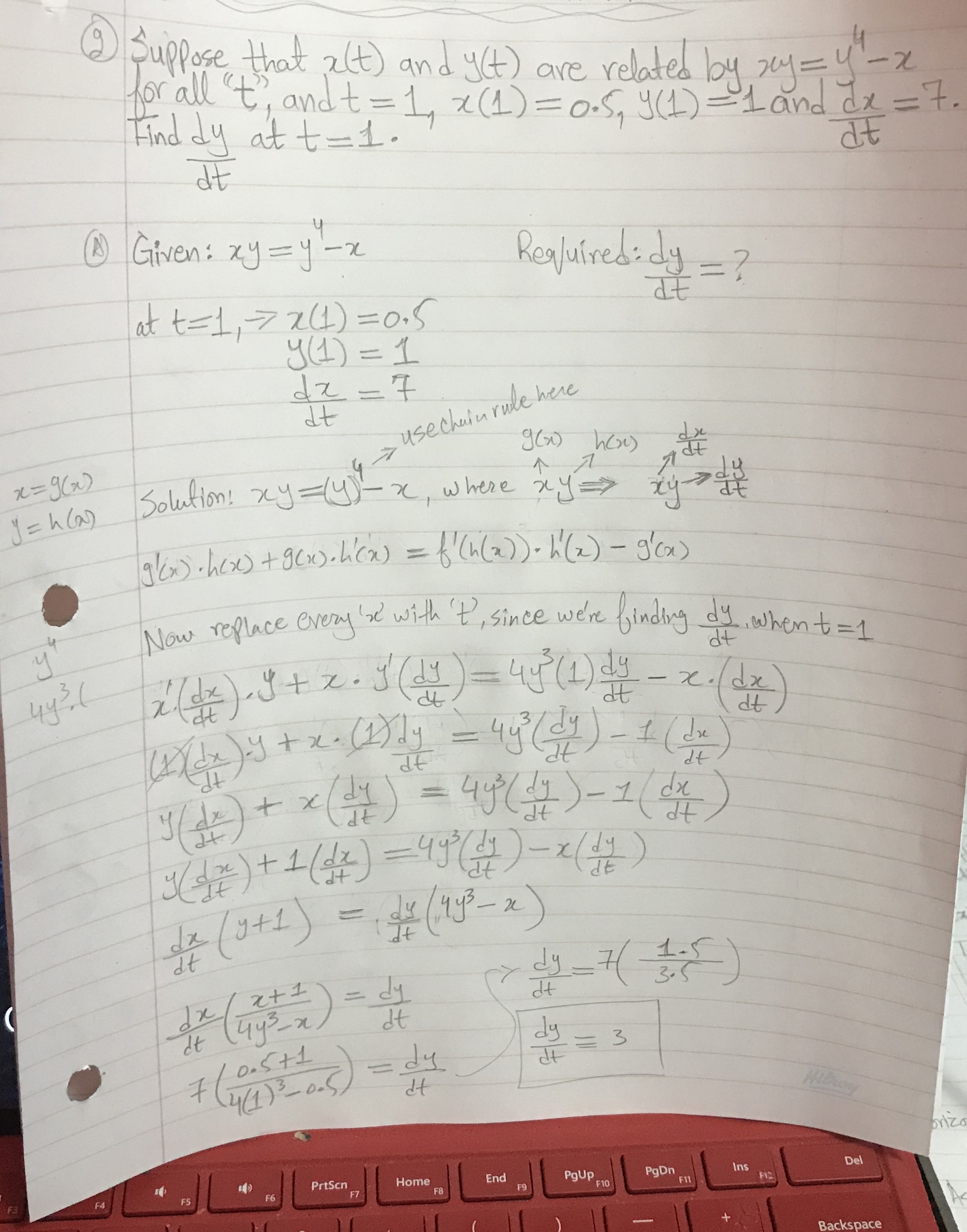
The answer is 4... -_-
Nnesha:
that's what i got.
Nnesha:
dhyan kaha hai.?.?
Ballery1:
U literally highlighted an empty space bro
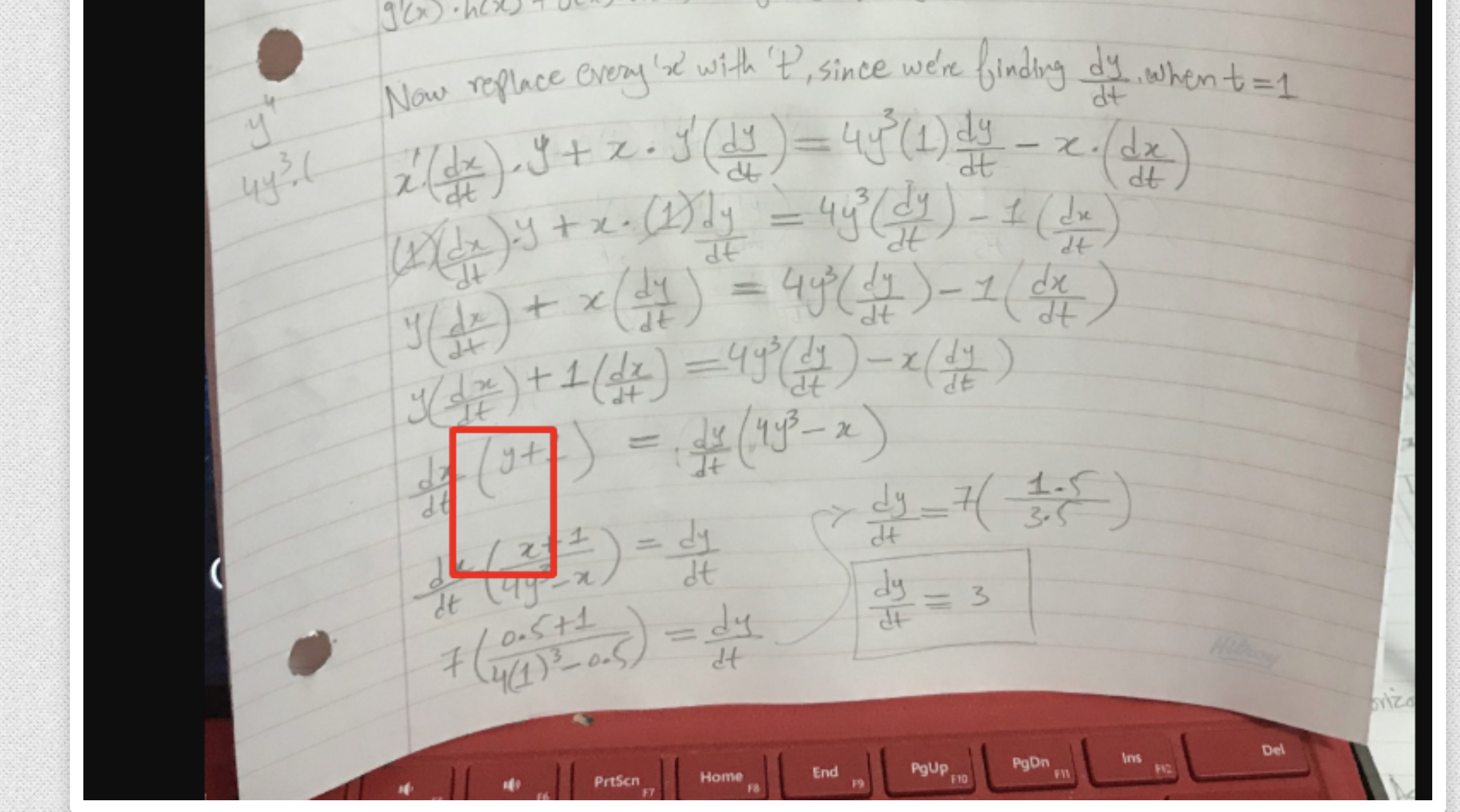 Nnesha:
empty??
Ballery1:
Pakistan has lost 3 matches in a row bruhh... i’m already fuming over here... lol
Nnesha:
highlighted transition y-->x
Nnesha:
ohh really not following this time..
Ballery1:
Oh my gook... one second plz
Ballery1:
Oh no...I Isolated the dx/dt to the left side and dy/dt to the eight side
Ballery1:
Oh no probably sounds like I made a mistake...but no...all I did was isolated the dx/dt the Rhs and dy/dt to the rhs
Ballery1:
Oh my gook... I finally see it...
Nnesha:
what i highlighted is a mistake..
Ballery1:
You have laser eyes bruhh
Ballery1:
Finally....you deserve women of the century award for helping me through this problem.... :)
Nnesha:
ty.
Join our real-time social learning platform and learn together with your friends!
 KBaby:
Verse 1 We left our names in the dust of the driveway Watched the old town shrink
KBaby:
Lyrics Generator Use AI to write the lyrics for a song. Suggested Genres: Pop Hip
KBaby:
Verse 1 We left our names in the dust of the driveway Watched the old town shrink
KBaby:
Lyrics Generator Use AI to write the lyrics for a song. Suggested Genres: Pop Hip

 aitexturegenerator:
How are you all handling AI-generated textures for 3D models and game assets without losing the hand-made feel? I've been doing a small stylized environment
aitexturegenerator:
How are you all handling AI-generated textures for 3D models and game assets without losing the hand-made feel? I've been doing a small stylized environment

 Demon25:
Woke up feeling like that girl and that dude well he still aint crap pluse the du
Demon25:
Woke up feeling like that girl and that dude well he still aint crap pluse the du
 playtsec:
how do I get rid of stress from teachers... I just feel like running out the classroom and leaving on my own.
playtsec:
how do I get rid of stress from teachers... I just feel like running out the classroom and leaving on my own.
 JohnnyLFowler0812:
What type of gamer would play something and then get off for a while. Why not sta
JohnnyLFowler0812:
Which is better? Metallica Rap Country R&B hiphop Medal Gospel Chill Which 3 opti
JohnnyLFowler0812:
What type of gamer would play something and then get off for a while. Why not sta
JohnnyLFowler0812:
Which is better? Metallica Rap Country R&B hiphop Medal Gospel Chill Which 3 opti