
 bill533:
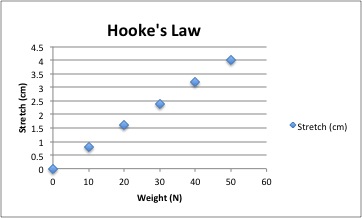
1) According to the data shown, A) when more weight is added to a spring, it will stretch more. B) when more weight is added to a spring, it will compress more. C) when more weight is added to a spring, the spring will remain unchanged. D) when more weight is added to a spring, the result is not always the same. 2) According to the information provided in the graph, which statement is incorrect? A) When there is no weight added to the spring in the experiment, the spring will stretch 0.2 cm. B) When 5 Newtons of weight are added to the spring in the experiment, the spring will stretch 0.5 cm. C) When 20 Newtons of weight are added to the spring in the experiment, the spring will stretch 1.6 cm. D) When 50 Newtons of weight are added to the spring in the experiment, the spring will stretch 4.0 cm. 3) What would be the weight of an object that caused the spring to stretch 8.0 cm? A) 1 Newton B) 8 Newtons C) 10 Newtons D) 100 Newtons 4) Which formula best represents the relationship between weight (F) and stretch (x) in this experiment? A) Fx = 0.2 B) F-x = 10 C) F+x = 1.5 D) F/x = 12.5 5) After the experiment the students are taught that the formula for Hooke’s Law is F=-kx, where F is the weight, x is the distance the spring stretches, and k is the spring constant. The students are then given a second spring to test. They find that the spring will stretch 0.2 cm when a 10 Newton weight is applied. What is the constant for this spring? A) 10 N/cm B) 20 N/cm C) 50 N/cm D) 200 N/cm 6) After the experiment the students are taught that the formula for Hooke’s Law is F=-kx, where F is the weight, x is the distance the spring stretches and k is a spring constant. The students are then given three springs to test. What variable would be the BEST indicator of how “tight” the springs are? A) weight, F B) spring constant, k C) distance of stretch, x D) The springs cannot be compared using Hooke’s law.
 bill533:
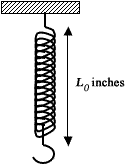
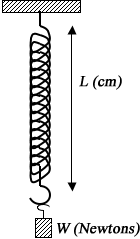
Hooke’s Law Patty Gordon Consider the system shown here, a spring attached to a support. The spring hangs unstretched. If you held the bottom of the spring and pulled downward, the spring would stretch. The harder you pulled, the more the spring would stretch. Students conducted an experiment to determine the quantitative relationship between the amount of pulling force and the length of stretch. This relationship between the force applied to a spring and the amount of stretch was first discovered in 1678 by English scientist Robert Hooke, who stated Ut tension, sic vis. Translated from Latin, this means As the extension, so the force. To determine this quantitative relationship between the amount of force and the length of stretch, objects of known weight (measured in Newtons) were attached to the spring. For each object added the length of stretch, L, was measured in centimeters. Weight on Spring (Newtons) Stretch on Spring (cm) 0 0.0 10 0.8 20 1.6 30 2.4 40 3.2 50 4.0
bill533:
1. B 2. C 3. D 4. D 5. A 6. B @Gdeinward
Join our real-time social learning platform and learn together with your friends!
 KBaby:
Verse 1 We left our names in the dust of the driveway Watched the old town shrink
KBaby:
Lyrics Generator Use AI to write the lyrics for a song. Suggested Genres: Pop Hip
KBaby:
Verse 1 We left our names in the dust of the driveway Watched the old town shrink
KBaby:
Lyrics Generator Use AI to write the lyrics for a song. Suggested Genres: Pop Hip

 aitexturegenerator:
How are you all handling AI-generated textures for 3D models and game assets without losing the hand-made feel? I've been doing a small stylized environment
aitexturegenerator:
How are you all handling AI-generated textures for 3D models and game assets without losing the hand-made feel? I've been doing a small stylized environment

 Demon25:
Woke up feeling like that girl and that dude well he still aint crap pluse the du
Demon25:
Woke up feeling like that girl and that dude well he still aint crap pluse the du
 playtsec:
how do I get rid of stress from teachers... I just feel like running out the classroom and leaving on my own.
playtsec:
how do I get rid of stress from teachers... I just feel like running out the classroom and leaving on my own.
 JohnnyLFowler0812:
What type of gamer would play something and then get off for a while. Why not sta
JohnnyLFowler0812:
Which is better? Metallica Rap Country R&B hiphop Medal Gospel Chill Which 3 opti
JohnnyLFowler0812:
What type of gamer would play something and then get off for a while. Why not sta
JohnnyLFowler0812:
Which is better? Metallica Rap Country R&B hiphop Medal Gospel Chill Which 3 opti