
 Ballery1:
Find the solution set of the following equations: X-2y+3z = 5
 jhonyy9:
,,equations" - where are ?
 mhchen:
It looks like there's only 1 equation, and 3 variables. x = 2y - 3z + 5 y = y z = z \[\left[\begin{matrix}x \\ y \\ z\end{matrix}\right] = \left[\begin{matrix}2r -3s + 5\\ r \\ s\end{matrix}\right] = r\left[\begin{matrix}2\\ 1 \\0 \end{matrix}\right] + s \left[\begin{matrix}-3\\ 0 \\ 1\end{matrix}\right] + \left[\begin{matrix}5 \\ 0 \\ 0\end{matrix}\right]\] r and s can be anything. Are you sure your question is right though? xd
 imqwerty:
This equation represents a plane, you can represent the solutions with the parametric form
Ballery1:
Yup, there’s only one equation with three variables.
Ballery1:
Let me post the actual picture of the question for you guys lol
mhchen:
if it's just 1 equation, then you have your answer right up there.
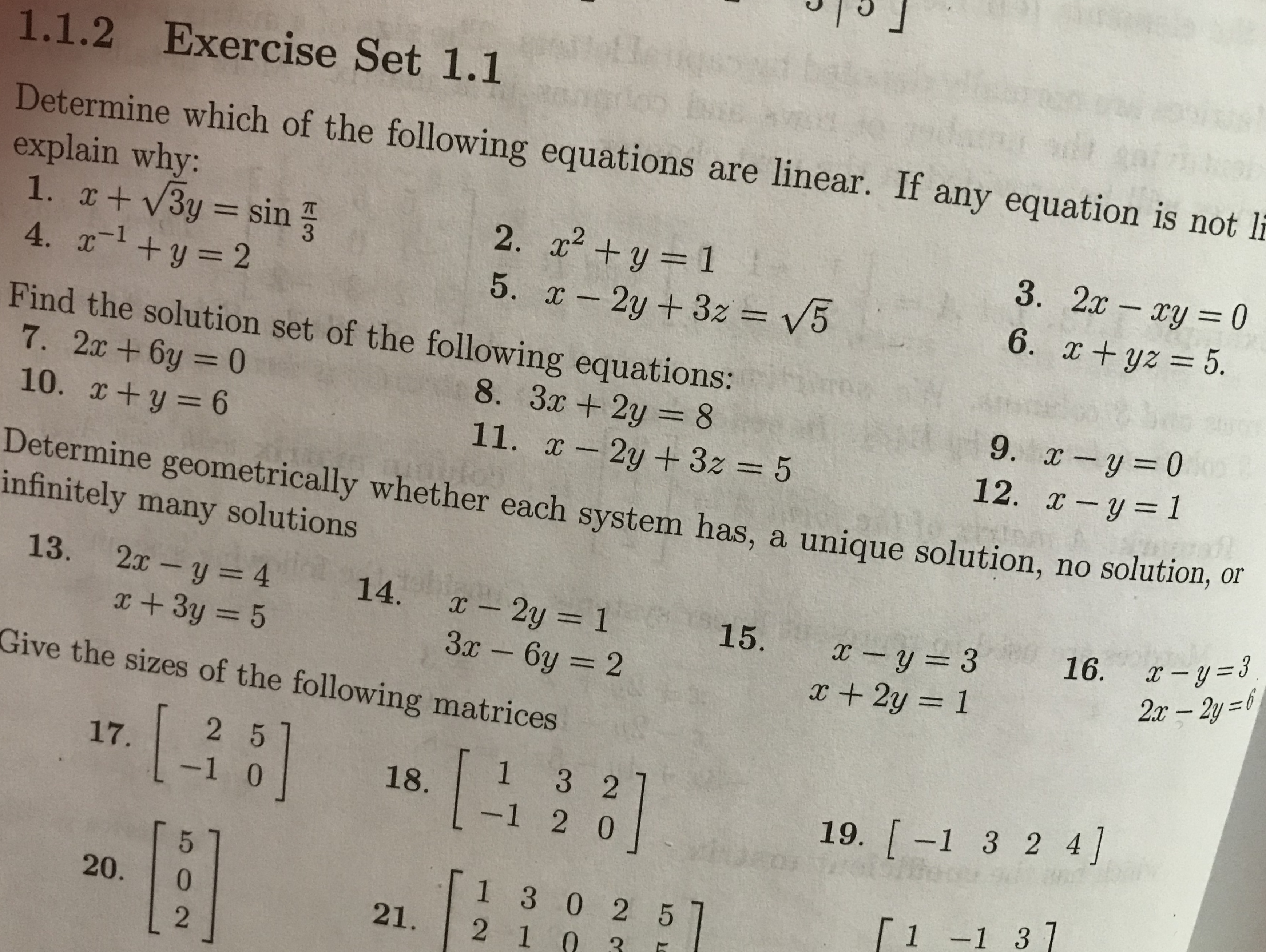 Ballery1:
The answer is written in some other way... let me post ..one sec
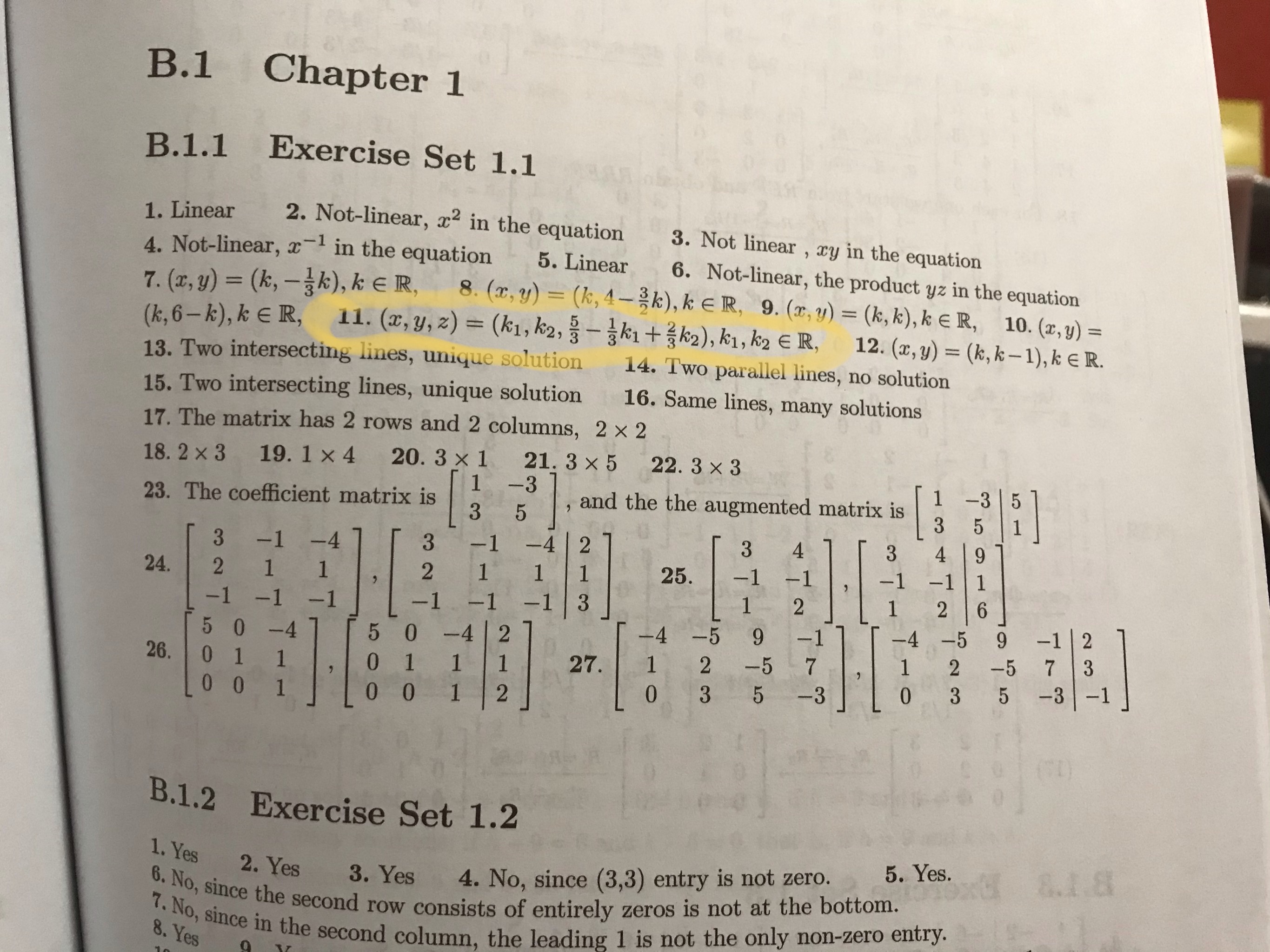 Ballery1:
Wait, let me show you a method that I’ve been using to solve these questions... one second plz
mhchen:
So their k1 and k2 is just like my r and s. But I think they did z = (5/3) + (2/3)y - (1/3)x
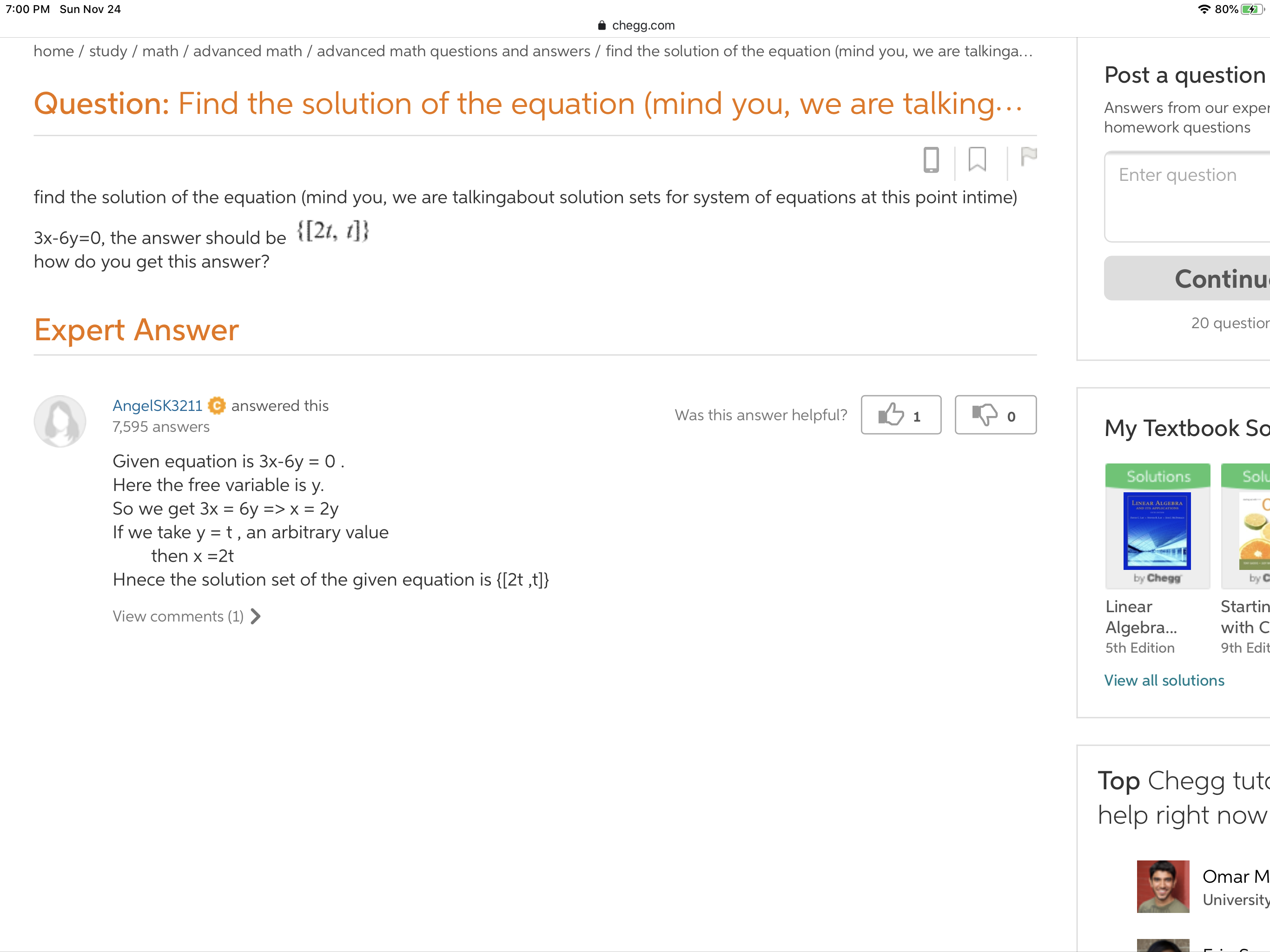 mhchen:
Yeah that works
Ballery1:
But please tell me why did they divide both sides by 3 instead of 2 or 1??
Ballery1:
Do you want me to draw for you sir? :)
mhchen:
because they were solving for z
Ballery1:
Why z in particular?
mhchen:
it doesn't have to be z, it can be x or y actually.
Ballery1:
So does that mean if you divide and isolate for let’s say y variable, we should come to the same answer in the end?
Ballery1:
|dw:1574640331221:dw|
mhchen:
So my solution was \[\left[\begin{matrix}x \\ y \\ z\end{matrix}\right] = \left[\begin{matrix}2r -3s + 5\\ r \\ s\end{matrix}\right] \] and their solution was \[\left[\begin{matrix}x \\ y \\ z\end{matrix}\right] = \left[\begin{matrix}r\\ s \\ \frac{5}{3}-\frac{1}{3}r+\frac{2}{3}s\end{matrix}\right] \] hmmm
mhchen:
I never explored this, but theoretically...the should have the same "Solution space" There's infinite number of solutions, but not every number is a solution, so we call it a solution space.
Ballery1:
Is there a video on this topic ?
Ballery1:
My textbook literally didn’t do any sample questions for this particular topic
mhchen:
3blue1brown might have a good video on this
Ballery1:
Thanks bro, really appreciated:)
Join our real-time social learning platform and learn together with your friends!
 KBaby:
Verse 1 We left our names in the dust of the driveway Watched the old town shrink
KBaby:
Lyrics Generator Use AI to write the lyrics for a song. Suggested Genres: Pop Hip
KBaby:
Verse 1 We left our names in the dust of the driveway Watched the old town shrink
KBaby:
Lyrics Generator Use AI to write the lyrics for a song. Suggested Genres: Pop Hip

 aitexturegenerator:
How are you all handling AI-generated textures for 3D models and game assets without losing the hand-made feel? I've been doing a small stylized environment
aitexturegenerator:
How are you all handling AI-generated textures for 3D models and game assets without losing the hand-made feel? I've been doing a small stylized environment

 Demon25:
Woke up feeling like that girl and that dude well he still aint crap pluse the du
Demon25:
Woke up feeling like that girl and that dude well he still aint crap pluse the du
 playtsec:
how do I get rid of stress from teachers... I just feel like running out the classroom and leaving on my own.
playtsec:
how do I get rid of stress from teachers... I just feel like running out the classroom and leaving on my own.
 JohnnyLFowler0812:
What type of gamer would play something and then get off for a while. Why not sta
JohnnyLFowler0812:
Which is better? Metallica Rap Country R&B hiphop Medal Gospel Chill Which 3 opti
JohnnyLFowler0812:
What type of gamer would play something and then get off for a while. Why not sta
JohnnyLFowler0812:
Which is better? Metallica Rap Country R&B hiphop Medal Gospel Chill Which 3 opti