
 justjm:
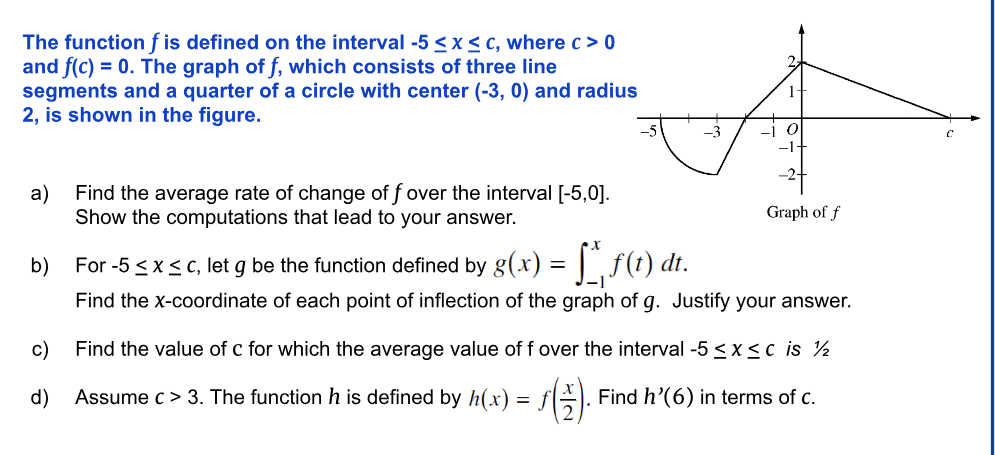
I need help on part C and D, how do I go about in solving?
 justjm:
@myeyeshurt
 myeyeshurt:
Write a closed form expression for the area for -5 to c. It should be the sum of a few definite integrals
myeyeshurt:
From there divide by the interval c-(-5) to get the average value. You can set this equal to 1/2 as the problem requests
myeyeshurt:
Let me know if you need more detail
justjm:
So like this? \( \frac{1}{c+5}\left(\left(\int_{-5}^{-3}f\left(x\right)dx\right)+\left(\int_{-3}^{-2}f\left(x\right)dx\right)+\left(\int_{-2}^{0}f\left(x\right)dx\right)+\left(\int_{0}^{c}f\left(x\right)dx\right)\right)=\frac{1}{2} \)
justjm:
And then I evaluate the first few using geometry? \(\frac{1}{c+5}\left(\pi+1+2+\int_{0}^{c}f\left(x\right)dx\right)=\frac{1}{2}\)
justjm:
How do I solve for C now?
myeyeshurt:
Use FTC corrollary
myeyeshurt:
The integrand is F(c)-F(0)
myeyeshurt:
When evaluated
myeyeshurt:
But you can also just use 1/2 b*h since it's a triangle
myeyeshurt:
Here b=(c-0)=c and h is the y intercept
justjm:
Ohh I see, let me give that a try
justjm:
I tried using FTC but I was confused bc I didn't know what F(x) was
justjm:
So the area of that is just c because length is c and width is 2
justjm:
\(\frac{1}{c+5}\left(\pi+3+c\right)=\frac{1}{2}\) I got it now, thanks man. Do you have a suggestion for part D as well? Thank you very much once again
justjm:
Hold on, unless I did something wrong in the last step, I got a negative value for c.
justjm:
Nevermind, silly me, the area for the bottom bit is negative of course. Realized my mistake. So back to D, how do I do that?
myeyeshurt:
So h(6)=f(3) and you want h'(6) or f'(3)
myeyeshurt:
Since c is greater than 3
myeyeshurt:
It's just the slope of f
justjm:
Oh okay I got it, thanks. I find the slope with (c,0) and (0,2).
justjm:
I appreciate it brother thank you. God bless
myeyeshurt:
Yup!
myeyeshurt:
Wait you have to multiply by one half
myeyeshurt:
Cause of the chain rule
justjm:
Oh from the x/2? why would that matter?
myeyeshurt:
d/dx f(x/2)=1/2 f'(x/2)
justjm:
Oh okay I see. Thank you once again.
justjm:
One more thing, for part b is the answer -3 and 0, because the inflection point is the change in signs for g'(x) or f(t)?
myeyeshurt:
Idr any second derivative stuff tbh :(
justjm:
it's okay bro :) thank you
Join our real-time social learning platform and learn together with your friends!
 KBaby:
Verse 1 We left our names in the dust of the driveway Watched the old town shrink
KBaby:
Lyrics Generator Use AI to write the lyrics for a song. Suggested Genres: Pop Hip
KBaby:
Verse 1 We left our names in the dust of the driveway Watched the old town shrink
KBaby:
Lyrics Generator Use AI to write the lyrics for a song. Suggested Genres: Pop Hip
 aitexturegenerator:
How are you all handling AI-generated textures for 3D models and game assets without losing the hand-made feel? I've been doing a small stylized environment
aitexturegenerator:
How are you all handling AI-generated textures for 3D models and game assets without losing the hand-made feel? I've been doing a small stylized environment

 Demon25:
Woke up feeling like that girl and that dude well he still aint crap pluse the du
Demon25:
Woke up feeling like that girl and that dude well he still aint crap pluse the du
 playtsec:
how do I get rid of stress from teachers... I just feel like running out the classroom and leaving on my own.
playtsec:
how do I get rid of stress from teachers... I just feel like running out the classroom and leaving on my own.
 JohnnyLFowler0812:
What type of gamer would play something and then get off for a while. Why not sta
JohnnyLFowler0812:
Which is better? Metallica Rap Country R&B hiphop Medal Gospel Chill Which 3 opti
JohnnyLFowler0812:
What type of gamer would play something and then get off for a while. Why not sta
JohnnyLFowler0812:
Which is better? Metallica Rap Country R&B hiphop Medal Gospel Chill Which 3 opti