
 InsatiableSuffering:
So I am in a real pickle when it comes down to differential equations. I don't even know how to begin with these...
InsatiableSuffering:
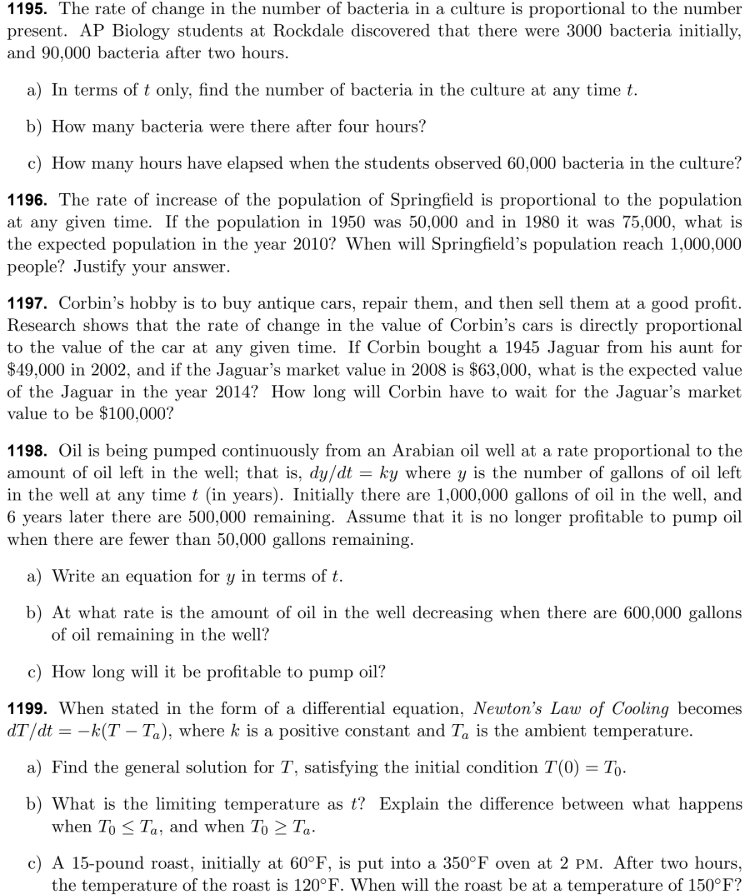
https://cdn.discordapp.com/attachments/182221549431029761/654834206530338816/Differential_Equations.png @justjm can you help guide me in what I should be doing
 justjm:
So for problem 1195) You need to use the differential equation \(y\left(t\right)=y_{o}e^{kt}\) You know that the initial, \(y_{o}=3000\) And that y(2) = 90,000 Thus \(y(2)=3,000e^{2k}=90,000\) Now you need to find k using your natural log rules and you get k=\(\frac{\ln\left(30\right)}{2}\). So you found your constant. Thus the final equation for part a is \(y\left(t\right)=3000^{\left(\frac{\ln\left(30\right)}{2}\right)t}\) part b. Just find y(4) part c. Set y(t)=60,000 and find t using your ln rules.
justjm:
I'm also just starting to do differential equations, so we just started today so I'm not sure if it's the right approach. But for the remainder of the problems, I think you just need to know which differential equation to use and then you're just plugging in, there isn't much calculus involved.
justjm:
Anyhow for the next question, you're using the same differential equation from earlier \(y\left(t\right)=y_{o}e^{kt}\) They're giving you y initial as 50,000 and then you need to find k by plugging in y(30)=75000. Once you find k, you will have your differential. Now, plug y(t)=1000000 and find t.
InsatiableSuffering:
We haven't learned how to deal with these today in class, and we're expected to do them for homework. Also, I believe we're literally being tested tomorrow on them after he explains how to do problems like these, so that was the reason I asked about it. Thanks for your input, but apparently the answer to the 1195a is 3000(30)^(t/2). I'll try to figure out what I can. Again, thanks for your help!
 Zarkon:
"You need to use the differential equation \(y(t)=y_oe^{kt}\)" This is not a differential equation. The differential equation is \(\frac{dy}{dt}=ky\)
justjm:
No problem, we started it yesterday but we're testing on it next semester and it's not on our semester exam. And whoops, thank you @Zarkon , I wrote that without thinking. After all I only learned it like yesterday.
justjm:
Oh and about the answer as \(3000\left(30\right)^{\frac{x}{2}}\), I believe it's the same as \(3000\left(e\right)^{1.7006x}\) but I used a different approach for it. You can derive it from each other.
Join our real-time social learning platform and learn together with your friends!
 KBaby:
Verse 1 We left our names in the dust of the driveway Watched the old town shrink
KBaby:
Lyrics Generator Use AI to write the lyrics for a song. Suggested Genres: Pop Hip
KBaby:
Verse 1 We left our names in the dust of the driveway Watched the old town shrink
KBaby:
Lyrics Generator Use AI to write the lyrics for a song. Suggested Genres: Pop Hip

 aitexturegenerator:
How are you all handling AI-generated textures for 3D models and game assets without losing the hand-made feel? I've been doing a small stylized environment
aitexturegenerator:
How are you all handling AI-generated textures for 3D models and game assets without losing the hand-made feel? I've been doing a small stylized environment

 Demon25:
Woke up feeling like that girl and that dude well he still aint crap pluse the du
Demon25:
Woke up feeling like that girl and that dude well he still aint crap pluse the du
 playtsec:
how do I get rid of stress from teachers... I just feel like running out the classroom and leaving on my own.
playtsec:
how do I get rid of stress from teachers... I just feel like running out the classroom and leaving on my own.
 JohnnyLFowler0812:
What type of gamer would play something and then get off for a while. Why not sta
JohnnyLFowler0812:
Which is better? Metallica Rap Country R&B hiphop Medal Gospel Chill Which 3 opti
JohnnyLFowler0812:
What type of gamer would play something and then get off for a while. Why not sta
JohnnyLFowler0812:
Which is better? Metallica Rap Country R&B hiphop Medal Gospel Chill Which 3 opti